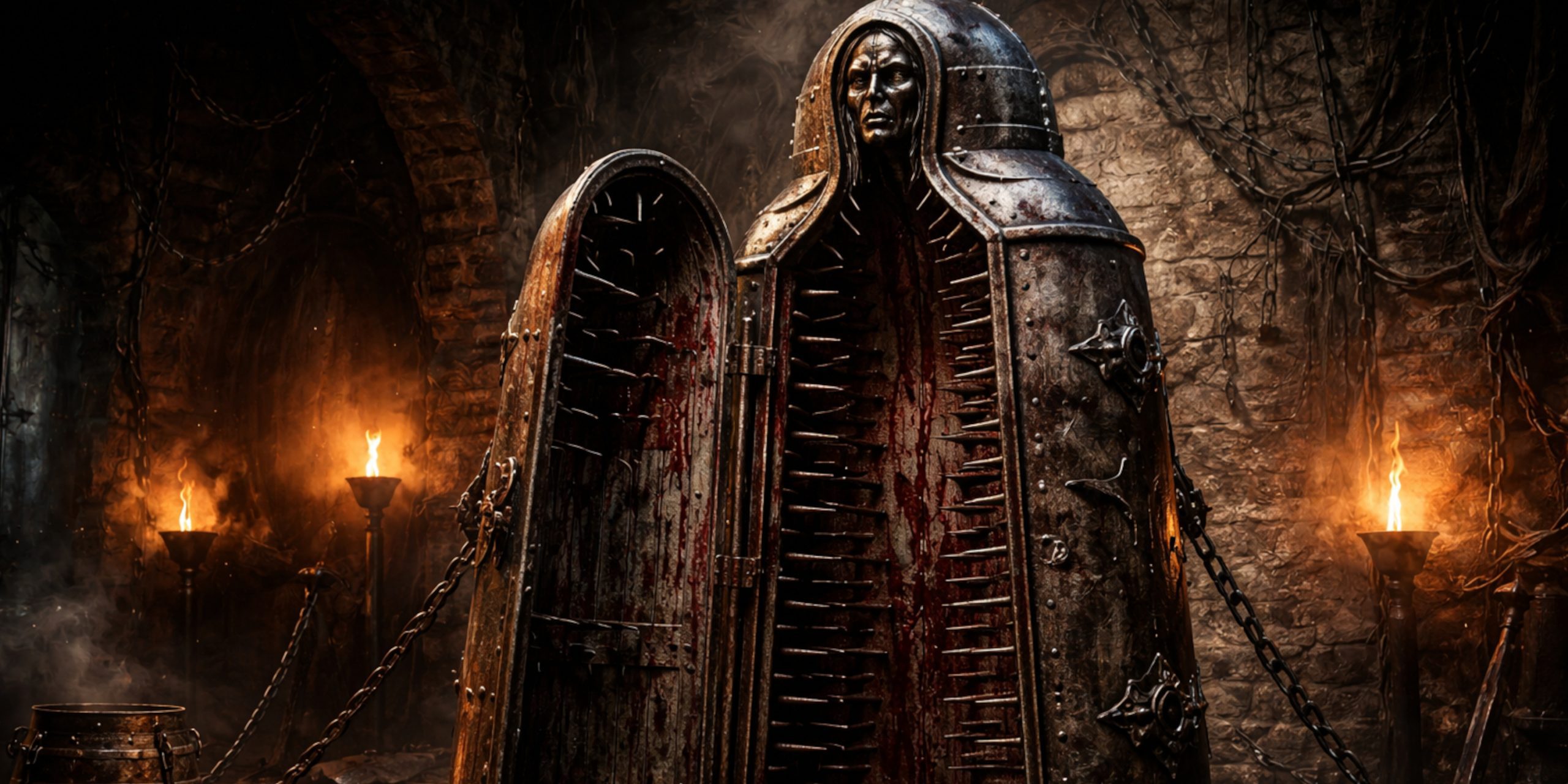
The Iron Maiden has a reputation that borders on theatrical. A human-sized iron cabinet lined with spikes, closing in on its victim with grim inevitability. It appears in museums, horror films, and popular imagination as a symbol of medieval cruelty.
Yet, like many things attributed to the Middle Ages, the story is less straightforward. When you begin to sift through the evidence, the Iron Maiden becomes less a tool of justice and more a product of later fascination with a brutal past that may not have been quite so inventive.
What Is the Iron Maiden?
The Iron Maiden is typically described as:
- A standing iron cabinet or sarcophagus
- Fitted with internal spikes positioned to pierce the body
- Designed so the spikes avoid immediate death, prolonging suffering
- Sometimes depicted with a human face or religious imagery on the exterior
Most examples seen today are later reconstructions, often from the eighteenth or nineteenth centuries.
The Medieval Context of Punishment
To understand the Iron Maiden, one must look at how punishment actually worked in medieval Europe.
- Executions were usually public and direct
- Methods included hanging, beheading, burning, and breaking on the wheel
- Torture existed but was regulated, particularly under legal systems such as the Inquisition
- Devices were typically simple, practical, and designed to extract confession rather than create elaborate spectacle
The idea of an intricate mechanical coffin filled with spikes does not sit comfortably within this framework. Medieval authorities tended to favour methods that were visible, efficient, and, importantly, recognisable.
Origins of the Iron Maiden Story
The earliest detailed descriptions of the Iron Maiden do not appear in medieval records. Instead, they emerge much later.
- The most famous example is the so called “Iron Maiden of Nuremberg”
- It was first described in the late eighteenth century
- By the nineteenth century, it had become a popular exhibit
This timing matters. The eighteenth and nineteenth centuries saw a surge in fascination with medieval cruelty, often exaggerated for effect.
The device as we know it seems to have been assembled or embellished during this period, rather than preserved from the Middle Ages.
Contemporary and Near-Contemporary References
There are a few earlier texts sometimes cited as evidence, though they are far from conclusive.
One often referenced account comes from ancient Rome rather than medieval Europe. The Roman historian Polybius describes a Spartan tyrant’s device used to punish victims:
“The body was enclosed within a statue, so that every limb was pressed by iron spikes.”
This is sometimes linked to the concept of the Iron Maiden, though it is a different cultural and historical setting.
Later writers in early modern Europe mention spiked enclosures or punitive devices, but these references are sparse and often second hand.
The Nuremberg Iron Maiden
The Nuremberg example is the most famous case and often presented as proof of medieval use.
However:
- It was likely constructed or heavily modified around the eighteenth century
- It became a centrepiece of museum displays designed to shock visitors
- It was destroyed during the Second World War, leaving only descriptions and replicas
Nineteenth century audiences were particularly receptive to such exhibits. They reinforced a narrative of the Middle Ages as barbaric and backward, a useful contrast to the supposed enlightenment of modern Europe.
Did It Ever Exist in the Middle Ages?
Most modern historians are sceptical.
There is:
- No clear medieval documentation describing such a device in use
- No surviving example that can be reliably dated to the medieval period
- A strong pattern of later fabrication and embellishment
That does not mean spiked enclosures never existed in any form. It means the iconic Iron Maiden, as popularly imagined, is almost certainly not a genuine medieval instrument.
Why the Myth Endured
The Iron Maiden persists because it satisfies several powerful instincts.
- It offers a vivid image of cruelty that is easy to understand
- It aligns with long standing stereotypes about medieval brutality
- It was promoted through museums, literature, and later film
There is also a certain grim theatricality to it. Compared to hanging or beheading, it feels engineered for horror, which makes it memorable, even if it is historically doubtful.
A Historian’s Perspective
There is a temptation to imagine the past as either nobler or more savage than it truly was. The Iron Maiden falls firmly into the latter category.
Medieval justice could be harsh, certainly. One does not need to invent spiked coffins to make that point. The records of executions and punishments are sobering enough on their own.
If anything, the Iron Maiden tells us more about the eighteenth and nineteenth centuries than the medieval world. It reflects a period that was keen to distance itself from its predecessors, occasionally by exaggerating their faults.
Legacy in Popular Culture
Today, the Iron Maiden lives on in:
- Horror films and gothic fiction
- Museum displays, often with limited historical context
- The name of the band Iron Maiden, which arguably did more to cement its place in modern culture than any medieval record
It has become less a historical artefact and more a symbol. A shorthand for a brutal past, whether or not that past quite matched the image.
Seven Swords Takeaway
The Iron Maiden stands as a curious case where myth has outpaced evidence. It looks convincingly medieval, it feels plausible, and it has been widely displayed as fact.
Yet, when examined closely, it slips through the historian’s fingers.
There is no firm medieval origin, no reliable documentation, and no surviving example that withstands scrutiny. What remains is a powerful story, shaped not by the Middle Ages themselves, but by those who came later and found the idea of medieval cruelty too tempting to resist.