The Achaemenid dynasty ruled a realm so vast that even modern logistics would wince. From the Aegean to the Indus, this Persian imperial house shaped how power could be organised across languages, climates, and stubborn local customs. As a historian, I find them bracingly practical. They did not insist the world become Persian. They simply asked it to pay taxes, keep the roads clear, and avoid revolts at inconvenient moments.
Origins and the Rise of Cyrus
The story begins in the highlands of Persia with Cyrus the Great, who managed the rare trick of conquering without making everyone hate him immediately. By the mid sixth century BC, Cyrus had absorbed Media, Lydia, and Babylon. His entry into Babylon in 539 BC was almost suspiciously calm. Temples were respected, local elites kept their jobs, and deported peoples were allowed home. It is not kindness exactly, more enlightened self interest, which in imperial terms counts as virtue.
Cyrus understood that conquest is easy compared to administration. He also understood that propaganda helps. The famous Cyrus Cylinder presents him as chosen by the gods to restore order. I am always wary of royal self portraits, but even with scepticism applied, his reputation for moderation is hard to dismiss.
Imperial Structure and Governance
The Achaemenids governed through satrapies, regional provinces overseen by satraps. Power was deliberately split. Military commanders, tax officials, and judges answered directly to the king, not to one another. This was an early lesson in checks and balances, born not of philosophy but of hard experience with rebellious governors.
The Royal Road stitched the empire together, running from Sardis to Susa with waystations and couriers. Messages moved with astonishing speed. When Herodotus marvelled that neither snow nor rain stopped Persian messengers, he was admiring an administrative machine, not a romantic ideal.
Taxes were assessed by region, not ideology. Tribute could be silver, grain, horses, or labour. The system was flexible enough to keep money flowing and rigid enough to discourage creative accounting, at least in theory.
Kings Who Defined the Dynasty
Cyrus the Great
Founder, conqueror, and the benchmark everyone else was compared against. Most failed.
Darius I
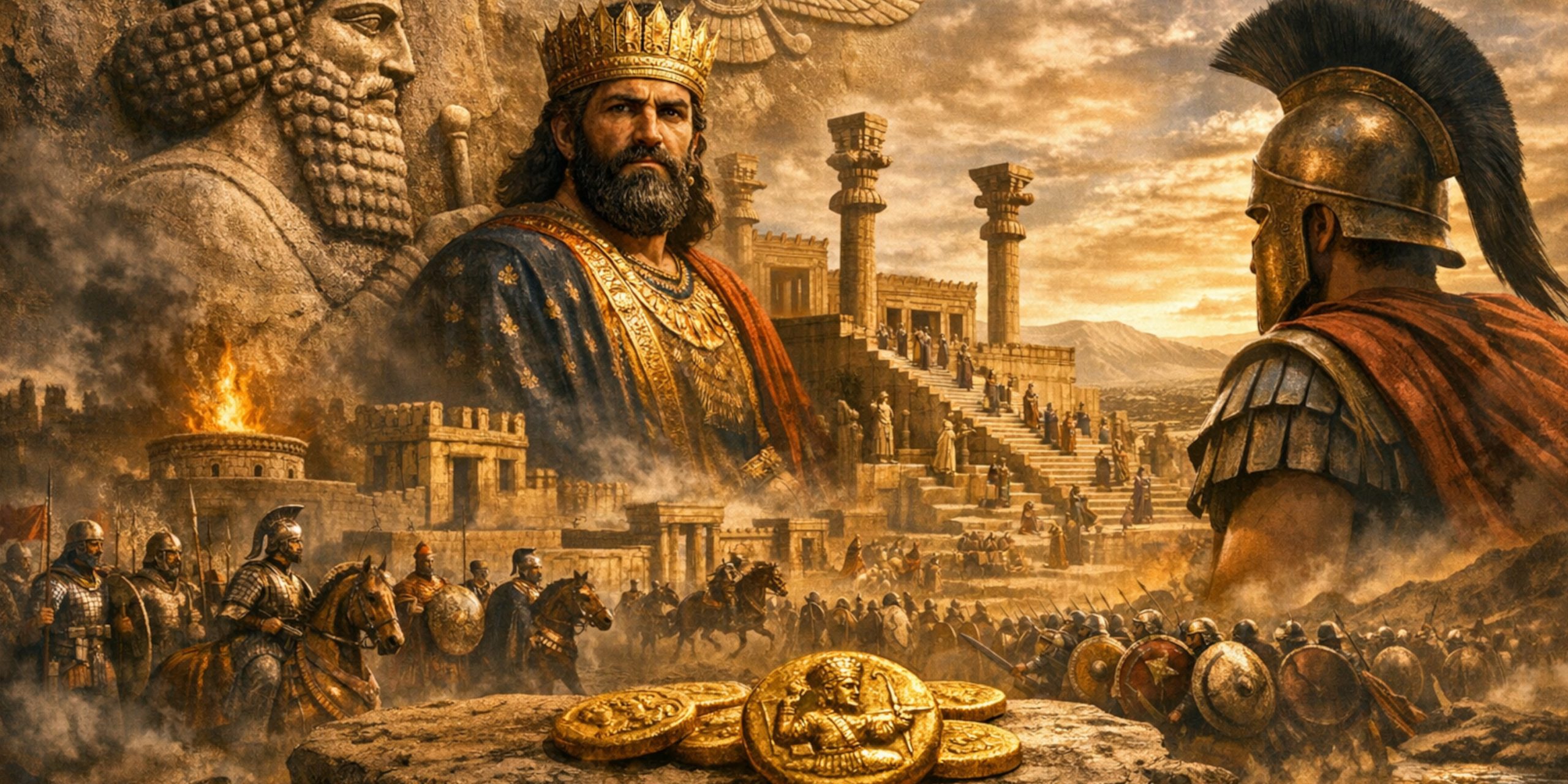
Darius was the organiser. He standardised coinage, introduced the gold daric, reformed taxation, and turned royal authority into a routine rather than a personal miracle. His inscriptions are long, detailed, and unmistakably written by a man who wanted the record set straight.
Xerxes I
Best known in the west for Greece, less fairly for losing there. Xerxes inherited a complex empire and spent much of his reign holding it together. His campaigns against the Greek city states ended badly, but empire building is not a single exam you pass or fail. He remained king of most of the known world.
Later rulers were competent, occasionally inspired, and increasingly beset by court politics. Palace intrigue has a way of multiplying once conquest slows.
Religion, Culture, and Tolerance
Zoroastrian ideas influenced royal ideology, especially the emphasis on truth, order, and the cosmic struggle against chaos. Yet the empire did not enforce religious uniformity. Local cults continued, priesthoods remained funded, and temples were repaired rather than razed. This was not modern pluralism. It was the sensible recognition that belief is hard to tax and harder to police.
Imperial art reflects this balance. Reliefs show delegations from across the empire bringing tribute, each carved with careful attention to local dress. The message is subtle but firm. You may be different, but you are also included, and you are carrying a gift.
Army, Warfare, and Power Projection
The Persian army was a composite force. Persian nobles fought as cavalry, infantry formed the backbone, and subject peoples contributed specialist troops. The so called Immortals, an elite infantry unit kept at a constant strength, were as much a symbol as a battlefield asset.
This was not a blunt instrument. Campaigns relied on logistics, diplomacy, and intimidation as much as combat. When things went wrong, usually in Greece, it was less due to Persian weakness and more to geography and fiercely independent enemies who refused to behave sensibly.
Capitals and Monumental Architecture
The empire had multiple capitals, each serving a purpose. Susa was administrative, Ecbatana seasonal, Babylon ceremonial. Persepolis was theatrical. Built for display and ritual, its terraces and reliefs broadcast imperial order in stone.
Persepolis was later burned by Alexander. Whether this was drunken impulse or calculated symbolism is debated. As a historian, I suspect it was both. History is rarely tidy.
Economy and Coinage
Darius’ introduction of a standard gold coin transformed imperial finance. Trade moved more easily across regions, and state payments became predictable. The empire controlled key trade routes linking the Mediterranean to Central Asia and India. Grain from Mesopotamia, metals from Anatolia, textiles from Iran, all flowed through Persian hands.
It was not a free market utopia. The crown took its share. Still, stability encourages commerce, and the Achaemenids provided it for nearly two centuries.
Decline and the Macedonian Conquest
By the fourth century BC, the empire faced internal revolts, succession disputes, and an energetic Macedonian king with very sharp friends. Alexander’s victories exposed weaknesses in leadership rather than in the imperial system itself. Satrapies sometimes surrendered, sometimes resisted, often hedged their bets.
The fall of the dynasty was swift, but its disappearance was not. Administrative practices, road systems, and royal ideology outlived the family name.
Timeline of the Achaemenid Dynasty
| Date (BC) | Event | Historical significance |
|---|---|---|
| c. 700 | Achaemenes, semi legendary ancestor, rules a Persian clan | Later kings use his name to legitimise dynastic rule |
| c. 559 | Cyrus II becomes king of Anshan | Marks the real beginning of Achaemenid expansion |
| 550 | Defeat of Media | Persia replaces Media as the dominant Iranian power |
| 547–546 | Conquest of Lydia | Control of Anatolia and its immense wealth |
| 539 | Capture of Babylon | Peaceful takeover cements Cyrus’ reputation and adds Mesopotamia |
| 530 | Death of Cyrus in Central Asia | Empire already the largest yet seen |
| 522 | Accession of Darius I after internal revolts | Transition from conquest to consolidation |
| c. 520–518 | Administrative and tax reforms | Satrapy system formalised, empire stabilised |
| c. 515 | Introduction of gold daric coinage | Standardised imperial economy |
| 499–493 | Ionian Revolt | First major challenge from Greek cities |
| 490 | Persian defeat at Marathon | Psychological boost for Greek resistance |
| 486 | Accession of Xerxes I | Inherits a stable but restless empire |
| 480 | Battles of Thermopylae and Salamis | Persian advance checked in Greece |
| 479 | Defeat at Plataea | End of major Persian offensives in mainland Greece |
| 465–424 | Reign of Artaxerxes I | Period of consolidation and diplomacy |
| 404–359 | Reigns of Darius II and Artaxerxes II | Court intrigue and regional revolts increase |
| 336 | Accession of Darius III | Faces Macedonian challenge |
| 334 | Alexander invades Asia Minor | Beginning of the end for Achaemenid rule |
| 331 | Defeat at Gaugamela | Effective collapse of imperial resistance |
| 330 | Death of Darius III | Formal end of the Achaemenid dynasty |
Legacy
The Achaemenids proved that empire could be bureaucratic, tolerant, and durable. They influenced later Persian states, the Hellenistic kingdoms, and even Rome, which quietly borrowed more than it admitted. When modern states talk about infrastructure, standardised taxation, and respecting local customs, they are echoing lessons learned in ancient Persia.
As a woman historian, I admit a soft spot for rulers who preferred ledgers to endless speeches about destiny. The Achaemenids were not perfect, but they were competent, and competence is underrated. Empires rarely fall because they are evil. They fall because they stop working. For two centuries, this one did.
Watch the documentary: