The Tepanec War was the turning point that forged the foundation of the Aztec Triple Alliance and ultimately led to the rise of Tenochtitlan as the dominant power of central Mexico. Taking place around 1426–1428, it was as much a civil war within the Tepanec sphere as it was a liberation movement led by the Mexica, the people of Tenochtitlan. The conflict pitted vassal against overlord, and neighbours who had once traded obsidian and cacao suddenly found themselves testing the edge of each other’s macuahuitl.
Like most wars of Mesoamerica, it was personal, symbolic and performed with a blend of ritual precision and vicious practicality.
Background
For decades before the war, the Tepanec city of Azcapotzalco, under the powerful ruler Tezozómoc, dominated the Valley of Mexico through tribute and military supremacy. The Mexica, based at Tenochtitlan, were among its loyal subjects and prospered under this arrangement, learning military strategy and diplomacy from their Tepanec overlords.
But when Tezozómoc died, succession disputes tore the kingdom apart. His son Maxtla seized power and turned his suspicion towards the Mexica ruler Itzcóatl. The relationship collapsed, tributes were refused, and assassins were allegedly sent across the causeways to Tenochtitlan. The result was open rebellion.
Forces
The Tepanec War was fought between two loose coalitions: the Tepanec forces loyal to Maxtla of Azcapotzalco, and a rebel alliance led by Tenochtitlan, with the crucial support of Texcoco and Tlacopan.
| Faction | Main Leaders | Key Cities | Estimated Troop Strength | Notes |
|---|---|---|---|---|
| Tepanec Empire (Azcapotzalco) | Maxtla | Azcapotzalco, Coyoacán, Tacuba (initially) | 30,000–40,000 | Experienced warriors, well-armed, fought in dense formations. |
| Triple Alliance Rebels | Itzcóatl (Tenochtitlan), Nezahualcóyotl (Texcoco), Totoquihuaztli (Tlacopan) | Tenochtitlan, Texcoco, Tlacopan | 25,000–35,000 | Less wealthy, but more disciplined and united by ideology. |
The figures are speculative, drawn from later colonial accounts and indigenous codices, but they convey the rough parity of the sides.
Arms and Armour
The warriors of both sides were similarly equipped, sharing the martial culture of the Valley.
Typical Weapons and Equipment:
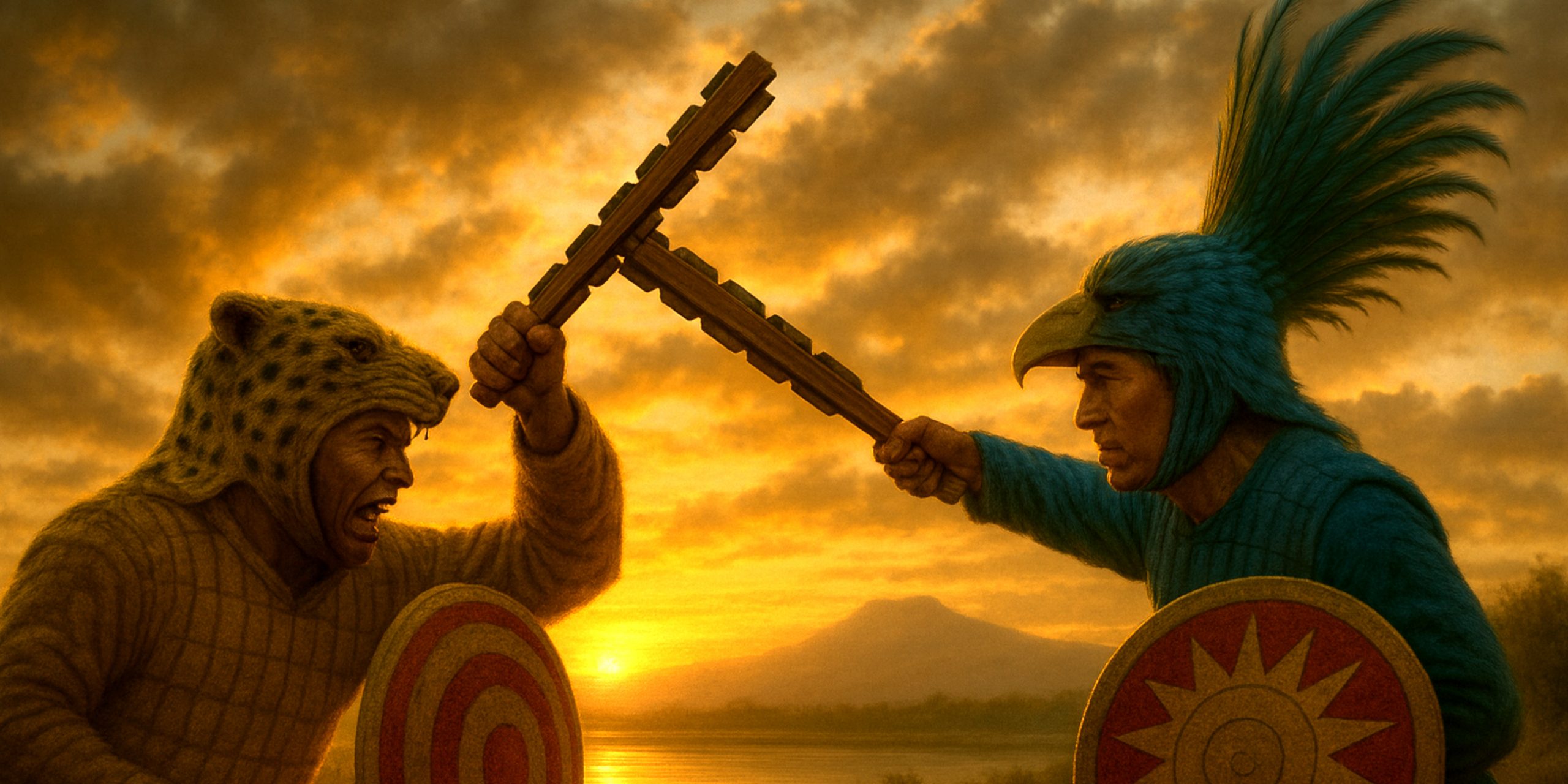
- Macuahuitl: A wooden club edged with obsidian blades, capable of decapitating a man or horse (as Spanish witnesses later discovered with horror).
- Tepoztopilli: A long thrusting spear with obsidian blades along the edge, used by elite warriors.
- Atlatl: Spear-thrower allowing darts to strike with formidable velocity.
- Chimalli: Round shield, often adorned with feathers and precious stones.
- Ichcahuipilli: Quilted cotton armour soaked in saltwater for rigidity, lighter and surprisingly effective against arrows.
- War suits: The tlahuiztli costume, often brightly coloured, marked the wearer’s rank. Eagle and Jaguar warriors wore animal disguises that combined intimidation with ceremony.
| Rank | Weapon Preference | Armour | Symbolism |
|---|---|---|---|
| Commoner warrior (yaotelpochtli) | Atlatl and shield | Light cotton tunic | Proved worth by capturing enemies. |
| Veteran (yaotequihua) | Macuahuitl | Full ichcahuipilli and chimalli | Entitled to wear decorated helmets. |
| Elite (Eagle/Jaguar warriors) | Macuahuitl or tepoztopilli | Animal-form war suit | Represented divine patrons of war. |
| Commander (tlacatecatl or tlacochcalcatl) | Macuahuitl with jade hilt | Heavier ichcahuipilli | Often led charges and took captives personally. |
The war was fought in tight urban terrain and around lake causeways, favouring disciplined infantry rather than cavalry or long-range weapons.
The Course of the War
Phase One: The Rebellion (1426–1427)
- Maxtla’s assassination attempts on Tenochtitlan’s nobles backfired.
- Itzcóatl declared independence, seeking allies among former Tepanec vassals.
- Nezahualcóyotl of Texcoco, himself a dispossessed prince, joined the cause, turning rebellion into revolution.
Phase Two: The Alliance Forms (1427)
- Tenochtitlan, Texcoco, and Tlacopan formed what became known as the Triple Alliance.
- The three cities divided future spoils: two-fifths to Tenochtitlan, two-fifths to Texcoco, and one-fifth to Tlacopan. This agreement, simple yet decisive, shaped the political map of the Aztec Empire.
Phase Three: The Siege of Azcapotzalco (1428)
- After months of skirmishes and sabotage, the allied armies besieged Azcapotzalco.
- Accounts describe burning bridges, cutting off food routes, and fierce hand-to-hand fighting.
- Maxtla’s forces collapsed under the sustained assault, and the city fell.
- Maxtla was captured and executed, reportedly sacrificed on a Tenochtitlan altar.
Timeline of Key Events
| Year | Event | Outcome |
|---|---|---|
| 1426 | Death of Tezozómoc, Maxtla seizes power | Instability in Tepanec Empire |
| 1427 | Tenochtitlan rebels against Azcapotzalco | Outbreak of hostilities |
| 1427–1428 | Alliance formed with Texcoco and Tlacopan | Birth of the Triple Alliance |
| 1428 | Siege and fall of Azcapotzalco | End of Tepanec dominance |
| 1429 onwards | Expansion under the Triple Alliance | Beginning of Aztec imperial era |
Contemporary Accounts and Quotes
The Codex Chimalpahin and later chroniclers preserve fragments of the war’s narrative. One passage, describing the aftermath, captures both vengeance and rebirth:
“Then the city of Azcapotzalco was broken, its lords cast down, its drums silenced, and its people made tributaries to the new sun.”
Nezahualcóyotl, reflecting later on the war, is quoted as saying:
“In the hearts of men, the gods find their instruments. We fought not for vengeance but for the right to breathe unchained.”
That sounds lofty, though one suspects the promise of tribute and territory also played its part.
Archaeology
Remains associated with the Tepanec War have surfaced primarily around Azcapotzalco and Tenochtitlan. Excavations by the Instituto Nacional de Antropología e Historia (INAH) have uncovered:
- Foundations of Azcapotzalco’s palace complex, burned and rebuilt multiple times, consistent with conquest narratives.
- Obsidian blades and spearpoints of Tepanec manufacture found near the old lakebed, perhaps remnants of the final siege.
- Human remains showing cranial deformation and ritual marks, likely prisoners of war sacrificed during victory ceremonies.
As with much of the Mexica past, archaeology provides the bones, while the codices add the colour. Together they paint a picture of disciplined, ruthless ambition.
Legacy
The Tepanec War did not merely change rulers, it rewrote the structure of power in central Mexico. The victors, bound by the Triple Alliance, embarked on a century of conquest that stretched from the Gulf Coast to Oaxaca. The Mexica, once tributaries, became emperors.
Itzcóatl’s victory set the stage for Moctezuma I, Axayácatl, and ultimately Moctezuma II, whose empire would face the Spaniards less than a century later. In many ways, the Tepanec War was the rehearsal for empire—the crucible that taught the Mexica how to rule as well as how to fight.
The Seven Swords Takeaway
The Tepanec War was a conflict fought not only for survival but for identity, with obsidian blades flashing under the Valley sun. If there’s a lesson to draw, it’s that empires often begin not with grand designs but with grievances, ambition, and a timely alliance or two.
And, as ever, the victors wrote the codices.
Watch the documentary: