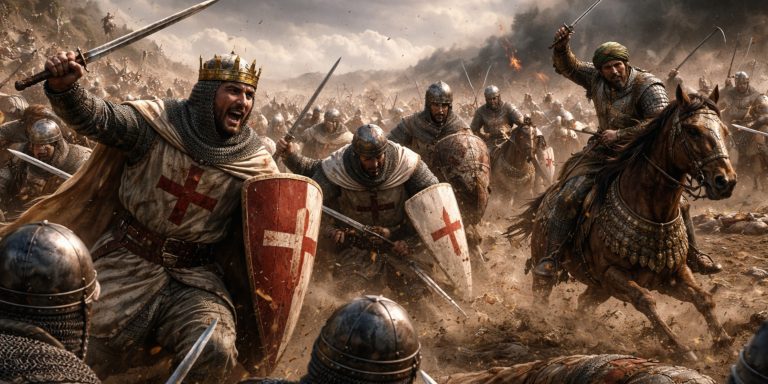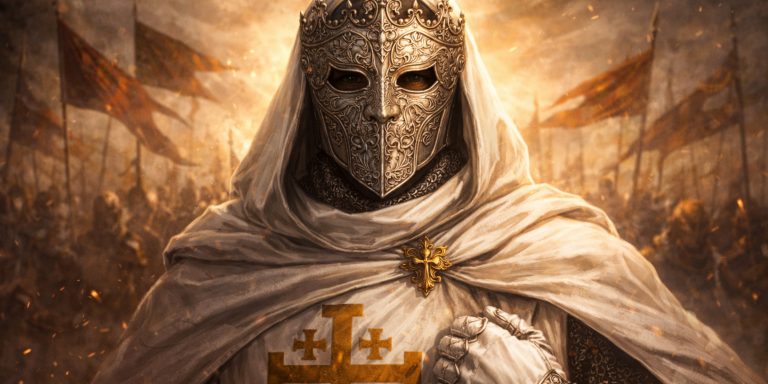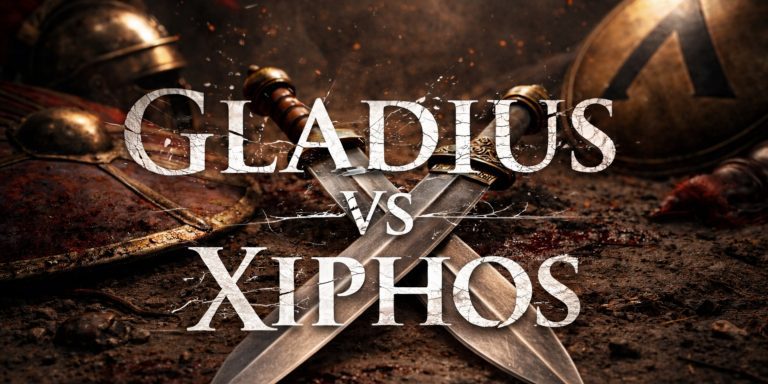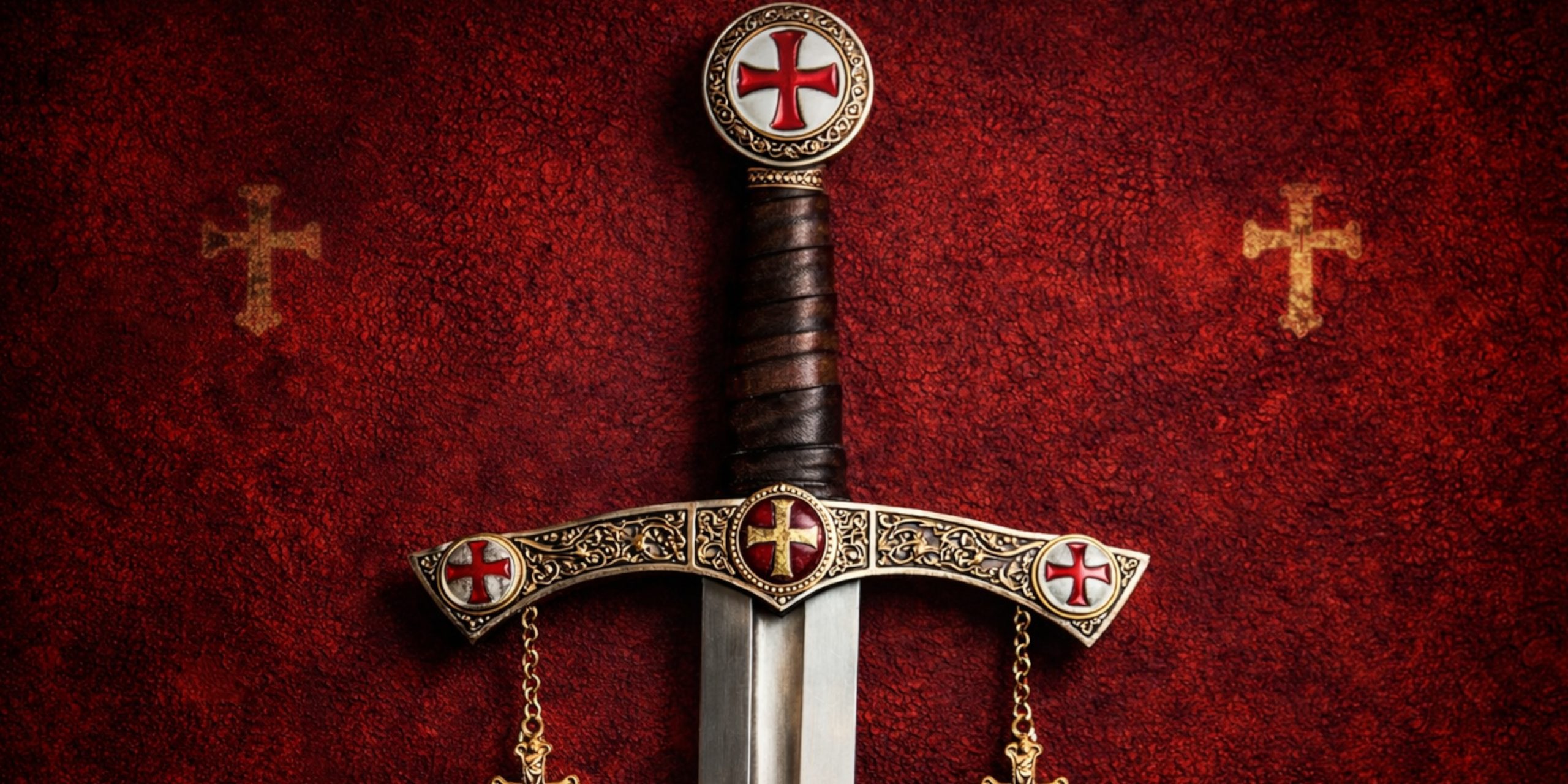
The so called Templar sword is less a single design and more a category of high medieval arming swords associated with the Knights Templar during the Crusades. What gives it identity is not a strict blueprint, but a combination of form and symbolism. Straight double edged blades, simple cruciform hilts, and a quiet confidence that suited both battlefield work and religious meaning.
These were practical weapons first. The cross shaped hilt has often been romanticised, though it was originally a matter of grip, control, and protection. Still, it is hard to ignore how neatly the design aligned with the order’s religious purpose.
Specifications
| Feature | Typical Range |
|---|---|
| Blade Length | 70 to 85 cm |
| Overall Length | 90 to 105 cm |
| Weight | 1.0 to 1.4 kg |
| Blade Type | Double edged, straight |
| Fuller | Single or short fuller |
| Hilt | Straight crossguard |
| Pommel | Wheel, Brazil nut, or disc |
| Grip | Wood core with leather wrap |
Common Characteristics
- Broad cutting blade with a reinforced point for thrusting
- Moderate taper, allowing both cut and thrust use
- Balance typically 10 to 15 cm from the guard
- Designed for one handed use, often paired with a shield
History and Evolution
The Templar sword sits firmly within the broader development of the medieval arming sword, particularly between the 12th and early 14th centuries.
Key Phases
- Early Crusades
- Blades were broader, optimised for cutting against lightly armoured opponents
- Influenced by earlier Viking sword traditions
- Mid Crusading Period
- More defined taper appears
- Points become stronger for thrusting into gaps in mail
- Late Templar Era
- Transition toward more specialised thrusting swords
- Armour developments begin to shift sword design away from pure cutting
Context
- Used across the Levant, Iberia, and Europe
- Not exclusive to the Templars, but strongly associated through iconography and effigies
- Often depicted in funerary monuments of knights
Advantages and Disadvantages
Advantages
- Reliable cutting power against unarmoured or lightly armoured targets
- Effective thrusting capability for its period
- Balanced and versatile in one handed combat
- Durable construction suited for campaign use
- Simple hilt design, easy to maintain and repair
Disadvantages
- Limited effectiveness against later plate armour
- Reach shorter than polearms and two handed swords
- Grip restricts leverage compared to hand and a half swords
- Symbolic decoration can be overstated in modern replicas
Comparison with Similar Weapons
| Weapon | Key Difference | Use Case |
|---|---|---|
| Viking Sword | Wider blade, less taper | Early medieval cutting weapon |
| Arming Sword | Nearly identical category | General European knightly weapon |
| Longsword | Longer grip, two handed use | Greater reach and control |
| Falchion | Single edged, heavier blade | Strong cutting focus |
| Xiphos | Shorter, leaf shaped blade | Ancient close combat |
Observations
- The Templar sword is best understood as a subtype of the arming sword
- Compared to the longsword, it trades reach for speed and manoeuvrability
- Against the falchion, it offers more balanced thrusting ability
Legacy
The legacy of the Templar sword rests as much in symbolism as in steel.
- Strong association with crusading orders and Christian iconography
- Frequently reproduced in modern ceremonial and replica swords
- A staple in film, games, and historical fiction
- Often misrepresented as a unique or sacred design
It has become shorthand for medieval knighthood, which is convenient, though not entirely accurate.
Where to See Templar Swords
Museums and Collections
- The British Museum
- Musée de l’Armée
- Royal Armouries
- Metropolitan Museum of Art
What to Look For
- Blade proportions and taper
- Wear patterns along the edge
- Pommel form and balance
- Inscriptions or maker’s marks
Collector’s Guide
Authentic vs Replica
- True Templar owned swords are extremely rare and often unprovenanced
- Most surviving examples are classified broadly as arming swords
- Many modern “Templar swords” are stylistic interpretations
Price Guide
| Type | Price Range |
|---|---|
| Museum grade medieval sword | £50,000 to £300,000+ |
| Provenanced crusader era sword | £80,000 to £500,000+ |
| High end reproduction | £800 to £3,000 |
| Decorative replica | £100 to £500 |
Factors Affecting Value
- Provenance and documentation
- Condition of blade and hilt
- Originality of components
- Historical attribution, even when debated
Auction Notes
- Major sales often occur through specialist arms and armour auctions
- Prices can fluctuate sharply depending on attribution claims
- Mislabelled “Templar” swords are common, caution is essential
Buying Advice
- Prioritise condition and authenticity over decorative appeal
- Seek expert verification before high value purchases
- Understand that most “Templar” labels are modern marketing
Takeaway
The Templar sword is not a mystical artefact, nor a single defined weapon. It is a practical knightly sword shaped by its time, then elevated by centuries of myth.
Strip away the symbolism and you are left with a well balanced, highly effective weapon of the high Middle Ages. Add the symbolism back in, and it becomes something else entirely. A piece of history that people still want to hold, own, and, if we are honest, imagine themselves carrying.