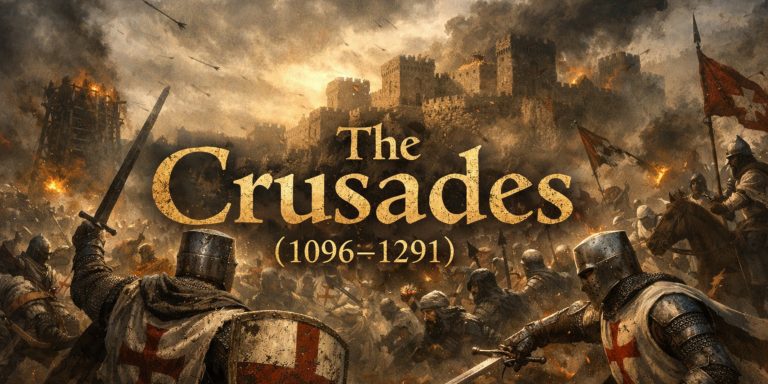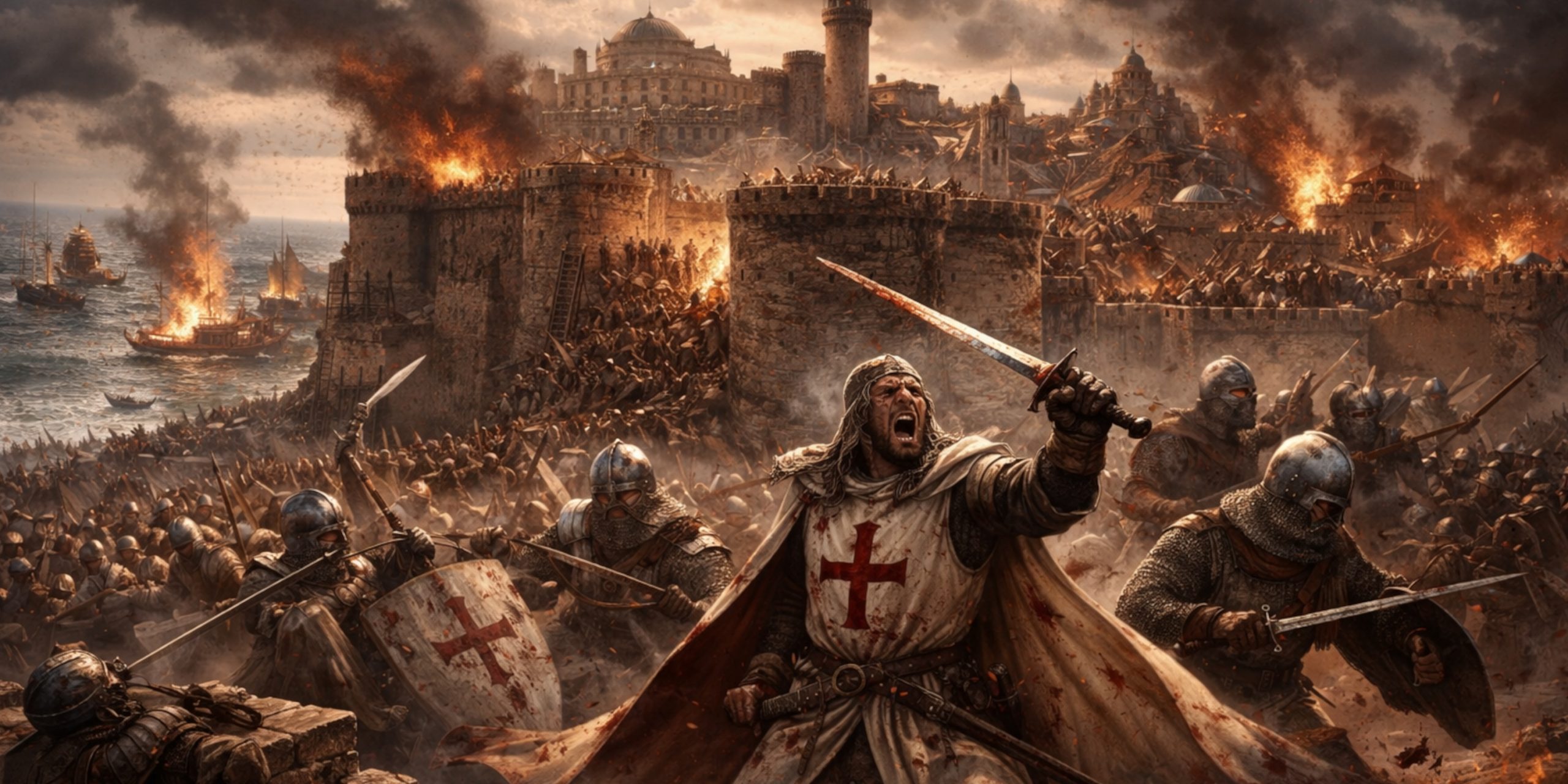
The Siege of Acre in 1291 was the end of nearly two centuries of Crusader rule in the Holy Land. When Acre fell to the Mamluk army of Sultan al-Ashraf Khalil on 18 May 1291, the last major Crusader stronghold in the Levant disappeared with it. The dream of Outremer, already battered, quarrelsome and running on borrowed time, finally collapsed into the sea.
Acre had once been the glittering capital of the Kingdom of Jerusalem. Merchants from Venice, Genoa and Pisa jostled in its streets. Knights of the Temple and Hospitallers strode about in polished mail, trying to look severe and pious at the same time. By 1291, however, Acre was overcrowded, politically divided and defended by men who often disagreed with each other more than with the enemy.
Still, when the siege began, the defenders fought with astonishing stubbornness. The battle for Acre became one of the bloodiest and most desperate sieges of the medieval world.
Why Acre Mattered
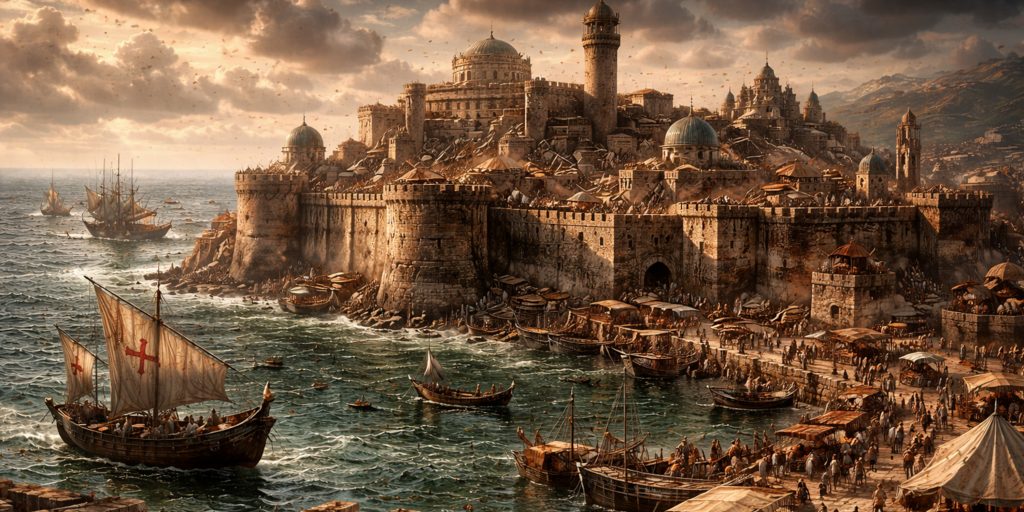
Acre was the largest and richest Crusader city left in the Holy Land. After the loss of Jerusalem in 1187, it became the capital of the remaining Crusader territories. Whoever controlled Acre controlled the last great port linking the Crusader states to Europe.
The city had:
- Massive double walls and fortified towers
- A large harbour protected by sea walls
- Strongholds belonging to the military orders
- Wealth from trade with Europe and the eastern Mediterranean
- A symbolic importance out of all proportion to its size
For the Mamluks, Acre was an intolerable reminder that the Crusaders still clung to the coast. Sultan al-Ashraf Khalil, son of the formidable Sultan Qalawun, intended to finish what his father had begun.
Background to the Siege
The years before 1291 were marked by growing tension between the Crusaders and the Mamluk Sultanate. A fragile truce existed, but it collapsed after Italian crusaders and unruly mercenaries attacked Muslim merchants in Acre in 1290. The massacre gave Khalil an excuse, though truthfully he scarcely needed one.
Qalawun had already planned to take Acre before his death in 1290. Khalil inherited both the throne and the ambition.
In spring 1291, the Mamluk army marched north from Egypt and Syria. Acre braced for the storm.
Forces
Crusader Defenders
The city held perhaps 15,000 to 20,000 defenders, although exact figures remain disputed. This included knights, infantry, sailors and armed townspeople.
| Group | Estimated Numbers | Notes |
|---|---|---|
| Knights Templar | 300 to 500 | Based in their great fortress near the harbour |
| Knights Hospitaller | 300 to 500 | Defended key stretches of the wall |
| Teutonic Knights | Fewer than 100 | Small but experienced contingent |
| French and English Crusaders | 1,000 to 2,000 | Included nobles and volunteers |
| Italian Militias | 5,000+ | Venetians, Genoese and Pisans |
| Local Infantry and Town Militia | 8,000 to 10,000 | Included Syrians and other residents |
Mamluk Army
Khalil assembled one of the largest armies ever seen in the Levant.
| Group | Estimated Numbers | Notes |
| Mamluk Cavalry | 20,000 to 30,000 | Elite professional mounted troops |
| Infantry | 30,000 to 40,000 | Included engineers and archers |
| Siege Engineers | Several thousand | Operated trebuchets, mining works and siege towers |
| Auxiliary Troops | Unknown | Syrian and Bedouin contingents |
Medieval chroniclers inflated the Mamluk numbers wildly, some claiming more than 100,000 men. Medieval chroniclers had a touching faith that every enemy army was the size of a small continent.
Leaders
| Side | Leader | Role |
| Mamluk Sultanate | Sultan al-Ashraf Khalil | Commander of the siege |
| Mamluk Sultanate | Emir Baydara | Senior commander |
| Mamluk Sultanate | Emir Lajin | Directed assaults and siege works |
| Crusaders | Guillaume de Beaujeu | Grand Master of the Templars |
| Crusaders | Jean de Villiers | Grand Master of the Hospitallers |
| Crusaders | Otto de Grandson | English knight and commander |
| Crusaders | King Henry II of Cyprus | Nominal ruler of Jerusalem and Cyprus |
| Crusaders | Peter de Sevrey | Military commander in the city |
Guillaume de Beaujeu became one of the defining figures of the siege. Mortally wounded during the fighting, he reportedly refused to leave the walls until the end.
Arms and Armour
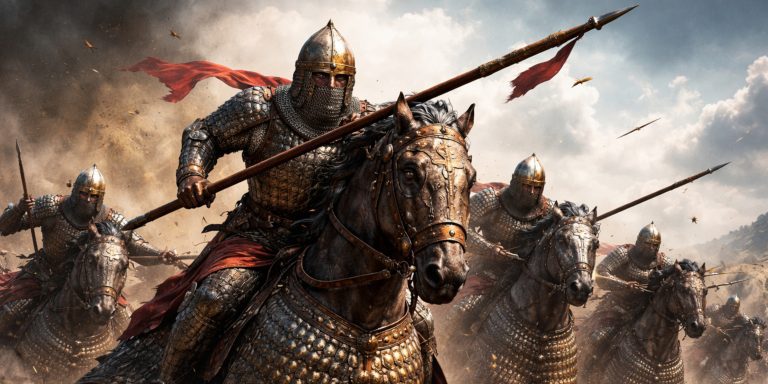
The Siege of Acre was fought with a mixture of traditional Crusader equipment and the more mobile, flexible arms of the Mamluks.
Crusader Arms and Armour
- Full mail hauberks with surcoats
- Great helms and enclosed helmets
- Kite shields and heater shields
- Crossbows, spears and maces
- Heavy cavalry lances
Specific sword types likely used by the Crusaders included:
- Oakeshott Type XII arming swords, broad-bladed and suited to cutting
- Oakeshott Type XIII swords, longer blades often favoured by mounted knights
- Early Type XIV swords, shorter and more thrust-oriented
- Falchions, particularly among infantry and sailors
| Weapon | Typical User | Purpose |
| Arming Sword | Knights and sergeants | Close combat on the walls |
| Falchion | Infantry and sailors | Brutal chopping weapon in confined spaces |
| Crossbow | Militia and Italian troops | Defence from towers and battlements |
| Lance | Mounted knights | Counterattacks outside the gates |
Mamluk Arms and Armour
The Mamluks wore lighter armour than the Crusader knights but were highly disciplined and deadly.
- Lamellar or mail armour
- Turban helmets and conical steel helmets
- Composite bows
- Spears, maces and axes
- Curved and straight swords
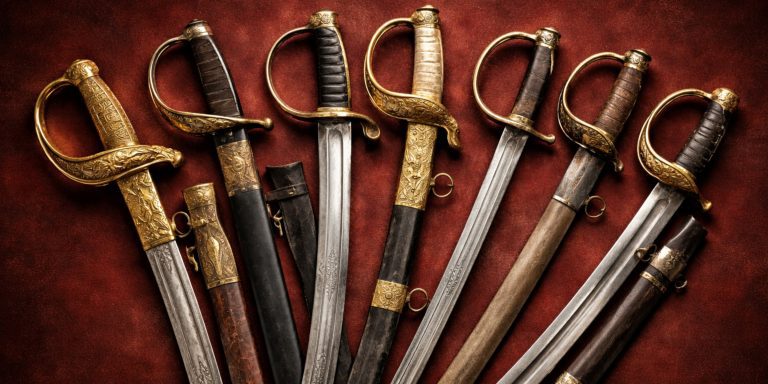
Sword types used by the Mamluks included:
- Straight double-edged swords descended from earlier Islamic designs
- Early sabres with slightly curved blades
- Saif swords used by officers and cavalry
| Weapon | Typical User | Purpose |
| Composite Bow | Mamluk cavalry | Long-range attacks against walls and defenders |
| Saif | Officers and cavalry | Fast cutting weapon |
| Axe and Mace | Infantry | Assaults against gates and barricades |
| Trebuchet | Siege engineers | Breaking the walls of Acre |
The Mamluks also brought an enormous siege train, including giant trebuchets with names such as “The Furious” and “The Victorious”. Medieval armies rarely resisted the urge to give siege engines names that sounded like wrestlers.
The Siege Begins
The Mamluk army arrived before Acre on 5 April 1291. Khalil established camps around the city and immediately began constructing siege lines.
Trebuchets pounded the walls day and night. Mamluk engineers dug mines beneath towers and filled them with timber and combustibles. The defenders responded with sorties, counter-mines and desperate repairs.
The heaviest fighting centred on:
- The Gate of St Anthony
- The Accursed Tower
- The outer walls near the Montmusard district
- The Templar fortress by the harbour
Despite fierce resistance, the Mamluks gradually shattered the outer walls.
Battle Timeline
| Date | Event |
| 5 April 1291 | Mamluk army arrives outside Acre |
| 6 to 15 April | Siege lines and trebuchets constructed |
| Mid-April | Continuous bombardment begins |
| Late April | Several Crusader sorties fail |
| Early May | Mamluk miners undermine sections of the wall |
| 15 May | Major breach opened near the Gate of St Anthony |
| 16 to 17 May | Intense street fighting inside the outer defences |
| 18 May | Final assault, city captured by the Mamluks |
| 28 May | Templar fortress collapses after final resistance |
The Final Assault
On 18 May, the Mamluks launched their full assault. Trumpets sounded across the camp and the entire line surged forward.
The walls were breached in several places. Crusader resistance quickly became fragmented. Fighting raged through the streets, churches and marketplaces of Acre.
Guillaume de Beaujeu was struck by a spear or arrow. According to one account, when his men begged him not to retreat, he replied:
“I am not fleeing. I am dead. See the blow.”
He soon collapsed and died.
Jean de Villiers, badly wounded, escaped to Cyprus. Thousands of civilians rushed to the harbour in the hope of escaping by ship. Many drowned. Others were crushed in the panic.
The Templars made their last stand in their fortress near the harbour. For ten more days they held out against overwhelming odds before their position collapsed. When the final tower fell on 28 May, the last organised Crusader resistance in Acre ended.
Contemporary Quotes
Contemporary chroniclers left vivid and often harrowing descriptions of the siege.
“The city was filled with the dead and the dying, and the streets ran with blood.”
Baha ad-Din, describing the aftermath of the fighting.
“The noise of the engines and the cries of men made the earth tremble.”
From the chronicle of the Templar of Tyre.
“Never was there seen such grief and lamentation in Acre.”
Templar of Tyre.
“The Franks fought like lions, but lions can still be surrounded.”
Later Arabic chronicler al-Maqrizi.
Archaeology
Modern archaeology has revealed much about the siege and the city itself.
Excavations at Acre, particularly beneath the modern Israeli city of Akko, have uncovered:
- Sections of the Crusader walls destroyed in 1291
- Remains of tunnels and counter-mines
- Crossbow bolts and arrowheads
- Fragments of swords, armour and helmets
- Burn layers from the final assault
- The underground halls of the Hospitallers
Archaeologists have also identified the likely location of the Templar fortress and parts of the harbour defences.
Particularly striking are the remains of collapsed masonry around the outer walls. These appear to match the areas described in medieval accounts where the Mamluk bombardment was most intense.
Excavations continue to produce small finds such as:
- Iron arrowheads from Mamluk composite bows
- Broken mail rings
- Fragments of European pottery and glass
- Coins from both the Crusader Kingdom and the Mamluk Sultanate
The archaeology of Acre has a grim intimacy. One can read the chronicles, then stand before a broken stretch of wall and realise that somebody died exactly there seven hundred years ago, probably shouting something unrepeatable in Old French.
Why Acre Fell
Several factors explain the defeat:
- The Mamluks possessed overwhelming numbers
- The Crusader states were politically divided
- European support arrived too late and in too little strength
- Acre’s defences, although formidable, could not withstand prolonged bombardment
- The Mamluks had superior siege engineering
The military orders fought fiercely, but bravery could not compensate for the fact that the Crusader Kingdom had become isolated and exhausted.
Legacy
The fall of Acre marked the effective end of the Crusader states in the Holy Land. Within weeks, the remaining Crusader ports surrendered or were abandoned.
After 1291:
- Tyre, Sidon and Beirut quickly fell
- The military orders retreated to Cyprus
- The Kingdom of Jerusalem survived only as a title
- Later Crusades never again established a lasting presence in the Levant
The Siege of Acre became a symbol of both heroic resistance and fatal disunity. Medieval writers turned it into a tragedy. Modern historians tend to see it as the inevitable conclusion of a long decline.
Both are true.
Acre in 1291 was brave, wealthy, divided, overcrowded and doomed. The defenders fought magnificently. They also left the impression of a society still arguing over precedence while the walls were coming down. History can be rather unforgiving about that sort of thing.
Further Reading
- Peter Edbury, The Kingdom of Cyprus and the Crusades
- Steven Runciman, A History of the Crusades, Volume III
- David Nicolle, The Fall of Acre 1291
- Denys Pringle, The Defence of Acre, 1291
- Jonathan Riley-Smith, The Crusades: A History