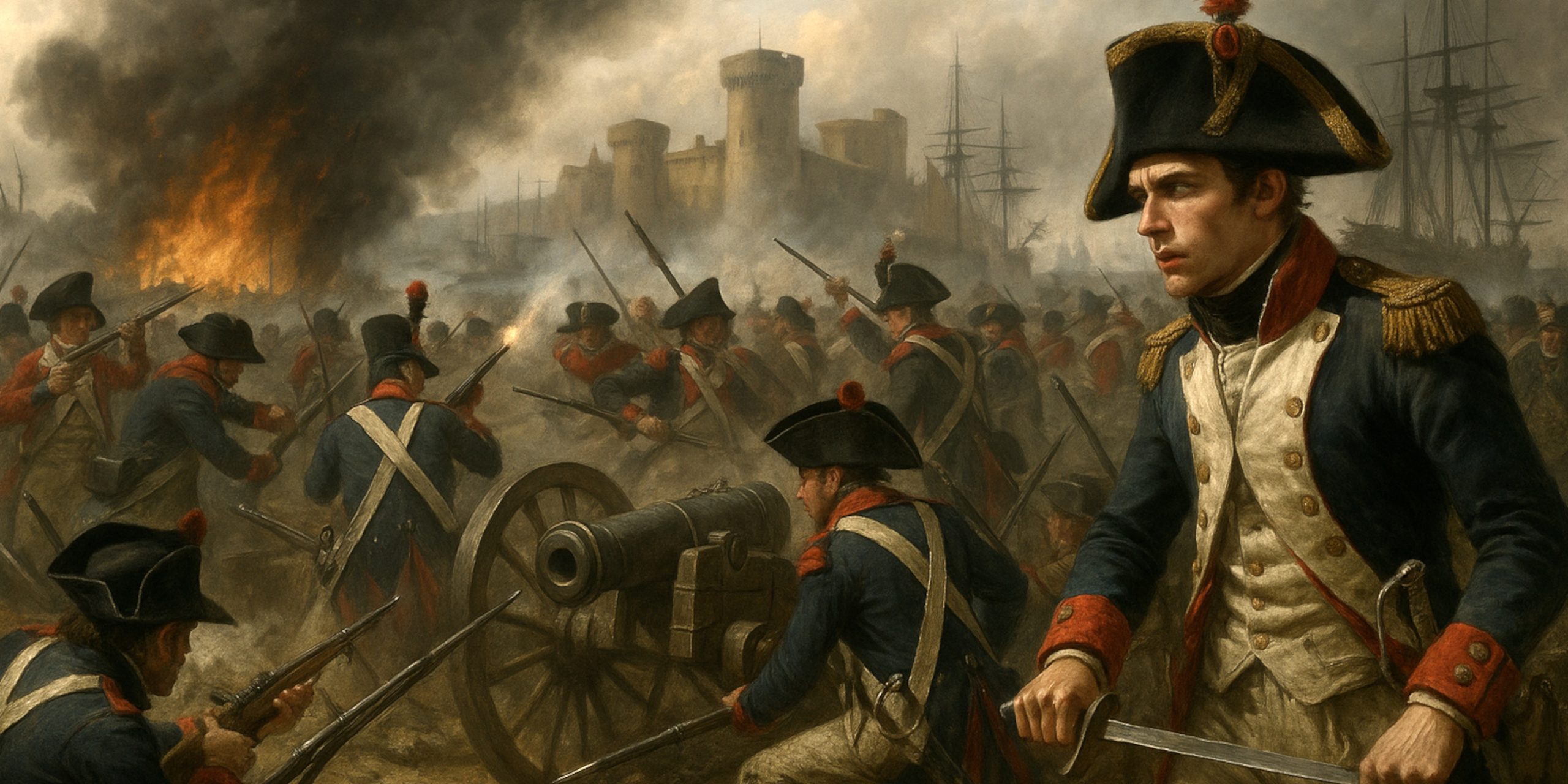
The Battle of Toulon in 1793 was one of the most significant early episodes of the French Revolutionary Wars. It marked the rise of Napoleon Bonaparte, then a young artillery officer, whose tactical skill proved decisive in reclaiming the city from a Royalist-Republican coalition. The siege involved complex naval manoeuvres, entrenched positions, and multinational forces, shaping both the course of the war and Napoleon’s career.
Background
By mid-1793, Revolutionary France was divided. Toulon, a key Mediterranean naval base, rose in rebellion against the Republic and welcomed British and Spanish fleets into its harbour. Control of Toulon meant control of the French Mediterranean fleet, making it a strategic prize. The Republicans launched a determined siege to retake the city before the Allies could consolidate their hold.
Forces
Republican Army
| Commander | Troop Estimate | Composition |
|---|---|---|
| Dugommier (overall), Napoleon Bonaparte (artillery) | c. 37,000 | Revolutionary infantry, National Guard units, artillery brigades, cavalry support |
Coalition Forces (Royalists with Allies)
| Commander | Troop Estimate | Composition |
|---|---|---|
| Admiral Hood (British), Admiral Lángara (Spanish), Prince of Hesse-Philipsthal (land forces) | c. 20,000 (mixed garrison and allied troops) | British Marines and line infantry, Spanish infantry, Neapolitans, Sardinians, French Royalists, naval artillery |
Leaders and Troop Composition
- Republican Commanders:
- Jacques François Dugommier (overall command)
- Napoleon Bonaparte (artillery organisation and battery placement)
- Jean François Carteaux (initial commander, replaced due to poor performance)
- Antoine François Doppet (interim commander before Dugommier)
- Coalition Commanders:
- Vice Admiral Lord Hood (British Navy)
- Admiral Don Juan de Lángara (Spanish Navy)
- Prince Frederick of Hesse-Philipsthal (land defence)
- Count Trogoff (French Royalist Admiral who surrendered the fleet)
Arms and Armour
Republican Forces
- Infantry Weapons: Charleville Model 1777 musket with bayonet
- Artillery: Gribeauval system cannon (4-, 8-, and 12-pounders), mortars, and howitzers directed by Napoleon
- Swords:
- Infantry and officers: Briquet sabre (short, curved)
- Cavalry: Sabre de cavalerie légère modèle 1767
- Officers and artillerymen often carried épée or smallsword for dress and close combat
Coalition Forces
- Infantry Weapons:
- British: Brown Bess musket with socket bayonet
- Spanish: Model 1757 musket
- Royalist French: Charleville muskets from old arsenals
- Artillery: Ship-based heavy guns repurposed for fortifications, Spanish coastal batteries
- Swords:
- British officers: 1796 pattern spadroon (early examples), naval cutlasses
- Spanish officers: M1796 espada ancha and cavalry sabres
- Royalist French: Standard French épée and sabre patterns
Archaeology
Excavations around Toulon and the naval dockyards have uncovered remnants of gun emplacements attributed to Bonaparte’s artillery batteries, particularly the batteries at “Petit Gibraltar” and “Fort Mulgrave.” Cannonballs, musket parts, and fragments of uniforms have been discovered in the surrounding terrain. In the harbour, underwater surveys have revealed remains of scuttled French ships burnt or destroyed during the Allied withdrawal.
Battle Timeline
- August 1793: Toulon opens its harbour to the British and Spanish, declaring against the Republic.
- September 1793: Republican forces begin the siege but suffer from poor coordination under Carteaux.
- October 1793: Napoleon Bonaparte proposes a systematic artillery plan to capture key forts controlling the harbour. Batteries are constructed at L’Éguillette and Balaguier.
- November 1793: Republicans intensify bombardments. Dugommier replaces Carteaux and adopts Bonaparte’s plan.
- 17 December 1793: Republican assault captures Fort Mulgrave (nicknamed “Little Gibraltar”) after heavy fighting.
- 18 December 1793: With key defences lost, Allied forces begin evacuation. British and Spanish set fire to French ships to prevent capture.
- 19 December 1793: Republicans enter Toulon, ending the siege. Thousands of Royalists flee with the Allies.
Contemporary Quotes
- Napoleon Bonaparte, reflecting later: “In Toulon, I learned the importance of artillery. Without it, armies are blind and defenceless.”
- Lord Hood, in dispatches: “The place could no longer be held with honour, the batteries of the enemy having rendered the harbour untenable.”
- Dugommier to the Convention: “Citizens, Toulon is returned to the Republic. The tricolour flies once more in the great arsenal of France.”
Legacy
The capture of Toulon was a defining victory for Revolutionary France. It restored the French Mediterranean fleet to Republican control and crushed a major Royalist stronghold. For Napoleon, the siege was his first major step toward prominence, earning him promotion to brigadier general at just 24 years old. The battle also revealed the growing importance of artillery in siege warfare, a lesson that Napoleon would carry into his later campaigns.
Watch the documentary: