The Russian Imperial Guard Infantry occupied a curious place in the armies of Napoleonic Europe. They were elite troops, richly dressed, fiercely proud and usually held back until the moment a battle had already begun to smell of disaster or triumph. In an army notorious for poor roads, uneven training and officers who occasionally treated maps as vague suggestions, the Guard stood apart.
From Austerlitz to Borodino and finally Paris, the infantry of the Russian Imperial Guard earned a formidable reputation. French soldiers regarded them with a mixture of admiration and irritation. They were tall, disciplined and stubborn to an almost unreasonable degree. If the regular Russian infantry was a wall, the Guard was the section of wall built twice as thick and then painted green with gold trim.
Who Were the Russian Imperial Guard Infantry?
The Imperial Guard was the personal military household of the Tsar. By 1805 it had expanded into a substantial field force, including infantry, cavalry and artillery. The infantry branch formed the core of this elite establishment.
The Guard infantry was divided into two broad categories:
- Old Guard regiments, the most prestigious and experienced
- Young Guard regiments, raised later and often containing younger or less seasoned men
The principal infantry regiments between 1805 and 1815 included:
- Preobrazhensky Life Guards Regiment
- Semyonovsky Life Guards Regiment
- Izmailovsky Life Guards Regiment
- Life Guards Jäger Regiment
- Lithuanian Life Guards Regiment
- Finnish Guards Regiment, from 1806 onwards
- Pavlovsky Grenadier Regiment, often attached to the Guard and treated with similar prestige
These regiments were recruited from some of the best men in the Empire. Height requirements were strict, particularly for grenadiers. A man under six feet had little chance of joining the tallest Guard battalions. The result was an army formation that looked intimidating before it had even begun marching. One French officer described them as “moving towers in dark green.”
The Origins and Prestige of the Guard
The oldest Guard regiments traced their history back to the childhood “toy army” of Tsar Peter the Great in the late seventeenth century. By the Napoleonic era, these regiments had become deeply tied to Russian politics and court life.
The most famous were the Preobrazhensky and Semyonovsky Guards. Membership in these regiments carried immense prestige. Officers often came from aristocratic families, while enlisted men enjoyed better pay, finer uniforms and better living conditions than the ordinary infantryman.
There was, however, a certain irony in all this splendour. The Guard was so prestigious that Russian commanders were often reluctant to use it. Throughout much of the Napoleonic Wars, the Guard spent an impressive amount of time standing magnificently in reserve while other men did the dying.
Organisation and Structure
A typical Guard infantry regiment consisted of:
- Two or three battalions
- Each battalion divided into four companies
- Grenadier and musketeer companies in line regiments
- Skirmisher companies in the Jäger regiments
Approximate wartime strength:
| Unit Type | Average Strength |
|---|---|
| Guard Infantry Regiment | 1,500–2,500 men |
| Battalion | 500–800 men |
| Company | 120–180 men |
The Guard infantry served under the command of the Grand Duke Constantine, brother of Tsar Alexander I, for much of the period. Constantine was brave, energetic and notoriously volatile. He was capable of inspiring his men one day and terrifying his officers the next. In that sense, he was very much a product of the Russian court.
Uniforms and Appearance
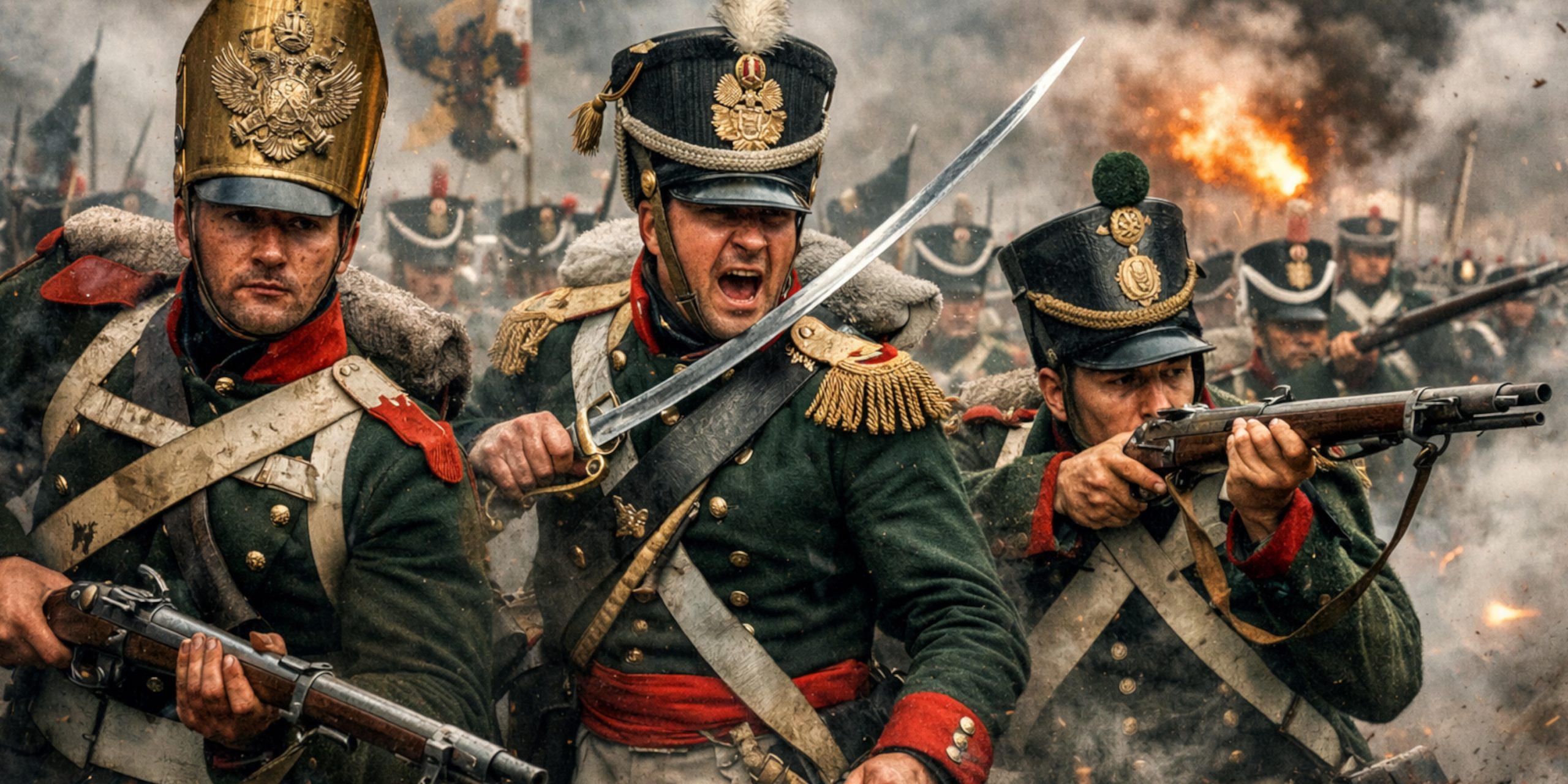
Russian Imperial Guard infantry uniforms were among the most striking in Europe. They wore dark green coats with coloured facings depending on regiment, white crossbelts and tall shakos or mitre caps.
The most famous visual feature belonged to the Pavlovsky Grenadiers. They retained their distinctive brass-fronted mitre caps long after most European armies had abandoned them. By 1812 these caps already looked faintly absurd, rather like something from Frederick the Great’s attic. Yet they became one of the most iconic symbols of the Russian Guard.
Common features of Guard infantry uniform included:
- Dark green coat with red collar and cuffs
- White breeches or trousers
- Tall black shako with brass plate and plume
- White leather crossbelts
- Distinctive regimental badges and embroidery
- Better cloth and tailoring than ordinary line infantry
The officers wore even more elaborate versions, with gold lace, silver gorgets and richly decorated sashes. Some looked less like field officers and more like men on their way to a very aggressive opera.
Arms and Armour
The Guard infantry carried the standard Russian infantry weapons of the period, but usually of better quality and in better condition.
Muskets
The main firearm was the Russian Model 1808 infantry musket, a flintlock weapon with a .70 calibre bore. It was broadly similar to the French Charleville or British Brown Bess.
Typical characteristics:
- Effective range of around 80 to 100 yards
- Bayonet permanently fixed during battle
- Rate of fire of roughly two to three rounds per minute
Guard Jäger regiments sometimes carried rifles or lighter muskets for skirmishing duties, although true rifles remained rare in Russian service.
Bayonets
Russian infantry relied heavily on the bayonet. Russian commanders repeatedly emphasised shock tactics and close combat. General Suvorov’s old maxim still lingered in the Russian army:
“The bullet is a fool, the bayonet is a fine fellow.”
By 1805 this saying was already famous, and Russian officers repeated it with the enthusiasm of men who were not personally standing in the front rank.
Swords and Sidearms
Guard infantry officers carried elegant sabres and smallswords, while senior NCOs often carried short sabres.
The most common sword types used by the Russian Imperial Guard infantry included:
- Russian Infantry Officer’s Sword, 1798 pattern
- Russian Infantry Officer’s Sabre, 1809 pattern
- Russian Briquet-style short sabre, carried by some NCOs and artillerymen
- Curved light cavalry sabres occasionally worn by officers in Guard Jäger units
The 1798 infantry officer’s sword had a straight blade and brass hilt, heavily influenced by earlier European smallswords. By the later Napoleonic period, many officers preferred the more fashionable curved sabre of the 1809 pattern.
Armour
No true body armour was worn by the infantry. By this period, armour had largely disappeared from European infantry warfare. The closest thing to protection was the thick woollen uniform and the large shako, neither of which was especially useful against musket balls.
One suspects the shako provided more protection against rain and poor decisions than enemy fire.
Training and Battlefield Role
The Russian Imperial Guard infantry was better trained than the ordinary Russian line. Drill was stricter, discipline harsher and parade-ground standards almost obsessive.
Guard infantry were expected to:
- Hold critical points in battle
- Deliver decisive counterattacks
- Serve as a reserve for the commander
- Maintain order during retreats
Unlike the French Imperial Guard, which became increasingly committed in major battles, the Russian Guard was often preserved carefully. Tsar Alexander and his generals saw it as both a military asset and a political symbol.
When finally committed, however, the Guard usually performed well. Their steadiness at Borodino and Leipzig became legendary.
The Guard at Austerlitz
The Battle of Austerlitz in 1805 gave the Russian Guard its first great test against Napoleon.
Late in the battle, the Russian Guard infantry and cavalry launched a desperate counterattack against the French Imperial Guard. For a brief moment, they nearly broke through.
The Preobrazhensky and Semyonovsky Guards fought with remarkable determination around the Pratzen Heights. Yet Napoleon’s Guard cavalry and supporting infantry eventually forced them back.
French officer Philippe-Paul de Ségur later wrote:
“The Russian Guard advanced with astonishing firmness, silent and terrible.”
Despite the defeat, the Russian Guard emerged from Austerlitz with enhanced prestige. They had been beaten, but not humiliated, which in Napoleonic warfare was sometimes about the best one could hope for.
The Guard in the 1812 Campaign
The Guard infantry played a major role during Napoleon’s invasion of Russia in 1812.
At the Battle of Borodino, much of the Guard remained in reserve near the Russian centre. Some regiments were committed late in the battle to support exhausted troops around the Raevsky Redoubt.
The Guard helped stabilise the Russian line and prevented complete collapse. Their mere presence reassured the army. One Russian officer remarked that seeing the Guard arrive “was like seeing a stone wall march forward.”
After Borodino, the Guard accompanied the Russian retreat and later joined the advance into Europe. By 1813 and 1814, these same regiments fought at Leipzig, Kulm and the capture of Paris.
Famous Regiments
Preobrazhensky Life Guards Regiment
The senior regiment of the Russian Guard, founded by Peter the Great. It enjoyed immense prestige and often occupied the place of honour in battle and ceremony.
Semyonovsky Life Guards Regiment
Another of the oldest Guard regiments. The Semyonovsky Guards fought at Austerlitz, Borodino and Leipzig with distinction.
Pavlovsky Grenadiers
Though technically outside the core Life Guards, the Pavlovsky Grenadiers became famous for their stubbornness and distinctive mitre caps.
After the Battle of Friedland in 1807, Tsar Alexander allowed them to keep damaged mitre caps pierced by enemy bullets. Few regiments in Europe could claim their dress uniform included actual evidence of being shot at.
Archaeology and Surviving Artefacts
Archaeological work on Napoleonic battlefields has uncovered numerous artefacts linked to the Russian Guard infantry.
At Borodino and Leipzig, excavations have revealed:
- Musket balls and bayonets
- Uniform buttons bearing Guard regimental insignia
- Fragments of shakos and cartridge boxes
- Sword hilts and officer equipment
- Brass plates from Pavlovsky mitre caps
Many surviving artefacts can now be seen in museums, especially in Russia.
Important collections include:
- Borodino Panorama Museum
- State Hermitage Museum
- Museum of the Patriotic War of 1812
The Pavlovsky mitre caps preserved in Russian collections are particularly striking. Several still show dents, cuts and bullet damage from Friedland and Borodino. They have the slightly battered appearance of objects that have survived both a battlefield and two centuries of museum storage.
Contemporary Quotes
“These giant grenadiers appeared immovable under fire.”
Philippe-Paul de Ségur on the Russian Guard at Austerlitz
“The Guard stood like a wall of iron.”
Russian officer Nikolai Muravyov at Borodino
“The Russian Guards are the finest troops in Europe after our own.”
Attributed to Napoleon Bonaparte
“One looked upon them with admiration and some apprehension.”
Carl von Clausewitz on the Russian Guard
Legacy
The Russian Imperial Guard infantry became one of the great military institutions of nineteenth-century Europe. Their performance during the Napoleonic Wars gave them an almost mythic status within Russia.
They represented more than battlefield strength. They embodied loyalty to the Tsar, aristocratic prestige and the idea that Russia, however chaotic it sometimes appeared, could still produce soldiers of remarkable discipline and courage.
By 1815 the Guard had marched from the disasters of Austerlitz to the triumph of Paris. Few military formations underwent such a dramatic journey in so short a time.
The French had their Old Guard, famous for dying where it stood. The Russians had their Imperial Guard, famous for standing where it stood, looking magnificent, and eventually winning the war anyway.