If you watched The Last Kingdom and thought, “This cannot possibly be real,” I have good news. Much of it actually is. The politics are condensed, the dialogue is sharper than any ninth-century chronicle, and Uhtred himself is fictional. But the wars? Very real. Very brutal. Very decisive.
Bernard Cornwell built his story on genuine Anglo-Saxon and Viking conflicts. What the show gives us in dramatic duels and shield walls usually has roots in actual blood-soaked ground somewhere in England.
Let’s look at the battles that shaped the series and, frankly, shaped England.
The Battle of Edington, 878
This is the big one. The turning point. The moment where England very nearly did not happen.
In 878, King Alfred the Great faced the Viking leader Guthrum after months of near collapse. Wessex had been pushed to the brink. Alfred famously retreated to the marshes of Athelney. Yes, the burnt cakes story is probably nonsense, but the desperation was real.
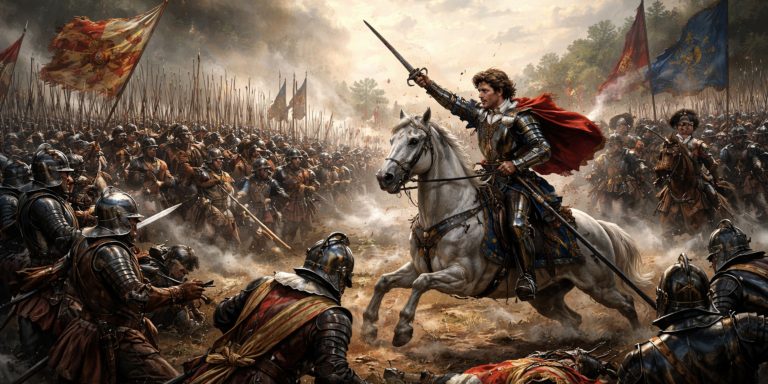
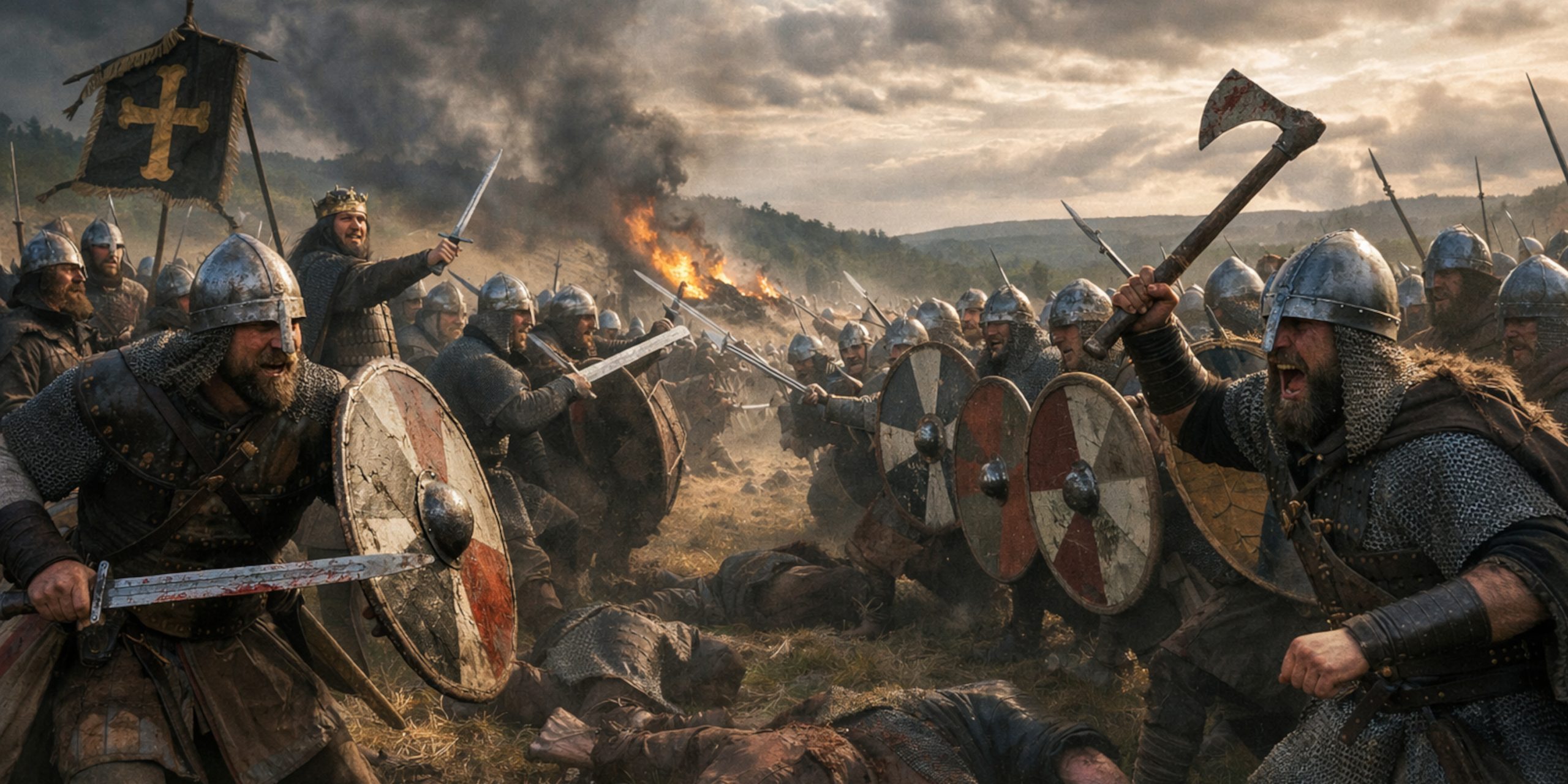
At Edington, Alfred reorganised his forces, called up the fyrd, and met Guthrum in open battle. The Anglo-Saxons held firm. The Viking shield wall broke. Guthrum retreated and later converted to Christianity.
In the show, this battle is adapted with dramatic tension and personal rivalries layered on top. Historically, it was less cinematic but far more consequential. Edington preserved Wessex as the last independent Anglo-Saxon kingdom. Without it, there is no later England to unite.
The Battle of Ashdown, 871
Before Alfred was “the Great,” he was the younger brother with something to prove.
In 871, the West Saxons faced the Great Heathen Army at Ashdown. The Viking force included leaders like Bagsecg. Alfred’s brother, King Æthelred, was technically in charge. According to the Anglo-Saxon Chronicle, Æthelred was at prayer when the battle began. Alfred took initiative.
The West Saxons won. Several Viking leaders were killed. It was a rare bright spot in a grim stretch of campaigns.
The series draws heavily from this atmosphere of constant pressure. Uhtred’s early years among competing loyalties reflect the reality of a generation that grew up knowing only war with Scandinavian forces. Ashdown showed that the Vikings were not invincible, but it also proved how fragile victory could be.
The Battle of Cynwit, 878
Cynwit is less famous but just as telling.
A Viking force led by Ubba landed in Devon. The local ealdorman Odda trapped his men on a hill fort. Instead of waiting to be starved out, the Saxons launched a surprise attack and killed Ubba.
The show blends and rearranges events, but Ubba’s presence as a terrifying, almost mythic antagonist has a solid historical foundation. His death in Devon helped relieve pressure on Alfred’s already strained kingdom.
It is one of those battles that reminds you history is not always decided by kings. Sometimes it is decided by a local commander who refuses to sit still.
The Battle of Tettenhall, 910
By the time we reach Tettenhall, Alfred is gone. His legacy, however, is very much alive.
In 910, a combined West Saxon and Mercian force crushed a major Viking army in Mercia. Several high-ranking Viking leaders were killed. The victory marked a shift from defensive survival to aggressive reconquest.
The show captures this transition well. The mood changes from scrambling to survive to strategic consolidation. What Alfred began, his successors expanded. The Danelaw did not disappear overnight, but its grip weakened.
If Edington saved Wessex, Tettenhall strengthened the foundations of a future English kingdom.
The Battle of Brunanburh, 937
Although it sits slightly beyond the core timeline of the series, Brunanburh represents the culmination of everything Alfred set in motion.
In 937, King Athelstan faced a massive coalition of Scots, Norse, and Strathclyde Britons. The battle was fierce enough to earn a lengthy poem in the Anglo-Saxon Chronicle celebrating the slaughter.
Brunanburh effectively confirmed Athelstan’s authority as king of a unified England. The show hints at this long arc. The constant question, “Can England truly exist as one kingdom?” finally receives an answer here.
It was not tidy. It was not peaceful. But it was decisive.
How The Show Blends Fact and Fiction
Uhtred of Bebbanburg is inspired loosely by a historical noble family from Northumbria, but the character himself is fictional. That creative freedom allows the narrative to weave through real events without being trapped by them.
The politics of Wessex, Mercia, and Northumbria are grounded in documented rivalry. The Viking leaders are mostly real. The shifting alliances, betrayals, and uneasy baptisms are straight out of the chronicles.
What the show does well is capture the instability of the era. Kingdoms were not permanent fixtures. They were fragile experiments. One lost battle could erase decades of power.
And that is not dramatic exaggeration. That is ninth-century reality.
Why These Battles Still Matter
Edington, Ashdown, Cynwit, Tettenhall, Brunanburh. They are not just footnotes for television scripts.
They represent the gradual emergence of a political identity that would become England. Without them, there is no later medieval kingdom, no Norman Conquest in the same form, no Plantagenets, no Tudors.
It is easy to treat Viking and Anglo-Saxon warfare as aesthetic. Cool helmets. Big axes. Moody fog. But behind every shield wall was a real decision about who ruled, who paid tribute, and who survived the winter.
Watching the show with that in mind changes everything. The drama feels less like fantasy and more like a very chaotic family argument with swords.
History rarely hands us clean narratives. The Last Kingdom trims and reshapes events for storytelling. Still, at its core, it rests on real battles fought by very determined people who had no idea they were laying foundations for a country.
Destiny may be all, but logistics, stubbornness, and a well-timed shield wall helped.