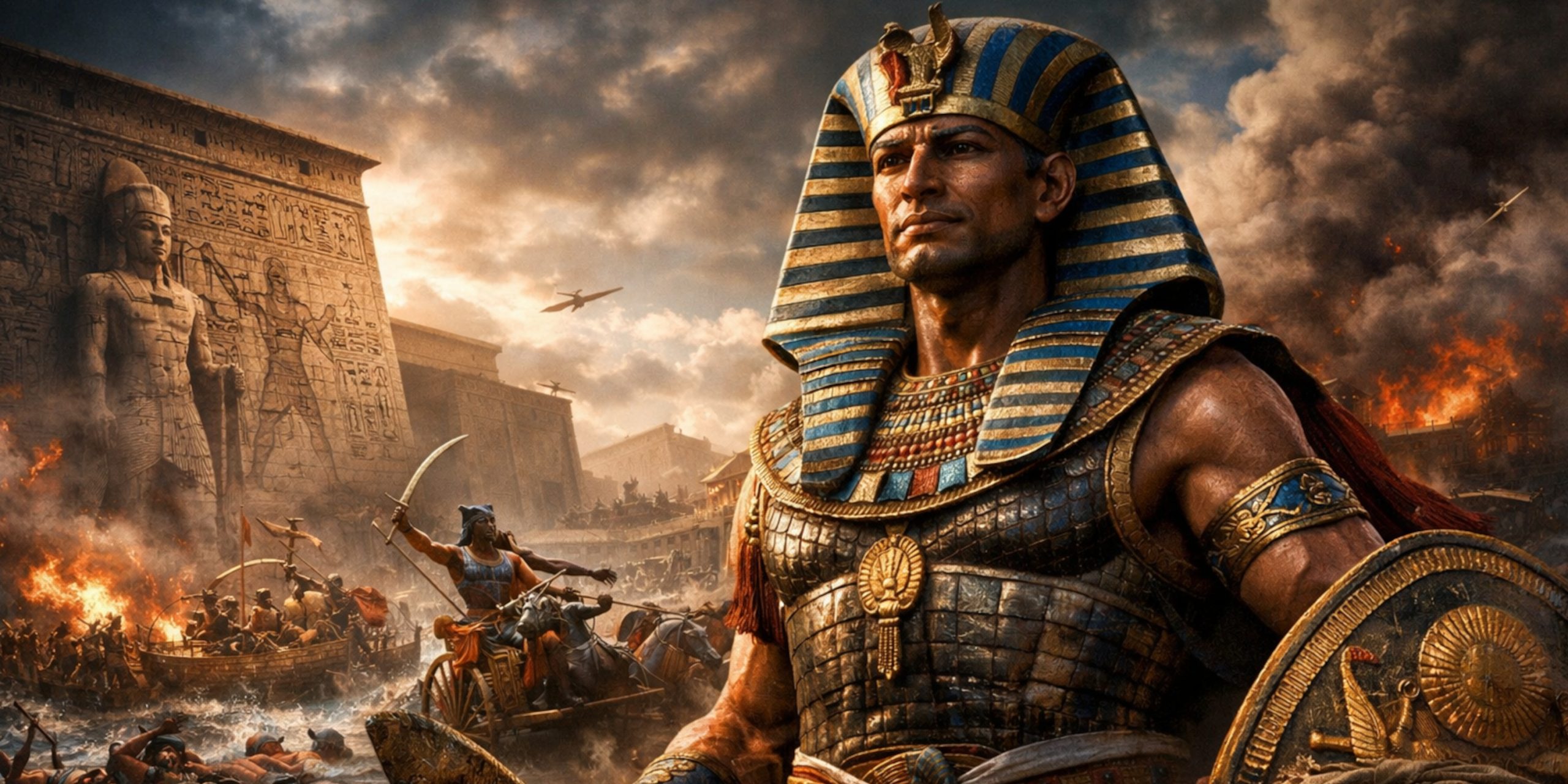
Ramesses III sits at an awkward but fascinating hinge point in Egyptian history. He ruled during the early 12th century BC, when the New Kingdom still carried imperial muscle but was already showing structural cracks. Later scribes remembered him as the last truly powerful pharaoh. Modern historians tend to agree, though often with a raised eyebrow. His reign was energetic, defensive, and relentlessly documented, which helps enormously when separating royal boast from practical achievement.
He was not an innovator in the way Thutmose III or Ramesses II had been. Instead, he was a stabiliser. He fought to keep Egypt intact at a moment when much of the eastern Mediterranean was burning, migrating, or quietly collapsing.
Historical Background and Reign
Ramesses III came to the throne around 1186 BC as the second king of the Twentieth Dynasty. Egypt he inherited was wealthy on paper but strained in practice. Long supply lines, expensive temples, and an increasingly entrenched priesthood placed constant pressure on the crown.
His reign lasted just over three decades, long enough to leave a deep paper trail. Administrative texts, temple reliefs, and legal documents give us a textured view of life under his rule. That texture includes the first recorded labour strike in history, a fact that still feels oddly modern.
Military Campaigns and Battles
Ramesses III defined his kingship through defence. His wars were not expansionist but existential, aimed at survival rather than glory.
Wars Against the Sea Peoples
The most famous conflict of his reign came in Year 8, when a coalition of migrating groups collectively labelled the Sea Peoples pushed into the eastern Mediterranean. Egypt faced a dual threat by land and sea.
At the Nile Delta, Ramesses III orchestrated a combined arms defence. Naval engagements trapped enemy ships in confined waters while archers raked decks from the shore. Reliefs at Medinet Habu show the aftermath in vivid detail, including captives counted and catalogued with bureaucratic care.
Libyan Campaigns
Earlier and later in his reign, Ramesses III fought Libyan groups pressing into western Egypt. These campaigns were smaller in scale but persistent. Victory stelae emphasise order restored rather than conquest achieved, which suggests a frontier constantly under pressure.
Military Acumen
Ramesses III was not a battlefield innovator, but he understood logistics, terrain, and timing. His decision to fight the Sea Peoples in the Delta rather than meet them at sea was shrewd. He let geography do half the work.
He also grasped the importance of morale and narrative. Victory scenes were carved at monumental scale, ensuring that success was remembered even when resources thinned later in the reign. One senses a ruler keenly aware that perception could prop up authority when material strength wavered.
Arms and Armour
Egyptian military equipment under Ramesses III reflects continuity rather than revolution.
Weapons in Use
- Composite bows with high draw weight, used extensively by archers.
- Bronze spearheads and thrusting spears for infantry formations.
- Sickle swords known as khopesh, still ceremonial but occasionally practical.
- Straight bronze swords, increasingly common as Mediterranean styles influenced Egypt.
Defensive Equipment
- Leather or linen body armour reinforced with bronze scales for elite troops.
- Large wooden shields covered in leather, often rectangular with rounded tops.
- Helmets were rare for Egyptian troops but appear among mercenaries and enemies.
Reliefs carefully distinguish Egyptian arms from those of their foes, a useful visual shorthand for identity as much as function.
Internal Challenges and Decline
Despite military successes, the home front deteriorated. Grain shortages delayed rations to royal workers at Deir el Medina, leading to the first documented strike. Court politics grew poisonous, culminating in the infamous harem conspiracy late in the reign.
Judicial papyri describe plots, trials, and executions with unsettling calm. Ramesses III survived the conspiracy in name, though modern CT scans suggest his throat was cut. If so, his final victory was purely ceremonial.
Archaeology and Latest Findings
Scientific study of Ramesses III has advanced significantly in recent decades. CT scans of his mummy revealed a deep wound to the neck, consistent with assassination. An accompanying severed toe suggests ritual violence rather than battlefield injury.
DNA analysis has linked him to the so called Unknown Man E, widely believed to be his son Pentawer, forced to commit suicide after the conspiracy failed. It is rare in Egyptian history to see political intrigue confirmed so starkly by forensic evidence.
Where to See Artefacts from His Reign
Ramesses III left behind a remarkable material legacy.
- Medinet Habu, Luxor. His mortuary temple, arguably better preserved than many more famous complexes.
- Egyptian Museum, Cairo. Statues, relief fragments, and inscriptions from his reign.
- Louvre Museum, Paris. Decorative reliefs and royal inscriptions.
- British Museum, London. Stelae and administrative texts tied to his military campaigns.
Medinet Habu remains the essential site. Walking its walls, one can trace an entire reign carved in stone, triumphs, anxieties, and all.
Legacy and Historical Assessment
As a historian, I find Ramesses III oddly sympathetic. He fought hard, governed conscientiously, and documented everything, yet still presided over decline. His reign feels like a long, stubborn holding action against forces too large to defeat permanently.
He was not the saviour of the New Kingdom, but he delayed its collapse with skill and determination. That alone earns him serious respect. When later kings faded into obscurity, Ramesses III at least left us a clear record of how hard the fight really was.
Watch the documentary: