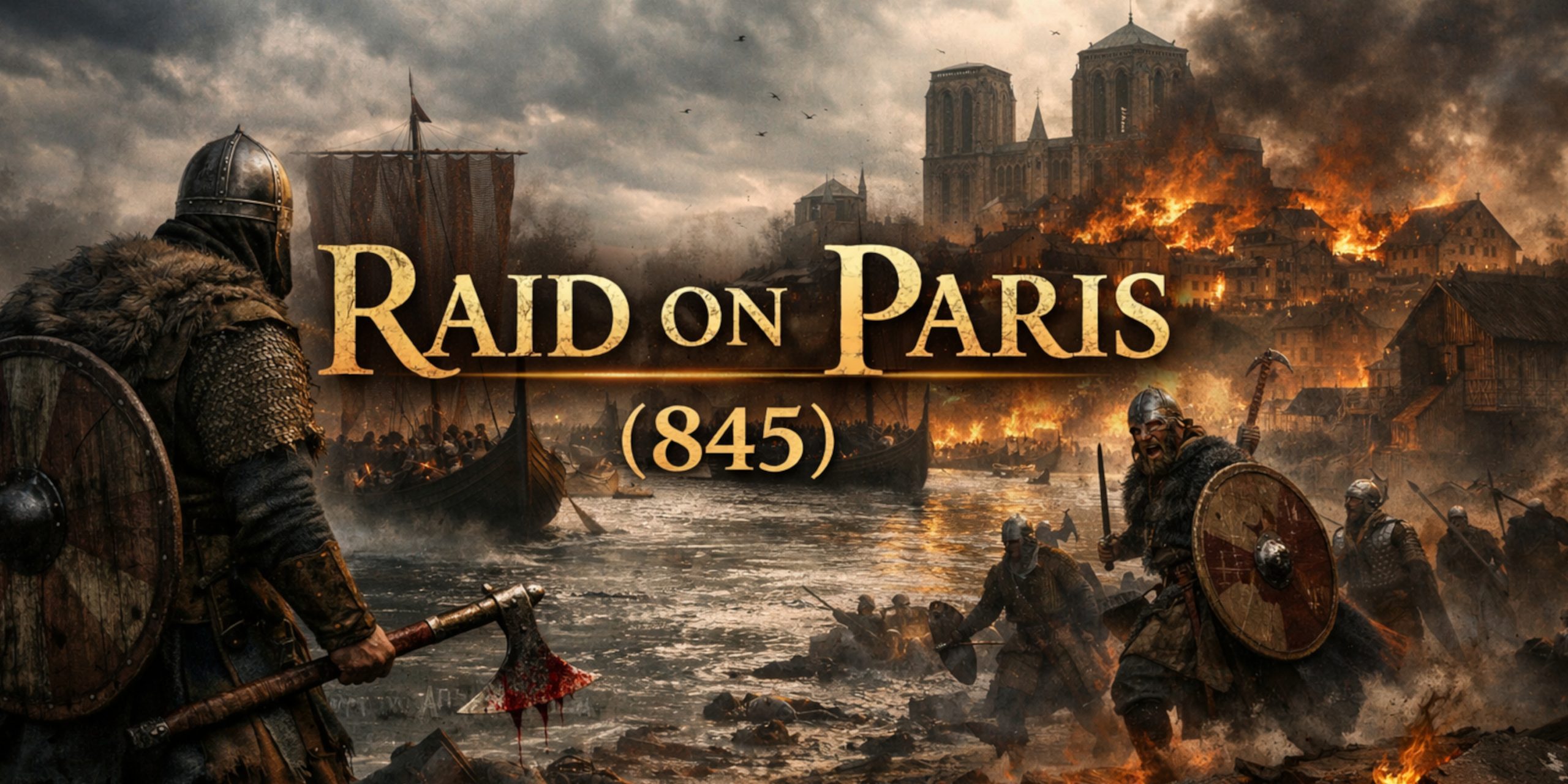
A Viking Strike That Shook a Kingdom
There are moments in early medieval history that feel almost theatrical, and the Raid on Paris in 845 is one of them. A fleet of Viking ships gliding up the Seine, a Frankish king scrambling to respond, and a city that, at least symbolically, represented the heart of Carolingian authority.
Paris at this point was not yet the grand capital we picture today. It was smaller, vulnerable, and rather exposed. Still, it mattered. Which is precisely why the Vikings chose it.
The raid is often tied, perhaps too neatly, to a figure named Ragnar. Whether this was the same legendary Ragnar of saga fame is another question entirely. Historians tend to wince slightly at that leap, and I sympathise.
Background
By the mid 9th century, Viking activity along the rivers of Western Europe had become increasingly organised. What began as coastal raids evolved into deep inland expeditions. Rivers were highways, not barriers.
The Carolingian Empire, once held together by Charlemagne, was fragmenting under his successors. Charles the Bald, ruler of West Francia, faced internal instability alongside these external threats.
The Seine offered a direct route into the political and economic core of the kingdom. The Vikings did not stumble upon Paris. They sailed there with intent.
Forces
Estimating numbers is always a delicate exercise with early medieval sources. Chroniclers had a habit of exaggeration, often dramatically.
Still, a reasonable outline can be drawn.
Viking Forces
| Element | Estimate |
|---|---|
| Ships | Around 100 to 120 longships |
| Warriors | Approximately 4,000 to 6,000 men |
| Leadership | Possibly a chieftain identified as Ragnar |
Frankish Forces
| Element | Estimate |
|---|---|
| Troops | Several regional levies, numbers unclear |
| Command | King Charles the Bald |
| Composition | Infantry levies, some mounted elite troops |
The Vikings had mobility and cohesion. The Franks had numbers, at least in theory, but coordination was another matter entirely.
Arms and Armour
Viking Equipment
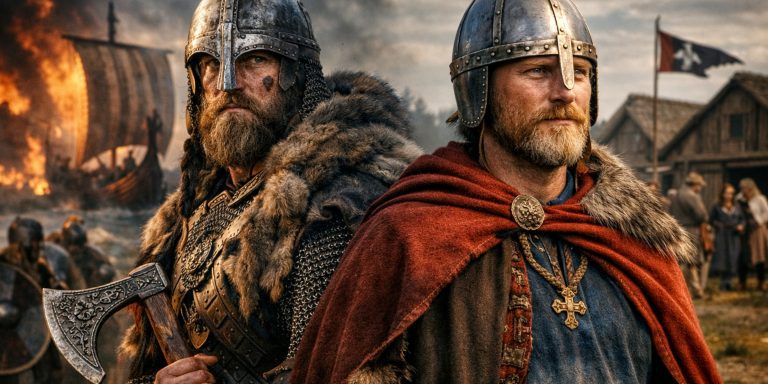
The Viking warband was not uniform, but certain patterns appear consistently.
- Swords:
- Carolingian-type swords, often pattern welded
- Petersen Type H and Type K forms are plausible for this period
- Double-edged blades designed for cutting, though capable of thrusting
- Axes:
- Broad bearded axes, versatile in both combat and utility
- Spears:
- The most common weapon, used for thrusting and throwing
- Shields:
- Round wooden shields with iron bosses
- Armour:
- Mail shirts for wealthier warriors
- Helmets were rare but present among elites
Frankish Equipment
Frankish forces were more varied, reflecting a stratified society.
- Swords:
- High-quality Frankish blades, often superior in metallurgy
- Spatha-derived forms still in use
- Spears and Lances:
- Standard issue for infantry and cavalry
- Axes:
- Less dominant than among Vikings, but still present
- Armour:
- Mail hauberks among elite warriors
- Conical helmets with nasal guards
- Cavalry Gear:
- Saddles and stirrups allowed for more effective mounted combat
There is a slightly uncomfortable irony here. Many Viking swords were likely made in Frankish lands, then used against them.
Leaders and Troop Composition
Viking Leadership
- A chieftain referred to as Ragnar in later traditions
- Command structure based on loyalty rather than rigid hierarchy
- Warbands organised around experienced captains
Frankish Leadership
- Charles the Bald, king of West Francia
- Regional counts and nobles commanding local levies
- Fragmented command, often reacting rather than coordinating
Composition Overview
- Vikings
- Professional raiders
- Highly mobile riverine force
- Experienced in siege intimidation rather than formal siegecraft
- Franks
- Feudal levies with uneven training
- Some elite cavalry units
- Defensive posture, divided forces along the Seine
Charles made a critical error. He split his army to defend multiple crossing points. The Vikings defeated these forces in detail.
The Raid: Battle Timeline
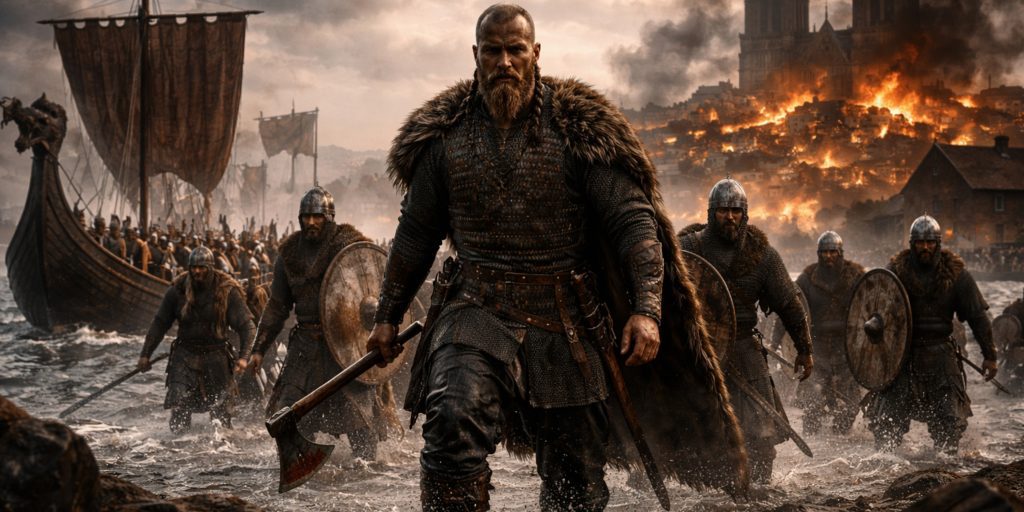
Early Spring, 845
The Viking fleet enters the Seine and advances inland with minimal resistance.
Approach to Paris
Frankish forces attempt to block river crossings. One contingent is overwhelmed. Accounts describe a grim display of executed prisoners, likely intended as psychological warfare.
Siege and Assault
Paris is attacked. The city lacks the fortifications that would later define it. Resistance is brief and ultimately ineffective.
Sack of the City
The Vikings loot extensively. Churches and monasteries are particular targets, both for wealth and symbolic value.
Payment of Tribute
Charles the Bald negotiates. A ransom of around 7,000 livres of silver is paid to secure the Viking withdrawal.
Withdrawal
The Vikings depart, though not without suffering losses, possibly from disease. Even raiders are not immune to poor sanitation and riverbank living.
Archaeology
Archaeological evidence for the raid itself is limited, which is not unusual for events of this nature.
- Few direct destruction layers in Paris can be definitively tied to 845
- Riverine archaeology along the Seine has revealed Viking activity, including ship remains and artefacts
- Hoards of Carolingian silver in Scandinavia suggest the movement of wealth taken during such raids
What we have is a blend of material hints and written accounts. Neither is complete, but together they sketch a convincing picture.
Contemporary Accounts
The primary written source is the Annals of St Bertin, which provides a near-contemporary narrative.
“The Northmen came to Paris and laid it waste.”
Concise, almost brutally so. Medieval chroniclers did not always indulge in flourish when devastation spoke for itself.
Another tradition claims that Ragnar, upon returning home, boasted of his success. Whether this reflects reality or later storytelling is difficult to pin down.
There are also references to a disease afflicting the Vikings after the raid, sometimes interpreted as divine punishment. Medieval writers had a fondness for that explanation.
Aftermath and Significance
The raid exposed a fundamental weakness in the Carolingian system. Wealthy centres along rivers were vulnerable, and royal authority struggled to respond quickly.
Paying tribute set a precedent. It solved the immediate problem but encouraged future raids. One can almost hear the Vikings taking notes.
In the longer term, these repeated incursions forced changes in defence.
- Fortifications along rivers improved
- Local lords gained more autonomy in defence
- The foundations were laid for later fortified Paris, particularly on the Île de la Cité
By the time of the famous siege in 885, the city would be far better prepared.
Seven Swords Takeaway
The Raid on Paris in 845 is not just a dramatic episode. It is a turning point that reveals how fragile early medieval kingdoms could be when faced with organised, mobile raiders.
There is also something quietly telling in Charles the Bald’s decision to pay. It was not cowardice. It was pragmatism, perhaps the only viable option at the time.
Still, it must have stung. Paying invaders to leave your capital is not the sort of legacy a king hopes for.
History, as ever, has a dry sense of humour about these things.