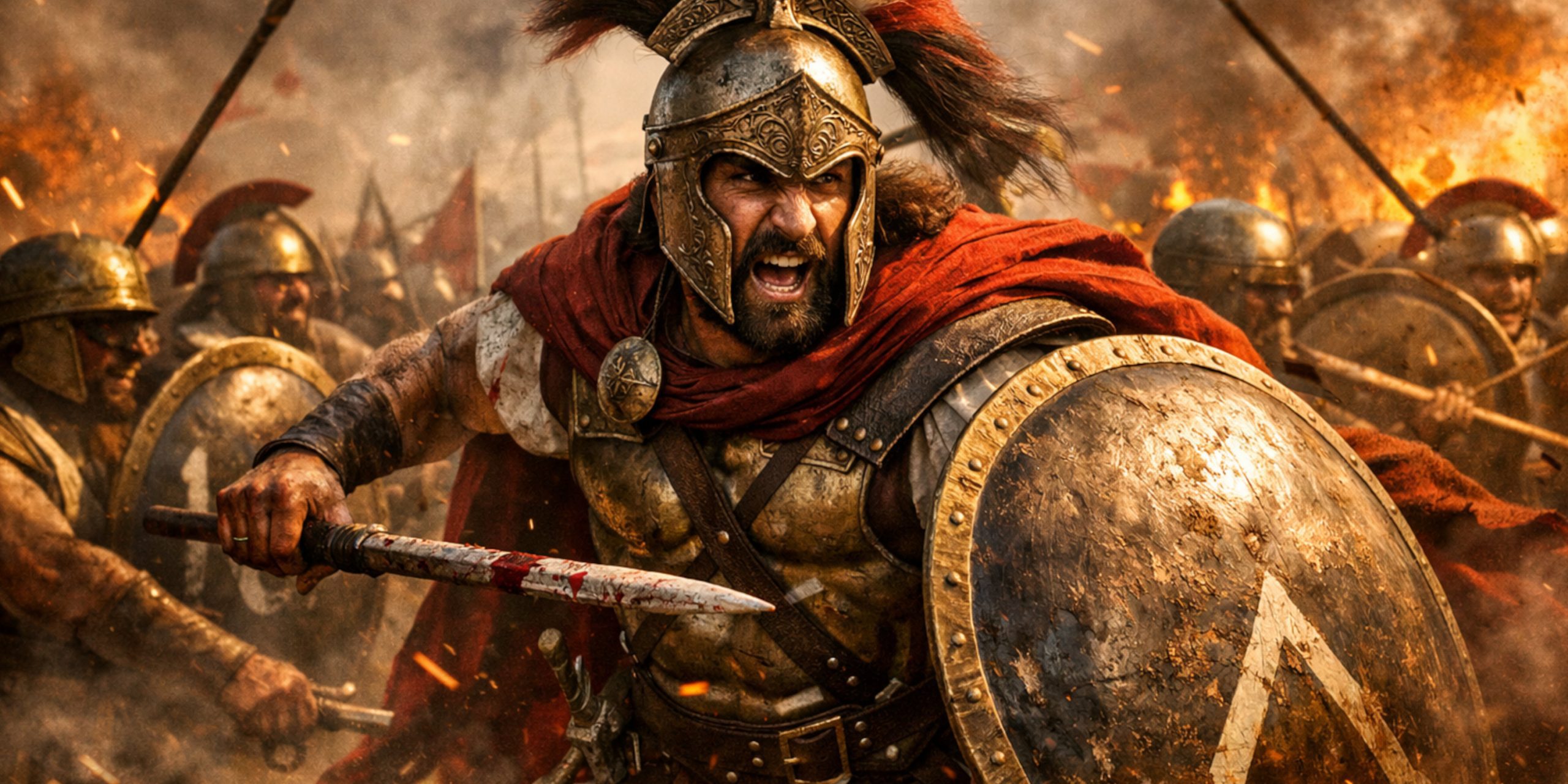
Pelopidas is one of those ancient commanders who somehow manages to stand in the shadow of his own friend. Ask most people about Thebes in the fourth century BC and they will mention Epaminondas. Fair enough. Epaminondas was a military genius. Yet Pelopidas was the man who made much of that genius possible.
He was the daring conspirator who helped overthrow Spartan control of Thebes, the commander of the Sacred Band, the diplomat who held together fragile alliances, and the battlefield leader whose courage was sometimes magnificent and occasionally, one suspects, just a little reckless.
Ancient writers describe him as brave, charismatic and intensely loyal. He had none of the cool, philosophical detachment often associated with Epaminondas. Pelopidas was a man of action. One gets the impression that if there was a dangerous mission requiring stealth, speed and a willingness to walk into a room full of armed enemies, Pelopidas would already be halfway through the door.
Who Was Pelopidas?
Pelopidas was born into a wealthy Theban family around 410 BC. He grew up during one of the most bitter periods in Greek history, when the Greek world was still recovering from the Peloponnesian War.
Thebes had briefly allied with Sparta, then fallen under Spartan domination. In 382 BC Spartan troops seized the Cadmea, the citadel of Thebes, and installed an oligarchic government loyal to Sparta. For proud Thebans this was a humiliation of the first order.
Pelopidas went into exile in Athens along with other anti-Spartan Thebans. In 379 BC he returned in disguise with a small group of fellow exiles. According to Plutarch, they entered Thebes secretly, infiltrated the houses of the Spartan-backed leaders, and killed them. It sounds less like a constitutional reform and more like the opening act of a rather violent political thriller.
The coup succeeded. Thebes rose against the Spartan garrison, the Cadmea was surrounded, and Spartan authority in Boeotia began to crumble.
Pelopidas and the Sacred Band
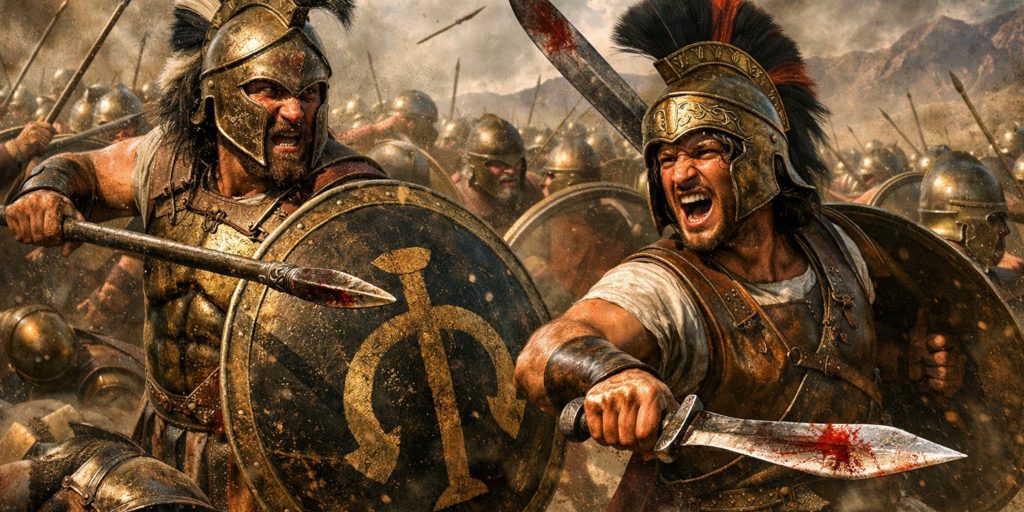
Pelopidas is closely associated with the Sacred Band of Thebes, one of the most famous elite military units of the ancient world.
The Sacred Band consisted of 300 chosen soldiers, traditionally organised into 150 pairs of male companions. Ancient writers believed that soldiers who loved and trusted one another would fight more fiercely and refuse to abandon their partner in battle.
Whatever one thinks of the theory, the results were formidable.
Under Pelopidas the Sacred Band became the cutting edge of the Theban army. Highly trained, heavily armed and disciplined, they were often placed at the decisive point of the battlefield. Spartan hoplites had spent generations terrifying the rest of Greece. Then they met the Sacred Band and discovered, to their horror, that someone had finally read the instructions and decided to fight back properly.
Character and Personality
Ancient accounts present Pelopidas as generous, fearless and deeply devoted to his friends. Plutarch contrasts him with Epaminondas.
- Epaminondas was thoughtful, restrained and philosophical.
- Pelopidas was fiery, impulsive and drawn to action.
- Epaminondas preferred careful planning.
- Pelopidas often relied on boldness and personal leadership.
That partnership worked remarkably well. Together they transformed Thebes from a city under occupation into the dominant power in Greece.
There is something undeniably attractive about Pelopidas as a historical figure. He was not merely a strategist directing troops from a safe distance. He fought in the front ranks, shared danger with his men, and inspired loyalty through personal example. The drawback, of course, is that commanders who spend too much time in the front line have a worrying tendency to die there.
Arms and Armour
Pelopidas fought as a Greek hoplite and would have worn the equipment typical of an elite Theban noble and officer.
Pelopidas’ Likely Equipment
| Equipment | Description |
|---|---|
| Helmet | A bronze Boeotian or Corinthian-style helmet, perhaps with a crest indicating rank |
| Body Armour | Bronze cuirass or linen thorax reinforced with metal scales |
| Shield | Large round hoplon bearing Theban or Boeotian symbols |
| Spear | Doru, around 7 to 9 feet long, used as the main battlefield weapon |
| Sword | Xiphos for thrusting, or possibly a kopis for cutting in close combat |
| Greaves | Bronze greaves protecting the lower legs |
| Cloak | Dark military cloak, probably practical rather than decorative |
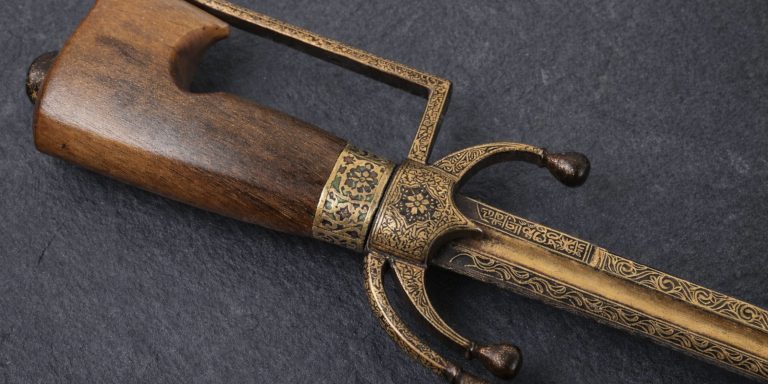
The spear remained the main weapon in hoplite warfare. Swords were secondary arms, used when formations collapsed into close combat. Elite Thebans such as Pelopidas may have favoured the kopis, a forward-curving sword capable of brutal chopping blows. It had all the subtlety of being hit with a bronze meat cleaver.
Sword Types Used by Pelopidas and the Sacred Band
| Sword Type | Description | Use |
| Xiphos | Straight, double-edged Greek short sword | Used for thrusting once the spear was lost or broken |
| Kopis | Curved, heavy chopping sword | Favoured by cavalry and some elite infantry |
| Machaira | Similar to the kopis but slightly lighter | Effective in close, chaotic fighting |
Archaeological finds from Boeotia and other Greek sites suggest that Theban warriors used both xiphoi and curved cutting swords. The Sacred Band, as an elite unit, almost certainly carried high-quality equipment.
Military Skill and Tactical Ability
Pelopidas was not simply a brave warrior. He was an unusually capable commander.
His strengths included:
- Rapid movement and surprise
- The use of elite troops at decisive moments
- Strong personal leadership
- The ability to inspire confidence in allies
- Effective cooperation with Epaminondas
He was particularly effective in smaller, aggressive actions. He excelled at raids, cavalry engagements and sudden attacks. Ancient sources repeatedly show him acting quickly before opponents had time to react.
Unlike many Greek generals, Pelopidas also understood the importance of diplomacy. He travelled repeatedly across Greece and even into Persia to secure alliances for Thebes.
He lacked the wider strategic brilliance of Epaminondas, but he was often the sharper political operator and perhaps the more charismatic public figure.
The Battle of Tegyra
One of Pelopidas’ greatest achievements came at the Battle of Tegyra in 375 BC.
Pelopidas and the Sacred Band found themselves heavily outnumbered by a Spartan force near the town of Tegyra. Conventional Greek military wisdom suggested that this was an excellent time to retreat.
Pelopidas disagreed.
Instead, he formed his men into a dense column and attacked directly. The Sacred Band smashed through the Spartan line and won a remarkable victory.
This was one of the first occasions in which a Spartan force had been defeated in open battle by a smaller enemy army.
Why Tegyra Mattered
- It shattered the myth of Spartan invincibility.
- It proved the effectiveness of the Sacred Band.
- It gave Thebes enormous confidence.
- It foreshadowed the larger victory at Leuctra.
The Battle of Leuctra
Although Epaminondas is usually given the credit for the tactics at Leuctra in 371 BC, Pelopidas played a central role.
At Leuctra the Thebans faced the Spartan army under King Cleombrotus. The Spartan line was traditionally arranged with the strongest troops on the right.
Epaminondas concentrated the Theban left into an unusually deep formation. Pelopidas and the Sacred Band were placed at the crucial point of attack.
When battle began, the Sacred Band struck the Spartan elite. The Spartan line collapsed, Cleombrotus was killed, and the myth of Spartan supremacy finally died on the Boeotian plain.
There are few moments in Greek history more dramatic. Sparta had dominated Greece for decades. Then, in a single afternoon, a Theban general and three hundred extremely determined men changed the political map of the Greek world.
Campaigns in Thessaly and Macedonia
After Leuctra, Pelopidas spent much of his career campaigning in northern Greece.
Thessaly was in chaos, dominated by the tyrant Alexander of Pherae. Pelopidas intervened repeatedly, supporting Theban allies and trying to stabilise the region.
He also travelled to Macedonia, where he became involved in the politics of the Macedonian royal family.
During one visit he took the young Philip, later Philip II of Macedon, as a hostage to Thebes. Philip spent several years there and almost certainly learned from Theban tactics and military organisation.
This is one of history’s more irritating little ironies. Pelopidas helped create the conditions in which Philip II and his son Alexander the Great would eventually overshadow every Greek city, including Thebes itself.
Capture and Release
In 368 BC Pelopidas was captured by Alexander of Pherae during a campaign in Thessaly.
The loss was a serious blow to Thebes. Even his enemies respected him enough to keep him alive.
Epaminondas eventually led a campaign that secured his release. Ancient writers treat this as proof of the extraordinary bond between the two men.
Their friendship is one of the more compelling partnerships in ancient history. Without Epaminondas, Pelopidas might never have become the champion of Thebes. Without Pelopidas, Epaminondas might have remained merely a gifted thinker with nobody to carry out his plans.
Death at Cynoscephalae
Pelopidas died in 364 BC at the Battle of Cynoscephalae in Thessaly.
He led his troops against Alexander of Pherae and won the battle, but in the heat of the fighting he charged too far ahead and was killed.
It was an end entirely in keeping with his character. Pelopidas had always led from the front. Ancient authors describe the grief of the Theban army when his body was recovered.
The victory was won, but at a heavy price.
Plutarch writes that the soldiers mourned him not simply as a commander but as a friend.
Major Battles of Pelopidas
| Battle | Date | Result | Importance |
| Liberation of Thebes | 379 BC | Victory | Ended Spartan domination of Thebes |
| Tegyra | 375 BC | Victory | First major defeat of Spartans by smaller force |
| Leuctra | 371 BC | Victory | Destroyed Spartan supremacy |
| Thessalian Campaigns | 370s BC | Mixed | Expanded Theban influence in northern Greece |
| Cynoscephalae | 364 BC | Victory, Pelopidas killed | Final defeat of Alexander of Pherae |
Ancient Views of Pelopidas
Plutarch, himself a Boeotian writing centuries later, admired Pelopidas enormously.
“Pelopidas was of a noble temper, eager for honour, and ready for action.”
Elsewhere he describes him as:
“A man who sought danger not from rashness but from courage.”
Cornelius Nepos praised his military ability and regarded him as one of the greatest commanders of Greece.
Even hostile or cautious sources admit that Pelopidas possessed extraordinary personal bravery.
Artefacts and Where to See Them
No object can be identified with certainty as belonging personally to Pelopidas. Ancient generals were rarely buried with labelled helmets obligingly reading ‘Property of Pelopidas, please return to Thebes’.
However, there are several important artefacts and sites associated with his world.
Important Artefacts and Museums
| Artefact or Site | Location | Why It Matters |
| Boeotian helmets and armour | entity[“point_of_interest”,”National Archaeological Museum of Athens”,”Athens, Greece”] | Displays examples of fourth-century BC Greek military equipment similar to that used by Pelopidas |
| Sacred Band lion monument | entity[“point_of_interest”,”Chaeronea Lion”,”Chaeronea, Boeotia, Greece”] | Monument marking the burial place of the Sacred Band, though erected after Pelopidas’ death |
| Theban military artefacts | entity[“point_of_interest”,”Archaeological Museum of Thebes”,”Thebes, Boeotia, Greece”] | Contains finds from fourth-century BC Boeotia, including weapons and armour |
| Battlefield finds from Leuctra | entity[“point_of_interest”,”Archaeological Collection of Thebes”,”Thebes, Boeotia, Greece”] | Includes material connected with the era of Theban power |
The Lion of Chaeronea deserves special mention. It commemorates the Sacred Band, destroyed decades after Pelopidas at the Battle of Chaeronea in 338 BC. Standing before it, one can almost feel the shadow of the older Theban generation who first made that elite force famous.
Latest Archaeology and Recent Discoveries
Recent archaeological work in Boeotia has improved our understanding of the Theban world in which Pelopidas lived.
Excavations around ancient Thebes and Boeotia have uncovered:
- Fourth-century BC defensive walls and fortifications
- Burial sites containing hoplite equipment
- Bronze spearheads, sword fragments and shield fittings
- Inscriptions relating to Theban political institutions
- New evidence for the scale and wealth of Thebes after Leuctra
Particular attention has focused on the area around Leuctra and Thebes, where archaeologists continue to study battlefield landscapes and military remains.
Recent work at the Sacred Band burial site at Chaeronea has also refined understanding of elite Theban warfare. Analysis of the remains suggests the soldiers fought in close formation and died where they stood, which rather reinforces the impression that the Sacred Band were not inclined to retreat under any circumstances.
Archaeologists have also continued to study Theban tombs and sanctuaries, revealing more about the wealth and military culture of fourth-century BC Boeotia. Finds of fine armour, imported pottery and dedicatory offerings suggest that leading Theban nobles such as Pelopidas belonged to a wealthy and highly connected elite.
Legacy
Pelopidas changed the history of Greece.
Without him there might have been no liberation of Thebes, no Sacred Band at its height, and perhaps no victory at Leuctra.
He helped break Spartan dominance and create a new balance of power. In doing so, he also shaped the world that produced Philip II and Alexander the Great.
Yet he is often overshadowed by Epaminondas and by the later Macedonians. That is a little unfair.
Pelopidas was one of the finest soldiers and political leaders of his age: brave, intelligent, charismatic and occasionally gloriously reckless.
Ancient Greece produced many generals. Few changed the course of history with such speed, and fewer still did it while charging directly into the thickest part of the battle.
Further Reading
- Plutarch, Life of Pelopidas
- Xenophon, Hellenica
- Cornelius Nepos, Pelopidas
- Victor Davis Hanson, The Soul of Battle
- Paul Cartledge, The Spartans
- John Buckler, The Theban Hegemony