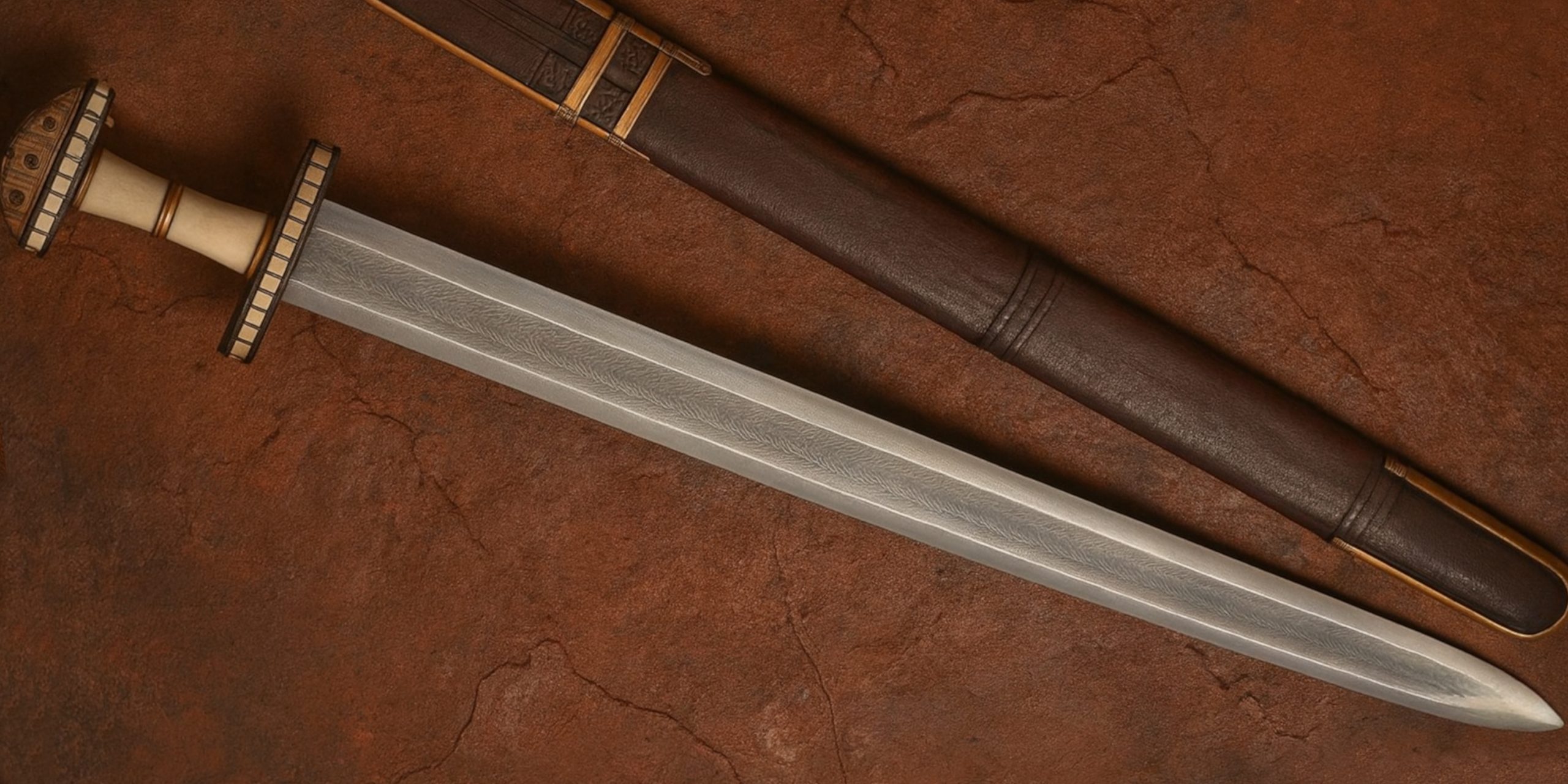
The Merovingian spatha sits at a turning point in early medieval European warfare. It bridges the long Roman tradition of the spatha with the emerging sword cultures of the Franks and later Carolingians. What survives in graves across France, Germany and the Low Countries reveals a weapon valued for reach, control and status. The blade is usually long and slender, the hilt simple but dependable and often decorated with subtle inlays or patterned iron. It speaks of a society in transition, where military identity was tied to personal equipment and where the warrior class was beginning to define itself through the sword it carried.
Specification
| Feature | Typical Details |
|---|---|
| Overall length | 85 to 100 cm |
| Blade length | 70 to 90 cm |
| Blade width | 4 to 6 cm |
| Blade cross section | Lenticular or very shallow diamond |
| Fuller | Often single broad fuller, sometimes no fuller |
| Grip | Short organic grip of wood or bone |
| Guard | Straight, usually narrow |
| Pommel | Disc, multi piece or trilobate types in later examples |
| Weight | 1.0 to 1.3 kg |
Key points
• Broad, relatively thin blade suited to slashing.
• Enough point control for basic thrusting.
• Hilts kept functional rather than ornate in most examples.
History and Evolution
The Merovingian spatha grew from the late Roman cavalry sword which emphasised reach from horseback. By the fifth century, Germanic artisans adapted the form with local hilt types and their own forging habits including pattern welding. Early Merovingian graves show strong continuity with Roman forms, but by the sixth and seventh centuries the blade becomes slightly broader, fullers become more consistent and the pommel types diversify. Some swords include gold or silver foils on the pommel plates which suggests growing warrior status culture.
The transition into the eighth century sees the spatha gradually reshaped into the recognisable Carolingian or early Viking Age sword. Blades become more standardised in length and cross section, hilts grow more substantial and pattern welding becomes less common as steel making improves. The Merovingian spatha is therefore one of the clearest stepping stones between the classical cavalry sword and the high medieval arming sword.
Advantages and Disadvantages
Advantages
• Long reach suitable for mounted combat.
• Effective cutting capability due to blade length and width.
• Light in the hand for its size which gives good battlefield stamina.
• Often produced with pattern welded cores which improved resilience.
Disadvantages
• Narrow tangs limit extreme force during powerful thrusts.
• Hilts can feel small to modern hands and lack later ergonomic shaping.
• Blade rigidity varies widely due to inconsistent early medieval steel quality.
• Not optimised for heavy armour which becomes more relevant in later centuries.
Comparison with Similar Weapons
| Weapon | Similarities | Differences |
|---|---|---|
| Late Roman spatha | Similar length and cavalry origin | Merovingian types add fuller use, local hilt styles and more decoration |
| Early Viking sword | Similar cutting focus and broad blade | Viking hilts are heavier, grip is more controlled and blades more uniform |
| Migration Period swords | Similar pattern welded construction | Merovingian pieces tend to be longer and slightly more standardised |
| Anglo Saxon spatha | Close cousins in form | Anglo Saxon examples often have more elaborate pommel plates |
General perspective
• The Merovingian spatha is an evolutionary midpoint.
• It keeps the long cut oriented blade while introducing the beginnings of early medieval sword aesthetics.
Legacy
The spatha helped shape European sword design for centuries. It informed the Carolingian and Viking typologies which then influenced the Norman arming sword. Many iconic medieval swords trace their proportions back to Merovingian examples. It also contributes heavily to our understanding of elite identity during the early medieval period since these swords appear regularly in male burials. The frequency of finds shows that the sword had already become a social marker rather than a purely military tool.
Where to See Merovingian Spathae
• Musée de l’Armée, Paris displays several early medieval blades from Merovingian Francia.
• Rheinisches Landesmuseum, Bonn holds notable pattern welded specimens.
• British Museum, London has Migration Period and Merovingian related pieces in the Early Medieval Europe gallery.
• Romano Germanic Museum, Cologne showcases regional Frankish swords from the sixth and seventh centuries.
• Museum of Frankfurt houses several richly decorated hilts and pommel sets.
Collectors Guide
Availability
Genuine Merovingian swords are extremely rare on the open market. Most complete examples are in museum collections. What appears for sale is usually fragmentary or from older private holdings. Provenance documentation is essential or the item will not be taken seriously.
Market Characteristics
• Pattern welded fragments are the most common offerings.
• Complete hilts are highly sought after and command strong prices.
• Conservation quality affects value more than minor ornamentation.
Typical Auction Prices
| Item Type | Estimated Price Range |
|---|---|
| Blade fragment | 800 to 2,000 GBP |
| Pattern welded section | 1,500 to 4,000 GBP |
| Partial hilt with pommel | 4,000 to 10,000 GBP |
| Near complete sword | 15,000 to 40,000 GBP depending on provenance |
| Fully authenticated high grade example | 50,000 GBP and above |
Guidance for buyers
• Verify provenance and export permits.
• Check for modern restoration that might affect authenticity.
• Seek metallurgical reports when available since pattern welded pieces vary widely in composition.
• Expect long gaps between opportunities since legitimate examples are scarce.