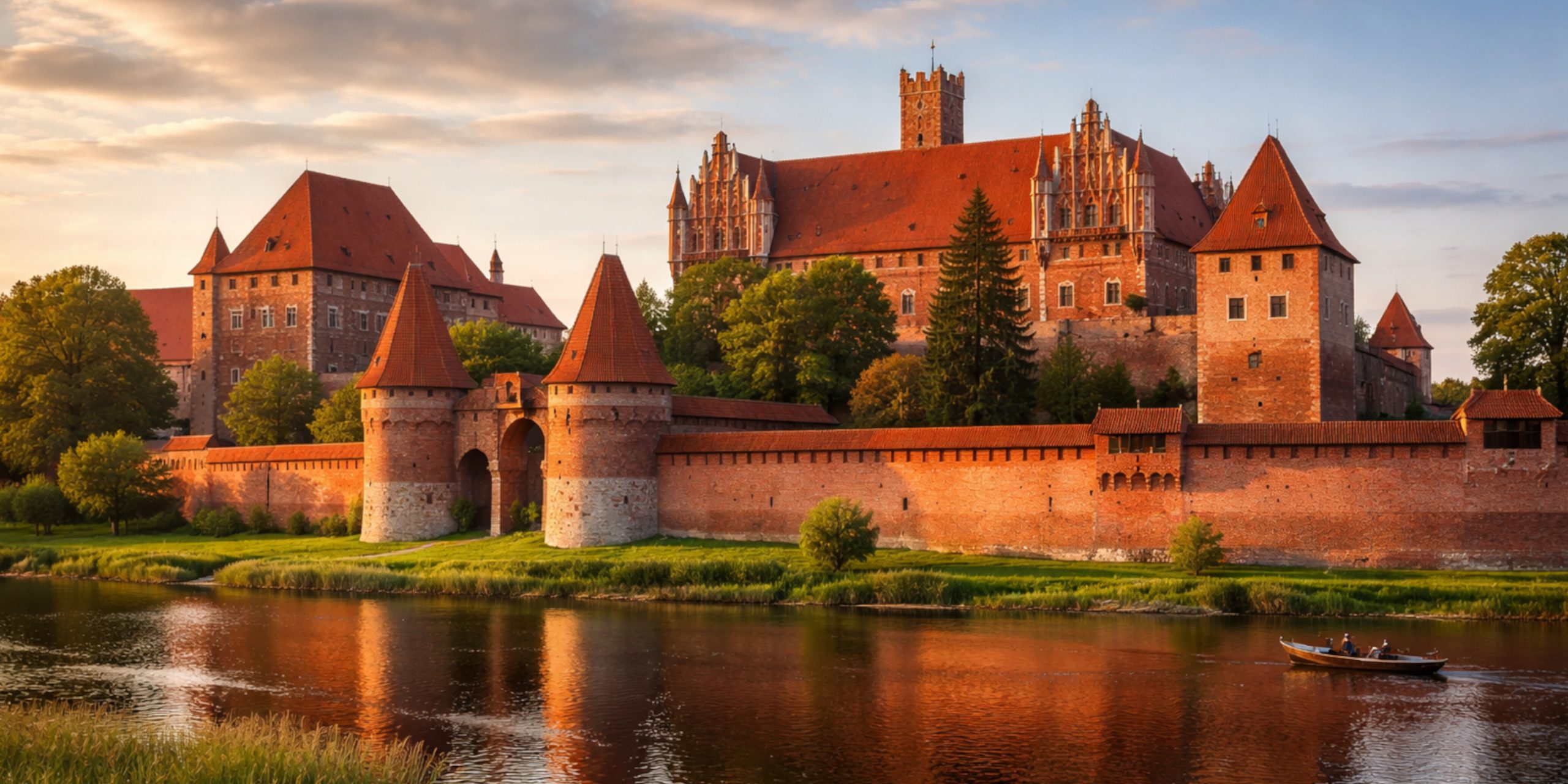
Malbork Castle sits on the banks of the Nogat River like a statement of intent. It is vast, unapologetically defensive, and built almost entirely of brick in a landscape that offered little else. Founded by the Teutonic Order in the late thirteenth century, it became the largest castle complex in the world by surface area and the political heart of a crusading state that most people forget once existed.
It is not a romantic ruin. It is a machine, designed for administration, warfare and control. Even now, wandering through its courtyards, one gets the sense that it was built less for comfort and more for obedience.
Origins and Construction
The castle was founded around 1274 by the Teutonic Knights, a military order originally formed during the Crusades. Their mission in Prussia was to convert and subdue the Baltic pagan populations, a task they pursued with a mixture of zeal and administrative efficiency.
By 1309, the Grand Master of the Order relocated his seat from Venice to Malbork, transforming it into the capital of a powerful monastic state. Expansion followed rapidly. The complex grew into three distinct sections:
- The High Castle, a monastic and spiritual core
- The Middle Castle, housing the Grand Master and administrative functions
- The Outer Bailey, devoted to workshops, stables and the everyday machinery of war
Brick was the material of necessity rather than choice. Northern Poland lacked good building stone, so the Knights turned clay into a symbol of permanence. The result is strangely elegant, though one suspects the elegance was incidental.
The Teutonic Order at Its Height
At its peak in the fourteenth century, Malbork was not simply a fortress. It was the administrative centre of a disciplined and wealthy order. Grain, amber and trade routes flowed through its halls, funding further campaigns and construction.
The Knights lived under monastic rules, though the scale of their headquarters suggests a flexible interpretation of austerity. The Grand Master’s Palace in particular feels less like a monk’s dwelling and more like a carefully curated display of authority.
Contemporary chroniclers occasionally marvelled at the scale of the place. One visitor noted that it seemed “more a city enclosed by walls than a single castle,” which is about as close as medieval understatement gets to awe.
Major Sieges and Conflicts
Malbork was tested repeatedly, and not always with success.
The Great Siege of 1410
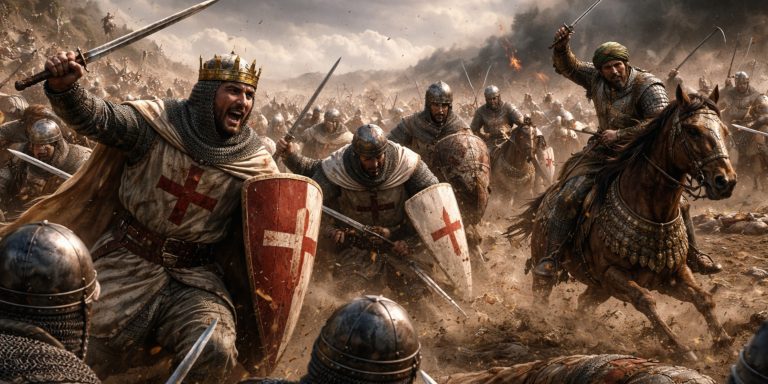
Following the decisive defeat of the Teutonic Order at the Battle of Grunwald, Polish and Lithuanian forces advanced on Malbork. The castle endured a prolonged siege under Grand Master Heinrich von Plauen.
Despite the Order’s catastrophic losses in the field, Malbork held. Strong defences, disciplined logistics and sheer stubbornness turned what should have been a final blow into a costly stalemate for the attackers.
A Polish chronicler lamented that the fortress was “too well provisioned and too well commanded,” which reads like reluctant admiration.
The Thirteen Years’ War
By the mid fifteenth century, the Order’s grip on the region was weakening. During the Thirteen Years’ War, Malbork changed hands in a manner that feels almost anticlimactic for such a formidable stronghold.
In 1457, unpaid mercenaries sold the castle to the Polish Crown. It is an oddly human ending to centuries of crusading ambition, the grand fortress reduced to a financial transaction.
Later Conflicts
The castle continued to play a role in regional warfare, including conflicts with Sweden in the seventeenth century. Its defences evolved, though artillery was steadily making medieval walls less decisive.
Occupants Timeline
Teutonic Order, c.1274 to 1457
- Founders and primary occupants
- Seat of the Grand Master from 1309
- Centre of a powerful crusading state
Polish Crown, 1457 to 1772
- Royal residence and administrative centre
- Integrated into the Kingdom of Poland
- Adapted for changing military needs
Prussian and German Control, 1772 to 1945
- Incorporated into Prussia after the First Partition of Poland
- Romantic restoration in the nineteenth century
- Used symbolically by the German state
Modern Poland, 1945 to Present
- Severely damaged during the Second World War
- Carefully reconstructed
- Now a UNESCO World Heritage Site and museum
Architecture and Defensive Design
Malbork’s design reflects a layered approach to defence. Each section of the castle could function independently if needed, forcing attackers to fight through multiple fortified zones.
Key features include:
- Thick brick curtain walls reinforced with towers
- Gatehouses with controlled access and killing zones
- Elevated walkways allowing defenders to move quickly
- Extensive storage for food and supplies, essential during sieges
The High Castle in particular is a fortress within a fortress. If you reached it, you had already done something impressive, though your prospects remained poor.
Archaeology and Restoration
The castle has undergone extensive archaeological work, particularly following the devastation of the Second World War. Much of what stands today is the result of careful reconstruction based on historical records, surviving fabric and excavation evidence.
Archaeologists have uncovered:
- Foundations of earlier building phases
- Artefacts related to daily life, including tools, ceramics and weapon fragments
- Evidence of trade networks, such as imported goods from across Europe
The nineteenth century restoration, led by German conservators, was driven partly by romantic nationalism. After 1945, Polish efforts focused on accuracy and preservation, though inevitably some interpretation was required. No medieval builder left a neat instruction manual.
Life Inside the Castle
Daily life at Malbork balanced discipline with practicality. The Knights followed a monastic routine of prayer, meals and duties, though the scale of administration required a large supporting population.
Within the walls you would have found:
- Knights and clergy
- Craftsmen and labourers
- Servants and administrators
- Visiting merchants and envoys
Meals were taken in large communal halls. Records suggest a diet that was hearty rather than refined, though the Grand Master’s table likely enjoyed certain privileges. Even in a monastic order, hierarchy has its perks.
Decline and Changing Role
By the late medieval period, the strategic value of castles like Malbork was fading. Gunpowder weapons altered siege warfare, and political power shifted away from military orders toward emerging states.
The Teutonic Order never fully recovered from its defeat at Grunwald. Malbork’s eventual transfer to Poland marked the end of its role as the centre of an independent crusading state.
It remained important, but no longer dominant. A subtle but telling distinction.
Legacy
Malbork Castle stands today as one of the most impressive medieval fortifications in Europe. It is a reminder of a period when faith, warfare and administration were tightly interwoven, and when a religious order could wield power comparable to a kingdom.
Modern visitors often arrive expecting a castle and leave having explored something closer to a fortified city. It is large enough to make you question your sense of scale, and organised enough to remind you that it was built with purpose, not spectacle.
As one nineteenth century observer remarked, it is “a monument not only of strength, but of persistence.” That feels about right.
Takeaway
Malbork is not subtle. It was never meant to be. It was designed to dominate its surroundings and to project authority across a contested frontier.
What remains today is both original and reconstructed, practical and symbolic. A place where brick was turned into power, and where history, rather inconveniently, refused to stay tidy.
If castles are meant to tell stories, Malbork tells them at full volume.