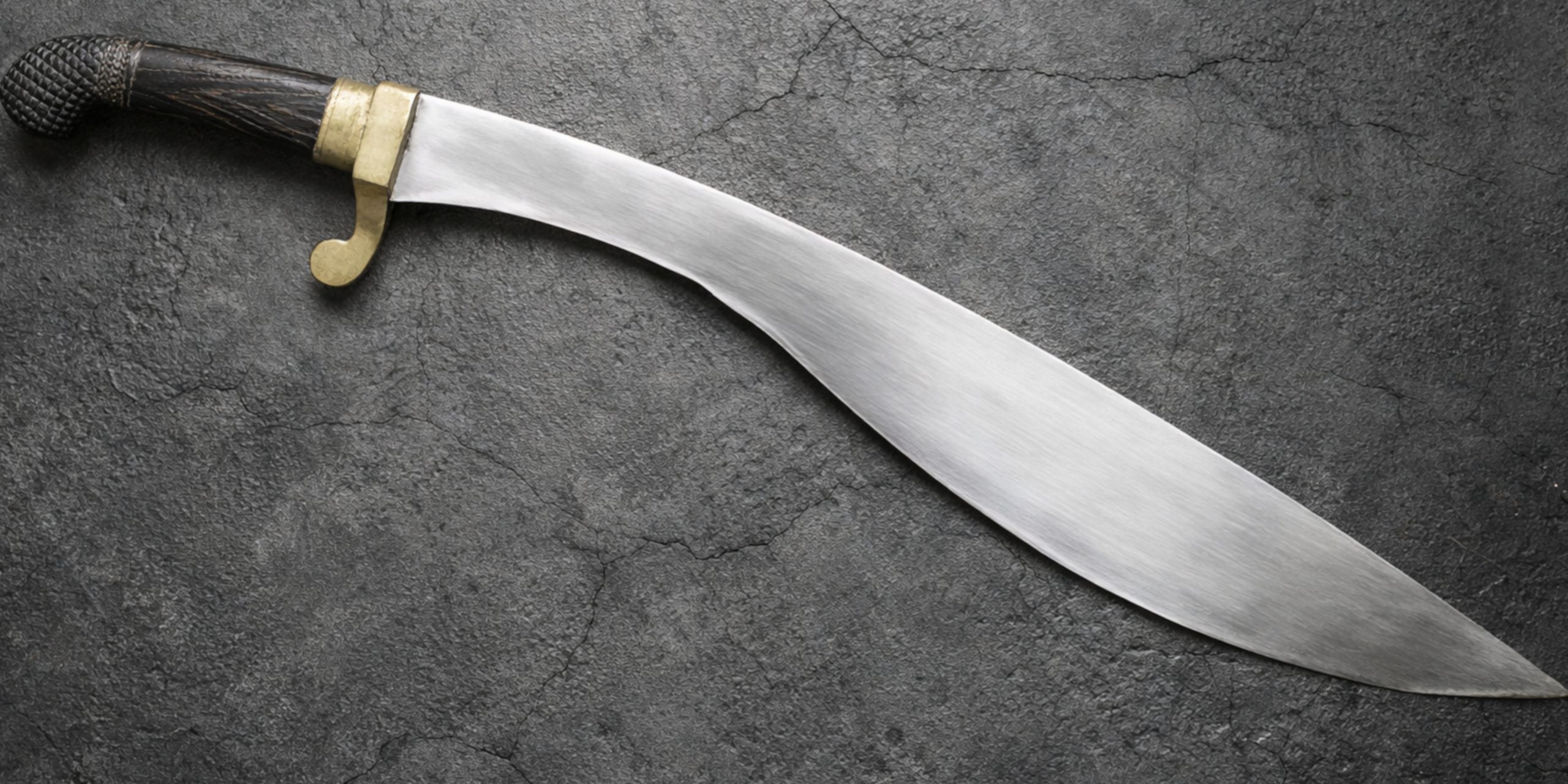
The makhaira is one of the most distinctive blades of the ancient Greek world. It is defined by its forward curving edge and pronounced cutting belly, a shape designed to deliver devastating slashing blows rather than delicate point work. Often associated with cavalry and elite warriors, the makhaira sits somewhere between a sword and a heavy knife, practical, brutal, and unapologetically focused on effectiveness.
In Greek sources the term makhaira can be fluid, sometimes overlapping with kopis, but the essential idea remains the same. This is a weapon built to cut deep and end fights quickly.
Specifications
Typical surviving examples and reconstructions show broad consistency rather than strict standardisation.
| Feature | Typical Range |
|---|---|
| Overall length | 60 to 75 cm |
| Blade length | 45 to 60 cm |
| Blade shape | Forward curving, single edged |
| Blade width | Broadest near the tip |
| Weight | Approx. 0.9 to 1.3 kg |
| Grip | Wood or bone scales |
| Guard | Minimal or absent |
| Pommel | Simple cap or hooked terminal |
Key physical characteristics include:
• Heavy blade bias towards the tip
• Single sharpened edge
• Thick spine for strength
• Ergonomic grip suited to cutting motions
History and Evolution
The makhaira appears in the Greek world by the late Archaic period and becomes increasingly common during the Classical era.
Early forms likely evolved from utility knives and hunting blades, gradually lengthened for battlefield use. By the 5th and 4th centuries BC, the makhaira was widely depicted in Greek art, particularly in cavalry contexts.
Its forward curve made it especially effective from horseback, where downward slashing blows were easier to deliver than precise thrusts. Xenophon explicitly praises curved blades for cavalry use, noting their superior cutting power compared to straight swords.
Over time, regional variations emerged. Some blades show a more pronounced curve similar to the kopis, while others are slightly straighter but still weighted forward. By the Hellenistic period, the makhaira begins to fade from prominence as longer straight swords and new military doctrines take over.
Advantages and Disadvantages
Advantages
• Exceptional cutting power due to forward weighted blade
• Effective against lightly armoured opponents
• Ideal for cavalry strikes and close combat
• Robust construction with low risk of tip breakage
Disadvantages
• Limited thrusting capability
• Less reach than long straight swords
• Awkward for tight formations such as hoplite phalanxes
• Requires space and momentum to use effectively
The makhaira rewards aggression and commitment. It is not a subtle weapon and does not pretend to be one.
Comparison with Similar Weapons
| Weapon | Key Difference | Practical Impact |
|---|---|---|
| Kopis | Often more pronounced curve | Even greater cutting bias |
| Xiphos | Straight double edged blade | Better thrusting and versatility |
| Falx | Longer inward curve | Two handed use and armour damage |
| Kukri | Shorter and heavier | Tool and weapon hybrid |
Compared to the xiphos, the makhaira sacrifices balance and fencing ability in exchange for raw cutting trauma. Against later curved blades like the falx, it is shorter and more controlled, designed for one handed use rather than sheer leverage.
Legacy
The makhaira left a long shadow despite its relatively short period of dominance. Its influence can be seen in later curved swords that prioritise cutting over thrusting, including blades used by Thracians, Iberians, and eventually non European cultures.
In art and literature, it became shorthand for savage efficiency, often carried by heroes, mercenaries, and cavalrymen rather than disciplined phalanx infantry. Modern historians increasingly recognise it as a purpose built military weapon rather than an oddity or sidearm.
Where to See the Makhaira Today
Authentic examples and fragments can be found in several major collections:
• National Archaeological Museum
• British Museum
• Metropolitan Museum of Art
Most surviving blades are heavily corroded, but their distinctive forward curve remains unmistakable.
Collector’s Guide and Auction Prices
Original makhairai are rare and highly regulated due to their archaeological status. Most collectors focus on documented fragments or high quality replicas.
Authentic artefacts
• Provenanced fragments, often incomplete
• Museum deaccessions are extremely uncommon
• Export restrictions apply in most cases
Auction price guidance
| Item Type | Typical Price Range |
|---|---|
| Fragmentary blade | £8,000 to £20,000 |
| Near complete example | £30,000 to £70,000 |
| Museum grade specimen | £100,000 plus |
Modern replicas
• High quality reproductions from specialist smiths
• Prices typically range from £300 to £1,200
• Look for accurate blade geometry and distal taper
Avoid pieces marketed vaguely as Greek curved swords without documentation. The makhaira’s value depends heavily on provenance and scholarly attribution.