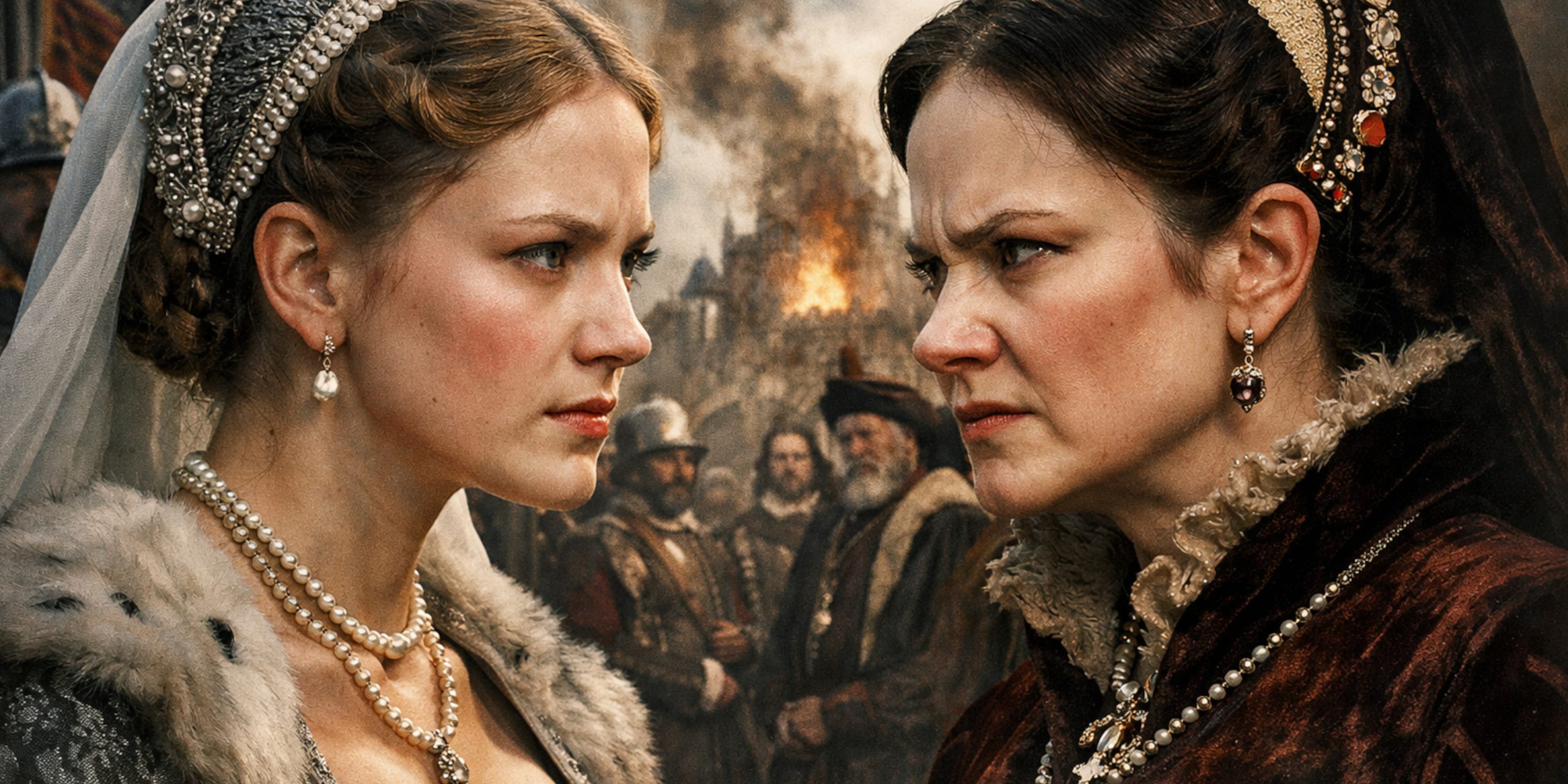
Lady Jane Grey is often remembered as the tragic girl queen, intelligent, pious and disastrously surrounded by ambitious men. Mary I, by contrast, tends to arrive in popular history wearing the rather unfortunate label of Bloody Mary, which is rather like introducing Henry VIII merely as “that man who had several weddings and a hobby for executions”. Neither woman is served particularly well by shorthand.
The question of who had the stronger claim to the English throne in July 1553 is one of the most fascinating constitutional rows in Tudor history. It was a struggle over blood, law, religion, Parliament, royal wills and, because this is Tudor England, a great deal of scheming in corridors.
In the end Mary won, and she won quickly. Yet Jane Grey was not simply a pretender plucked from nowhere. Her claim was real. The problem was that Mary’s was stronger.
The Family Tree Problem
The argument begins with Henry VIII and his extraordinary ability to turn family matters into a national crisis.
Henry had three surviving children:
- Edward, son of Jane Seymour
- Mary, daughter of Catherine of Aragon
- Elizabeth, daughter of Anne Boleyn
By the 1540s Henry had declared both Mary and Elizabeth illegitimate. Then, in one of his more characteristic reversals, he restored them to the line of succession through the Third Succession Act.
The order established by law was:
- Edward
- Mary
- Elizabeth
- The descendants of Henry’s younger sister Mary Tudor
Lady Jane Grey came from that last line. She was the granddaughter of Mary Tudor, Henry VIII’s younger sister, and therefore Henry’s great-niece.
Mary I, however, was Henry VIII’s daughter. In Tudor thinking, that mattered enormously. Blood descended directly from the king carried a weight that no great-niece, however clever or Protestant, could quite match.
Mary’s Claim
Mary’s claim rested on three things: birth, statute law and her father’s will.
She was Henry VIII’s eldest surviving child. Although Henry had once declared her illegitimate after divorcing Catherine of Aragon, Parliament restored her to the succession in 1544.
Under the law in force when Edward VI died, Mary was next in line after him.
Henry VIII’s will reinforced this order. It placed Edward first, then Mary, then Elizabeth. Only after all three had no heirs would the crown pass to the descendants of Henry’s sister Mary Tudor, including Jane Grey.
That gave Mary an enormous advantage. Her claim rested not merely on family connection but on an Act of Parliament and the late king’s own written wishes.
From a legal standpoint, Mary was the rightful heir in July 1553.
There is a certain irony in this. Henry VIII spent years insisting that Mary was not legitimate, then managed to create a system in which she nevertheless became almost impossible to dislodge. Tudor succession law has all the neat simplicity of a cupboard stuffed shut with far too many coats.
Jane Grey’s Claim
Jane Grey’s claim came through Henry VIII’s younger sister Mary Tudor.
By Henry’s will, Jane was in line to inherit, but only after Edward, Mary and Elizabeth.
So why was Jane proclaimed queen?
Because Edward VI, terrified that his Catholic half-sister would undo the Protestant Reformation, attempted to alter the succession before his death.
Edward drew up what became known as his “Devise for the Succession”. In it, he excluded both Mary and Elizabeth and named Jane as his heir.
At first Edward intended the crown to pass to Jane’s future sons, which was awkward because Jane had neither children nor, at that point, much prospect of suddenly producing one in the next week. Eventually the wording was changed to “Lady Jane and her heirs male”.
Jane therefore had a claim because the reigning king named her as successor.
To Protestant reformers, and especially to John Dudley, Duke of Northumberland, this seemed both necessary and sensible. Mary was openly Catholic and likely to reverse everything Edward’s government had built.
There was also another reason, rather less noble. Northumberland had recently married Jane to his son Guildford Dudley. A Jane Grey reign would leave him standing very comfortably near the centre of power. Tudor politics rarely misses an opportunity for self-interest.
Was Edward VI Allowed to Change the Succession?
This is where the argument becomes genuinely complicated.
Supporters of Jane claimed that Edward, as king, had the right to decide who should succeed him.
There was some precedent for this. Henry VIII had been given the power by Parliament to alter the succession through his will or letters patent.
The difficulty is that Parliament gave that power to Henry, not necessarily to every future monarch.
Edward’s “Devise” had not been approved by Parliament before he died. It existed as letters patent signed by judges and councillors, but it directly contradicted the law already in place.
Mary’s supporters argued that Edward could not simply overturn an Act of Parliament with his own personal wishes.
They had a very strong point.
The Third Succession Act and Henry VIII’s will had the force of law. Edward’s device did not.
If Edward had lived longer and managed to persuade Parliament to approve his new succession plan, Jane’s position might have become much stronger. But he died too soon.
As matters stood in July 1553, Jane’s title rested on a legal innovation that had never been fully secured. Mary’s rested on existing law.
Religion and the Succession
Religion made the whole crisis far more explosive.
Mary was Catholic. Jane was firmly Protestant.
By 1553 England had undergone years of Protestant reform under Edward VI. Many leading politicians feared that a Mary reign would restore Catholicism, bring back the Latin Mass and reverse the changes of the previous decade.
They were quite right.
Mary had no intention of compromising on religion. If anything, she was one of the few people in the story who seems entirely clear about what she wanted.
For Protestant nobles, Jane looked like the safer option. She was learned, devout and committed to reform. She had also spent her youth reading Greek, Latin and theology with alarming enthusiasm. One rather suspects she would have been unbearable at a Tudor dinner party, though undoubtedly in a very impressive way.
Yet religion could not entirely overcome the issue of legitimacy. Even many Protestants accepted that Mary had the better legal claim.
In fact, this is one of the most striking things about the crisis. England did not rally to Mary because everyone loved Catholicism. Many did not. They rallied to her because she was Henry VIII’s daughter and because the law seemed to be on her side.
Why Mary Won
Mary’s victory was remarkably swift.
Jane was proclaimed queen on 10 July 1553. Nine days later Mary had been recognised instead.
Several factors explain why:
- Mary had the stronger legal claim.
- She was the daughter of Henry VIII.
- She quickly gathered support in East Anglia.
- The nobility and Privy Council lost confidence in Jane.
- Northumberland was widely distrusted.
Northumberland was perhaps Jane’s greatest weakness. His involvement made the whole affair look suspiciously like a political coup wrapped in Protestant language.
Jane herself inspired sympathy, but Northumberland inspired alarm.
Once it became clear that Mary had broad public support, councillors in London hurried to abandon Jane with astonishing speed. Tudor statesmen had a remarkable instinct for changing sides at exactly the right moment.
Mary entered London in triumph. Jane was left in the Tower, where she had begun her brief reign and where, tragically, she would later await execution.
So Who Had the Stronger Claim?
Mary I had the stronger claim.
Jane Grey had a plausible claim, and under different circumstances she might even have kept the throne. Had Edward VI lived a few months longer, had Parliament approved his succession plan, or had Mary been captured before she could gather support, history might have looked very different.
But in July 1553 none of those things had happened.
By blood, by statute and by Henry VIII’s will, Mary stood ahead of Jane.
Jane’s claim depended on Edward VI’s last-minute attempt to alter the succession. Mary’s depended on laws already accepted by the kingdom.
That is why Mary won.
As a historian, I confess I have always felt deeply sorry for Jane Grey. She was seventeen, brilliant, serious and pushed towards a throne she does not seem to have wanted. She has the air of a clever schoolgirl handed the controls of a ship already heading for the rocks.
Yet sympathy is not the same thing as legitimacy. Jane was the better story. Mary was the better claimant.