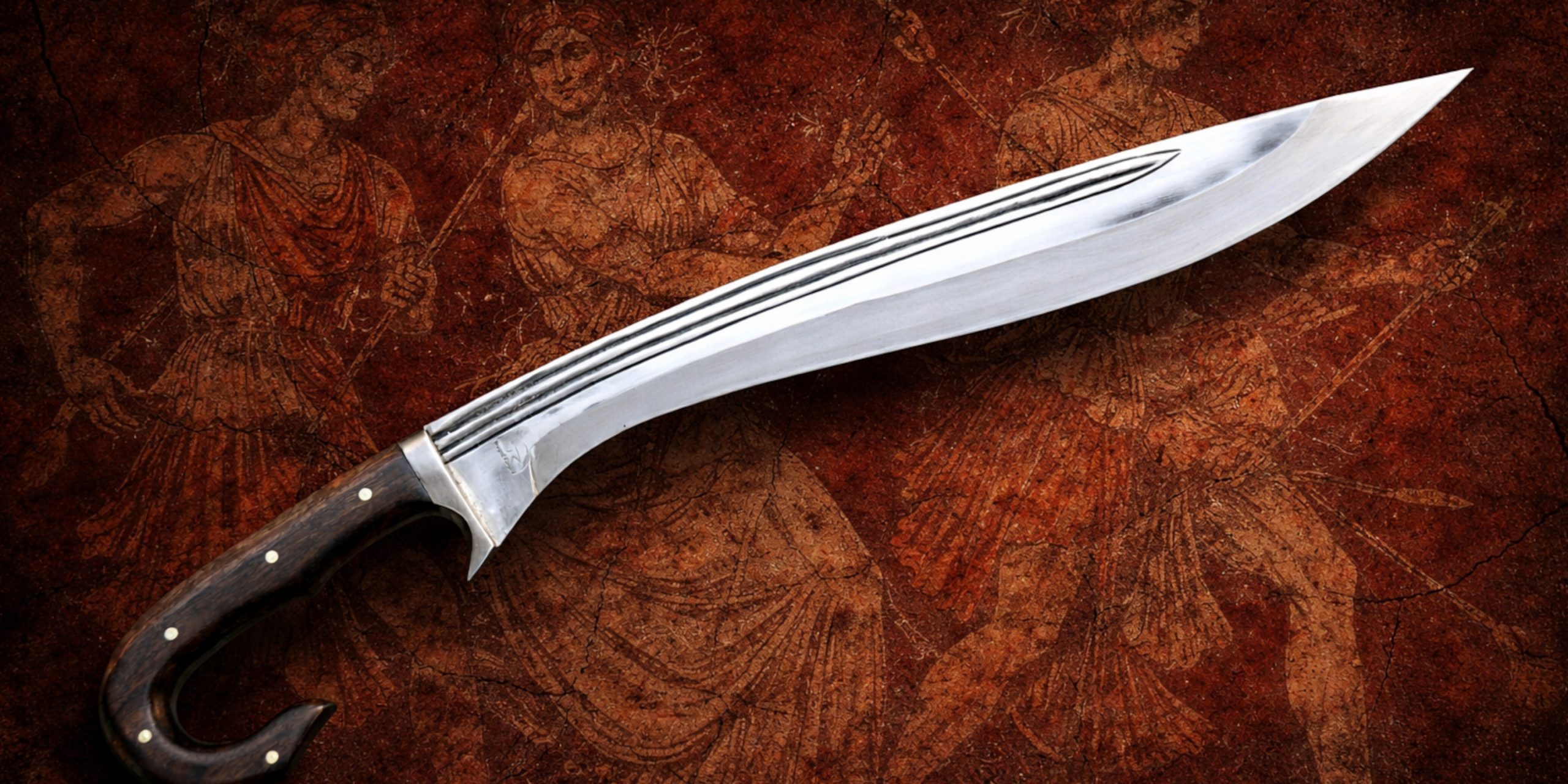
The kopis is one of the most distinctive edged weapons of the ancient Mediterranean. With its forward curving blade and heavy cutting profile, it looks purposeful, almost aggressive in silhouette. Unlike the straight double edged swords most people associate with Greek warfare, the kopis was built for forceful slashing. It concentrated weight toward the tip, creating a weapon that could deliver devastating cuts from horseback or on foot.
Although sometimes overshadowed by the xiphos in popular culture, the kopis appears frequently in Greek art and military contexts from the Classical period onward. It is closely associated with cavalry use, elite warriors and later Hellenistic armies. Its influence also stretches further east, shaping related forms across Iberia and the Near East.
Specifications
The kopis varied in size and curvature depending on region and era, but several core features remain consistent.
Typical Measurements
| Feature | Range |
|---|---|
| Overall length | 50 to 65 cm |
| Blade length | 40 to 55 cm |
| Blade profile | Single edged, forward curving |
| Weight | 0.8 to 1.3 kg |
| Balance point | Forward weighted toward tip |
| Hilt | Often with hooked pommel |
Structural Characteristics
- Single edged blade with pronounced forward curve
- Thick spine near the hilt tapering toward the tip
- Expanded cutting belly near the front third of the blade
- Wooden grip scales, sometimes bone or horn
- Hooked or beaked pommel for secure retention
The forward balance is the defining mechanical feature. Unlike straight swords that balance near the guard, the kopis shifts mass toward the cutting edge, increasing chopping power.
History and Evolution
The kopis appears in Greek contexts from the 6th century BC. It is depicted on Attic vase paintings and referenced by classical authors.
Archaic and Classical Greece
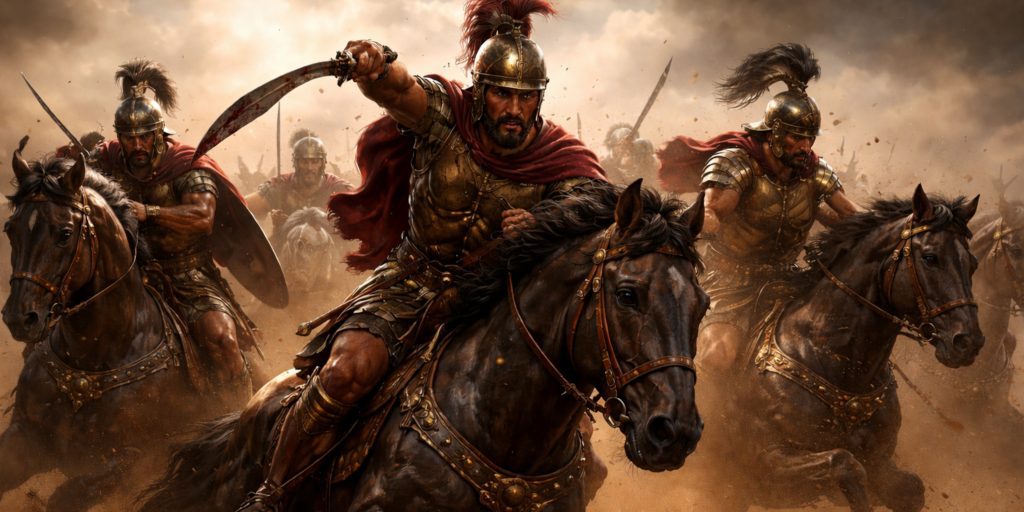
During the 5th and 4th centuries BC, the kopis gained traction as a cavalry weapon. Its chopping ability made it effective against lightly armoured opponents and useful for mounted combat. Xenophon notes the value of curved swords for cavalry use, highlighting their cutting efficiency.
The more common infantry sword in hoplite warfare remained the xiphos. However, cavalry units and certain regional troops favoured the kopis.
Macedonian and Hellenistic Period
Under Philip II and Alexander the Great, cavalry played a central role in warfare. Macedonian Companion cavalry likely used curved blades similar to the kopis, though terminology sometimes overlaps with the machaira.
In this era, the design spread widely across the eastern Mediterranean. Variants appear in Thrace and Anatolia, and related blades emerge in Iberia.
Regional Variants
- Machaira, often used interchangeably in sources, though sometimes described as slightly different in curvature
- Iberian falcata, a heavily curved development with pronounced grip design
- Eastern single edged sabre like forms influenced by Persian traditions
The kopis sits at a crossroads between Greek and Near Eastern blade traditions.
Advantages and Disadvantages
Advantages
- Strong chopping capability due to forward weight
- Effective from horseback
- Concentrated cutting force ideal against unarmoured or lightly armoured foes
- Secure grip from hooked pommel reduces slippage
Disadvantages
- Less versatile for thrusting compared to straight double edged swords
- Heavier blade tip can fatigue the wielder
- Reduced effectiveness against heavy armour compared to thrust centric weapons
The kopis rewards aggressive cutting techniques but demands control and stamina.
Comparison with Similar Weapons
| Weapon | Origin | Blade Type | Primary Strength | Primary Role |
|---|---|---|---|---|
| Kopis | Greece | Single edged, curved | Powerful chopping | Cavalry and elite infantry |
| Xiphos | Greece | Double edged, straight | Balanced thrust and cut | Hoplite infantry |
| Falcata | Iberia | Curved, heavy tip | Armour piercing cuts | Iberian warriors |
| Sabre | Various | Curved | Slashing from horseback | Later cavalry traditions |
The xiphos offers versatility in tight phalanx formations. The kopis excels in open combat and mounted warfare. The Iberian falcata arguably pushes the kopis concept further, with even more dramatic curvature and reinforced structure.
Legacy
The kopis contributed to the broader evolution of curved swords across Europe and the Near East. While it did not directly lead to medieval sabres, the concept of forward weighted cutting blades persisted.
Its visual legacy survives in:
- Greek vase art
- Hellenistic sculpture
- Modern historical reconstructions
- Film and gaming depictions of ancient Greece
It also informs academic debates about Greek military diversity. The existence of the kopis challenges the simplified image of uniform hoplite warfare.
Where to See Examples
Authentic kopis blades are rare but several museums house examples or related forms.
- British Museum, London
- National Archaeological Museum, Athens
- Metropolitan Museum of Art, New York
- Museo Arqueológico Nacional, Madrid for falcata parallels
Most surviving pieces are heavily corroded iron blades with fragmentary hilts. Context often comes from grave finds or sanctuary deposits.
Collector’s Guide
Original kopis swords are extremely scarce on the open market. Most reside in museum collections.
What Collectors Encounter
- Fragmentary iron blades from Mediterranean excavations
- Repatriated artefacts with strict provenance requirements
- High quality modern reproductions
Auction Prices
When genuine ancient examples appear, pricing varies dramatically based on condition and provenance.
| Condition | Estimated Auction Range |
|---|---|
| Fragmentary blade | £8,000 to £20,000 |
| Complete blade with hilt remains | £25,000 to £60,000 |
| Exceptional provenance example | £75,000 plus |
Prices fluctuate depending on legal status, documentation and historical significance. Buyers must exercise extreme due diligence due to cultural heritage laws.
What to Look For
- Documented excavation or long established collection history
- Stable corrosion with no modern tampering
- Clear curvature and forward weight profile
- Expert authentication
Serious collectors often focus on high end replicas crafted by specialist smiths. These typically range from £600 to £2,500 depending on materials and historical accuracy.
Final Takeaway
The kopis stands apart in the ancient Greek arsenal. It is not the standard infantry sword and never claimed that role. Instead, it reflects tactical flexibility within Greek warfare. Its forward weighted blade represents a deliberate design choice favouring decisive cutting power.
For historians, it highlights the complexity of Greek military equipment beyond the phalanx stereotype. For collectors, it remains rare, legally sensitive and highly prized. And for students of arms and armour, it offers a compelling case study in how blade geometry shapes battlefield function.triking form continue to capture the imagination of historians, collectors, and weapon enthusiasts.
Watch a documentary: