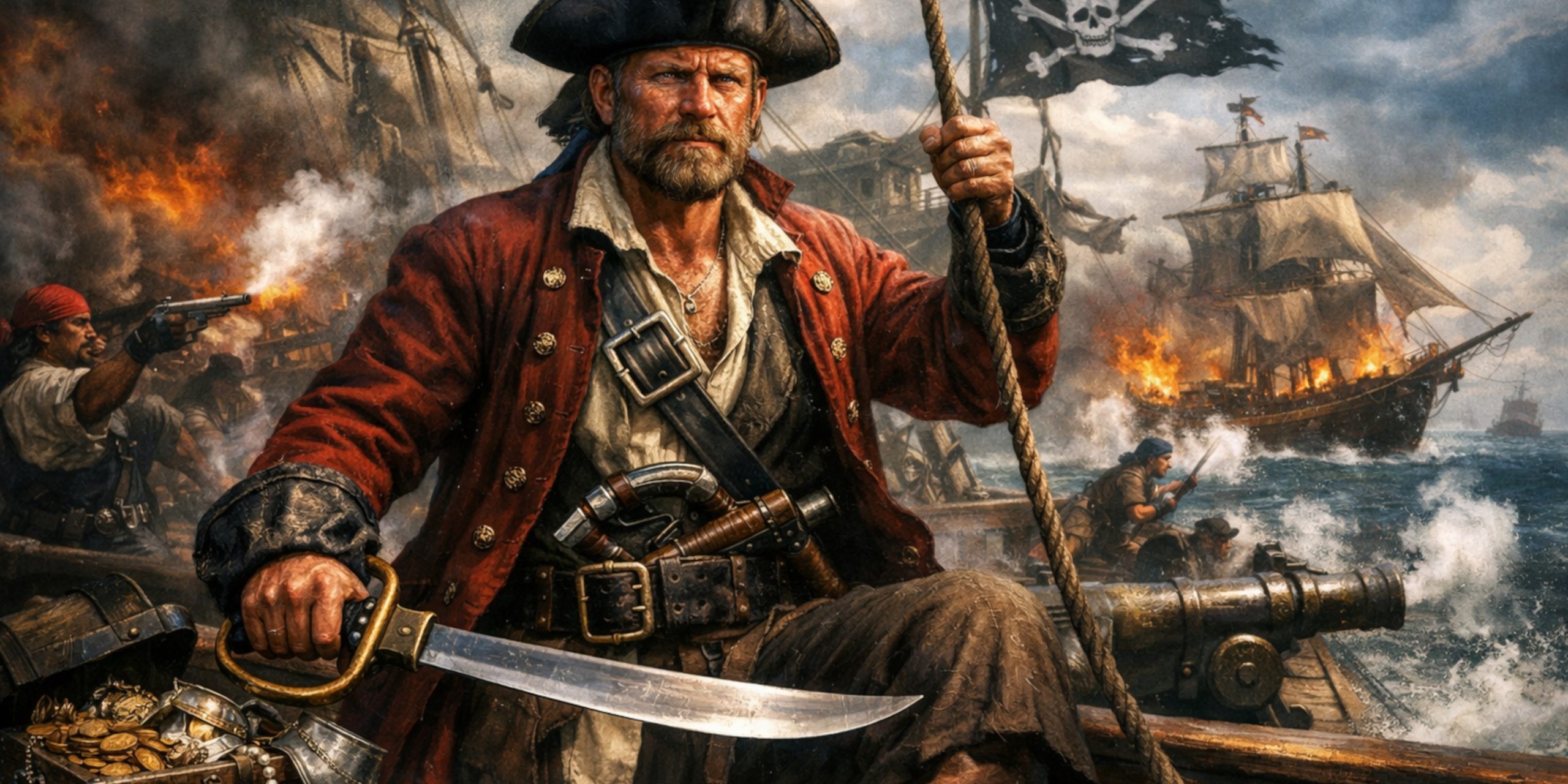
The Reluctant Gentleman of Crime
There is something faintly theatrical about Captain John Phillips. Not quite as notorious as Blackbeard, not as politically entangled as Kidd, yet he remains one of those pirates who, when examined closely, reveals the working machinery of early eighteenth century sea raiding. He was competent, disciplined, and just ruthless enough to survive for a while. In pirate terms, that qualifies as respectable.
Phillips operated during what historians rather grandly call the Golden Age of Piracy. The period from roughly 1715 to 1726 saw the Atlantic thick with private grudges, stolen rum, and former sailors who had decided that Crown service paid poorly and hanged well.
Historical Background
John Phillips was active in the early 1720s. He began not as a romanticised rogue but as a ship’s carpenter. A practical trade. The sea has little patience for incompetence in carpentry. It leaks.
In 1721, Phillips was serving aboard a fishing vessel off Newfoundland when he and a small group of companions mutinied. They seized the vessel and turned pirate. It was less a grand ideological stand and more an opportunistic decision. As one contemporary account suggests, pirates were often “men who had little to lose and much to gain by hazard”.
Phillips quickly established himself as captain. This was not a hereditary honour but an elected position. Pirate crews voted, and they deposed captains just as readily. Authority depended upon success.
He drafted articles for his crew, a written code of conduct that survives in fragmentary form. It regulated shares of plunder, discipline, and compensation for injury. Pirates, for all their violence, could be surprisingly bureaucratic.
The Ships Under His Command
Phillips did not command a vast fleet. He relied primarily on small, fast vessels, ideal for coastal raids and opportunistic captures.
The Bounty
His first vessel after mutiny was a modest fishing schooner. Hardly the terror of the seas, but nimble and unremarkable enough to approach merchantmen without immediate alarm.
He later commanded a small sloop, reportedly mounting a handful of swivel guns and light cannon. Speed mattered more than broadside weight. A pirate captain seeking decisive naval engagement was usually courting disaster.
Weapons and Equipment
Phillips and his crew carried the standard arms of Atlantic piracy in the 1720s.
Cutlasses were the principal blade. Short, broad, and brutally effective in confined spaces, they were designed for boarding actions rather than elegant duelling.
Flintlock pistols were common, usually carried in pairs. Accuracy was questionable, but intimidation was reliable.
Boarding axes served both practical and violent purposes. They cut rigging and skull with equal efficiency.
Light swivel guns mounted on deck provided suppressing fire during approaches. They were not designed to sink ships but to convince crews to surrender quickly. A quiet capture was far more profitable than a damaged prize.
Treasure and Plunder
Phillips did not uncover buried chests glittering in Caribbean sunlight. The reality was more prosaic. Pirates seized cargoes: sugar, rum, fish, textiles, coin. Anything portable and saleable.
He operated largely along the North American coast and Newfoundland waters, targeting fishing vessels and smaller merchant ships. His prizes were modest. The fortune of a pirate captain depended on frequency rather than grandeur.
The spoils were divided according to the crew’s articles. The captain typically received a slightly larger share, though nothing like the monarchic take one might imagine. Pirate society was violently egalitarian.
Battles and Engagements
Phillips was not known for grand fleet actions. His encounters were sharp, close, and pragmatic.
One notable episode occurred in 1724 when Phillips and his crew captured a fishing vessel off the New England coast. Contemporary testimony describes the pirates as armed but disciplined, seeking compliance rather than carnage.
There is a line from a colonial report that strikes me as particularly telling: “They behaved with civility when not opposed, but were resolute when crossed.” That rather sums up the pirate temperament.
His final confrontation was less dignified.
Contemporary Accounts
Much of what we know about Phillips comes from court records and pamphlets, notably works attributed to Captain Charles Johnson. These sources are coloured by moral judgement and occasional embellishment.
One colonial observer remarked that pirates were “the common enemies of mankind”. It is a phrase repeated in legal proceedings of the era. Phillips would have heard such language read aloud in courtrooms, though perhaps with limited personal reflection.
Another account suggests Phillips was stern but not gratuitously cruel. Compared with some contemporaries, that is faint praise.
Capture and Fate
Phillips’ career ended in 1724. While attempting to seize another vessel near Massachusetts, his intended victims resisted. In the skirmish that followed, Phillips was shot and killed.
There was no theatrical last speech. No dramatic scaffold scene. Simply a failed boarding and a fatal bullet.
His surviving crew were captured, tried, and executed in Boston. The machinery of imperial justice functioned efficiently when pirates were involved.
In truth, Phillips’ story illustrates the narrow margins of pirate life. Success required speed, surprise, and the occasional good fortune of a compliant victim. Remove one element and the enterprise collapsed.
Historical Significance
John Phillips may not command the popular imagination, but he offers historians something arguably more valuable than legend. He demonstrates how piracy functioned on a practical level. Small crews, coastal targets, improvised authority, and written codes of conduct.
He was neither romantic hero nor monstrous aberration. He was a tradesman who chose crime at sea and met a predictable end.
The Golden Age of Piracy was less about buried treasure and more about labour unrest with cannon. Phillips fits that description rather neatly.