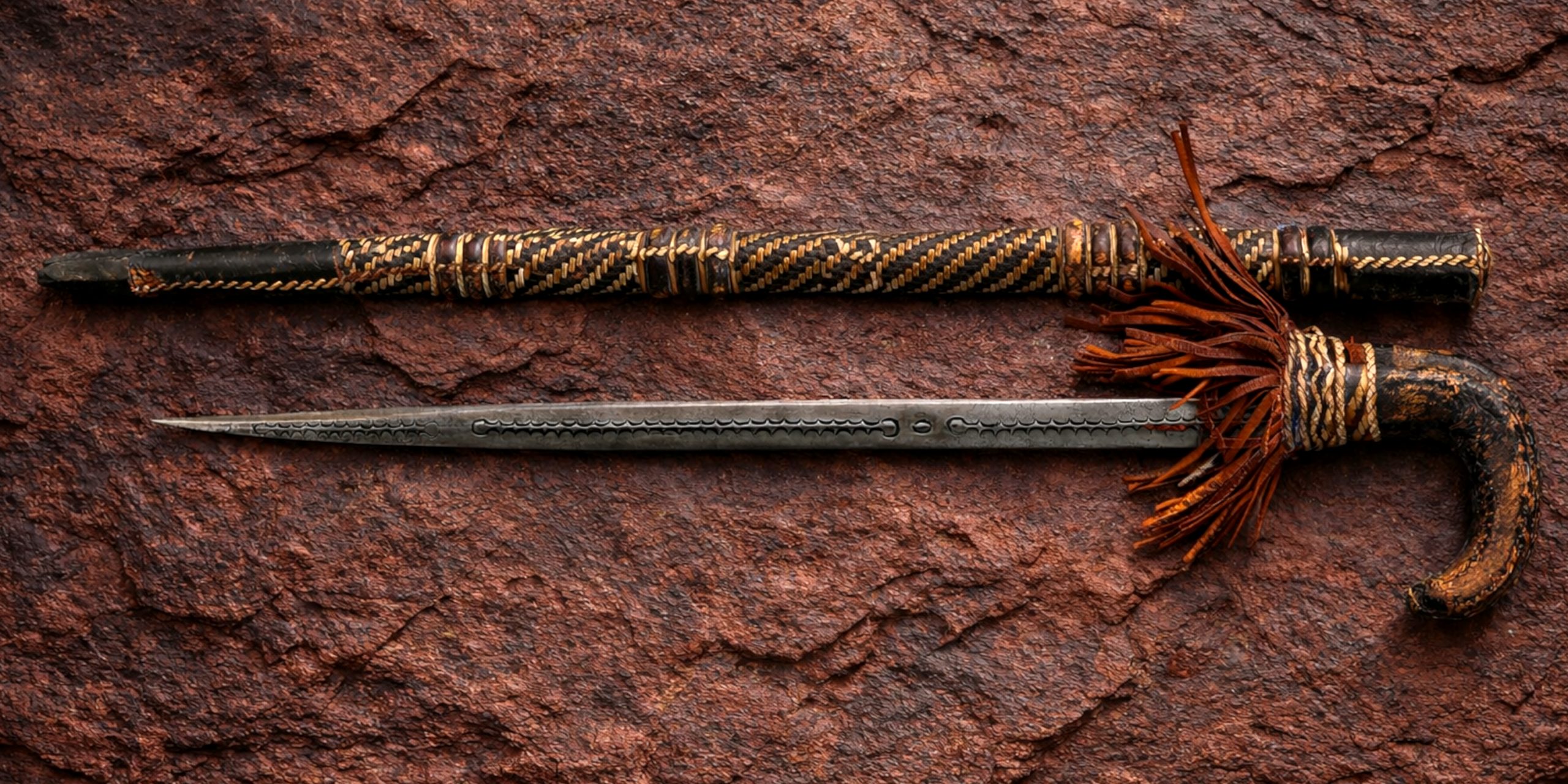
The Fulani sword is a distinctive West African blade associated with the Fulɓe people, a pastoralist culture spread across the Sahel from Senegal to Cameroon. It is most often recognised as a refined form of the takouba tradition, adapted to Fulani tastes and social customs. Slim, elegant, and often richly decorated, the sword carried practical value in warfare and travel, but also served as a visible marker of status, adulthood, and honour.
Unlike many mass battlefield weapons, the Fulani sword sits at the intersection of utility and identity. Its form reflects mobility, horsemanship, and a culture where personal arms mattered as much socially as they did tactically.
Specifications
| Feature | Typical Characteristics |
|---|---|
| Blade length | 80 to 100 cm |
| Overall length | 95 to 115 cm |
| Blade shape | Straight or very slightly tapering, double edged |
| Blade material | Imported European steel, locally forged steel |
| Fuller | Single shallow fuller common |
| Hilt | Short grip with disc or flattened pommel |
| Guard | Minimal crossguard or none |
| Scabbard | Leather, often tooled or dyed |
| Weight | Approx. 1.0 to 1.4 kg |
Common construction traits
- Long narrow blade optimised for cutting from horseback
- Balance point close to the guard for controlled handling
- Decorative leatherwork and metal fittings on scabbard
- Grip sized for one handed use
History and Evolution
The Fulani did not traditionally smelt iron on the same scale as settled West African kingdoms, relying instead on trade networks that stretched across the Sahara. From the seventeenth century onward, European blades from Solingen and other centres entered the Sahel via North African and trans Saharan trade routes. These blades were rehilted locally to suit Fulani preferences.
As Fulani jihads and state formations expanded in the eighteenth and nineteenth centuries, notably under leaders such as Usman dan Fodio, swords became symbols of authority and religious legitimacy. The Fulani sword evolved alongside cavalry warfare, favouring speed and reach rather than heavy chopping power.
By the late nineteenth century, the sword’s military role declined under colonial pressure, but its cultural value remained intact.
Advantages and Disadvantages
Advantages
- Excellent reach for mounted combat
- Lightweight and well balanced for prolonged carry
- High quality steel in many historic examples
- Strong cultural and aesthetic appeal
Disadvantages
- Limited hand protection due to minimal guard
- Less effective against heavy armour
- Narrow blade reduces cleaving power compared to broader sabres
- Many surviving examples show wear or later repairs
Comparison With Similar Weapons
| Weapon | Key Differences |
|---|---|
| Tuareg Takouba | Often heavier, more utilitarian, less decorative |
| Mandé Sabre | Broader blade with stronger cutting emphasis |
| Ethiopian Shotel | Dramatically curved blade, specialised cutting role |
| North African Saif | More curvature, stronger Islamic stylistic influence |
The Fulani sword stands apart for its restraint. Where other regional blades emphasise aggression or visual dominance, this weapon leans toward elegance, control, and personal bearing.
Legacy
Today, the Fulani sword is remembered less as a battlefield tool and more as a cultural artefact. It appears in ceremonial dress, family heirlooms, and oral histories tied to migration, faith, and leadership. Its clean lines and subtle decoration reflect a worldview that values discipline and dignity over excess.
In modern scholarship, these swords also illustrate how global trade shaped African material culture, blending European steel with African craftsmanship in a way that feels wholly local.
Where to See Fulani Swords
Notable examples can be found in major museum collections and regional institutions.
Museums and collections
- British Museum, London
- Musée du quai Branly, Paris
- National Museum of Mali, Bamako
- Royal Museum for Central Africa, Tervuren
Private collections and West African family holdings remain important but are rarely accessible to the public.
Collector’s Guide and Auction Prices
What collectors should look for
- Original rehilted European blade with clear patina
- Intact leather scabbard with traditional tooling
- Matching wear between blade, hilt, and scabbard
- Provenance linked to Sahelian or Fulani regions
Common issues
- Replaced hilts from the twentieth century
- Over polished blades removing historical surface
- Decorative replicas sold as antiques
Recent market values
| Condition | Typical Price Range |
|---|---|
| Museum quality, documented | £4,000 to £8,000 |
| Authentic, good condition | £2,000 to £4,000 |
| Partial restoration | £1,200 to £2,000 |
| Decorative or uncertain | Under £1,000 |
Prices continue to rise slowly as awareness of Sahelian arms improves and surviving examples become scarcer.