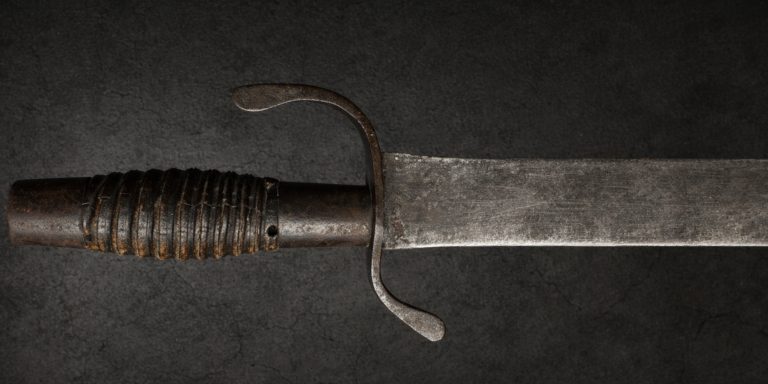
The French Renaissance duel sword sits at the point where medieval cutting traditions gave way to a more refined, civilian culture of honour and personal combat. Carried by gentlemen rather than soldiers, it was built for the duel rather than the battlefield. Precision mattered more than brute force, and the sword became an extension of posture, etiquette, and training. French makers were quick to absorb Italian fencing ideas, then refine them with local taste, producing weapons that were elegant, technically sharp, and quietly intimidating.
Specifications
| Feature | Typical Range |
|---|---|
| Overall length | 105 to 120 cm |
| Blade length | 85 to 100 cm |
| Blade type | Narrow, straight, diamond or flattened diamond section |
| Weight | 1.0 to 1.3 kg |
| Balance point | 6 to 10 cm from the guard |
| Hilt | Swept hilt or early cup hilt |
| Grip | Wood core with leather or cord wrap |
| Pommel | Scent stopper or globular |
Common construction details include a stiff blade optimised for thrusting, complex guard bars to protect the hand, and a long grip that allows fine point control.
History and Evolution
French duel swords emerged in the early sixteenth century as judicial duels faded and private affairs of honour increased. Italy led the way in fencing theory, but France rapidly developed its own schools and masters.
Early examples resemble military side swords with added hand protection. By the mid sixteenth century, French hilts became more intricate, favouring symmetrical swept guards and slimmer blades. These swords were worn daily by nobles and officers, not just drawn for formal duels.
By the late sixteenth and early seventeenth centuries, the weapon evolved toward the true rapier. Guards became more enclosing, blades more thrust focused, and the sword’s social role grew. It was no longer only a weapon but a visible signal of status, education, and readiness to defend one’s honour.
Advantages and Disadvantages
Advantages
- Excellent point control for thrust based fencing
- Strong hand protection compared to medieval arming swords
- Balanced for speed and precision rather than fatigue
- Well suited to civilian dress and daily wear
Disadvantages
- Limited cutting power against armoured or heavy clothing
- Less robust for battlefield use
- Complex hilts are vulnerable to damage if mistreated
- Requires skilled fencing training to use effectively
Comparison With Similar Weapons
| Weapon | Key Difference |
|---|---|
| Italian rapier | Often longer and heavier, with more exaggerated reach |
| Spanish cup hilt rapier | Later development, more enclosed hand protection |
| Side sword | Broader blade and stronger cutting ability |
| Small sword | Shorter, lighter, and purely thrust focused |
The French Renaissance duel sword sits between the side sword and the mature rapier, blending cutting heritage with emerging thrust focused technique.
Legacy
The French duel sword helped shape European fencing culture. French masters refined footwork, timing, and blade engagement, laying foundations for later small sword fencing and eventually modern sport fencing.
Its influence can be traced through court culture, military academies, and the codification of duelling etiquette. By the seventeenth century, the style it represented had become a standard across much of Europe.
Where to See Examples Today
Notable examples can be found in major European collections, including:
- Musée de l’Armée, Paris
- Musée Cluny, Paris
- Royal Armouries, Leeds
- Metropolitan Museum of Art, New York
These collections often display French pieces alongside Italian and Spanish examples, making stylistic comparison straightforward.
Collector’s Guide and Auction Prices
Original French Renaissance duel swords are scarce and desirable. Condition, provenance, and originality matter greatly.
What collectors should look for
- Even patina without heavy corrosion
- Straight blade with clear central ridge
- Original hilt components rather than later restorations
- Period grip construction
Typical auction prices
| Condition | Price Range |
|---|---|
| Fragmentary or restored | £4,000 to £8,000 |
| Complete with wear | £8,000 to £15,000 |
| High quality, well preserved | £15,000 to £30,000+ |
Provenance linked to a known fencing master or noble household can push prices significantly higher.