François L’Olonnais has long been introduced as the most brutal of the French buccaneers who haunted the Caribbean in the mid seventeenth century. This reputation is not an invention of later romantic writers. It comes straight from contemporary chroniclers who had no reason to embellish a man already overflowing with unpleasant enthusiasm. His career is a study in excess. Excess violence, excess ambition and eventually excess consequences. One hardly needs a moral lesson pinned to the end when the facts perform the work neatly on their own.
Early Life and Background
He was born Jean David Nau in Les Sables d’Olonne on the French Atlantic coast around 1630. The nickname L’Olonnais references his home region and indicates that very early in life he found himself far from it. Like many impoverished young men of the period, he was sent to the Caribbean as an indentured servant. It was an arrangement that promised opportunity and delivered almost anything else.
Upon gaining his freedom he joined the buccaneers of Hispaniola, a loose community of hunters, sailors and opportunists who moved between subsistence and piracy with few qualms. L’Olonnais proved talented at both navigation and brutality, a combination that tended to take one far in the Caribbean of the 1660s, although not always far enough to guarantee retirement.
Reputation in Contemporary Sources
The chronicler Alexandre Exquemelin knew L’Olonnais personally, which is usually a historian’s blessing but in this instance leans closer to a curse. Exquemelin described him with a calm horror that suggests he had run out of adjectives by the fourth chapter.
A few choice lines include:
“He was not content with victory and plunder, but delighted in cruelty as if it were a craft to be perfected.”
“No man in the islands surpassed him in acts of violence, for he believed fear more useful than honour.”
One historian can only note that seventeenth century writers were rarely squeamish. If even they felt the need to underline his behaviour, we can be fairly certain it was extreme.
Weapons
L’Olonnais used the standard tools of a buccaneer captain. They were neither sophisticated nor subtle, which suited him.
Common weapons associated with him
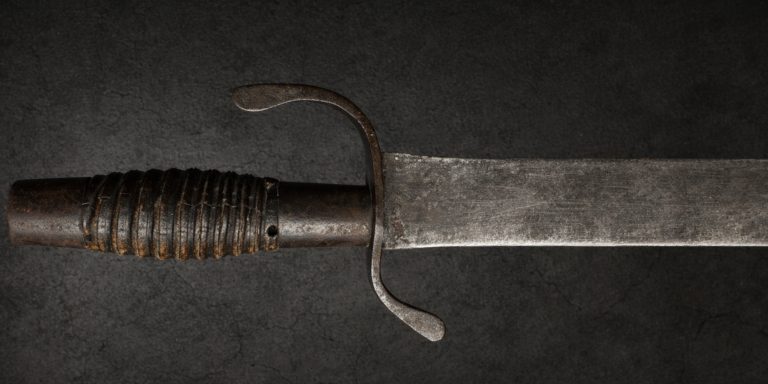
- Cutlass used for boarding actions and the efficient encouragement of surrender.
- Pair of flintlock pistols often carried in the sash where they doubled as symbols of authority.
- Long musket used by his men during coastal assaults. Buccaneers prized accuracy, especially when shooting Spaniards from behind palm trees, which appeared to be a favourite pastime.
- Grenades and fire pots for clearing decks or terrifying garrisons that had not yet realised resistance was futile.
None of these weapons explains the scale of his reputation. That part came from how he used them.
Ships
He commanded several vessels during his career. The most notable were:
La Couronne
A modest ship outfitted for raiding coastal settlements. It was fast and carried enough men to be persuasive. L’Olonnais used it in early operations around Cuba.
Captured Spanish prize ships
He regularly replaced his vessel with something larger taken from Spanish shipping. This was an economical approach, assuming one survived long enough to enjoy the upgrade.
His ships were crewed by a mix of French, Dutch and English buccaneers. Loyalty was based on the expectation of profit rather than affection, which was fortunate given his personality.
Bounty, Treasure and Plunder
L’Olonnais was not a subtle strategist, but he was effective. He raided villages, ambushed trade routes and extorted ransoms. His most infamous haul came from the 1666 and 1667 campaigns that targeted Spanish settlements along the Gulf of Honduras.
Loot included:
- Silver coin taken from Spanish transport ships.
- Church plate and ornaments.
- Trade goods such as cacao, indigo, tobacco and textiles.
- Weapons, powder and shot.
- Captives who either paid ransom or provided information. One shudders at the interrogation methods, which Exquemelin insisted were unpleasant even by contemporary standards.
Although some buccaneers frittered their gains almost immediately, L’Olonnais tended to reinvest in ships and new expeditions. Ambition often consumes the purse faster than rum.
Battles and Major Raids
The Cuban Coast Raids
Early in his career he targeted Spanish coastal towns in Cuba. During one ambush his ship was wrecked, but he escaped disguised in the blood of fallen companions. Contemporary accounts report this with unnerving simplicity, as if it were an accepted phase in a pirate’s growth.
The Attack on Puerto de Cavallos
In 1667 he united several buccaneer crews and attacked this fortified port in Honduras. Despite strong defences he took the town, plundered it thoroughly and demanded ransoms from local authorities. His ability to intimidate garrisons was matched only by his enthusiasm for doing so.
The San Pedro Campaign
He marched inland toward San Pedro with around seven hundred men. The Spanish attempted an organised defence. It did not go well for them. L’Olonnais seized the region, gathered treasure and reportedly carved his name into the memory of every survivor who regretted failing to run sooner.
His Fate
For a man who treated his enemies with enthusiasm, he met a predictable if grisly end. Around 1668 he sailed for Nicaragua to repeat his earlier successes. Instead he encountered a strong indigenous group, usually identified as the Kuna or a related community along the Darién coast.
According to both Spanish and buccaneer accounts, they captured him and executed him in a manner that suggested they had been briefed on his reputation and wished to respond in kind. His body was reportedly cut apart and burned. A historian does not rejoice in anyone’s suffering, but one understands why contemporary chroniclers recorded the incident with a tone that wandered suspiciously close to relief.
Why His Story Endures
L’Olonnais sits at the extreme end of the buccaneer spectrum. Many were violent. Few appeared to enjoy it so openly. He exemplifies the darker truth of the Caribbean in this period. There was no romance in his actions, only opportunism pursued with a zeal that terrified even his peers.
His story lingers because it poses uncomfortable questions about the nature of power when oversight is absent. It also provides a cautionary note. The world rarely allows such men a peaceful retirement, and L’Olonnais was no exception.
Closing Thoughts from a Weary Historian
If there is a lesson in his career, it is perhaps that fear may carry a man across oceans but rarely carries him home again. Seventeenth century imperial politics provided the stage. L’Olonnais supplied the spectacle. His name survives not because he was skilful, though he was, nor because he was successful, though at times he certainly was, but because he demonstrated what happens when raw violence meets a world already stretched thin by empire and ambition.
His is a story best read with a cup of tea and the quiet recognition that humanity has always been capable of such things, although thankfully less often than men like L’Olonnais would have preferred.
Watch the documentary: