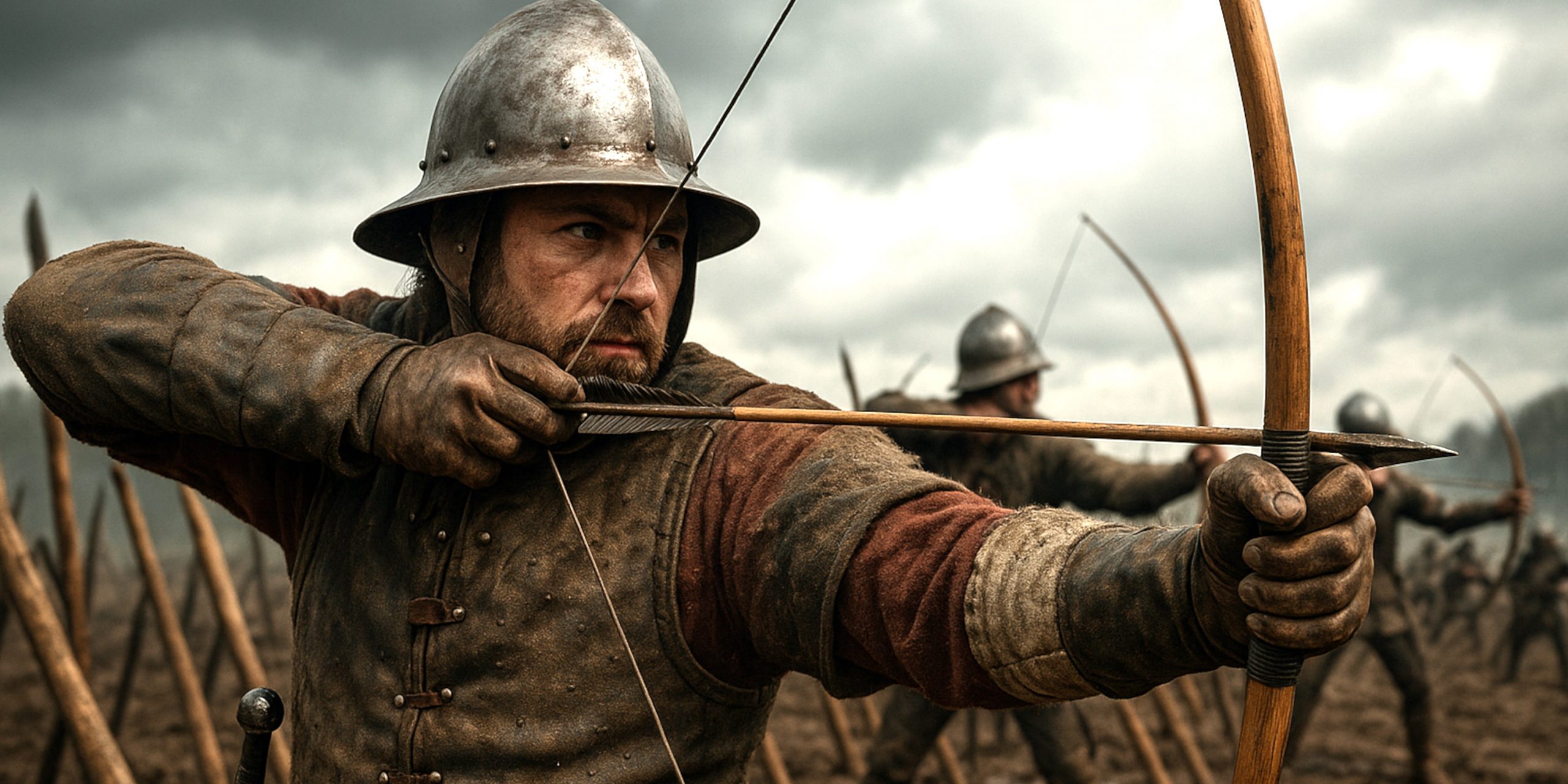
Few soldiers have enjoyed such an enduring mystique as the English longbowman. Part peasant, part professional, part national legend, the longbowman occupies a strange place in the medieval imagination. You have the romance of the yeoman archer who brings down armoured knights with a length of yew, and you have the cold reality of a military system that depended on bruising training and a state that wanted every able lad to practise until his spine protested.
The longbowman earned his reputation the hard way and left a considerable archaeological footprint behind him, which is refreshing in a field where myth often fills the gaps.
Origins and Training
The longbow is closely associated with Wales, where powerful self bows made from native yew were part of local warfare. England adopted the weapon with enthusiasm, partly because it gave kings a reliable means of turning yeoman farmers into battlefield assets.
Training began early. Medieval statutes encouraged practice from childhood, which may sound idyllic until you remember that drawing a war bow involved a pull weight that could challenge a grown adult. The skeletons of known archers often show enlarged left arms, thickened shoulder joints, and, in a few grim cases, spinal deformation. It is one of the rare points where archaeology and common sense shake hands.
The English crown came to rely on these archers as a strategic tool. A competent archer could loose ten to twelve arrows a minute and maintain pressure that changed the character of a battlefield.
How the Longbow Worked
A typical war bow stood between five feet ten inches and six feet six inches, with some specimens longer still. Yew remained the prized wood, though elm, ash and other timbers filled in when yew supplies ran thin.
War arrows were heavy, often tipped with bodkin points for piercing armour or broadheads for fleshier targets. The medieval arrow bag was not a neat quiver from a Robin Hood film but more of an efficient bundle stored in the ground or carried under the belt.
Archers fought in massed units and used terrain to make life miserable for cavalry and infantry. Mud, slopes and narrow approaches were ideal. A clever commander borrowed the landscape as readily as any weapon.
Arms and Armour
Longbowmen were not the half dressed rabble often painted in romantic dramas. By the fourteenth century many archers marched with respectable equipment. They were not expected to stand unarmoured in front of armoured knights and hope for the best.
Common equipment included
- Brigandine or jack
- Iron skullcap or kettle hat
- Gauntlets or finger guards
- Dagger at the belt
- Sidearm sword
Sword types regularly carried by longbowmen
- Falchion. Popular with archers for its chopping strength. Surviving examples show broad blades that handled close combat well.
- Short arming sword. A simple, robust design suited to anyone who needed a reliable blade without knightly pretensions.
- Baselard dagger. Worn as backup and sometimes mentioned in accounts of melee fighting after arrows were spent.
- Hanger style knife. A shorter utility blade which doubled as a fighting weapon.
The image of the archer dropping his bow and drawing a falchion for the final push at Agincourt is not romantic invention. Contemporary accounts note that archers joined the hand to hand fighting once the arrowstorm had done its work.
On Campaign and in Battle
At Crécy, Poitiers and Agincourt, the longbowmen shaped the battle long before swords crossed. Dense volleys disrupted charges and forced opponents into decisions they later regretted. The French chronicler Jean Froissart, not known for his English bias, wrote of Crécy:
“The English archers sent their arrows so thickly and so straight that it seemed as if it snowed.”
That is about as close as one comes to a medieval GIF.
The rhythm of archery mattered. Commanders expected sustained fire and disciplined units rather than individual heroics. The bowmen fought in tight formations, protected by stakes hammered into the ground. Once the enemy hit the killing zone, the arrows did the rest.
Archaeology and Physical Evidence
Archaeology has been unexpectedly generous to longbow studies. The most famous finds come from the wreck of the Mary Rose, Henry VIII’s warship which sank in 1545. Recoveries included more than 130 longbows and thousands of arrows. Many bows exceeded 150 pounds draw weight, confirming what chroniclers hinted at. This was not a weapon for a casual Sunday shoot.
The skeletal remains of archers found on the ship show notable asymmetry in the shoulders and spine. Their bodies record lifelong training that moulded bone as much as muscle.
Arrowheads recovered from medieval sites also give clues to battlefield practice. Bodkins with slender profiles suggest armour piercing use. Wider broadheads hint at anti personnel roles. Even the fletching glue has been studied, because medieval archery refuses to be boring.
Contemporary Voices
Richard FitzNigel, writing in the twelfth century, already noted the English tendency for archery:
“The English are not very skilful in war, but with the bow they are most deadly.”
A later, anonymous Burgundian observer wrote after Agincourt:
“Never have I seen such a rain of arrows, nor men so determined to send it.”
Even critics respected the skill involved, perhaps grudgingly.
Strengths and Weaknesses
The longbow gave England a battlefield edge for more than a century. It broke charges, punished slow manoeuvres and rewarded commanders who understood timing.
Its weaknesses sat in plain sight. Training took years. Bows suffered in damp weather. Armour improved and reduced the lethality of long range hits. And when armies modernised with handguns, the poor archer found himself outranged and outpowered by men who had spent more time holding a matchlock than hauling a yew stave.
Legacy
The longbowman occupies a special corner of English identity. It is a mixture of hard fact and national storytelling. The success of the archer depended on state policy, harsh training and commanders who understood how to use them, yet the legend of the common man who shaped history persists. Historians can be forgiven a fond smile when they read that a group of bent backed, weather toughened archers once shifted the fate of kingdoms.
Watch the documentary: