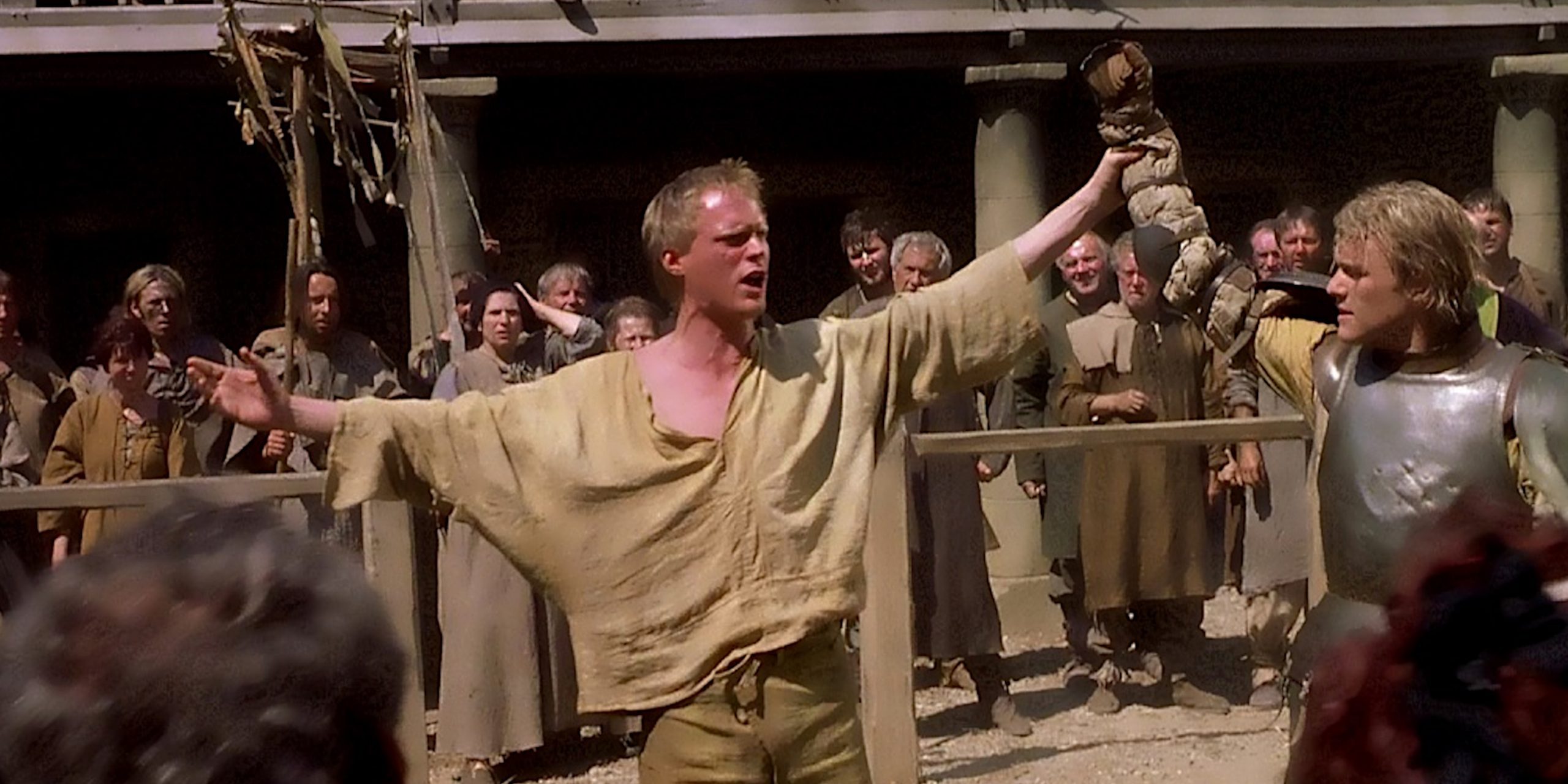
Among the colourful cast of A Knight’s Tale, Geoffrey Chaucer, played by Paul Bettany, delivers some of the most memorable speeches in the film. With theatrical flair and poetic absurdity, his words stir crowds, inspire fear in rivals, and cement William Thatcher’s reputation. While some moments lean more toward cheeky bluster, others genuinely elevate the drama of the tournament. Here is every notable Chaucer speech, ranked from mild to truly epic.
6. “And one more thing… I’m terribly naked.”
Context: Introduced in a most unfortunate state, Chaucer first appears walking starkers along the road, robbed and disgraced by gambling debts.
This is less a speech and more a pitiful ramble, but it introduces his gift for self-deprecation and sarcasm. It sets the tone for his role: a man with wit, literary flourishes, and a worrying tendency toward self-destruction. It’s amusing and tragic in equal measure, but hardly his most stirring moment.
5. “Pain. Lots of pain.”
Context: Used to intimidate competitors with vague menace during William’s entrance.
This line comes during one of Chaucer’s mid-tournament provocations. It’s short, almost throwaway, but delivered with relish. It lacks substance or poetry, but his gusto is evident. While not profound, it helps sustain William’s image as a looming threat.
4. “You may feel a tingling in your feet… a distant thunder…”
Context: One of his more experimental flourishes before a joust, combining mystery with melodrama.
This speech is playful, deliberately obscure, and clearly made up on the spot. Its strength lies in Chaucer’s confidence rather than the content. The crowd doesn’t always follow, but they don’t need to. It captures his style, part bard, part conman, and adds levity in the middle of high-stakes competition.
3. “You have been weighed, you have been measured, and you have been found wanting.”
Context: Chaucer’s personal taunt to Count Adhemar after a defeat.
This is where his role shifts from comic relief to a true voice of vengeance. Delivered coldly and with perfect timing, it echoes Biblical phrasing and hits harder than any lance. It shows Chaucer’s loyalty to William and his ability to cut deeper with words than others can with weapons. A devastating line that lingers long after the dust settles.
2. “I give you the seeker of serenity, the protector of Italian virginity, the enforcer of our Lord God…”
Context: One of his most absurd and verbose introductions for William, full of fabricated titles and religious nonsense.
This one is pure theatre. Chaucer’s booming exaggeration turns William into a myth. It’s entirely false, of course, but the spectacle delights the crowd. Bettany leans into every syllable, pacing like a preacher while the stands erupt. It’s unhinged, joyous, and brilliantly satirical.
1. “Behold his glory, and be ashamed!”
Context: Final tournament. Chaucer’s voice opens the scene, as William returns to the lists with his name finally restored.
This is Chaucer at full command, elevating his friend’s return into something transcendent. It is no longer about trickery or borrowed titles. William rides not under a false name but as himself. Chaucer’s speech reflects that change, less comic and more reverent, with genuine pride in his voice. It brings the story full circle and captures the heart of the film. Of all his moments, this one rings loudest.
The Seven Swords takeaway
Chaucer’s speeches shift with the film’s tone. At first, they are flamboyant distractions, helping William fabricate a new identity. As the story progresses, they become expressions of loyalty, defiance, and truth. Bettany’s delivery elevates even the smallest lines, turning a wandering poet into one of the most memorable figures in a medieval sports drama. From bawdy wordplay to righteous declarations, Chaucer’s tongue is as sharp as any sword on the field.