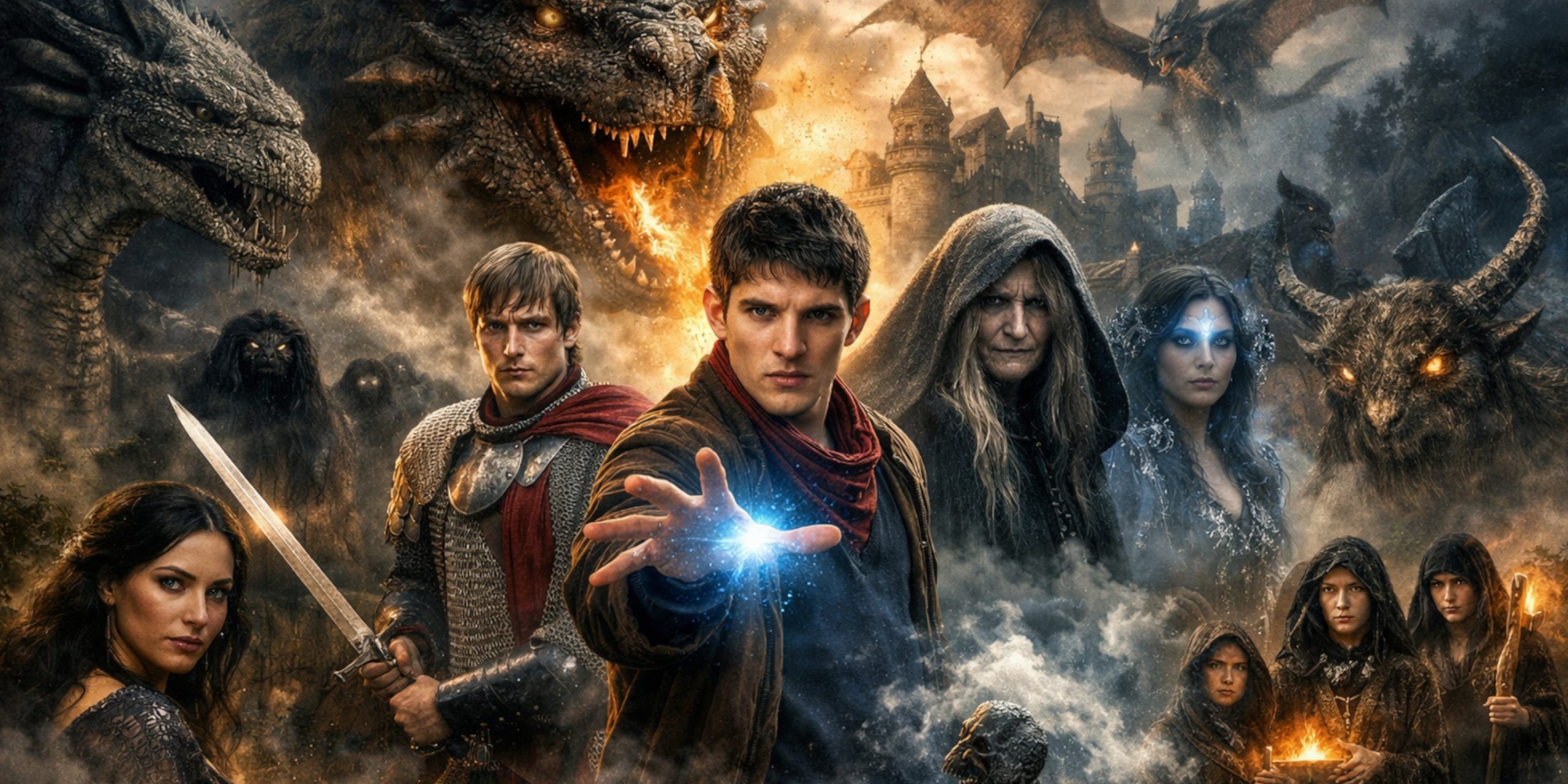
The world of Camelot in Merlin is not just swords, destiny and suspiciously dramatic torch lighting. It is packed with creatures that range from majestic to mildly traumatic. Some are ancient guardians. Some are chaos in reptile form. All of them matter.
What I love about the show is that its magic never feels decorative. Every creature carries weight. They shape politics, prophecy and, occasionally, Arthur’s blood pressure.
Here are the ten that left the biggest mark.
The Great Dragon, Kilgharrah
Kilgharrah is not simply a dragon. He is the dragon. Ancient, bitter and disturbingly patient.
Voiced by John Hurt, he functions as Merlin’s reluctant mentor and moral warning system. His advice often comes wrapped in prophecy and light emotional manipulation.
Focus points:
- Last of the dragonlords’ age
- Speaks in prophecy and riddles
- Represents the cost of Uther’s purge
- Walks the line between ally and threat
He is terrifying, yes, but also tragic. A creature shaped by persecution and vengeance. Camelot would not exist without him, and it nearly burns because of him.
The Dragonlord’s Power
Not a creature in the usual sense, but the dragonlord bloodline unlocks control over dragons. That power changes everything.
When Merlin realises he can command Kilgharrah, the balance shifts.
Focus points:
- Ancient magical lineage
- Overrides dragon autonomy
- Symbol of inherited responsibility
- One of Merlin’s most dangerous abilities
It is less flashy than fire and lightning, but arguably more consequential.
The Questing Beast
Appearing early in the series, this creature feels pulled straight from Arthurian folklore.
It hunts with purpose. It stalks rather than charges. The forest becomes its territory, not Camelot’s.
Focus points:
- Based on Arthurian legend
- Symbol of untamed magic
- Forces Arthur to confront fear
- Reinforces the danger beyond the city walls
It reminds us that Camelot is an island of order in a wild and ancient world.
The Sidhe
Elegant. Manipulative. Politically terrifying.
The Sidhe masquerade as ethereal allies but operate with cold calculation. Their attempt to bind Arthur to their realm is one of the show’s most unsettling plots.
Focus points:
- Otherworldly magical race
- Masters of illusion and glamour
- Threaten Camelot through marriage politics
- Reflect the seductive side of magic
They are proof that not all monsters roar.
The Lamia
The Lamia feeds on devotion and warps perception. It weaponises loyalty.
Watching hardened knights turn irrational is genuinely disturbing.
Focus points:
- Feeds on emotional attachment
- Causes paranoia and division
- Tests Arthur’s leadership
- Explores vulnerability within brotherhood
It is less about claws and more about psychological decay.
The Cailleach
Guardian of the veil between life and death, the Cailleach is not evil. She is inevitable.
Her scenes are heavy with fate.
Focus points:
- Keeper of the spirit world
- Embodiment of inevitability
- Connects to Morgana’s arc
- Reinforces the cost of tampering with life and death
She feels ancient in a way that predates Camelot entirely.
The Dorocha
Shadow creatures unleashed from the veil, the Dorocha are relentless.
They do not negotiate. They advance.
Focus points:
- Born from the spirit world
- Nearly unstoppable without magic
- Force open conflict with Morgana
- Raise the stakes for the kingdom
Visually simple, narratively devastating.
The Wyvern
A dragon’s lesser cousin, but no less lethal.
Its attack on Camelot proves that Uther’s purge did not erase magical threats.
Focus points:
- Corrupted magical origin
- Physical threat to the city
- Early demonstration of Merlin’s intervention
- Echo of dragon mythology
Sometimes a creature exists simply to remind you that walls are not enough.
The Catha
The Catha speaks truth, and truth is dangerous in Camelot.
When Merlin encounters it, we see him confronted by destiny stripped of comfort.
Focus points:
- Forest spirit with prophetic knowledge
- Challenges Merlin’s faith in Arthur
- Embodies the burden of foresight
- Ties into the series’ tragic trajectory
It feels less like a monster and more like a reckoning.
The Disir
The Disir are priestesses of the old religion, but they function like something elemental.
They judge. They do not plead.
Focus points:
- Embodiment of ancient magic
- Offer Arthur a final chance at balance
- Tie directly to Camelot’s downfall
- Represent moral crossroads
Their episode is one of the most quietly important in the series.
Seven Swords Takeaway
The creatures in Merlin are not random obstacles. They are narrative pressure points. Each one forces Arthur or Merlin to confront something larger than themselves, power, prejudice, fate, loyalty.
For a show that aired in the late 2000s with BBC budget constraints, it built a surprisingly coherent magical ecosystem. Some CGI has aged. The themes have not.
And honestly, if you can survive five seasons of prophetic dragons and morally complex forest spirits, you deserve a round table seat.
Camelot may have fallen, but its monsters are unforgettable.