The Battle of the Sea Peoples occured on the edge of history and collapse. It is not one neat clash with a tidy date and battlefield. Instead, it is a series of desperate encounters fought by Egypt against migrating and raiding groups during the early twelfth century BC, at the moment when the Bronze Age world was coming apart. Cities burned, trade routes failed, kings vanished from the record, and Egypt found itself staring down an enemy that arrived by land and sea with families in tow.
Our clearest account comes from the reign of Ramesses III, who framed the conflict as a defensive war for survival. As a historian, I always read his inscriptions with one eyebrow raised. Pharaohs rarely wrote memoirs about near misses. Still, when the archaeological record lines up with royal boasting, it deserves attention.
Historical Context
By around 1200 BC, the eastern Mediterranean was in freefall. The Hittite Empire collapsed. Mycenaean palaces were abandoned. Levantine cities from Ugarit to Ashkelon were destroyed or severely disrupted. Egypt remained standing, but only just.
The Sea Peoples were not a single nation. They were coalitions with names like the Peleset, Sherden, Shekelesh, Denyen, Tjeker and Weshesh. Some arrived as raiders, others as migrants looking for land. Ramesses III describes them bluntly as people who had already ruined every land they touched and were now heading for Egypt.
Forces
Egyptian Forces
Egypt fought with a professional core supported by levies and riverine naval units.
| Component | Description |
|---|---|
| Infantry | Spearmen and swordsmen with shields |
| Archers | Composite bow units, decisive in the battle |
| Navy | Oared river and coastal vessels |
| Command | Centralised under royal authority |
Egypt’s strength lay in discipline and coordination. Archers played a decisive role, particularly against ships packed with enemies who had nowhere to manoeuvre.
Sea Peoples Forces
The Sea Peoples were more varied and less formally organised, though clearly effective.
| Component | Description |
|---|---|
| Warriors | Mixed infantry, often heavily armed |
| Ships | Broad, high sided vessels suitable for transport and combat |
| Non combatants | Families, carts, livestock in land columns |
| Leadership | Tribal chiefs rather than kings |
The presence of women and children is not propaganda alone. Archaeology and iconography support the idea of mass movement, not just raiding.
Leaders
Egypt
- Ramesses III
Supreme commander and master of self promotion. To his credit, he did prepare well.
Sea Peoples
- No named leaders survive in the record. This absence frustrates historians but also hints at decentralised leadership rather than a single commander to blame or praise.
Arms and Armour
Egyptian Equipment
- Swords
- Bronze khopesh with forward curving blade
- Straight bronze swords for thrusting
- Missile Weapons
- Composite bows with reed or bronze tipped arrows
- Defensive Gear
- Wooden shields with leather coverings
- Linen corselets for elite troops
- Bronze scale armour for officers
Sea Peoples Equipment
- Swords
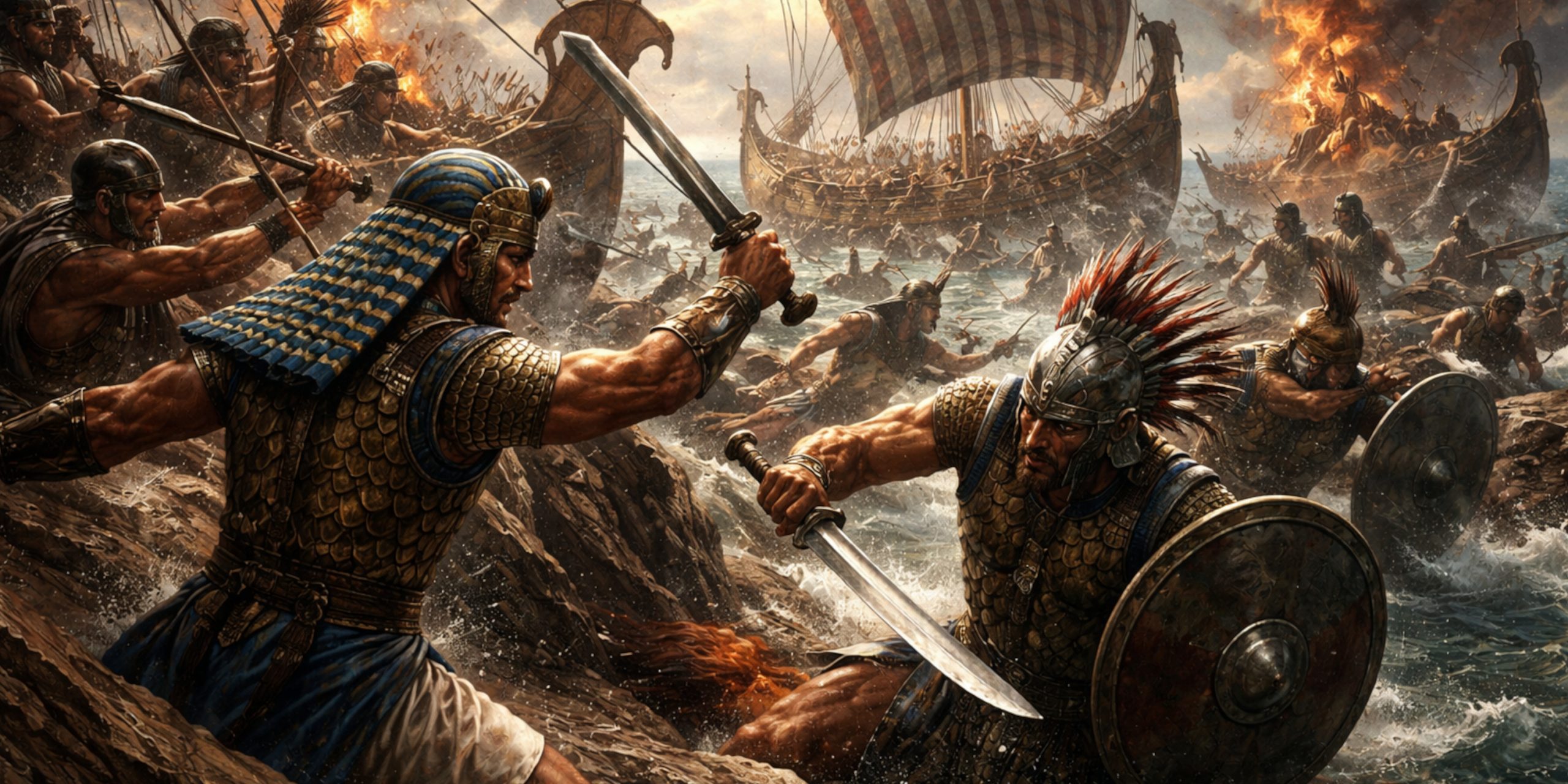
- Naue II type bronze swords, long and straight, ideal for cutting and thrusting
- Early iron blades may have appeared among elite warriors
- Spears and Javelins
- Leaf shaped bronze heads
- Defensive Gear
- Round shields
- Distinctive horned or feathered helmets, particularly among the Sherden
The Naue II sword is one of those weapons historians quietly admire. It survives the Bronze Age collapse because it works and can be made anywhere. There is a lesson in that.
The Battle
The Naval Engagement
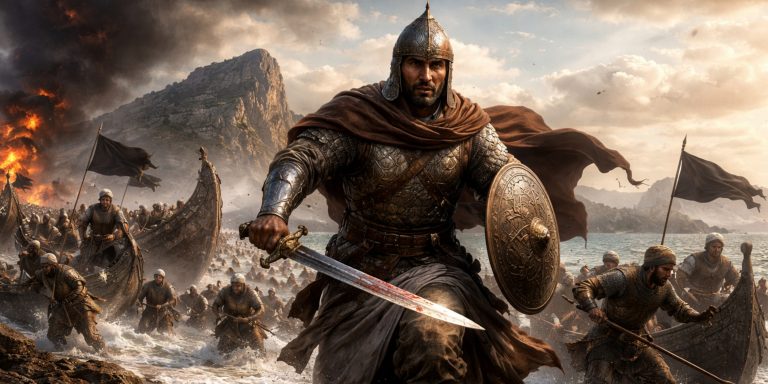
The most famous scenes show a naval battle fought in confined waters, likely near the Nile Delta.
Egyptian ships formed defensive lines close to shore. Archers rained arrows into tightly packed Sea Peoples vessels. Once enemy ships were disabled, Egyptian marines boarded them. It was organised, brutal, and effective.
The Land Engagement
Simultaneously, land forces met migrating groups moving with carts and families. Egyptian troops blocked routes and attacked piecemeal, preventing the Sea Peoples from settling or regrouping.
This was not heroic single combat. It was containment warfare, and Egypt did it well.
Battle Timeline
- c. 1208 BC
Early encounters with Sea Peoples during the reign of Merneptah - c. 1180 BC
Widespread destruction across the eastern Mediterranean - c. 1177 BC
Major Sea Peoples assault on Egypt by land and sea - Aftermath
Egypt repels the invasion but emerges economically strained and politically weakened
Archaeology
The key evidence comes from reliefs and inscriptions at Medinet Habu, Ramesses III’s mortuary temple. They show ships, weapons, armour, prisoners, and battlefield scenes with unusual detail.
Beyond Egypt, destruction layers across Anatolia, the Levant, and Greece support the broader narrative of upheaval. What archaeology does not give us is a single smoking gun. Collapse is messy, and this one refuses to behave like a clean military conquest.
Contemporary Quotes
From the inscriptions of Ramesses III at Medinet Habu:
“Those who came together were confederated in their islands. All at once the lands were on the move, scattered in war.”
Another passage, with typical royal confidence:
“I organised my frontier in Djahi, prepared before them. I was like a wall of bronze.”
As always, take royal metaphors with caution. Bronze walls have a habit of cracking.
Outcome and Legacy
Egypt survived. That alone is significant. However, survival came at a cost. The New Kingdom entered a long decline marked by economic strain, internal unrest, and loss of influence abroad.
The Sea Peoples did not vanish. Some settled in the Levant, most famously the Peleset, often associated with the Philistines. Others disappeared into the archaeological fog, leaving names but no clear descendants.
For historians, the battle marks a hinge point. After it, the Bronze Age world is gone. Trade networks shrink, writing systems disappear in many regions, and warfare changes. Iron slowly replaces bronze, not because it is better at first, but because bronze depends on trade that no longer exists.
Watch the documentary: