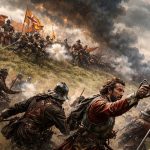
The Battle of St Quentin still feels like one of those moments where the French crown trusted fortune to behave itself, only to discover that she preferred Spanish company that day. For readers who enjoy military history with the occasional wince, St Quentin continues to reward. The town was meant to hold. The relief force was meant to arrive in orderly fashion. Neither obliged.
Forces
French Army
Commander
Anne de Montmorency, Constable of France
Estimated Strength
25,000 to 28,000
Composition
| Unit Type | Notes |
|---|---|
| Gendarmes | Heavy cavalry in plate harness, aristocratic shock arm |
| Picardy and Norman infantry | Pike, halberd and arquebus troops, mixed quality |
| Gascon light cavalry | Faster horse, sabres and pistols for skirmishing |
| German landsknechts in French service | Experienced pike blocks and zweihänder men |
| Artillery | Field pieces supporting the attempted relief of the town |
Habsburg Spanish Imperial Army
Commander
Emmanuel Philibert, Duke of Savoy
Estimated Strength
45,000 to 50,000
Composition
| Unit Type | Notes |
|---|---|
| Spanish tercios | Pike and shot in deep formation, highly disciplined |
| Imperial German infantry | Mixed polearms and shot, reliable and battle hardened |
| Burgundian cavalry | Medium and heavy horse used to pursue broken French lines |
| English auxiliaries | Billmen, pikemen and archers sent under the treaty with Mary I |
| Artillery | Strong siege train and mobile guns supporting the Spanish advance |
Arms and Armour
Weaponry at St Quentin belonged to that peculiar mid sixteenth century world in which armour still clung to the battlefield with stubborn pride while gunpowder carved its slow, smoky path forward. Pikemen eyed arquebusiers with suspicion, cavalry prayed the marshes would not swallow their horses, and swords remained very much in fashion for those planning to stand close enough to use them.
Weapons and Armour Table
| Category | French Forces | Imperial Forces |
|---|---|---|
| Primary Swords | Estocs, longswords, light sabres | Sideswords, espadas roperas, short arming swords |
| Polearms | Pikes, halberds | Pikes, bills |
| Ranged Weapons | Crossbows, arquebuses | Arquebuses, early muskets |
| Cavalry Arms | Sabres, hunting swords, pistols | Sideswords, lances, pistols |
| Armour | Gothic and early Maximilian plate, brigandines | Breastplates, morion helmets, mail collars |
Officer and Elite Equipment
| Rank or Unit | Typical Kit |
|---|---|
| French Gendarmes | Full plate harness, visored helmets, estoc or heavy cavalry sword |
| French Infantry Officers | Part plate, brigandine, longsword or short estoc |
| Spanish Tercio Pikemen | Breastplate, morion, pike and short sword |
| Spanish Arquebusiers | Morion, breastplate, espada ropera as sidearm |
| English Billmen | Mail shirt, kettle hat, arming sword |
Background
France in 1557 found itself worn thin by years of campaigning. Henry II had gambled heavily on diplomatic opportunity, only to find Philip II applying pressure with renewed English support. St Quentin, a fortified town in Picardy, became a strategic hinge in the conflict. It was expected to hold long enough for reinforcements to intervene. As sixteenth century history often reminds us, expectation and reality rarely speak the same language.
The Battle
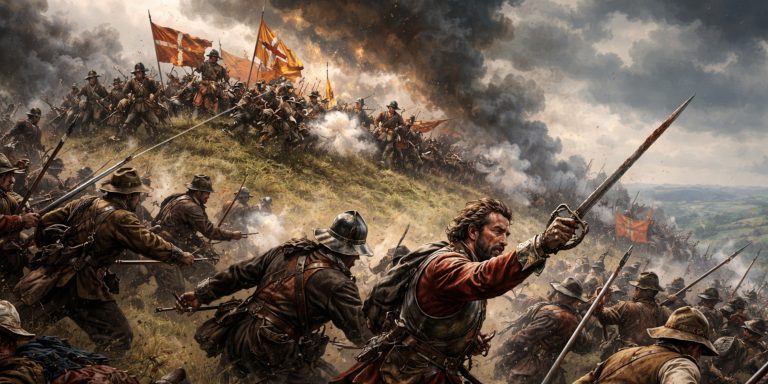
Montmorency’s attempt to relieve the town on 10 August achieved little beyond demonstrating how badly marshland can ruin a timetable. His approach was slowed, the element of surprise evaporated, and the Imperial commanders were ready. Spanish and Imperial cavalry pinned the French centre, the tercios advanced with their usual grim resolve, and the French army sagged under the pressure.
What followed resembled less a heroic stand and more a controlled dismantling of the French line. Thousands were captured, including the Constable himself. Captivity was an indignity he bore with what one imagines was a very tight smile.
Contemporary Quotes
Spanish observer
Our tercios moved upon them with such weight that the field folded before us.
French chronicler
The Constable fought with spirit, but heaven did not favour France that day.
English auxiliary
The smoke clung to the earth, and through it the Spaniards marched as if fashioned from fire.
These accounts hint at the confusion, the pride and the bitter taste left in the mouths of those who survived.
Archaeology
Archaeology at St Quentin has been sporadic, yet fragments continue to surface. Lead shot clusters line up neatly with the documented firing zones of the Imperial advance. Collapsed firing platforms near the old walls suggest French gunners attempted a defence before the final breach. The occasional sword fragment or buckled breastplate clasp confirms the ferocity of close combat, although no singular treasure has emerged.
Local collections hold several recovered buckles and misfired shots, each one a small reminder that this quiet ground once hosted a decidedly noisy afternoon.
Battle Timeline
Early August
Imperial forces surround St Quentin and strengthen their siegeworks.
9 August
Montmorency marches to relieve the town but loses time in the marshes.
10 August, morning
French probes begin against the besieging lines. Coordination proves difficult.
10 August, midday
Imperial cavalry strike the French flank. Tercios push steadily forward, firing in organised volleys.
10 August, afternoon
French lines collapse. Montmorency is captured. Survivors retreat toward La Fère.
Following days
St Quentin falls. Imperial troops storm the town, causing heavy destruction and civilian suffering.
Aftermath and Legacy
Philip II and Emmanuel Philibert enjoyed a notable victory, though one they were unable to exploit fully. France, despite licking its wounds, recovered quickly enough to negotiate peace at Cateau Cambrésis. England briefly enjoyed a rare martial success, the glow of which faded rapidly once Calais slipped away soon after.
St Quentin stands as a reminder that strategy is often humbled by terrain, timing and the stubborn refusal of an army to do what its commander had in mind.
Watch the documentary: