The Battle of Rocroi, fought on 19 May 1643, is one of those rare clashes where you can almost hear the hinge of history turning. For more than a century, Spanish infantry had been regarded as nearly invincible. Then a 21 year old French commander met them on a damp field near the Ardennes frontier and proved that reputation was not the same thing as reality.
It was not merely a battlefield victory. It marked the beginning of the end of Spanish military dominance in Europe and the rise of France as the pre-eminent continental power. As a historian, I find Rocroi fascinating because it exposes the moment when an old system met a new one and could not quite keep up.
Strategic Context
The battle took place during the later phase of the Thirty Years’ War. Spain, ruled by Philip IV of Spain, was attempting to relieve pressure on its positions in the Spanish Netherlands. France, under the guidance of Cardinal Richelieu and then Cardinal Mazarin, had committed itself to breaking Habsburg power.
The French army was commanded by the young Louis II de Bourbon, then known as the Duc d’Enghien. Opposing him was the experienced Spanish commander Francisco de Melo.
Spain aimed to besiege Rocroi, a fortress guarding the French frontier. Enghien marched rapidly to intercept. What followed was not a siege but a full scale pitched battle.
The Battlefield
Rocroi lay near wooded terrain with open fields suitable for cavalry manoeuvre. The ground was slightly undulating and damp. Spanish forces deployed in their traditional deep infantry blocks, the famous tercios, supported by cavalry on the flanks. The French adopted a more linear formation, with flexible infantry brigades and aggressive cavalry wings.
The terrain allowed cavalry to play a decisive role, and Enghien used that fact ruthlessly.
Forces
French Army
| Component | Estimated Strength | Notes |
|---|---|---|
| Infantry | 15,000 to 17,000 | Organised in brigades |
| Cavalry | 6,000 to 7,000 | Highly aggressive deployment |
| Artillery | 14 to 20 guns | Mobile field pieces |
Leaders
- Louis II de Bourbon, Duc d’Enghien
- François de l’Hospital
- Jean de Gassion
Spanish Army
| Component | Estimated Strength | Notes |
|---|---|---|
| Infantry | 18,000 to 20,000 | Core tercios plus German and Italian units |
| Cavalry | 5,000 to 6,000 | Mixed quality |
| Artillery | 18 guns | Defensive positioning |
Leaders
- Francisco de Melo
- Count of Isenburg
- Marquis of Fontaines
The Spanish infantry included veteran tercios who had served across Europe. Their reputation alone was formidable. That reputation would be tested severely.
Arms and Armour
Infantry Weapons
Spanish Tercios
- Pike, typically 16 to 18 feet in length
- Matchlock musket
- Sidearms such as the Spanish cup hilt rapier
- Short arming swords for close work
French Infantry
- Matchlock musket
- Pike
- Early plug bayonet experiments in limited form
- Hangers and short infantry swords
Cavalry Weapons
- Wheel lock or flintlock pistols
- Heavy cavalry broadswords
- Rapiers among officers
- Breastplates and buff coats
By 1643, full suits of armour were rare. Most cavalry wore cuirasses and open helmets. Infantry often fought in little more than a buff coat and morion or felt hat. Protection had been sacrificed for mobility and firepower.
The sword remained important. Spanish officers favoured complex hilt rapiers with cup guards. French cavalry typically carried broader cutting swords better suited to shock action.
The Battle Timeline
Early Morning
Spanish forces deploy in depth. The tercios form dense central squares. French forces mirror them but with shallower formations.
Opening Phase
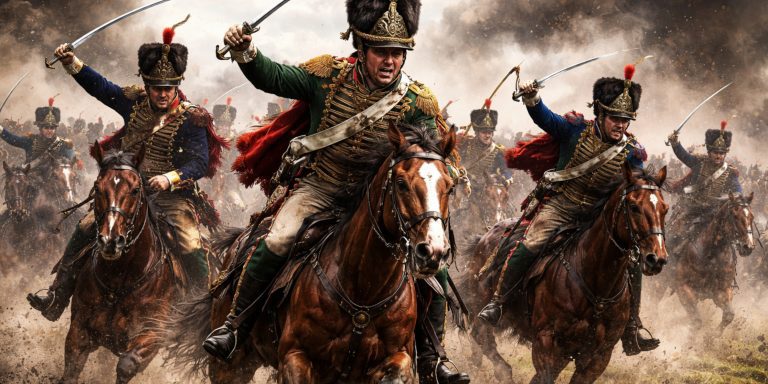
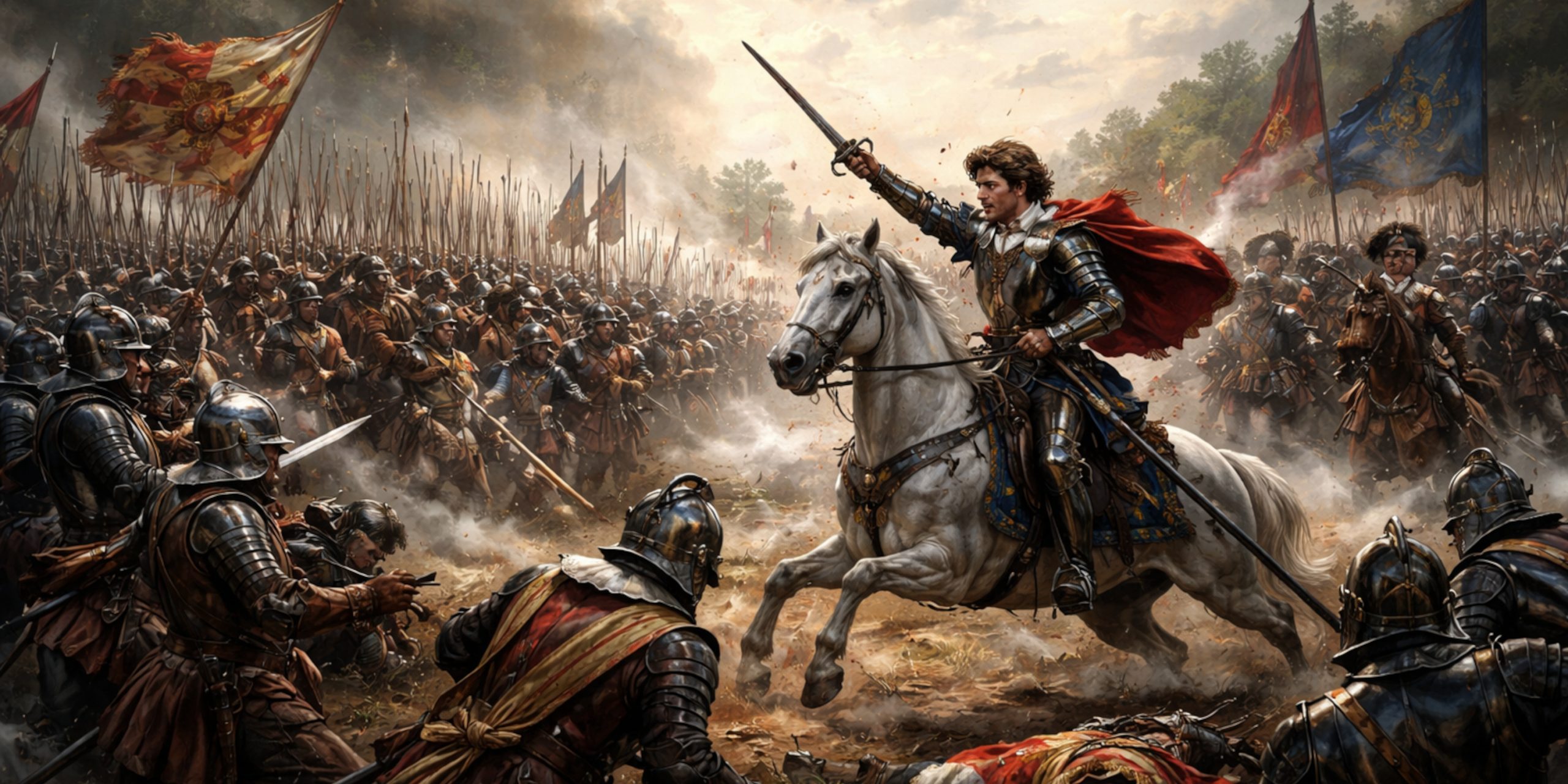
French cavalry on the right, under Enghien’s personal direction, attack the Spanish left. The initial charge succeeds, driving back Spanish horse.
On the French left, matters go poorly. Spanish cavalry counterattack and threaten to roll up the line.
Mid Battle Crisis
Enghien rallies his right wing and wheels inward against the Spanish centre. French cavalry begins to envelop the tercios.
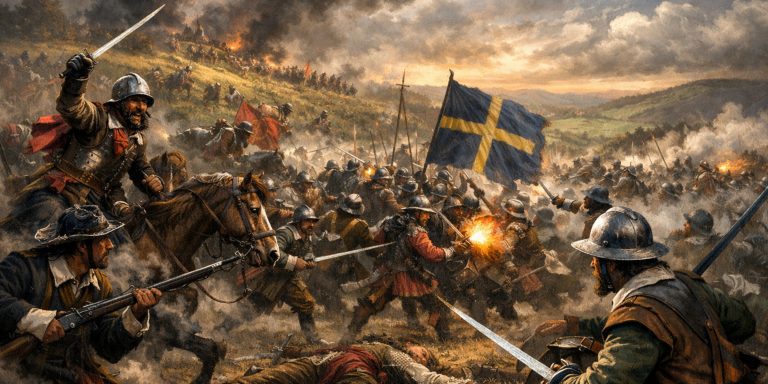
Spanish infantry stand firm, repelling repeated assaults. Contemporary accounts describe them kneeling in ranks, pikes levelled, musketeers firing disciplined volleys.
Final Phase
With Spanish cavalry routed, the tercios are surrounded. They refuse to surrender immediately. After brutal fighting and mounting casualties, most are destroyed or captured.
The battlefield falls silent with the Spanish army effectively shattered.
Contemporary Quotes
A French officer wrote:
“We saw those famous battalions stand like ancient walls, yet even walls may fall when beaten long enough.”
A Spanish survivor reportedly lamented:
“The infantry of Spain died where they stood.”
Such remarks reflect both admiration and grief. Rocroi was not a rout in the early stages. It became one only when isolation made resistance futile.
Archaeology and Material Evidence
Archaeological work in the Rocroi region has uncovered:
- Musket balls deformed by impact
- Pike heads and fragments of polearms
- Buttons and buckles from military coats
- Occasional blade fragments
Such finds confirm the intensity of close quarters fighting. The density of musket balls in certain areas suggests concentrated volleys, particularly where the tercios made their final stand.
Material culture aligns with written accounts. The battle was brutal and personal.
Why Rocroi Mattered
Rocroi did not instantly end Spanish power, but it punctured the myth of invincibility surrounding the tercios. After 1643, European warfare increasingly favoured linear tactics, greater emphasis on coordinated firepower, and flexible manoeuvre.
France emerged with renewed confidence. The young Enghien, later known as the Great Condé, secured his reputation overnight.
Spain continued to fight, yet the psychological shift was profound. Prestige, once lost, is difficult to regain.
Legacy
Rocroi has often been romanticised as the last stand of the old Spanish infantry tradition. That is slightly exaggerated. Tercios continued to serve for years. Yet their dominance was clearly waning.
From a broader perspective, the battle symbolises a military transition. Deep pike squares gave way to thinner lines. Cavalry shock regained importance when properly coordinated. Command flexibility mattered more than rigid doctrine.
If one were feeling poetic, one might say Rocroi marked the twilight of one military age and the dawn of another. I will resist being too poetic, but the point stands.
Takeaway
The Battle of Rocroi was more than a clash of armies. It was a confrontation between systems. The Spanish tercios, proud and formidable, faced a French army willing to adapt and exploit weakness.
The result reshaped European power politics and military doctrine. For historians, Rocroi remains compelling because it captures a rare and decisive moment when a long held military orthodoxy finally cracked under pressure.
It reminds us that no formation, however celebrated, is immune to change.