The Battle of Reading, fought in early January 871, sits at a fascinating point in the long struggle between the Anglo-Saxon kingdoms and the Viking Great Heathen Army. It was not the largest clash of the age, nor the most decisive, yet it carries the unmistakable feeling of a campaign turning grim.
By 871 the Viking invasion had already smashed Northumbria and East Anglia. Wessex, the last major Anglo-Saxon kingdom standing between the raiders and total domination, now faced a seasoned army that had spent years campaigning across England.
Reading, strategically placed where the River Kennet meets the Thames, became the Viking forward base. When the Saxons attempted to drive them out, the result was a sharp and costly defeat.
It also marked the beginning of a brutal series of battles that would define the early career of Alfred the Great.
Background
The Great Heathen Army, a coalition of Scandinavian warbands led by experienced Viking commanders, had landed in England in 865. Within a few years it dismantled two Anglo-Saxon kingdoms.
In late 870 the army marched into Wessex, the final major target.
The Vikings seized Reading and quickly fortified the town. Earthworks and ramparts were raised between the rivers, creating a defensible base from which raids could strike deeper into Wessex.
The Saxon response came swiftly.
A force led by Ealdorman Æthelwulf of Berkshire marched to challenge the Viking position before the invaders could consolidate.
The resulting fight was chaotic, fierce, and ultimately disastrous for the defenders.
Forces
Precise numbers are unknown, as usual with early medieval battles. Contemporary chronicles prefer drama over accounting.
Historians generally estimate a few thousand fighters on each side.
| Army | Estimated Strength | Composition |
|---|---|---|
| West Saxons | 1,500 to 3,000 | Fyrd militia, household warriors, local levies |
| Viking Great Heathen Army | 2,000 to 4,000 | Scandinavian raiders, professional warbands, shield-wall infantry |
Key Leaders
West Saxons
- Æthelwulf of Berkshire, Ealdorman and regional commander
- Possible involvement of King Æthelred of Wessex and Prince Alfred, though not directly commanding at Reading
Vikings
- Halfdan Ragnarsson, reputed commander of Viking forces
- Bagsecg, another prominent Viking leader mentioned in chronicles
The Viking leadership structure likely involved multiple jarls commanding their own contingents rather than a single central general.
Arms and Armour
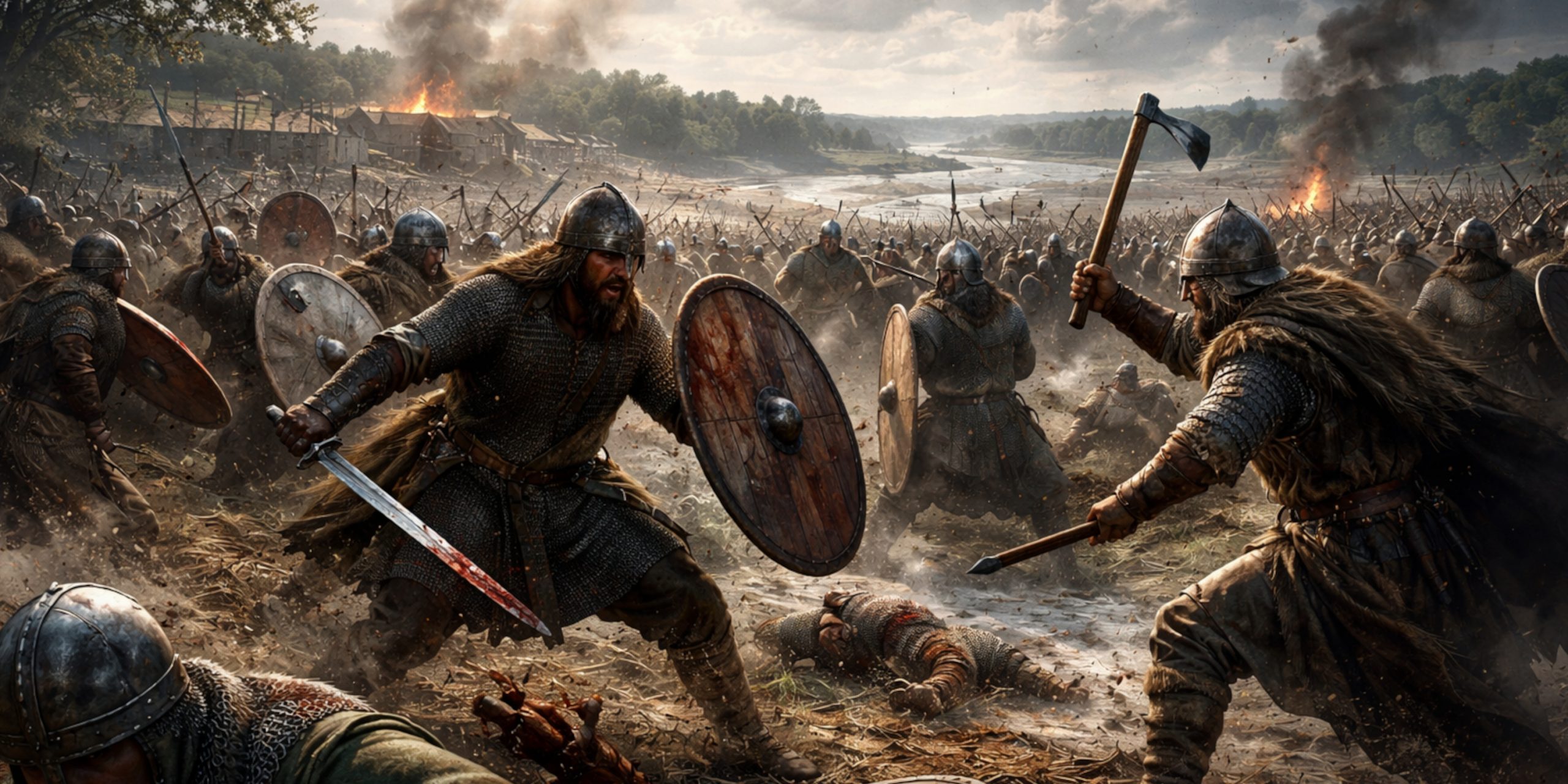
The combatants at Reading fought in a style familiar across northern Europe in the ninth century. Battles revolved around dense infantry formations, most notably the shield wall.
Weapons were brutal, reliable, and designed for close combat.
Common Weapons
Anglo-Saxon forces
- Pattern-welded Viking Age swords (often Petersen types H and K)
- Spears and throwing spears
- Seaxes, the distinctive Anglo-Saxon long knife
- Round wooden shields with iron boss
Viking warriors
- Viking swords such as Petersen Type H and Type S
- Broad-bladed spears
- Axes including the early bearded axe
- Round shields painted in bright colours
Armour and Equipment
- Mail shirts worn by wealthier warriors
- Conical iron helmets, often with nasal guard
- Leather or padded tunics for poorer fighters
- Thick wool cloaks, not fashionable but useful in January weather
The average fighter relied heavily on a spear and shield. Swords were expensive, prized possessions. Losing one was not merely embarrassing, it was financially painful.
Battle Timeline
Viking Occupation of Reading
The Great Heathen Army captures Reading and constructs fortifications between the rivers Kennet and Thames.
Saxon Advance
Æthelwulf gathers a local force from Berkshire and marches to challenge the Viking position.
Initial Engagement
The Saxons encounter Viking troops outside the fortifications. A fierce clash develops near the town.
Viking Counterattack
The main Viking army launches a coordinated counterattack from the fortified camp.
Saxon Collapse
The Saxon line begins to break. Ealdorman Æthelwulf is killed during the fighting.
Viking Victory
The remaining Saxon forces retreat. The Vikings retain control of Reading.
Archaeology
Direct archaeological evidence from the battle itself is limited, which is common for early medieval conflicts.
However, several discoveries around Reading and the Thames Valley help illuminate the broader context of Viking activity.
Finds in the region include:
- Viking-era weapon fragments
- Anglo-Saxon spearheads
- Scandinavian coins and hacksilver
- Evidence of early medieval fortifications
Some scholars believe the Viking earthworks described in the chronicles may correspond with defensive structures discovered during later excavations near the historic town centre.
The rivers themselves played a major role in the battle’s geography. Anyone who has walked the confluence of the Kennet and Thames can quickly see why the Vikings chose it. It forms a natural defensive pocket, which makes attacking forces look slightly optimistic.
Contemporary Quotes
The Anglo-Saxon Chronicle gives the most important surviving account of the battle.
“The Danes came to Reading in Wessex and there pitched their camp.”
The chronicle then describes the Saxon attempt to drive them out and the loss of their commander.
“There was Ealdorman Æthelwulf slain.”
The entry is brief and almost blunt in tone. Medieval chroniclers often wrote like accountants of tragedy. Events are listed, deaths recorded, and the reader is left to imagine the chaos.
Consequences
The defeat at Reading was not the end of Wessex resistance. If anything, it triggered a furious response.
Just four days later the Saxons fought the Battle of Ashdown, where Prince Alfred and King Æthelred managed to defeat the Vikings.
Yet the campaign of 871 remained brutal and uncertain.
Several more battles followed in rapid succession. Both sides suffered heavy casualties. Victory swung back and forth like a door in a storm.
In the long view of history, Reading matters because it shows how precarious Wessex’s survival really was. Alfred the Great would eventually halt Viking expansion, but at this stage he was a young commander watching experienced men fall around him.
That is rarely the beginning anyone hopes for in a military career.
Legacy
Today the Battle of Reading is overshadowed by later and more famous clashes such as Ashdown or Edington. Yet it marks the opening chapter of one of the most important campaigns in English history.
The battle highlights several truths about the Viking Age:
- Viking armies were highly mobile and strategically aware
- Anglo-Saxon defences relied heavily on rapid local mobilisation
- Even small defeats could have enormous political consequences
Reading itself would grow into a prosperous medieval town. The rivers that once shielded Viking warriors now host rowing clubs and riverside pubs.
History has a habit of doing that. Places that once rang with the noise of shields eventually settle into quiet afternoons and dog walkers.
Which is probably for the best.