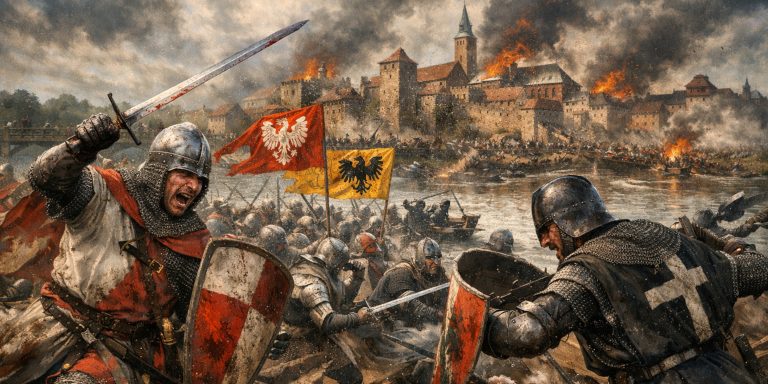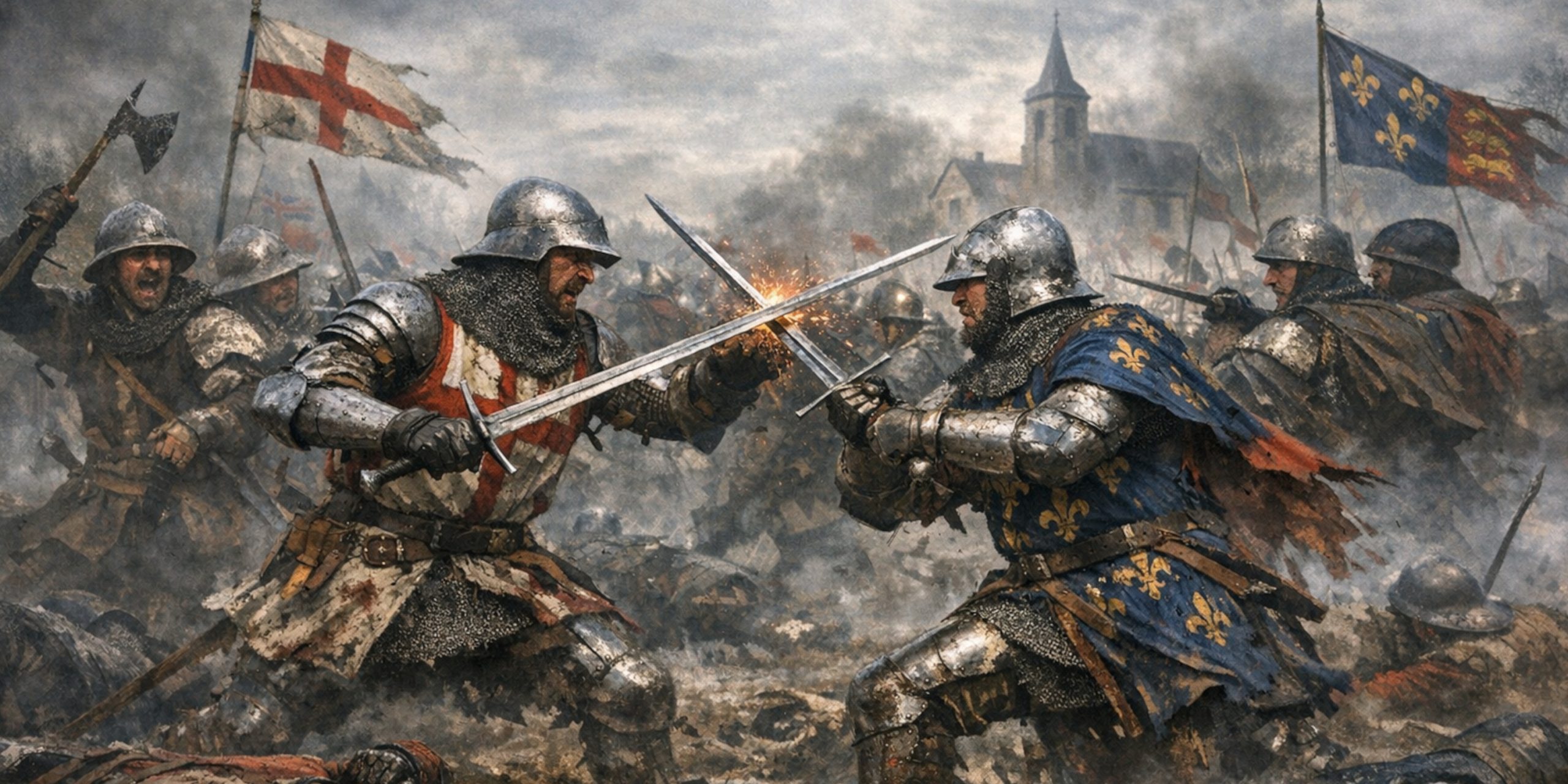
The Battle of Pontvallain, fought on 4 December 1370, rarely receives the same attention as Crécy, Poitiers or Agincourt. That is a pity, because Pontvallain marked one of the most important turning points of the Hundred Years’ War. Here, the French finally proved that they had learned from earlier disasters. Instead of obligingly riding into a hail of English arrows or allowing themselves to be dragged into another ruinous pitched battle, they struck quickly, unexpectedly and with a refreshing lack of concern for English notions of fair play.
The result was a sharp French victory under Bertrand du Guesclin against the English forces of Sir Robert Knolles. It ended one of England’s last great chevauchées of the period and helped begin the steady French recovery under King Charles V.
Where and When Was the Battle of Pontvallain?
Pontvallain lies in modern Sarthe, in north-western France, south of Le Mans. In late 1370 the region became the stage for an English raid led by Robert Knolles. His army had marched through northern France in the traditional English style, burning villages, plundering the countryside and hoping to provoke the French into another grand battle.
By December, however, the English force had become stretched out and divided. Knolles and his captains were arguing, which in medieval armies was about as reliable as rain in Yorkshire. Several detachments had separated from the main body, leaving them dangerously exposed.
The French seized their chance.
Background to the Battle
After the Treaty of Brétigny in 1360, England held vast territories in France. Yet by the late 1360s the political situation had changed dramatically. King Charles V of France, often overshadowed by his more theatrical predecessors, proved to be a patient and intelligent ruler.
Rather than throwing French armies into disaster, Charles relied on attrition, local resistance and experienced commanders. Chief among them was Bertrand du Guesclin, the Breton knight whose appearance was apparently so unimpressive that chroniclers often felt obliged to mention it. Fortunately for France, his military skill was considerably better than his portrait.
In 1370, King Edward III sent Sir Robert Knolles into France with a large mounted force. Knolles was a seasoned commander, famous for hard campaigning and harder manners. Yet his expedition quickly ran into problems:
- French forces avoided battle
- Supplies became scarce
- The English army dispersed across a wide area
- Rivalries developed between Knolles and his sub-commanders
The French watched carefully, then struck when the English were weakest.
Forces
English Army
The English force probably numbered between 4,000 and 6,000 men at the start of the campaign, though far fewer were present at Pontvallain itself.
By the time of the battle, the army had split into several groups. The contingent caught at Pontvallain was led largely by Sir Thomas Grandison, Sir Hugh Calveley and other captains, with perhaps 1,200 to 2,000 men.
| English Leaders | Role |
|---|---|
| Sir Robert Knolles | Overall commander of the campaign |
| Sir Thomas Grandison | Commander of one of the separated divisions |
| Sir Hugh Calveley | Veteran captain and mercenary leader |
| Walter Fitzwalter | English noble and field commander |
French Army
The French force under Bertrand du Guesclin probably numbered around 3,000 to 4,000 men, including men-at-arms, cavalry and local troops.
| French Leaders | Role |
| Bertrand du Guesclin | Constable of France and overall commander |
| Olivier de Clisson | Breton commander |
| Louis II, Duke of Bourbon | Senior French noble |
| Marshal Arnoul d’Audrehem | Experienced French marshal |
Troop Composition
| Army | Men-at-Arms | Archers/Crossbowmen | Cavalry | Other Troops |
| English | Heavy men-at-arms, mounted knights | Longbowmen | Mounted retainers | Mercenaries and camp followers |
| French | Knights and men-at-arms | Crossbowmen and infantry | Fast cavalry | Breton and local levies |
The French held a crucial advantage in mobility and coordination. The English, scattered across the countryside, resembled less an army and more a collection of unhappy armed tourists.
Battle Timeline
Early November 1370
- Robert Knolles enters northern France with an English raiding army
- French forces shadow the advance but refuse battle
- The English devastate large areas of the countryside
Mid-November 1370
- Disputes emerge among English commanders
- The English army splits into separate columns
- Bertrand du Guesclin gathers French forces near Tours and Le Mans
3 December 1370
- French scouts discover the isolated English detachments near Pontvallain
- Du Guesclin marches rapidly to attack before the English can reunite
4 December 1370: The Battle
- French cavalry and men-at-arms launch a surprise attack on the English camp
- Many English soldiers are caught unprepared
- Some are still attempting to form battle lines while others are searching for horses, armour or perhaps a very late breakfast
- French troops overwhelm the English positions at Pontvallain
- Survivors retreat north towards Vaas and other nearby villages
Aftermath
- The French pursue the fleeing English for several days
- Several smaller actions follow around Vaas and Mayet
- Robert Knolles eventually abandons the campaign and withdraws
How the Battle Was Fought
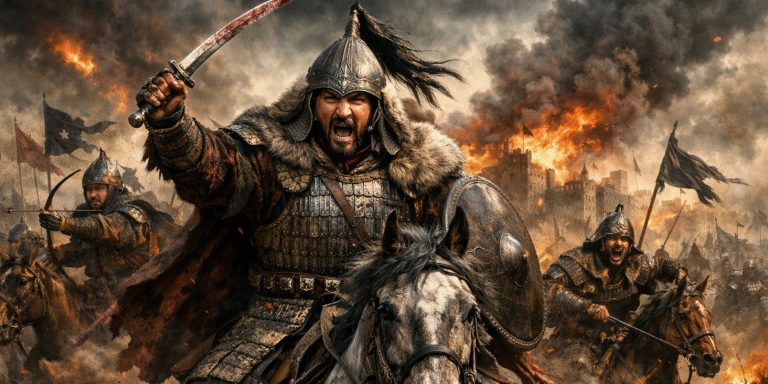
Pontvallain was not a formal set-piece battle in the style of Crécy or Poitiers. There were no carefully prepared defensive lines or grand speeches about honour. Instead, the French relied on speed, surprise and aggressive pursuit.
Du Guesclin attacked the English while they were divided and off guard. The French cavalry moved quickly through the wooded countryside and fell upon isolated groups before they could unite.
The English longbowmen, usually the great strength of English armies, had little chance to establish their usual positions. There was no time to drive stakes into the ground or prepare a proper defensive formation. English men-at-arms fought stubbornly, but they were overwhelmed piecemeal.
This was precisely the sort of battle Charles V wanted. He had no interest in allowing the English another glorious victory sung by chroniclers. He preferred a practical result. Medieval chroniclers, one suspects, found this rather unsporting.
Arms and Armour
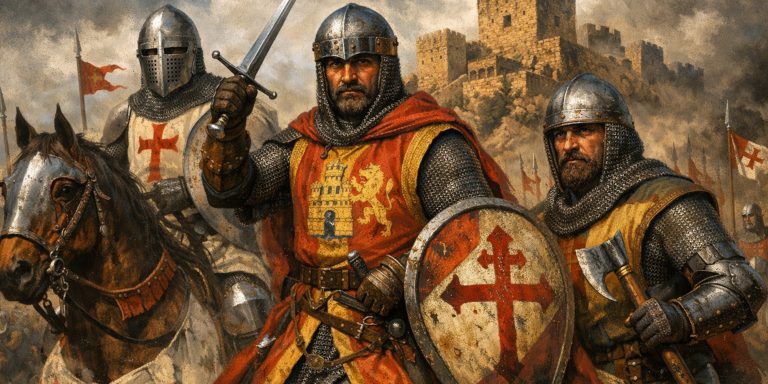
The soldiers at Pontvallain fought in the transitional style of the late fourteenth century, when armour was becoming heavier and more sophisticated, yet still retained elements of earlier mail.
English Arms and Armour
English men-at-arms typically wore:
- Mail hauberk or shirt beneath plate defences
- Breastplate or coat-of-plates
- Steel bascinet with mail aventail
- Plate protection for arms and legs
- Surcoat displaying heraldic colours
Common English weapons included:
- Longbow
- Lance
- Mace
- War hammer
- Dagger
Specific sword types likely used by English men-at-arms included:
- Oakeshott Type XV arming sword, suited for thrusting against plate armour
- Oakeshott Type XVI longsword, offering both cutting and thrusting ability
- Falchion, often favoured by soldiers and mercenaries for brutal close fighting
French Arms and Armour
French men-at-arms were similarly equipped, though some Breton and French knights were slightly more heavily armoured.
French equipment commonly included:
- Bascinet with visor
- Coat-of-plates or early breastplate
- Full mail chausses or partial plate leg protection
- Heavy cavalry lance
- Crossbow for supporting infantry
French sword types probably included:
- Oakeshott Type XVa longsword, ideal for mounted and armoured combat
- Oakeshott Type XVIII sword, increasingly popular among knights in the later fourteenth century
- Estoc, a narrow thrusting sword designed specifically to pierce armour gaps
The estoc in particular was becoming more common by this period. It was not an elegant weapon in the romantic sense. It was essentially a long, determined metal spike intended to persuade an opponent that armour was only a temporary inconvenience.
Contemporary Quotes
The battle impressed contemporaries because it showed that the English could be beaten.
The chronicler Jean Froissart wrote of the French attack:
“The French came upon them suddenly, and there was great slaughter.”
Froissart also noted the disorder among the English:
“They were not all together, but scattered abroad in small companies.”
A later French chronicler described du Guesclin’s conduct in admiring terms:
“He knew better than any man how to find his enemy at his weakest moment.”
That may not sound especially chivalrous, but it was undeniably effective.
Archaeology and the Battlefield Today
The exact site of the Battle of Pontvallain remains uncertain. Like many medieval battles, Pontvallain left surprisingly little clear archaeological evidence. The fighting took place across a wide area rather than on one neatly defined field.
Archaeologists and local historians have identified possible locations around Pontvallain, Vaas and the surrounding countryside. Finds from the region have included:
- Medieval horseshoes
- Arrowheads and crossbow bolts
- Fragments of armour and weapon fittings
- Pottery and camp remains associated with military occupation
None of these finds can be tied beyond doubt to the battle itself, which is one of the perpetual frustrations of medieval archaeology. Historians are left piecing together evidence from chronicles, landscape features and the occasional rusted object dug up by an unusually enthusiastic farmer.
The terrain around Pontvallain still helps explain the battle. The countryside is broken by woods, streams and narrow roads, ideal for ambushes and rapid cavalry movement. Looking at the landscape today, it becomes rather obvious why the French chose to strike there.
Why Pontvallain is important in the the larger War.
The importance of Pontvallain goes far beyond the numbers killed or captured.
The battle:
- Ended Robert Knolles’s campaign
- Demonstrated the success of Charles V’s strategy
- Strengthened Bertrand du Guesclin’s reputation
- Showed that England’s old methods no longer guaranteed victory
- Marked the beginning of a wider French recovery in the Hundred Years’ War
In the years after Pontvallain, France steadily regained lost territory. By the end of Charles V’s reign, much of the land won by England after Crécy and Poitiers had been recovered.
Pontvallain was therefore less a dramatic finale and more a quiet revolution. The French had learned patience, coordination and discipline. They had also learned not to fight the English on English terms.
Legacy
Today Pontvallain is often overshadowed by larger and more famous battles. Yet historians increasingly recognise it as one of the decisive engagements of the Hundred Years’ War.
Crécy and Agincourt remain the glamorous battles, full of mud, arrows and doomed French charges. Pontvallain, by contrast, is a battle of planning, timing and cold efficiency. It lacks some of the theatrical qualities beloved by filmmakers and patriotic poets.
Still, wars are not usually won by theatrical qualities. They are won by commanders who notice their enemy has split his army and decide to do something about it.
Bertrand du Guesclin did exactly that in December 1370, and France would benefit from it for decades.
Further Reading
- Jean Froissart, Chronicles
- Jonathan Sumption, The Hundred Years War: Divided Houses
- Christopher Allmand, The Hundred Years War: England and France at War
- Richard Barber, Edward, Prince of Wales and Aquitaine
- Desmond Seward, The Hundred Years War