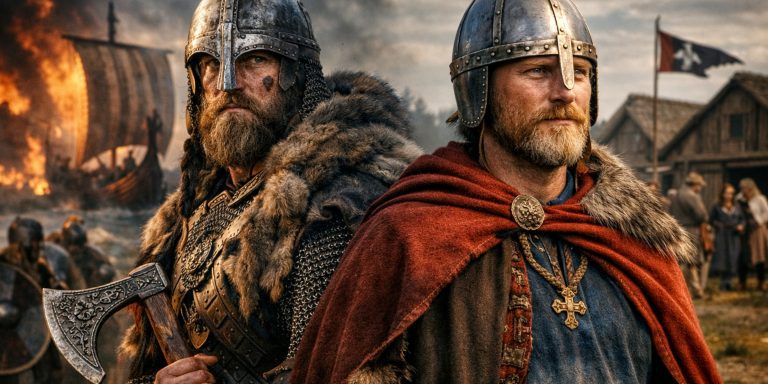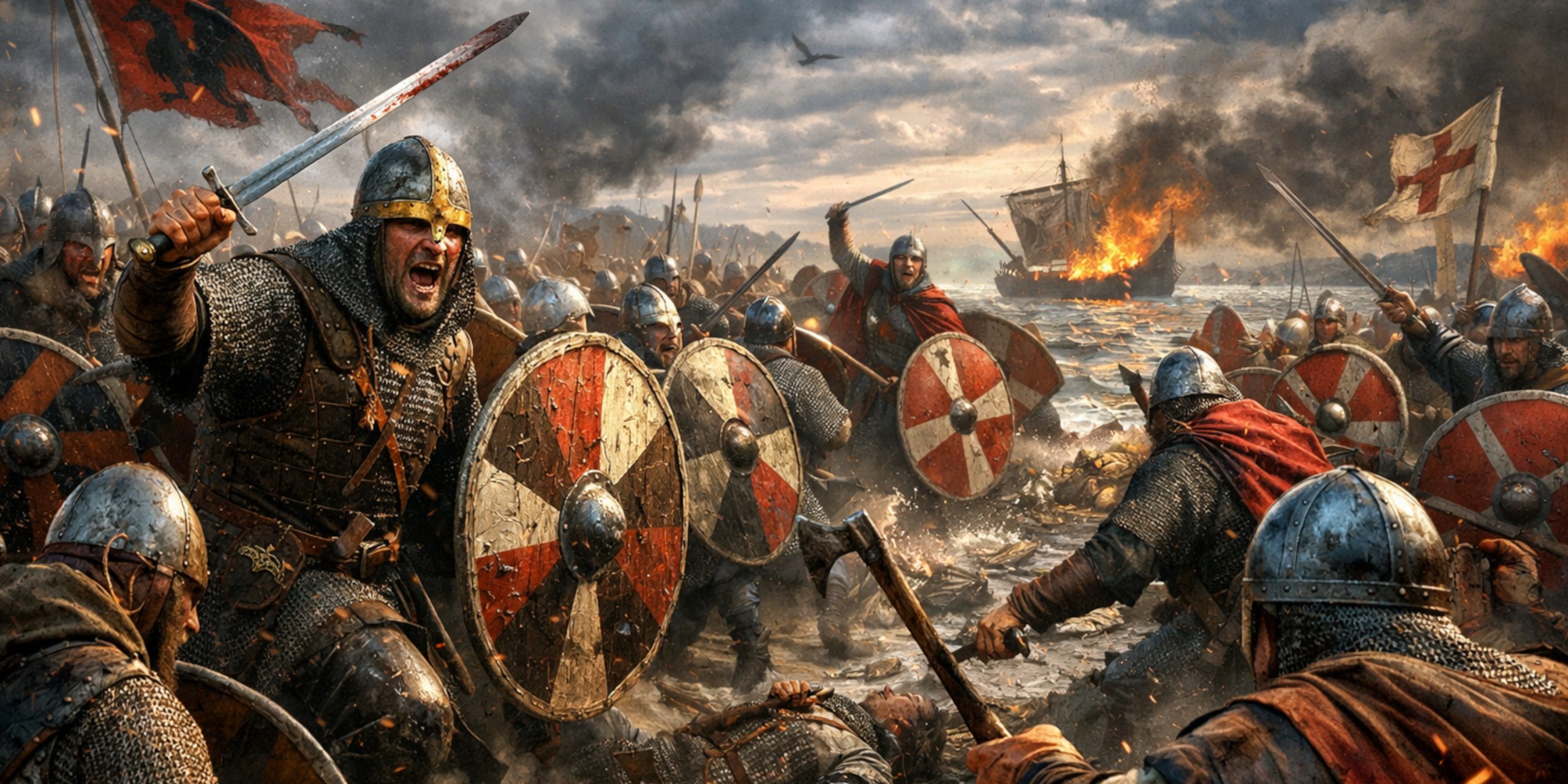
The Battle of Niså in 1062 was one of those Scandinavian confrontations where ambition, pride, and long memories collided in a very damp corner of southern Scandinavia. Fought near the River Niså, likely in Halland, it pitted King Harald Hardrada of Norway against King Sweyn II of Denmark. Both men believed they had a rightful claim to rule the Danish realm, and both were stubborn enough to test that belief with steel rather than diplomacy.
This was not a chaotic Viking raid or a romanticised shield wall at sunset. Niså was a hard, grinding battle between organised royal armies, and it marked the moment when Norway’s ambitions in Denmark finally ran out of momentum.
Historical Background
Harald Hardrada had spent years harassing Denmark after inheriting what he saw as a legitimate claim through earlier agreements with Magnus the Good. Sweyn II, younger but politically sharper, had survived repeated Norwegian incursions and learned when to bend and when to stand firm.
By 1062, Harald wanted a decisive battle to settle the matter once and for all. Sweyn, for once, agreed to meet him head on. That decision would define the political map of Scandinavia for a generation.
Foces
| Side | Commander | Estimated Strength |
|---|---|---|
| Kingdom of Norway | Harald Hardrada | 8,000 to 10,000 |
| Kingdom of Denmark | Sweyn II Estridsson | 6,000 to 8,000 |
The numbers are approximate and come from later saga traditions rather than tidy medieval ledgers. As ever, medieval armies had a habit of growing larger on parchment than they ever were in mud.
Leaders
Norway
- Harald Hardrada, King of Norway
Veteran of the Varangian Guard, professional soldier, and not a man inclined to retreat once committed.
Denmark
- Sweyn II Estridsson, King of Denmark
Politically resilient, cautious when needed, and far better at losing battles than losing kingdoms.
Arms and Armour
The battle was fought by late Viking Age armies transitioning into more medieval forms of warfare. Equipment varied widely depending on wealth and status.
Common equipment
- Round shields with central iron bosses
- Spear as the primary battlefield weapon
- Mail shirts for wealthier warriors
- Conical helmets, often without face protection
Sword types in use
- Viking Age single edged swords, often pattern welded earlier in the period
- Late Petersen Type X and XI swords with broader blades and simpler guards
- Frankish influenced straight double edged swords, increasingly common among elite warriors
Other weapons
- Dane axes, particularly among Norwegian household troops
- Seaxes and long knives as secondary weapons
- Bows used mainly before close engagement
By 1062, swords were status symbols as much as tools of war. Many men carried them. Far fewer used them well once the lines collapsed.
Battle Timeline
Morning
- Both armies assemble near the River Niså.
- Harald Hardrada forms an aggressive forward line, aiming to break the Danish centre quickly.
Midday
- Initial Norwegian success as Sweyn’s forces give ground.
- Danish troops begin an organised withdrawal rather than a rout, a rare show of discipline in saga warfare.
Afternoon
- Harald pushes forward too far, stretching his formation.
- Danish forces counter attack on the flanks, exploiting Norwegian overconfidence.
Late afternoon
- Norwegian army suffers heavy casualties.
- Harald is forced to disengage and retreat, an outcome he personally despised.
Outcome and Consequences
Tactically, Niså was a Danish victory. Strategically, it was even more important. Harald Hardrada abandoned his claim to Denmark shortly afterwards, recognising that further campaigns would bleed Norway without reward.
Sweyn II emerged as the uncontested ruler of Denmark, free to consolidate his kingdom rather than constantly defend it. Harald, meanwhile, turned his attention west. England would feel the consequences just four years later at Stamford Bridge.
One might say Niså saved England from a Norwegian invasion in 1062, only to postpone it until 1066. History enjoys that sort of irony.
Archaeology
No definitive battlefield excavation has been confirmed at Niså, which is frustrating but hardly unusual. Riverine landscapes change, floodplains shift, and medieval armies were very good at dying in places that later became inconvenient to excavate.
Finds from the broader Halland region include:
- Viking Age spearheads and axe heads
- Shield boss fragments
- Occasional sword fittings consistent with late 11th century manufacture
These finds support the general location described in saga sources, even if the exact killing ground remains elusive.
Contemporary Quotes
From Heimskringla, attributed to Snorri Sturluson:
“There was then a hard battle, and many brave men fell, and neither side could boast of easy victory.”
A Danish perspective, later paraphrased in medieval chronicles, dryly notes:
“King Sweyn lost the field, but kept the kingdom.”
Both statements feel accurate. One describes the bloodshed. The other understands politics.
Legacy
The Battle of Niså marked the end of large scale Norwegian attempts to rule Denmark. It also highlighted the limits of personal warrior kingship in an age moving steadily towards bureaucratic rule and dynastic stability.
Harald Hardrada remains the more famous figure, but Sweyn II was the man who quietly won what mattered. Historians tend to admire the former. States tend to survive because of the latter.
Watch the documentary: