Fairfax Breaks the West and the King’s Last Field Army
The Battle of Langport, fought on 10 July 1645, was the sharp, decisive action that ended serious Royalist resistance in the West Country during the First English Civil War. It came only weeks after Naseby and confirmed that the New Model Army was not merely a promising reform, but a machine built to win.
On a ridge near the Somerset town of Langport, Sir Thomas Fairfax demonstrated what discipline, firepower, and well-handled cavalry could achieve against a weary Royalist field army under Lord Goring. The result was not a slaughter on the scale of Naseby, yet it was strategically fatal. After Langport, the King’s western strongholds were living on borrowed time.
Background
Following the Royalist disaster at Naseby in June 1645, Parliament moved swiftly to prevent the King’s remaining armies from regrouping. In the West Country, Lord Goring commanded a sizeable force that had, until then, fought with considerable aggression. His cavalry was feared. His reliability was not.
Fairfax marched south, determined to break Goring before he could threaten Parliament’s communications or reinforce Royalist garrisons at Bristol, Exeter, and beyond. Langport, perched between marshy ground and the River Parrett, offered Goring a defensible position. He chose high ground east of the town, with hedged lanes and narrow approaches that might blunt an attack.
He relied on terrain. Fairfax relied on drill.
Forces
Parliamentarian Army
Commander: Sir Thomas Fairfax
Lieutenant-General of Horse: Oliver Cromwell
Estimated strength: 10,000 to 12,000
Royalist Army
Commander: Lord Goring
Estimated strength: 7,000 to 8,000
Goring’s men were experienced but uneven in discipline. Fairfax’s New Model Army was cohesive, centrally supplied, and increasingly confident.
Leaders and Troop Composition
| Side | Key Leaders | Infantry | Cavalry | Artillery |
|---|---|---|---|---|
| Parliament | Sir Thomas Fairfax, Oliver Cromwell | New Model foot regiments | Ironside cavalry | Light field guns |
| Royalist | Lord Goring, Sir Richard Grenville | Western infantry brigades | Royalist horse | Limited field pieces |
Parliamentarian Strengths
- Well-drilled infantry capable of coordinated volley fire
- Cavalry trained to charge, reform, and charge again
- Effective command structure
Royalist Strengths
- Experienced cavalry officers
- Strong defensive ground
- Local knowledge of terrain
Arms and Armour
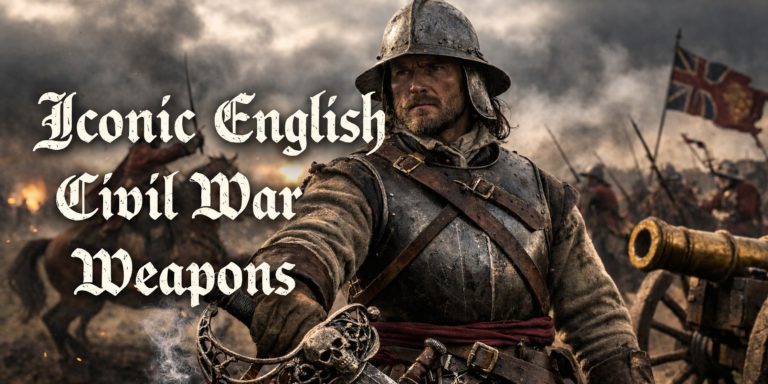
By 1645, the armour of earlier decades was already thinning. Protection had not vanished, but weight and cost were constant concerns.
Infantry
- Muskets with matchlock ignition
- Pike for close protection
- Buff coats
- Steel morion or pot helmets
Cavalry
- Harquebuses and pistols
- Broad cavalry swords
- Partial cuirasses
Specific Sword Types Used
- Basket-hilted backswords
- Early mortuary-hilt swords
- Straight double-edged broadswords suited to mounted combat
Parliamentarian cavalry tended to favour sturdy, serviceable blades designed for thrust and cut in rapid succession. Royalist officers often carried more ornate hilts, sometimes reflecting continental influence. One suspects Goring’s officers appreciated style. Fairfax’s men appreciated efficiency.
The Battle
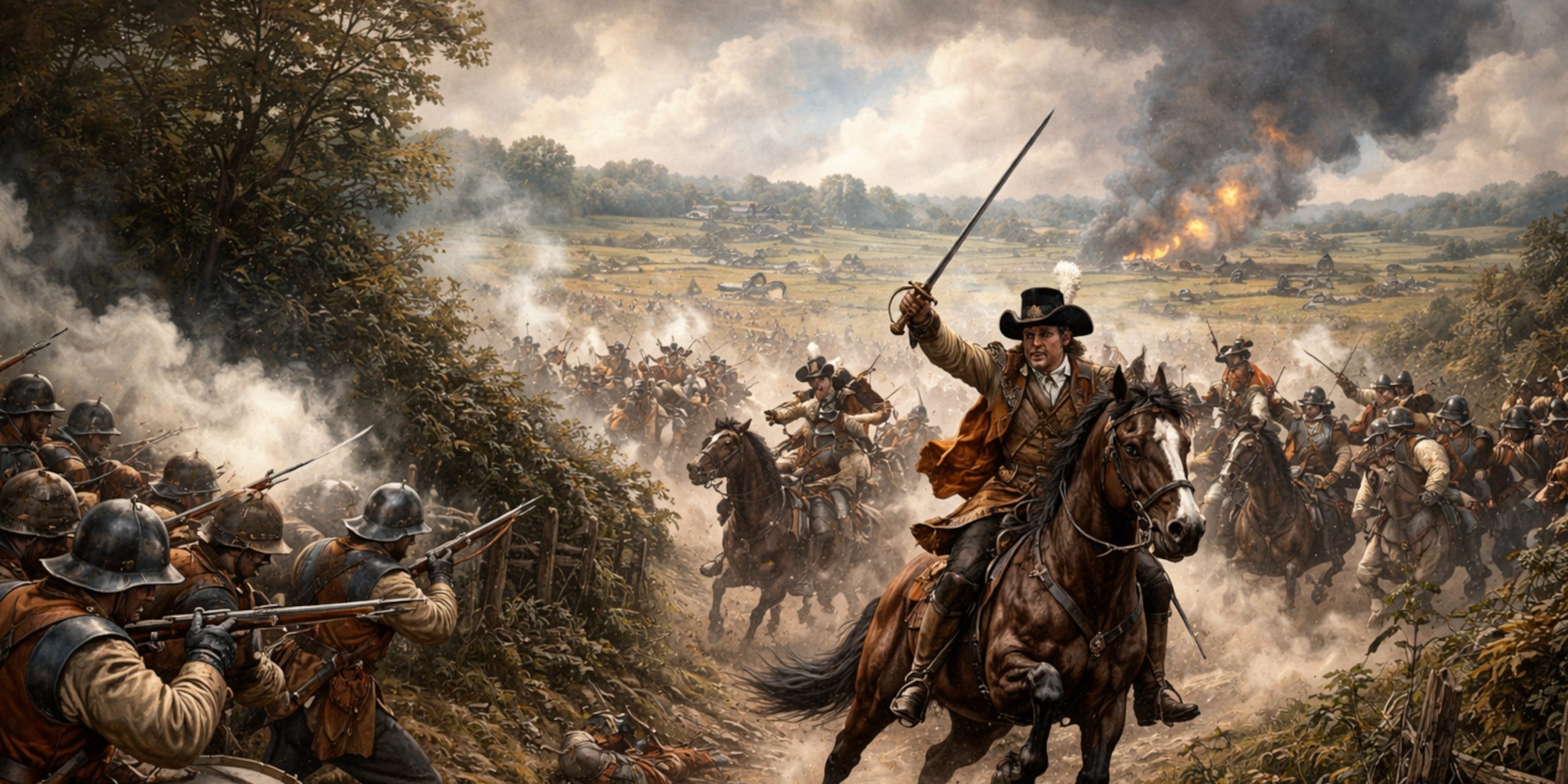
Fairfax attacked along a narrow lane bordered by thick hedges. Royalist infantry initially held firm, using the confined ground to delay the advance. For a moment, it appeared Goring’s choice of terrain might vindicate him.
Then Parliamentarian fire discipline told. Controlled volleys pushed back the defenders. Once the hedges were forced, Cromwell’s cavalry exploited the opening. Royalist horse counter-charged but faltered under sustained pressure.
Goring’s line gave way. The retreat became disordered. Parliamentarian cavalry pursued with methodical aggression. What had been a position of strength turned into a liability as the Royalists were driven from the ridge and scattered across the countryside.
It was not dramatic in the theatrical sense. It was efficient. That, in 1645, was more dangerous.
Battle Timeline
Early Morning
Fairfax positions artillery and prepares the assault along the hedged lane.
Mid Morning
Infantry engage at close quarters. Parliamentarian volleys force Royalist foot to fall back.
Late Morning
Cromwell leads cavalry forward. Royalist horse attempt resistance.
Midday
Royalist line collapses. Pursuit begins.
Afternoon
Royalist forces disperse. Parliament secures the field and the West Country road network.
Contemporary Voices
Edward Hyde, later Earl of Clarendon, observed that Goring’s army was “so broken and disheartened, that it never after made any stand.”
A Parliamentarian officer wrote that the enemy “gave ground apace, and our horse followed with great resolution.”
Such phrases carry the restrained tone of the period, yet beneath them lies a clear truth. The King’s western army was finished as a serious field force.
Archaeology and the Battlefield Today
The landscape around Langport remains largely rural. Fieldwalking and metal detecting, conducted under controlled archaeological conditions, have recovered:
- Musket balls and shot
- Fragments of match and gun hardware
- Occasional sword fittings
The hedged lanes still shape the terrain. Standing there, one can appreciate how confined the approach would have felt under fire. It is a quiet place now. In July 1645, it was anything but.
Aftermath and Significance
Langport opened the way for Parliament to reduce Royalist strongholds in the West. Within weeks, Taunton was secured and Bristol would fall later that year. The King’s capacity to wage conventional field war diminished rapidly.
Strategically, Langport confirmed that the New Model Army was not dependent on a single victory. It could win again, and do so in different conditions. That consistency, rather than a single dramatic clash, sealed the Royalist fate.
As a historian, I find Langport compelling precisely because it lacks the spectacle of Naseby. It is the quiet demonstration of competence. Wars are not only decided by heroic last stands. They are often decided by disciplined advances along muddy lanes.
Goring may have hoped the hedges would save him. They did not.
Seven Swords Takeaway
The Battle of Langport was a decisive Parliamentarian victory that dismantled Royalist resistance in the West Country and accelerated the end of the First English Civil War. Through disciplined infantry fire and coordinated cavalry action, Fairfax and Cromwell delivered a defeat from which the King’s western army never recovered.
It stands as a testament to organisation over improvisation, and to the power of reform when backed by steel.