Wellington Holds the Line on the Spanish Frontier
The Battle of Fuentes de Oñoro, fought from 3 to 5 May 1811, was one of those tense, grinding encounters that rarely makes the front of a school textbook but mattered enormously at the time. It pitted the Anglo Portuguese army under Arthur Wellesley against the Army of Portugal commanded by André Masséna during the Peninsular War.
At stake was the siege of Almeida and, more broadly, control of the Portuguese Spanish frontier. Wellington needed to hold. Masséna needed a breakthrough. What followed was three days of savage fighting around a small Spanish village that neither side would ever forget.
Strategic Background
In early 1811, Wellington had invested the French garrison at Almeida. Masséna, already weakened by his failed invasion of Portugal and the Lines of Torres Vedras, marched to relieve it. His army remained formidable on paper, though worn down by hunger, desertion, and stubborn British resistance.
The ground around Fuentes de Oñoro was deceptive. A ridge ran north south, with the village itself clinging to a shallow valley. To the south lay open ground, dangerously exposed. Wellington anchored his line on the village and the heights, confident but not complacent. He knew the French were capable of a sharp, concentrated strike.
Forces
Anglo Portuguese Army
| Component | Estimated Strength | Notes |
|---|---|---|
| British infantry | 28,000 | Including Guards, Light Division |
| Portuguese infantry | 10,000 | Reorganised under British command |
| Cavalry | 2,000 | Limited but effective screening force |
| Artillery | 38 guns | Well positioned on ridge lines |
Total strength approximately 38,000.
French Army of Portugal
| Component | Estimated Strength | Notes |
|---|---|---|
| French infantry | 36,000 | Veteran units from previous campaigns |
| Cavalry | 3,500 | Strong arm under Montbrun |
| Artillery | 40 guns | Aggressive counter battery use |
Total strength approximately 40,000.
The French held a slight numerical advantage, particularly in cavalry. Wellington, characteristically, relied on ground and discipline rather than bravado.
Leaders and Command Structure
Anglo Portuguese Command
- Arthur Wellesley, Commander in Chief
- Sir Brent Spencer, divisional command
- Major General Robert Craufurd, Light Division
- Major General Stapleton Cotton, cavalry
Wellington was cautious to the point of irritation. He rarely committed reserves early, which sometimes drove subordinates to distraction, though history generally sided with him.
French Command
- André Masséna, overall command
- General Jean Andoche Junot
- General Louis Loison
- General Louis Pierre Montbrun, cavalry
Masséna had once been Napoleon’s favoured strategist. By 1811, he was facing supply shortages, strained relationships with subordinates, and an opponent who simply refused to collapse.
Arms and Armour
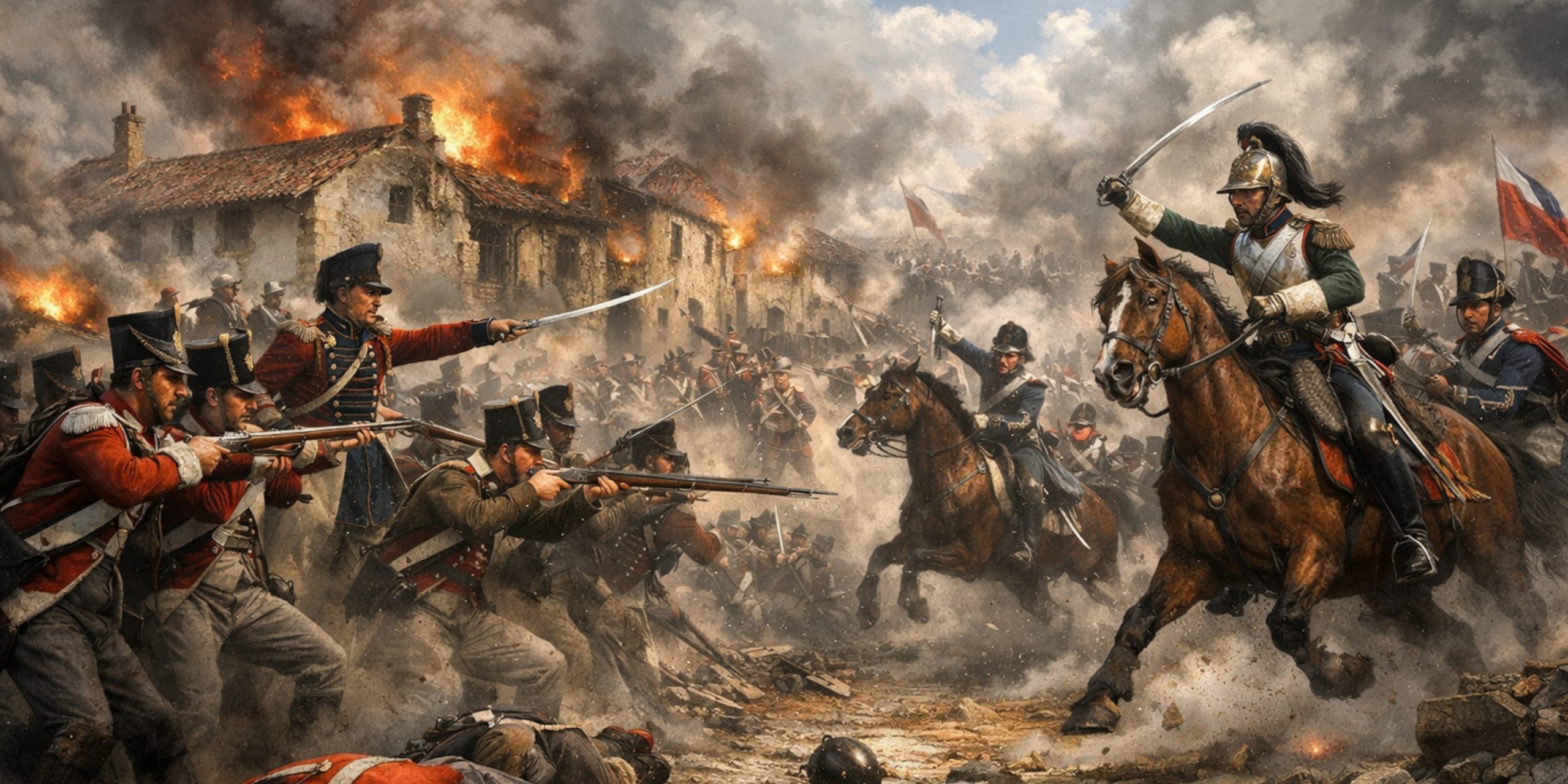
Despite the Napoleonic setting, close combat remained decisive in village fighting and cavalry clashes.
British and Portuguese Equipment
- Infantry muskets: Brown Bess flintlock
- Bayonets: Socket bayonet for line infantry
- Swords:
- 1796 Pattern Light Cavalry Sabre, curved cutting blade
- 1796 Pattern Heavy Cavalry Sword, straight thrusting blade
- Artillery: 6 pounder and 9 pounder guns
- Uniform protection: Shako headgear, limited body protection
The 1796 Light Cavalry sabre, with its pronounced curve, was particularly effective in sweeping charges. It could be brutally efficient in the right hands.
French Equipment
- Infantry muskets: Charleville Model 1777
- Bayonets: Triangular section
- Swords:
- AN XI cavalry sabre
- Heavy cuirassier straight swords
- Cavalry armour: Some cuirassiers wore breastplates
French cavalry, especially Montbrun’s, were aggressive and mobile. Their sabres were balanced between cut and thrust, suited to shock action on open ground south of the village.
The Battle Timeline
3 May 1811
- French attack Fuentes de Oñoro village directly.
- Brutal house to house fighting.
- British 1st Division holds with difficulty.
4 May 1811
- Relative lull.
- French reposition forces south of the village.
- Wellington adjusts his right flank, sensing danger.
5 May 1811
- Massive French flanking attack against the Allied right.
- Anglo Portuguese troops conduct a disciplined fighting withdrawal.
- Cavalry clashes erupt in open fields.
- Wellington stabilises the line on the ridge.
- French assaults falter by evening.
It was not elegant warfare. It was stubborn, grinding, and decided by who blinked first. Wellington did not.
Contemporary Voices
Wellington wrote to a colleague with characteristic understatement:
“If Boney himself had been there, I could not have managed him more easily.”
A British officer described the village fighting:
“The houses were contested step by step, and the enemy came on with a resolution which deserved a better fate.”
French accounts speak of frustration, noting the steady Allied line and missed opportunities in cavalry exploitation.
Archaeology and Battlefield Remains
The battlefield around Fuentes de Oñoro has yielded:
- Musket balls and case shot fragments
- Uniform buttons from British and French regiments
- Scattered personal effects, including buckles and equipment fittings
The village itself still preserves structural traces consistent with early nineteenth century construction. Modern surveys have confirmed the intensity of fighting within narrow streets and stone houses.
Unlike larger Napoleonic battlefields, excavation here is more modest, though local finds continue to surface during agricultural work. It is a battlefield that still feels intimate rather than monumental.
Outcome and Casualties
| Side | Estimated Casualties |
|---|---|
| Anglo Portuguese | 1,700 |
| French | 2,600 to 3,000 |
The French failed to break the Allied line. Almeida’s garrison eventually escaped, which slightly blunted Wellington’s success. Still, Masséna’s army retreated. His campaign in Portugal was effectively over.
Shortly afterwards, Masséna was recalled to France. It was not a promotion.
Legacy
Fuentes de Oñoro confirmed Wellington’s growing reputation. He could hold against a senior French marshal in open battle. The Anglo Portuguese army proved it could stand its ground even under heavy cavalry pressure.
Strategically, it cemented Allied control of Portugal. Operationally, it showed that French dominance in the Peninsula was fading.
It also revealed something else. Wellington’s method, careful positioning, controlled withdrawals, disciplined infantry squares, was not glamorous. But it worked. Repeatedly.
Visiting the Battlefield Today
Fuentes de Oñoro lies near the Portuguese border in western Spain. The ridge lines and open southern ground remain visible, offering a clear sense of how the battle unfolded. Walking the ground, one quickly understands why Wellington anchored his position where he did.
It is not a grand battlefield park. It is farmland, quiet roads, and a village that once endured days of musket fire. History here feels close.
Takeaway
The Battle of Fuentes de Oñoro was not the largest clash of the Peninsular War. It was not the bloodiest. Yet it marked a decisive moment in which Wellington proved he could outmanoeuvre and outlast one of Napoleon’s most experienced marshals.
For historians, it is a study in restraint, terrain, and discipline under pressure. For soldiers who fought there, it was smoke filled streets, charging cavalry, and the stubborn refusal to give way.
Sometimes that is enough to change the course of a campaign.