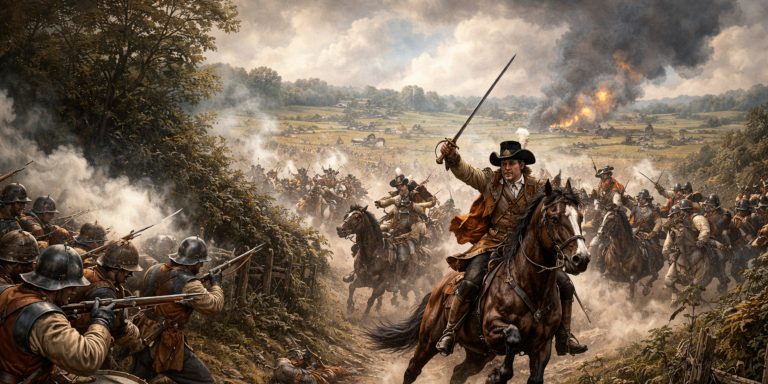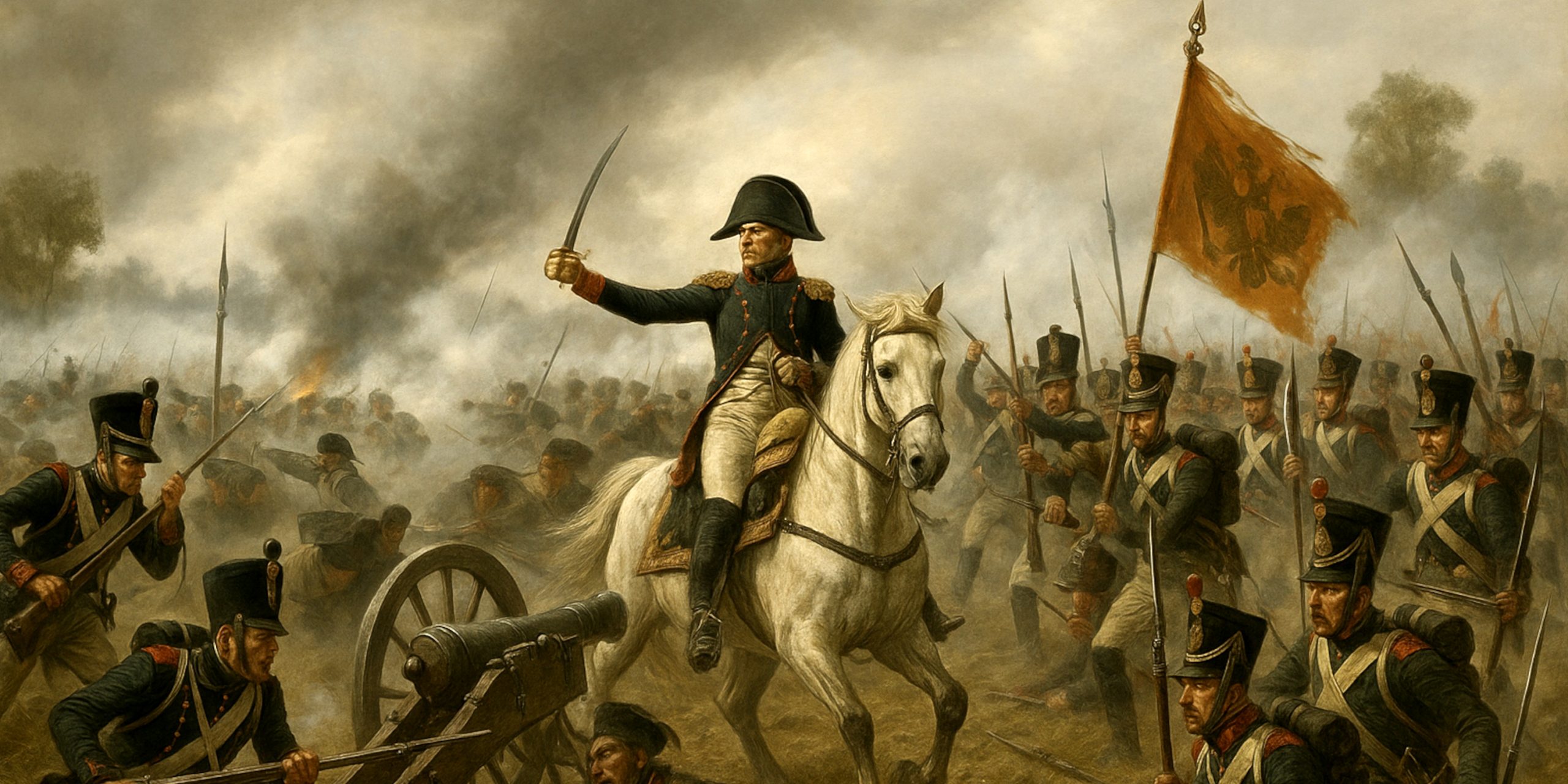
The Battle of Friedland was a decisive confrontation during the War of the Fourth Coalition, where Napoleon Bonaparte’s Grande Armée clashed with the Russian army under General Levin August von Bennigsen. Fought near the town of Friedland (modern-day Pravdinsk, Russia), the battle marked the culmination of the campaign against Russia and led to the Treaties of Tilsit. It showcased the peak of Napoleonic battlefield coordination and exposed the weaknesses in Russian command and deployment.
Forces
| Side | Total Strength | Infantry | Cavalry | Artillery |
|---|---|---|---|---|
| France (Napoleon) | ~80,000 | ~65,000 | ~10,000 | ~120 guns |
| Russia (Bennigsen) | ~63,000 | ~50,000 | ~8,000 | ~120 guns |
Leaders and Troop Composition
France – Emperor Napoleon Bonaparte
- Marshals Involved:
- Jean Lannes (Reserve Corps)
- Michel Ney (VI Corps)
- Nicolas Oudinot (Grenadier Division)
- Joachim Murat (Cavalry Reserve)
- Victor (I Corps)
- Mortier (Imperial Guard in reserve)
- Composition:
- Imperial Guard
- Line infantry and light infantry regiments
- Dragoon, cuirassier, and hussar cavalry
- Horse artillery and foot batteries
Russia – General Levin August von Bennigsen
- Senior Officers:
- General Gorchakov (Left wing)
- General Bagration (Right wing)
- General Dokhturov (Centre)
- General Galitzin (Artillery Reserve)
- Composition:
- Infantry battalions with bayonets and muskets
- Cavalry regiments including hussars and cuirassiers
- Artillery drawn from foot batteries and horse batteries
- Cossack auxiliaries
Arms and Armour
French Grande Armée
- Infantry:
- Charleville musket with bayonet
- Shako helmets, blue wool uniforms, cross belts
- Cavalry:
- Cuirassiers with breastplates and helmets
- Dragoons and hussars with sabres and carbines
- Elite lancers equipped with Polish lances
- Artillery:
- Gribeauval system guns (4, 8, and 12-pounders)
- Rapid deployment horse artillery teams
Russian Imperial Army
- Infantry:
- Flintlock muskets (Model 1805)
- Green uniforms with white crossbelts
- Officers carried sabres and pistols
- Cavalry:
- Cuirassiers, hussars, and uhlans
- Cossack irregulars with sabres, pistols, and spears
- Artillery:
- Smoothbore cannons
- Larger calibres but slower to reposition
Archaeology
Modern archaeological work in and around Pravdinsk has been limited due to the town’s expansion during the Soviet era, but metal detecting surveys have uncovered musket balls, uniform buttons, and fragments of artillery shells. A series of mass graves discovered near the Alle River indicate high casualties and hurried burials, in line with eyewitness accounts. Excavated French insignia and Russian regimental markers are now housed in local Kaliningrad museums.
Battle Timeline

Morning (14 June 1807):
- Russian forces crossed the Alle River and took positions near Friedland.
- Bennigsen aimed to destroy a French corps before Napoleon could concentrate.
Midday:
- French reinforcements under Ney and Victor arrived and began pressing the Russian flanks.
- Lannes and Mortier engaged in holding actions to delay the Russians.
Afternoon:
- Ney’s VI Corps launched a major assault on the Russian left.
- Oudinot’s grenadiers stormed the town of Friedland itself.
- Murat’s cavalry pushed against Russian retreat paths.
Evening:
- The Russian army collapsed toward the river.
- Thousands drowned or were captured as bridges were destroyed or became impassable.
- Napoleon ordered a full pursuit.
Contemporary Quotes
Napoleon Bonaparte, in his bulletin following the battle:
“The Russian army is no more. It has been driven into the Alle and crushed. This day crowns our campaign.”
French officer Jean-Baptiste Barrès, recalling the aftermath:
“The river ran red with blood, and still the firing did not cease. We marched over corpses to reach the enemy lines.”
Russian general Gorchakov, in a letter:
“We stood too long in a trap of our own making, and by the time we saw it, it was already sealed.”
Legacy
Friedland was Napoleon’s final major victory before a rare diplomatic pause. The heavy Russian losses and collapse of morale forced Tsar Alexander I to the negotiating table. The resulting Treaties of Tilsit reshaped continental Europe and marked the high tide of Napoleon’s diplomatic power. The battle is still studied for its textbook use of timing, flanking, and concentration of force.
Though overshadowed by Austerlitz and Borodino in public memory, Friedland played a pivotal role in Napoleon’s military arc and the temporary reordering of Europe before the Russian campaign unraveled it all.
Watch the documentary: