The Battle of Falkirk was the moment when the Scottish Wars of Independence stopped feeling like a heroic uprising and started to resemble a long, grinding contest of resources, discipline, and cold political reality. Fought on 22 July 1298, it pitted the hard-won confidence of a Scottish army under William Wallace against the full military weight of Plantagenet England led by Edward I.
As a historian, Falkirk always feels less like a single disaster and more like an unpleasant lesson delivered with arrows. The Scots did many things right. The English did one thing better, and that was enough.
Background and Context
Wallace’s victory at Stirling Bridge the previous year had shaken English authority in Scotland. It had also provoked Edward I, who returned north with an army designed not just to win but to make a point. Falkirk was not a hasty encounter. It was the collision between an improvised national resistance and a professional war machine refined in Wales, Gascony, and continental campaigns.
The Scots needed to stand and fight. The English needed to demonstrate that Stirling had been an aberration.
Forces
Commanders
Scotland
- William Wallace, Guardian of Scotland
- Sir John Stewart, commander of the Scottish cavalry
England
- Edward I, King of England
- Hugh de Cressingham, Treasurer of Scotland
- Anthony Bek, Bishop of Durham
Troop Composition
| Side | Estimated Strength | Core Troops |
|---|---|---|
| Scotland | 6,000–8,000 | Spearmen, light cavalry, archers |
| England | 15,000–20,000 | Heavy cavalry, longbowmen, infantry |
The imbalance was obvious. Wallace knew it. Edward enjoyed it.
Arms and Armour
Scottish Equipment
- Spears: Long ash spears used in dense schiltron formations
- Swords: Early medieval single-handed arming swords, broad-bladed and functional rather than elegant
- Shields: Small round shields or bucklers, not always uniformly equipped
- Armour: Padded aketons and occasional mail, with wide variation in quality
Scottish infantry doctrine relied on discipline and nerve. Once those failed, the kit did not offer much forgiveness.
English Equipment
- Swords: Knightly arming swords of Oakeshott Type XII and XIII, optimised for cutting and thrusting from horseback
- Longbows: Welsh longbows, the true battle-winner at Falkirk
- Polearms: Bills and spears for infantry support
- Armour: Mail hauberks, iron helms, reinforced by wealth and supply lines
The English army arrived equipped for a long campaign, not a romantic gesture.
The Battle
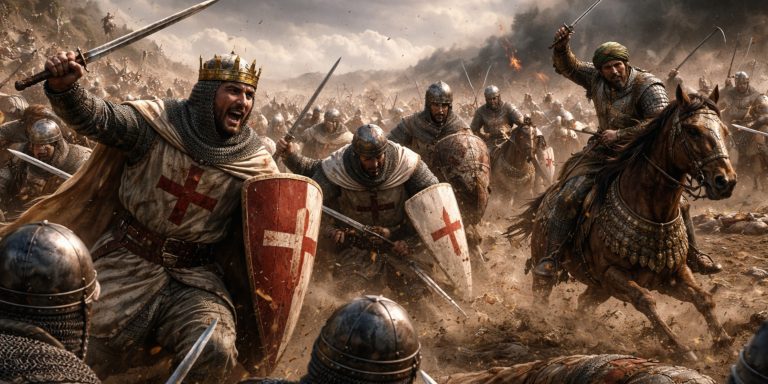
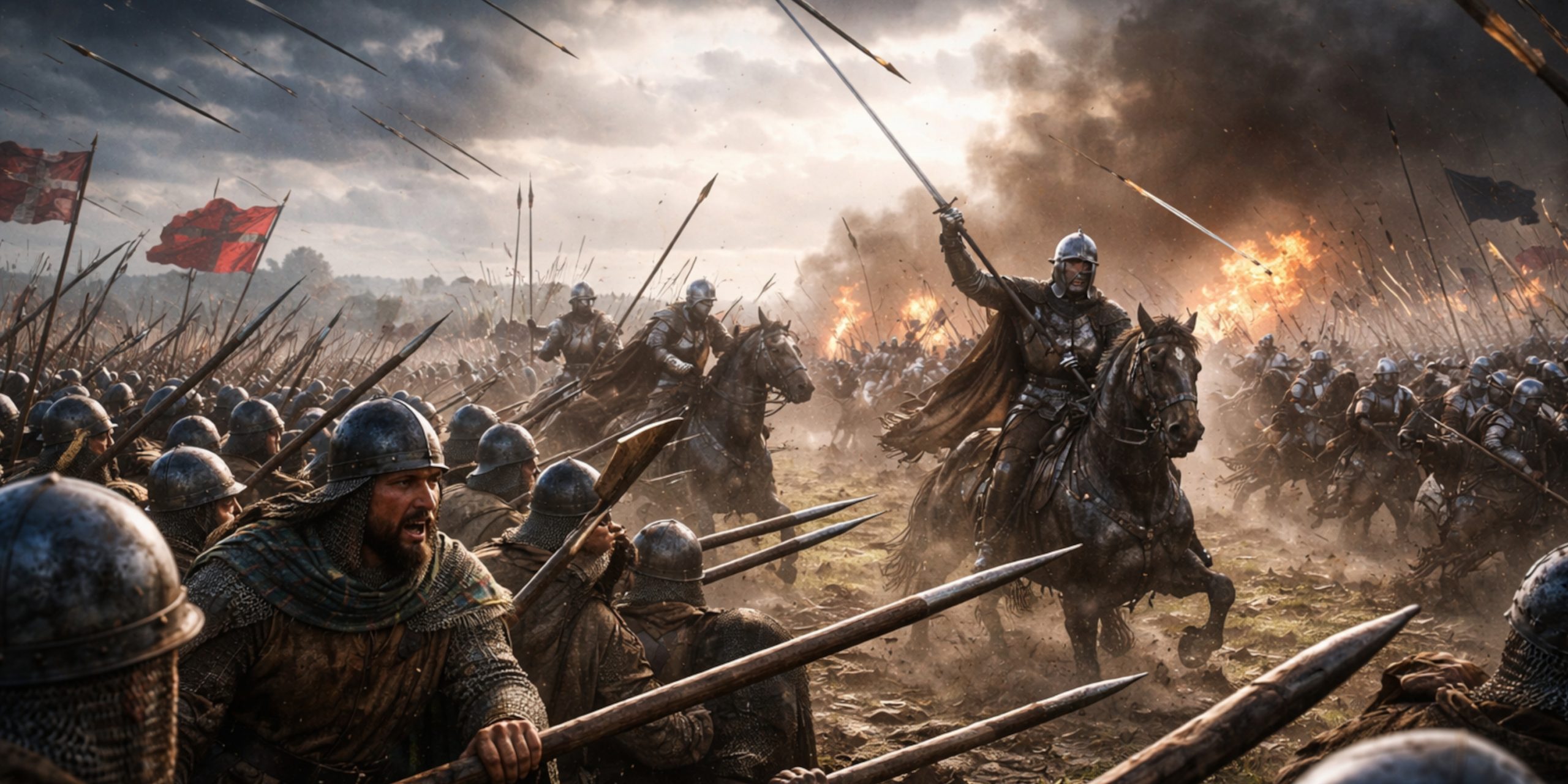
Wallace deployed his spearmen in four large schiltrons, circular hedgehogs of spear points anchored by rough ground. It was a sound plan against cavalry. Edward tested it anyway.
English cavalry charges failed to break the schiltrons but succeeded in exposing the real weakness. The Scottish archers were lightly protected and badly positioned. Once English longbowmen were brought forward, the schiltrons became static targets. Arrows punched gaps, morale followed, and cavalry returned to finish what missile fire had started.
The Scottish cavalry withdrew early, a decision still debated but rarely forgiven. Wallace escaped. Many others did not.
Battle Timeline
- Morning: English army advances near Falkirk
- Midday: Scottish schiltrons form defensive positions
- Early afternoon: English cavalry probes and withdraws
- Mid afternoon: Longbowmen unleash sustained arrow fire
- Late afternoon: Schiltrons collapse under combined assault
- Evening: English victory secured, Scottish army shattered
The entire battle likely lasted only a few hours. The consequences lasted decades.
Archaeology and Evidence
No mass grave has been conclusively identified at Falkirk, which is frustrating but typical for medieval battles fought in open countryside. Finds in the wider area include arrowheads consistent with late thirteenth-century English military types, reinforcing written accounts of longbow dominance.
The lack of definitive archaeological proof has not stopped confident opinions, which historians produce in abundance when evidence is thin.
Contemporary Quotes
Walter of Guisborough noted the deadly efficiency of English archery, writing that the Scots “stood like a wood before the axe.” It is not subtle, but it is accurate.
The Lanercost Chronicle recorded that Wallace’s men “were struck down in heaps,” a phrase that suggests observation rather than imagination.
Edward I himself was characteristically brief, treating Falkirk as a correction rather than a triumph.
Aftermath and Legacy
Falkirk ended Wallace’s time as Guardian of Scotland and exposed the limits of infantry-only resistance without missile support. It did not end the war. If anything, it clarified what future Scottish victories would require, namely combined arms, careful ground selection, and patience.
Robert the Bruce learned from Falkirk. Bannockburn would not repeat its mistakes.
Falkirk stands as a battle where courage met logistics and lost. It is an uncomfortable story, which is usually a sign that it matters.