The Battle of Crocus Field was fought around 274 BC in northern Greece, probably in Macedonia, at a moment when the Hellenistic world was still reeling from Galatian migrations. These were not tidy border skirmishes or ritualised set pieces. This was crisis warfare. Antigonus II Gonatas, newly fighting to secure his grip on Macedonia, faced Galatian raiders who had already humiliated Greek armies and terrorised sanctuaries. Crocus Field was his answer, and it worked.
As a historian, I find this battle fascinating because it is less about heroic charges and more about nerve, preparation, and exploiting an enemy’s habits. Antigonus did not win by brilliance alone. He won by understanding exactly who he was fighting.
Background and Causes
After their defeat near Delphi in 279 BC, Galatian groups did not simply vanish. Many turned south and east, surviving through mercenary work or outright plunder. Macedonia, weakened by years of instability, was an inviting target.
Antigonus II Gonatas needed legitimacy as much as territory. Crushing the Galatians would secure his throne and present him as a restorer of order in a shaken Greek world. The Galatians, for their part, expected another easy campaign against fractured Hellenistic forces. That assumption would cost them dearly.
Forces
Macedonian Kingdom
Commanded by Antigonus II Gonatas
| Element | Estimated Numbers | Notes |
|---|---|---|
| Infantry | 15,000 to 20,000 | Core phalanx supported by lighter troops |
| Cavalry | 2,000 to 3,000 | Thessalian and Macedonian horse |
| War Elephants | Several dozen | Rare in Greece, decisive psychologically |
Galatian War Bands
Loosely organised tribal contingents
| Element | Estimated Numbers | Notes |
|---|---|---|
| Heavy Infantry | 15,000 to 20,000 | Fierce shock fighters |
| Light Infantry | Several thousand | Skirmishers and raiders |
| Cavalry | Minimal | Mostly infantry based |
Ancient sources are vague on numbers, which is historian code for “someone exaggerated”, but relative parity seems likely.
Leaders
Macedonian Command
- Antigonus II Gonatas, overall commander
- Veteran officers trained in phalanx warfare
- Experience fighting both Greeks and foreign mercenaries
Galatian Leadership
- Tribal chieftains rather than a unified general
- Leadership based on personal prestige and battlefield aggression
- Little coordination once fighting began
Arms and Armour
Macedonian Equipment
- Sarissa pikes, long two handed spears used in the phalanx
- Xiphos short swords as secondary weapons
- Bronze helmets, linothorax or mail armour, large round shields
- War elephants equipped with towers and handlers
Galatian Equipment
- Long slashing swords, often La Tène style blades designed for powerful cuts
- Large oval shields with iron bosses
- Minimal armour, favouring mobility and intimidation
- Javelins and throwing spears for the opening of combat
The contrast is stark. Discipline and formation on one side, raw ferocity on the other. It is rarely a fair fight once formations hold.
The Battle Timeline
| Phase | Events |
|---|---|
| Deployment | Antigonus positions his phalanx with elephants concealed or held back |
| Opening Clash | Galatians advance aggressively, expecting the Macedonians to break |
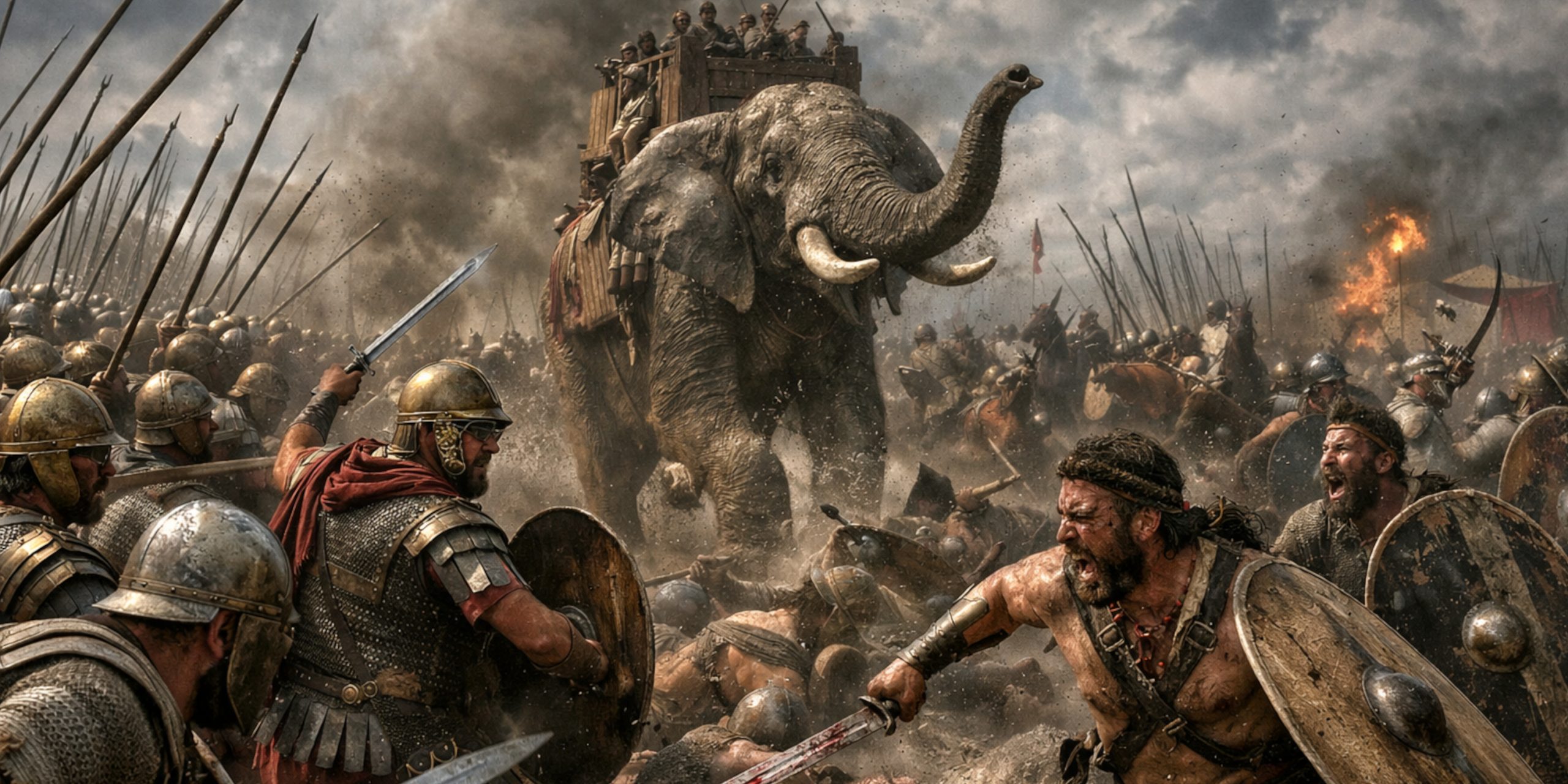
| Shock Moment | Elephants are unleashed, panicking Galatian ranks and disrupting charges |
| Phalanx Advance | Macedonian pikes lock together and push forward methodically |
| Collapse | Galatian cohesion fails, leading to mass casualties and rout |
| Aftermath | Survivors flee or are hunted down by cavalry |
This is one of those battles where psychology mattered as much as steel. The elephants did not just kill. They terrified.
Archaeology and Evidence
There is no single confirmed archaeological site labelled “Crocus Field”, which is frustrating but typical. The name itself may describe terrain rather than a fixed location.
What we do have includes:
- Literary accounts from later historians such as Pausanias
- Comparative evidence from Galatian weapon finds in Greece
- Hellenistic military treatises that align with Antigonus’ tactical approach
The lack of battlefield archaeology means we rely heavily on synthesis rather than spades in the ground.
Contemporary and Near Contemporary Quotes
Ancient authors consistently emphasise the psychological shock inflicted on the Galatians.
Pausanias later remarked that the Macedonians “broke the barbarian confidence with beasts unknown to them”, which is a polite way of saying panic did the work.
Another tradition notes that the Galatians, so bold in earlier campaigns, “lost heart when their charge failed”, a reminder that courage without cohesion has limits.
Outcome and Legacy
The victory secured Antigonus II Gonatas’ rule over Macedonia and marked the effective end of large scale Galatian raids in southern Greece. Some Galatians would later settle in Thrace or move into Asia Minor, eventually forming Galatia proper.
Crocus Field also reinforced a lesson Hellenistic kings never forgot. Exotic troops and psychological warfare could decide battles before blades truly crossed. It was not pretty, but it was effective.
As dry historical humour goes, one might say the Galatians came for plunder and left with a lesson in combined arms tactics.