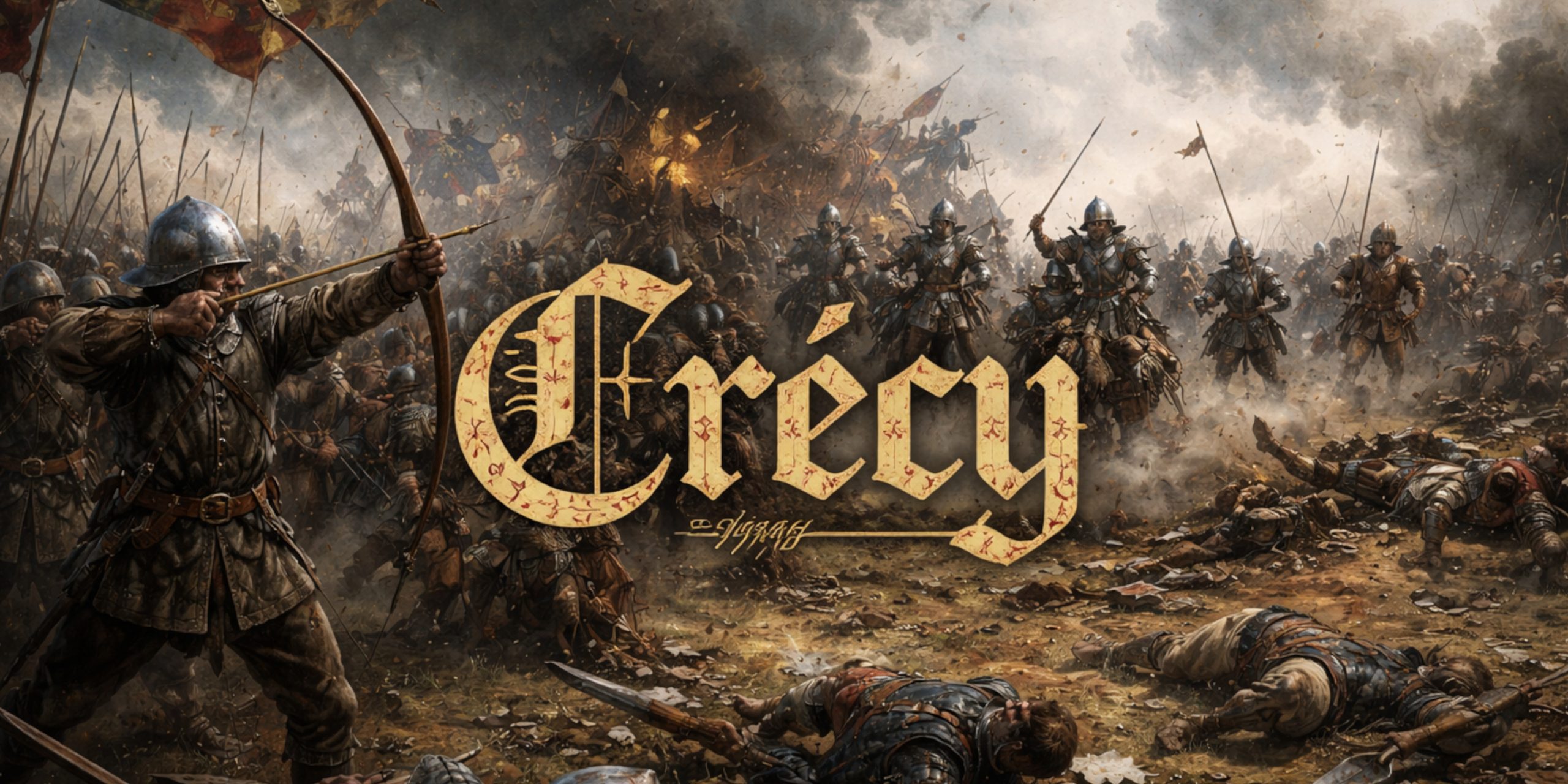
The Battle of Crécy, fought on 26 August 1346 near the village of Crécy-en-Ponthieu in northern France, remains one of the most studied clashes of the Middle Ages. It was the first major land battle of the Hundred Years’ War, and it forced Europe to confront an uncomfortable truth. Courage and noble lineage counted for less than discipline, terrain and a well-handled longbow.
King Edward III led a relatively small English army deep into French territory. Opposing him was Philip VI, commanding a host that, on paper, should have crushed the invaders. Instead, the French army collapsed in a series of chaotic and costly assaults.
Crécy did not end the war. It did something more important. It changed how war would be fought.
Background to the Campaign
Edward III landed in Normandy in July 1346 with a hard, professional force. His aim was not mere raiding, although there was plenty of that. He sought battle and political leverage for his claim to the French throne.
After marching north and evading French attempts to trap him along the Seine and the Somme, Edward crossed the Somme at Blanchetaque. With French forces in pursuit, he chose strong ground near Crécy. He did not wait to be surprised. He prepared.
Philip VI arrived late in the day on 26 August. His army was large but exhausted from forced marches. There was pressure to attack immediately. Chivalric pride overruled caution.
Historians often speak of inevitability at Crécy. There was nothing inevitable about it. It was a contest of choices. Edward’s were calm. Philip’s were hurried.
Forces at Crécy
Medieval numbers are notoriously inflated. Chroniclers loved large figures. Modern estimates are more restrained.
Estimated Strength
| Army | Estimated Numbers | Composition |
|---|---|---|
| English | 10,000 to 15,000 | Men-at-arms, longbowmen, Welsh infantry |
| French | 20,000 to 30,000 | Knights, men-at-arms, crossbowmen, infantry |
The French likely outnumbered the English by at least two to one. In medieval warfare, that should have mattered more than it did.
Leaders and Command Structure
English Command
- Edward III
- Edward the Black Prince
- Earl of Northampton
- Earl of Arundel
Edward divided his army into three battles or divisions, positioned on rising ground. The Black Prince commanded the forward division. When pressed hard, he reportedly asked for aid. Edward III refused to intervene immediately, saying his son must win his spurs. It was stern parenting by any measure.
French Command
- Philip VI
- Charles, Count of Alençon
- King John of Bohemia
- Numerous feudal lords commanding their own retinues
The French command structure was fragmented. Coordination suffered. Knights charged in waves, sometimes without clear direction.
Arms and Armour
Crécy is remembered for the longbow, yet it was a meeting of diverse military technologies.
English Arms and Armour
Men-at-arms
- Plate armour reinforced with mail
- Bascinets with visors
- Arming swords, often Oakeshott Type XIIIa and XV forms
- Lances and poleaxes
- Large heater shields declining in use among heavily armoured elites
- English longbow of yew, approximately six feet in length
- Bodkin and broadhead arrows
- Falchions or short arming swords as sidearms
- Minimal armour, often padded jacks or brigandines
The longbow could penetrate mail and, at close range, even plate at vulnerable points. More importantly, it disrupted cohesion. Horses panicked. Knights fell before reaching striking distance.
French Arms and Armour
Knights and Men-at-arms
- Transitional plate harness over mail
- Great helms and bascinets
- Arming swords, often similar Oakeshott types
- Lances for shock combat
- Daggers such as rondels for close fighting
- Powerful crossbows with windlass mechanisms
- Pavise shields for protection
- Short swords and daggers
A rainstorm reportedly dampened crossbow strings. English bowmen, who could unstring and protect their bows, may have been less affected. Whether exaggerated or not, the crossbowmen advanced without adequate support and were quickly overwhelmed.
The Battle Timeline

Morning to Early Afternoon
- French army approaches after forced march
- English complete defensive positioning on a slope
- Stakes and obstacles prepared in front of longbow lines
Late Afternoon
- Genoese crossbowmen advance
- English longbow volleys break their formation
- French knights, frustrated, charge through retreating crossbowmen
Evening
- Repeated French cavalry assaults uphill
- Heavy casualties among French nobility
- King John of Bohemia killed in combat
- Philip VI wounded and withdrawn
By nightfall, the French army was shattered. The field belonged to Edward.
Archaeology and the Physical Evidence
Archaeological work around Crécy has uncovered arrowheads consistent with longbow use. Bodkin points found in the region align with mid fourteenth century military equipment.
Mass graves have been suggested though not conclusively identified. Medieval battlefields are difficult to excavate due to agricultural disturbance and limited contemporary mapping.
Artefacts from the broader campaign period, including armour fragments and weaponry, are housed in regional French museums. They reinforce what written sources describe. Crécy was not a skirmish. It was a grinding and lethal encounter.
Contemporary Voices
Jean Froissart, the great chronicler, wrote of the English that:
“They shot their arrows so wholly together and so thick that it seemed snow.”
A French account laments:
“The flower of French chivalry was cut down.”
These are literary voices, shaped by narrative flair, yet the sense of shock is genuine. The mounted knight had been publicly humiliated.
Consequences and Legacy
After Crécy, Edward III besieged and captured Calais. The port would remain in English hands for over two centuries.
Militarily, the battle confirmed that disciplined infantry and missile troops could defeat heavily armoured cavalry. Crécy was followed by Poitiers and later Agincourt. The lesson was repeated until even the proudest noble could no longer ignore it.
As a historian, one cannot help but feel a certain irony. The age that celebrated mounted heroism was undone by farmers with bows and careful planning. War has always rewarded practicality over romance.
Takeaway
The Battle of Crécy was a triumph of preparation, terrain and command discipline over haste and pride.
Edward III chose his ground and held it. Philip VI attacked without full coordination. In the end, steel and feathered shafts decided the matter.
Crécy remains a reminder that warfare evolves. Those who fail to adapt pay dearly. In 1346, the price was counted in fallen banners and silent fields in Picardy.
Watch the documentary: