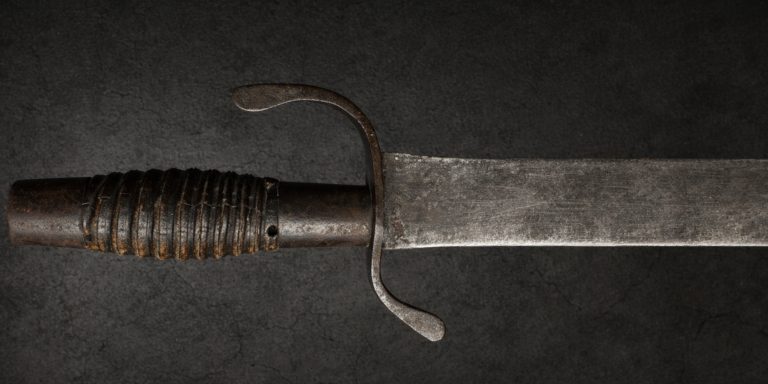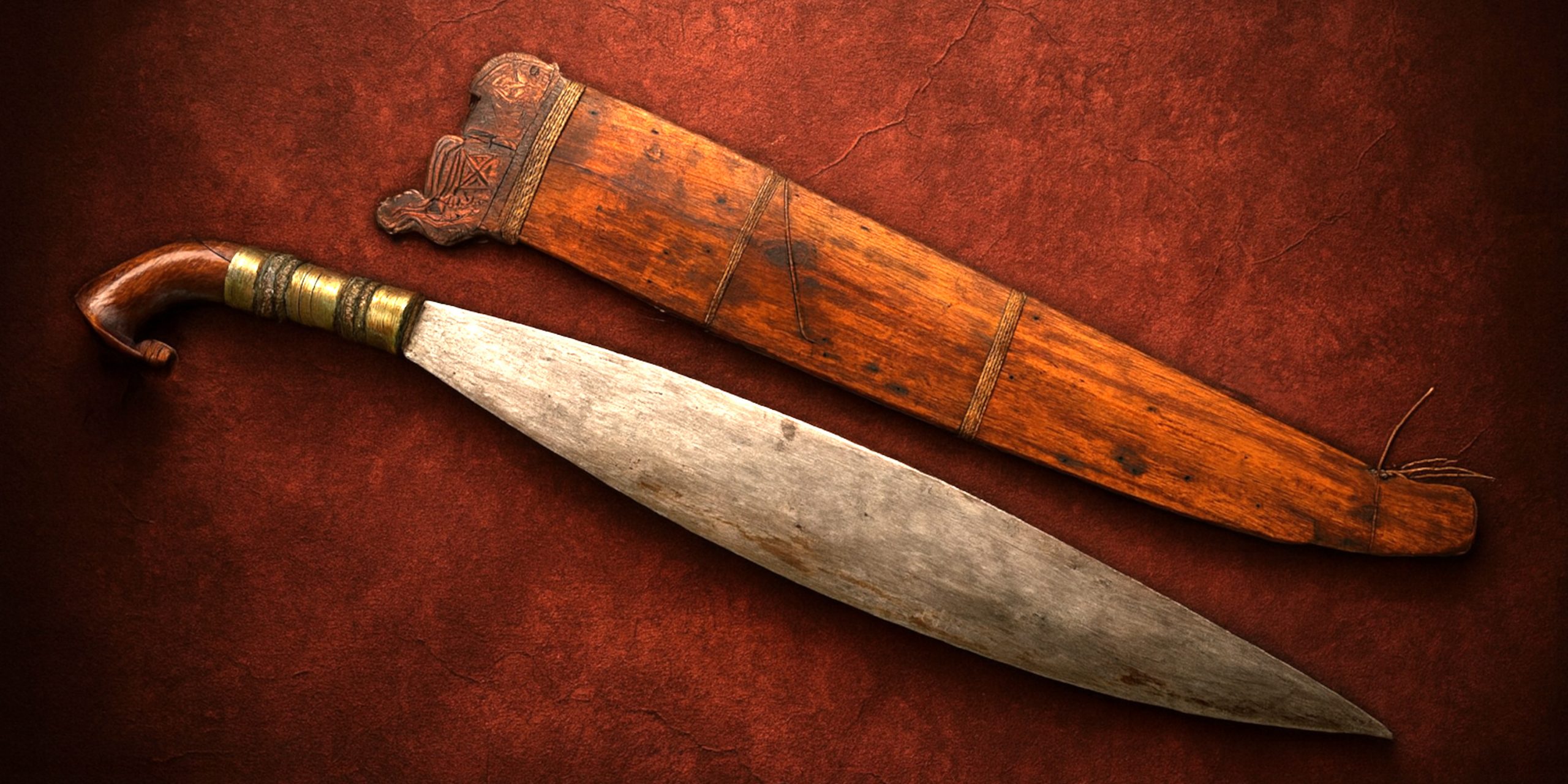
The barong is one of the defining blades of the southern Philippines, especially among Moro communities such as the Tausug, Sama-Bajau and Yakan. Its short, heavy, leaf shaped blade and bird headed hilt give it a strong presence, both as a working weapon and as a cultural emblem. European and American accounts from the late nineteenth and early twentieth centuries describe its impact in close quarter fighting, which helped to cement its reputation far beyond Mindanao and Sulu.
The barong today is a symbol of identity, a practical blade in some rural settings, and a popular category in ethnographic arms collecting.
Specification
The barong varies by region and period, but surviving examples, museum records and field collected pieces point to a consistent core design.
Typical features
- Short, broad, leaf shaped blade
- Strong forward weight for chopping
- Thick spine for durability
- Hilt of hardwood, horn or ivory
- Bird or cockatoo style pommel
- Wooden sheath, often carved or rattan bound
Typical dimensions
| Feature | Typical details |
|---|---|
| Overall length | About forty five to sixty five centimetres |
| Blade length | Roughly twenty to fifty six centimetres |
| Blade width | Often seven to nine centimetres at the widest point |
| Weight | About one kilogram on larger war blades, lighter for ceremonial pieces |
| Blade profile | Leaf or teardrop shaped, widest toward the front |
| Edge | Single edged, often convex ground |
| Hilt materials | Kamagong hardwood, carabao horn, ivory |
| Pommel style | Bird headed with distinctive hooked beak |
| Sheath | Wooden, sometimes carved or fitted with silver or rattan |
Handling
- Excellent chopping power relative to size
- Very manoeuvrable in dense vegetation or tight spaces
- Durable spine and tang
- Forward balance can cause fatigue during long use
History and evolution
The barong likely developed within a wider Austronesian family of leaf shaped blades found in the southern Philippines and Borneo. By the early modern period, it was firmly established among Moro groups in Mindanao and the Sulu Archipelago.
During the eighteenth and nineteenth centuries it became one of the principal weapons of local warriors, used in sea raids, clan fighting and confrontations with Spanish and later American forces. Many surviving examples were taken as war trophies during the Philippine American War and subsequent campaigns, and these often show field wear, smoke staining or repairs.
Not every barong was a war blade. Prestige pieces, decorated with ivory, silver and fine carving, functioned as status symbols. During the twentieth century the barong shifted from a practical battlefield weapon to a cultural icon, appearing in dance, ritual, ceremony and modern Bangsamoro identity.
Contemporary makers still produce barongs for martial arts, ceremonial use and collecting, ranging from inexpensive tourist pieces to carefully forged high end replicas.
Advantages and disadvantages
Advantages
- Strong cutting power for its size
- Compact and highly effective in close quarters
- Tough construction suited to heavy blows
- Versatile enough for both war and everyday tasks in rural settings
Disadvantages
- Limited reach compared with spears or long swords
- Forward weighted design can tire the arm with extended use
- Less effective at thrusting than blades with narrower profiles
- In modern settings, overshadowed by cheaper machete like tools
Comparison with similar weapons
| Weapon | Region and users | Blade form | Fighting role | Key contrasts with barong |
|---|---|---|---|---|
| Barong | Southern Philippines, Moro groups | Broad, leaf shaped, single edged | Close quarter chopping | Most compact heavy cutter in the Moro armoury |
| Kris | Philippines, Indonesia, Malaysia | Narrow, often wavy, double edged | Cut and thrust, ritual status | Better at thrusting, heavier symbolic meaning |
| Kampilan | Mindanao and Sulu | Long, tapering, single edged | Battlefield weapon with long reach | Much longer reach, less suited to dense terrain |
| Panabas | Mindanao | Large, cleaver like, heavy forward curve | Execution and shock weapon | Even greater chopping power but considerably bulkier |
| Bolo | Wider Philippines | Machete like | Agricultural tool and militia weapon | Cheaper, lighter and more general purpose |
The barong settles into the role of a powerful close range cutter. It is more direct and workmanlike than the kris, and much easier to carry and conceal than the kampilan or panabas.
Legacy
The barong’s legacy is shaped by warfare, artistry and identity. In colonial accounts it became a sign of Moro resistance. In local culture it remains a marker of status and heritage, with carved hilts and scabbards expressing regional styles and symbolism. High quality examples show a level of craftsmanship that rivals other Southeast Asian edged weapons.
Within Filipino martial arts and historical study, the barong continues to receive attention. Its recognisable outline ensures it remains part of the modern imagination, from museum collections to contemporary bladesmithing.
Where to see barong swords
Many large museums hold barong swords, though not all are always on display.
- The Metropolitan Museum of Art in New York has a range of barongs with carved hilts and complete scabbards.
- The Rosenberg Library in Galveston preserves early twentieth century examples collected by American personnel.
- Philippine museums such as the National Museum of Anthropology in Manila regularly feature Moro weapons.
- Several British and European museums include barongs collected before the First World War.
Checking display rotation guides is useful, as some pieces spend time in storage or loans.
Collector’s guide and auction prices
What affects value
Collectors tend to favour pieces with:
- Age and good provenance
- High quality forging
- Complete scabbard and matching fittings
- Ivory or fine horn hilts with detailed carving
- Silver mounts
- Documented battlefield or historical connections
Condition is critical. Original patina on blade and wood adds value. Heavy cleaning or replacement parts reduce it.
Recent price ranges
Auction records in recent years give a workable sense of the market.
| Category | Typical price band |
|---|---|
| Lower grade tourist or late pieces | About one hundred to two hundred dollars |
| Early twentieth century examples with sheath | About two hundred to four hundred dollars |
| High grade pieces with ivory or silver | About six hundred to fourteen hundred dollars |
| Rare or historically documented examples | Often higher, depending on competition |
Results vary with region, condition and auction venue. Specialist arms sales often achieve stronger prices than general antiques auctions.
Collecting guidance
- Learn to recognise regional styles and genuine age.
- Avoid over polished blades, as original surface is prized.
- Check that hilt, ferrules and scabbard belong together.
- Be cautious with suspiciously cheap items that mimic high status fittings.
- Keep documentation for future resale and ethical clarity.