Few swords in European legend carry the weight of fate quite like Balmung. It is the blade of Siegfried, dragon slayer, oath breaker, tragic hero and, depending on the version, rather reckless young man with a talent for getting himself killed.
Balmung belongs to the German heroic tradition, most famously preserved in the medieval epic the Nibelungenlied. Yet like many legendary weapons, it does not sit neatly in one text. Its story overlaps with Norse material, most notably the Volsunga Saga, where the sword bears a different name but a strikingly similar role.
As a historian, I have always found Balmung interesting not because it is the most ornate of mythical swords, but because it stands at the crossroads of oral tradition, courtly literature and nineteenth century opera. It is a weapon shaped by centuries of retelling.
Origins in the Nibelungenlied
The Nibelungenlied, composed around the early thirteenth century in the German lands, is our principal source for Balmung by name. In this epic, Siegfried acquires the sword after defeating the dwarf king Nibelung and later claims the vast Nibelung treasure.
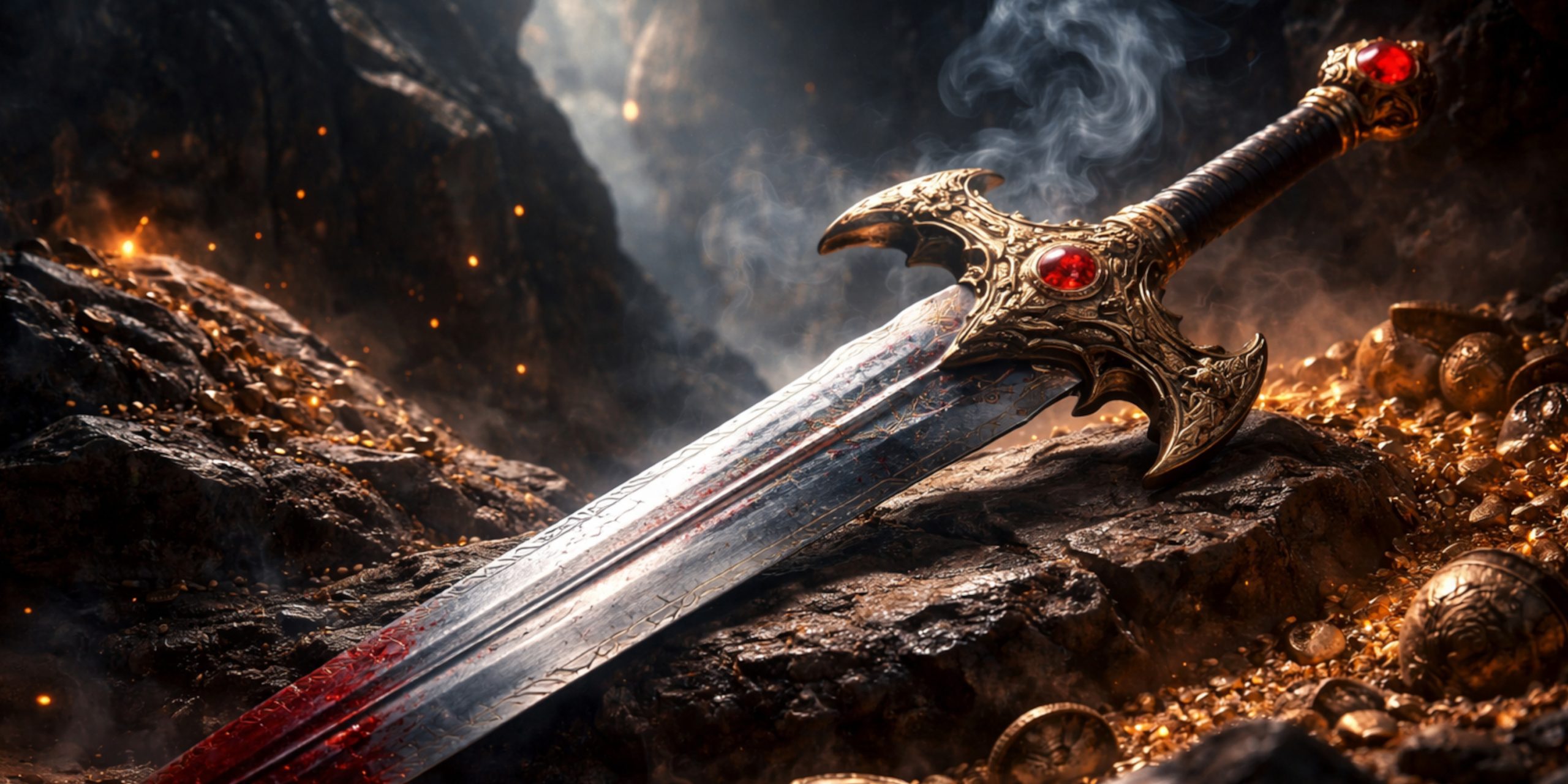
The poem presents Balmung as a blade of immense quality, capable of cutting through armour and cleaving opponents with ease. It is not merely decorative. It is a battlefield weapon, practical and lethal.
In the poem’s tragic arc, Balmung eventually passes to Hagen after Siegfried’s murder. That detail matters. Legendary swords often signal legitimacy and power. When Hagen wields Balmung, he symbolically claims the strength of the man he betrayed. The sword becomes an uncomfortable reminder of treachery.
The text does not dwell on elaborate magical properties. Balmung’s power is implied through performance rather than description. It is sharp, resilient and formidable. In heroic literature, that is enough.
Norse Parallels and the Sword Gram
In the Old Norse Volsunga Saga, the hero Sigurd, the Norse counterpart to Siegfried, wields a sword called Gram. The parallels are unmistakable. Sigurd slays the dragon Fafnir with Gram, just as Siegfried kills a dragon before bathing in its blood to gain invulnerability.
Many scholars view Balmung and Gram as literary siblings, shaped by a shared Germanic heroic tradition. Whether they descend from a single lost prototype is impossible to prove, but the narrative functions align closely.
Gram is reforged by the smith Regin after being shattered, which gives it an added layer of mythic craftsmanship. Balmung in the Nibelungenlied does not receive quite the same dramatic forging episode, but later retellings blur the lines. Over time, audiences often conflate Balmung and Gram as variations of one legendary weapon.
This overlap illustrates how fluid medieval storytelling could be. Names shift. Details migrate. The core myth survives.
Balmung in Richard Wagner’s Ring Cycle
The nineteenth century composer Richard Wagner revived and reshaped the Germanic myths in his monumental opera cycle, Der Ring des Nibelungen. Here, the sword appears under the name Nothung, more closely aligned with the Norse tradition, yet modern audiences often associate Balmung with this operatic revival.
Wagner’s version adds theatrical intensity. The sword is shattered and reforged in a blaze of orchestral triumph. It becomes a symbol of rebellion, destiny and heroic self assertion.
For many modern readers and viewers, Wagner’s interpretation colours how they imagine Balmung. The opera’s influence cannot be overstated. It transformed a medieval epic into a cornerstone of Romantic nationalism and mythic spectacle.
As a historian, I approach Wagner cautiously. His work is artistically profound, but it is also a reinterpretation layered with nineteenth century ideology. Balmung in Wagner is as much a product of modern Europe as of medieval Germany.
Symbolism and Meaning
Balmung is more than a cutting edge of steel. In the Nibelungenlied, it represents inherited power and the fatal consequences of pride. Siegfried’s strength isolates him. His possession of the sword does not protect him from betrayal.
The blade also embodies the heroic ideal. It is tied to dragon slaying, treasure, courtship and ultimately tragedy. Like many legendary swords, it offers no moral guidance. It empowers, but it does not save.
There is a sobering consistency in these myths. The greatest weapons do not prevent human folly. They often sharpen it.
Historical Context and Material Reality
Unlike archaeological finds such as the Sutton Hoo sword or Viking age pattern welded blades, Balmung belongs firmly to literature. There is no physical artefact we can point to and say, this was it.
That said, the sword described in the Nibelungenlied would not have been fantastical to a medieval audience. High quality knightly swords of the twelfth and thirteenth centuries were capable weapons. Pattern welding, refined steel production and careful heat treatment were well established.
Balmung likely reflects the elite arming sword of its era, a straight double edged blade, cruciform hilt and wheel pommel. It would have been recognisable to the poem’s original listeners. The legend enhances the man, not the metallurgy.
Balmung in Modern Culture
Beyond medieval epic and Wagnerian opera, Balmung appears in novels, games and fantasy media. It surfaces in role playing games, anime and modern retellings of Germanic myth. Each adaptation reshapes it slightly.
The name carries an austere authority. It sounds heavy, deliberate and ancient. Creators continue to draw on that resonance.
In a curious way, Balmung has achieved what many fictional swords aspire to. It escaped its original text and entered the broader imagination.
Seven Swords Takeaway
Balmung stands at the heart of the Nibelung legend, bound to the rise and fall of Siegfried. It bridges German and Norse traditions, medieval poetry and Romantic opera, heroic fantasy and modern pop culture.
As a historian, I find Balmung compelling not because it promises magical spectacle, but because it reveals how stories travel. A blade forged in oral tradition becomes literature. Literature becomes opera. Opera becomes modern myth.
The sword endures, even if its bearer does not. And perhaps that is the most fitting fate for a legendary weapon.