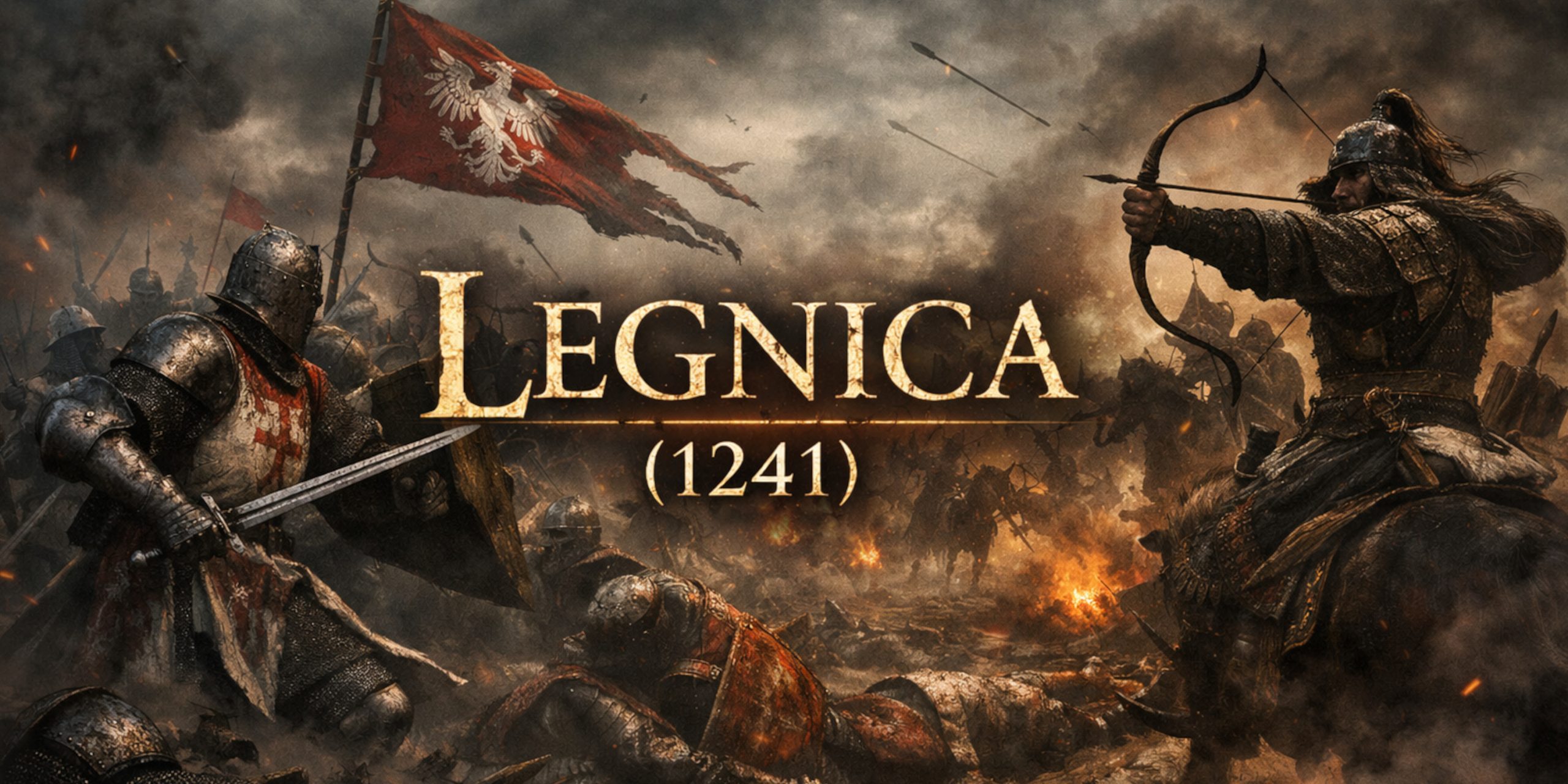
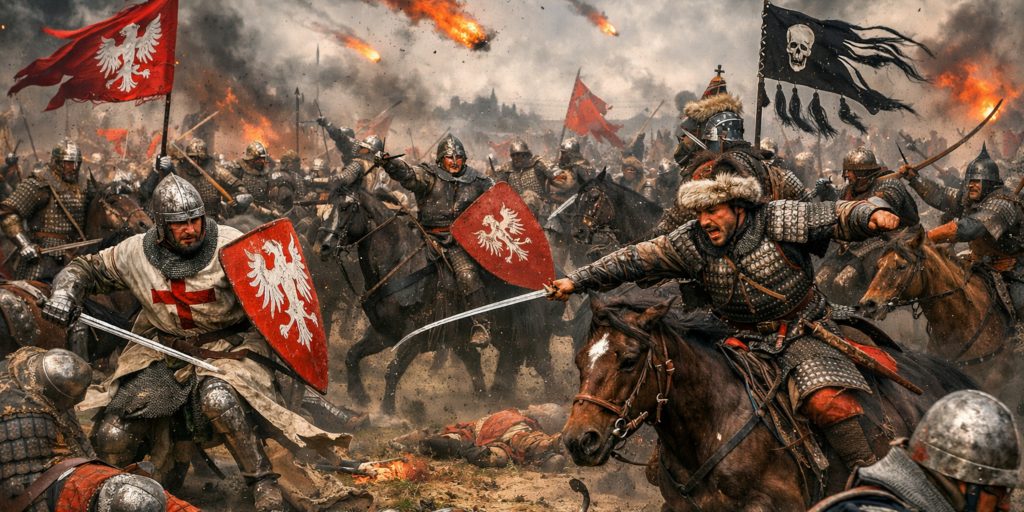
The Battle of Legnica, fought on 9 April 1241, sits in that uneasy corner of history where Europe first realised, rather abruptly, that it was not the centre of the world’s military innovation. A Mongol force, operating at the far edge of its advance, dismantled a coalition of European troops in Silesia with unnerving efficiency.
It was not a vast battle by medieval standards. It did not decide the fate of Christendom in a single afternoon. Yet the shock it delivered travelled far beyond the battlefield, carried by rumour, exaggeration, and the occasional severed head in a sack.
Background
The Mongol advance into Eastern Europe formed part of a wider campaign orchestrated under Batu Khan and Subutai. Their objective was Hungary, though Poland received what might politely be called a diversion.
Duke Henry II of Silesia attempted to assemble a defensive coalition. This included Polish levies, Silesian knights, remnants of the Templars, and various German contingents. Coordination was imperfect. Reinforcements from Bohemia never arrived in time.
The Mongols, meanwhile, operated with a clarity of purpose that tends to make coalitions look untidy by comparison.
Forces
Estimated Strength
| Force | Estimated Numbers |
|---|---|
| Mongol Army | 8,000 to 12,000 |
| European Coalition | 15,000 to 25,000 |
The figures remain debated, though the imbalance in cohesion matters more than raw numbers.
Commanders
Mongol Command
- Baidar
- Kadan
- Orda Khan
European Command
- Henry II the Pious, Duke of Silesia
- Mieszko II the Fat, Duke of Opole
- Various Silesian and Polish nobles
- Contingents of the Knights Templar
Arms and Armour
European Forces
European troops reflected a patchwork of regional styles and levels of wealth.
Typical Equipment
- Mail hauberks with coifs
- Nasal and early great helms
- Kite and heater shields
- Lances for cavalry charges
- Crossbows and long spears for infantry
Sword Types
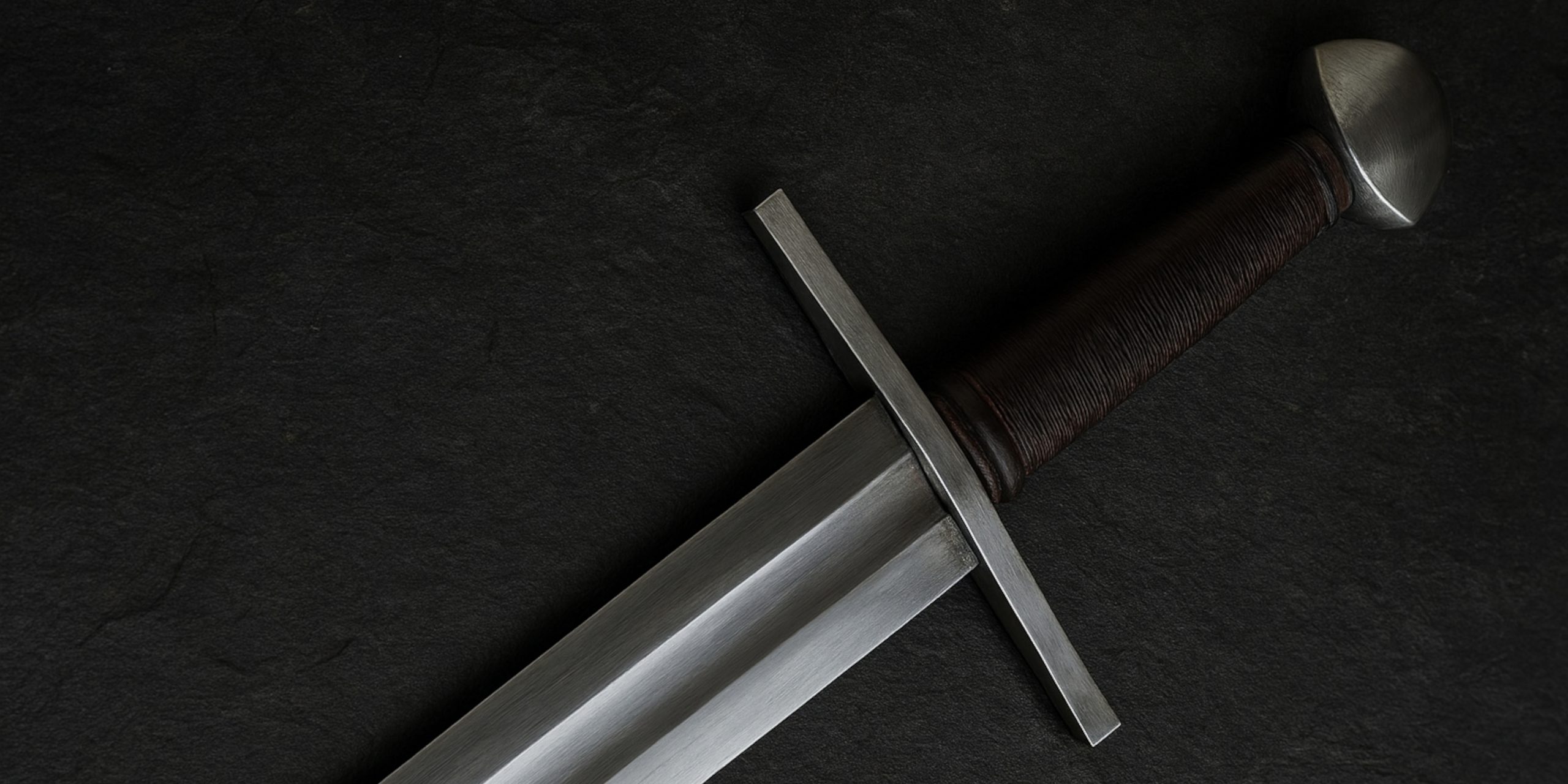
- Oakeshott Type X and XII arming swords
- Broad, double-edged blades suited for cutting from horseback
- Simple crossguards and disc pommels
Strengths
- Heavy cavalry shock power
- Strong defensive armour for close combat
Weaknesses
- Limited mobility
- Poor coordination between contingents
Mongol Forces
The Mongols arrived with a system rather than an army in the European sense.
Typical Equipment
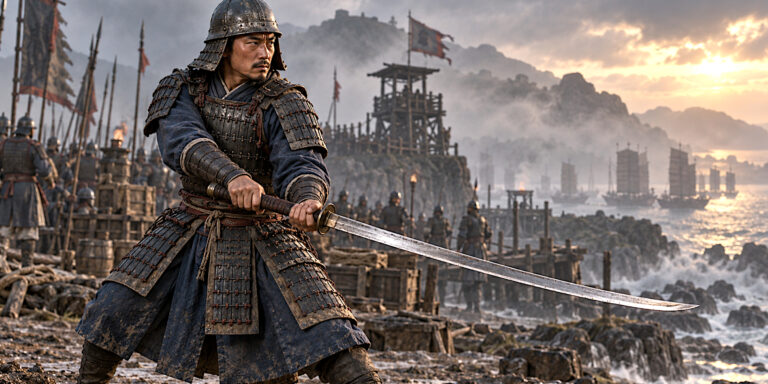
- Lamellar armour of leather or iron
- Composite bows with exceptional draw strength
- Light sabres and maces
- Lances for close engagements
Sword Types
- Curved sabres designed for slicing cuts from horseback
- Compact and practical rather than ceremonial
Strengths
- Mobility and discipline
- Coordinated manoeuvres and feigned retreats
- Effective command structure
Weaknesses
- Lighter armour in prolonged melee
- Reliance on open terrain
Battle Timeline
Early Morning
The Mongols positioned themselves on open ground near Legnica. Their formation encouraged engagement, which was precisely the point.
Henry II advanced with his coalition, likely eager to strike before further Mongol incursions could spread.
Initial Engagement
European cavalry launched an aggressive charge. Early momentum appeared promising. Some Mongol units withdrew under pressure.
This was, as it often was, deliberate.
Feigned Retreat
The Mongols executed a controlled withdrawal, drawing parts of the European force out of formation. Discipline began to fray among the coalition ranks.
At this stage, coordination between different European contingents collapsed. Some pursued. Others hesitated. None quite agreed on what the plan had been.
Encirclement
Mongol forces regrouped and counterattacked. Horse archers enveloped exposed flanks, maintaining distance while delivering sustained missile fire.
A smoke screen, possibly created using burning materials, added confusion. Whether it was chemical warfare or simply battlefield theatrics is debated, though the effect was clear enough.
Collapse
Henry II attempted to rally his forces but was ultimately surrounded and killed. His head was later displayed by the Mongols, a gesture that required no translation.
With leadership gone, resistance disintegrated. Survivors fled, pursued in typical Mongol fashion.
Archaeology
Archaeological work around Legnickie Pole has produced a modest but telling collection of finds.
Key Discoveries
- Arrowheads consistent with Mongol composite bow use
- Fragments of mail and plate elements from European armour
- Horse equipment, including bits and fittings
- Scattered weapon remains suggesting chaotic close combat
The relative scarcity of mass graves has led to speculation that many bodies were removed or dispersed. Medieval battlefields rarely behave like neat archaeological sites.
Recent surveys using ground-penetrating radar have identified possible burial zones, though interpretation remains cautious. Soil disturbance across centuries does not preserve tidy narratives.
Contemporary Quotes
From the Annals of Jan Długosz:
“The Tartars, feigning flight, drew the Christians into disorder and turned upon them with dreadful slaughter.”
From the Chronica Polonorum:
“Duke Henry fell, and with him the strength of the army, and the land was left open to fear.”
A Templar account, fragmentary and likely embellished:
“They rode as if the wind carried them, and no man could close with them unless they wished it.”
Analysis
Legnica is often described as a near miss for Europe, though that depends on what one thinks the Mongols intended. Their primary objective lay elsewhere. Poland was a flank, not the main stage.
What the battle demonstrates, rather starkly, is the gap between European feudal warfare and Mongol operational thinking. The former relied on courage and local initiative. The latter functioned as a coordinated system with clear command and control.
The result was predictable, even if the participants did not quite realise it at the time.
Legacy
The Mongols did not push deeper into Central Europe after Legnica. Their withdrawal, tied to political developments in the east, spared the region further devastation.
Yet the psychological impact lingered. Chronicles across Europe speak of fear, confusion, and a growing awareness that warfare had changed.
Legnica became less a turning point and more a warning. Europe, to its credit, eventually paid attention.
Where to Visit
- Legnickie Pole, Poland, traditional site of the battlefield
- Museum of the Battle of Legnica, housing artefacts and interpretive displays
- Regional archaeological exhibits in Lower Silesia
Seven Swords Takeaway
The Battle of Legnica is not a story of heroic last stands or miraculous victories. It is a study in preparation meeting improvisation, and preparation winning without much ceremony.
If there is a lesson, it is not especially comforting. Organisation tends to beat enthusiasm, particularly when the organisation arrives on horseback and refuses to fight on your terms.to Hungary, where the decisive Battle of Mohi followed.