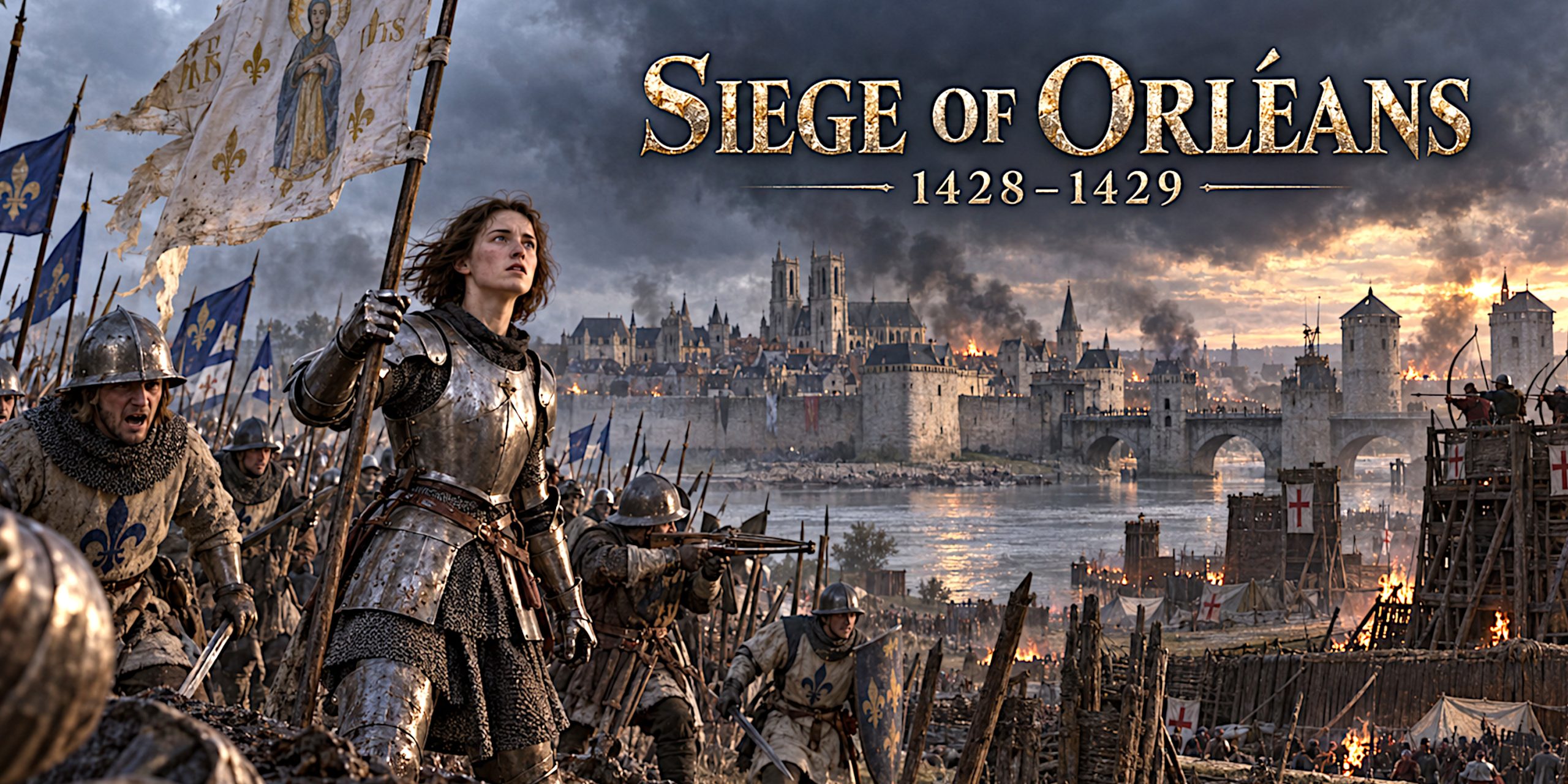
The Siege of Orléans was the moment when the English advance through France finally lost its air of inevitability. From October 1428, English troops attempted to isolate and capture the city controlling one of the Loire’s most important crossings. If Orléans fell, the territories loyal to Charles VII south of the river would become dangerously exposed.
The siege was already faltering when Joan of Arc arrived in April 1429. The English lacked enough men to seal the city completely, while French troops and supplies could still enter through gaps in the blockade. Joan did not single-handedly command the campaign, nor did she devise every assault. What she brought was urgency, confidence and an uncompromising belief that the French should attack.
Within nine days of her arrival, the English positions around Orléans had collapsed. That extraordinary reversal turned a strategically important siege into one of the defining episodes of the Hundred Years’ War.
Siege of Orléans at a Glance
| Detail | Information |
|---|---|
| Conflict | Hundred Years’ War |
| Dates | 12 October 1428 to 8 May 1429 |
| Location | Orléans and the Loire Valley, France |
| Combatants | Kingdom of England and allies against forces loyal to Charles VII |
| English objective | Capture Orléans and open a route into central France |
| Result | French victory and English withdrawal |
| Key turning point | Capture of the Tourelles on 7 May 1429 |
| Historical importance | Revived the Valois cause and opened the road towards Charles VII’s coronation |
Why Was Orléans So Important?
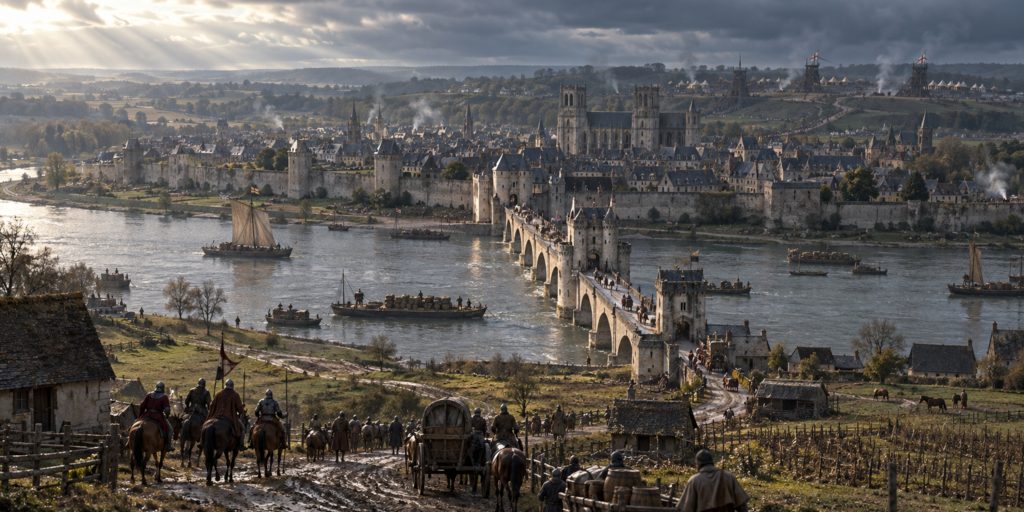
By 1428, the political map of France was a miserable sight for supporters of Charles VII. Henry V’s victories, followed by the Anglo-Burgundian alliance and the Treaty of Troyes, had placed much of northern France under English or Burgundian control.
The infant Henry VI was recognised by the English and their allies as king of both England and France. Charles VII, still uncrowned and dismissively called the “Dauphin” by his enemies, controlled a reduced kingdom centred largely south of the Loire.
Orléans stood on the northern bank of that river. Its bridge provided a route into the Valois heartlands of Berry, Bourbonnais and the Loire Valley. Taking the city would also eliminate a powerful base belonging to Charles, Duke of Orléans, who had remained an English prisoner since Agincourt.
The city therefore mattered for several reasons:
- It guarded a major crossing of the Loire.
- It protected the approaches to Charles VII’s remaining territories.
- It served as a supply, administrative and military centre.
- Its fall could encourage undecided towns to accept Anglo-Burgundian rule.
- Its survival carried enormous political value for the Valois cause.
The English did not need to conquer every corner of France. They needed to convince people that resistance was pointless. Orléans stubbornly refused to cooperate with that argument.
The English Approach to the Siege
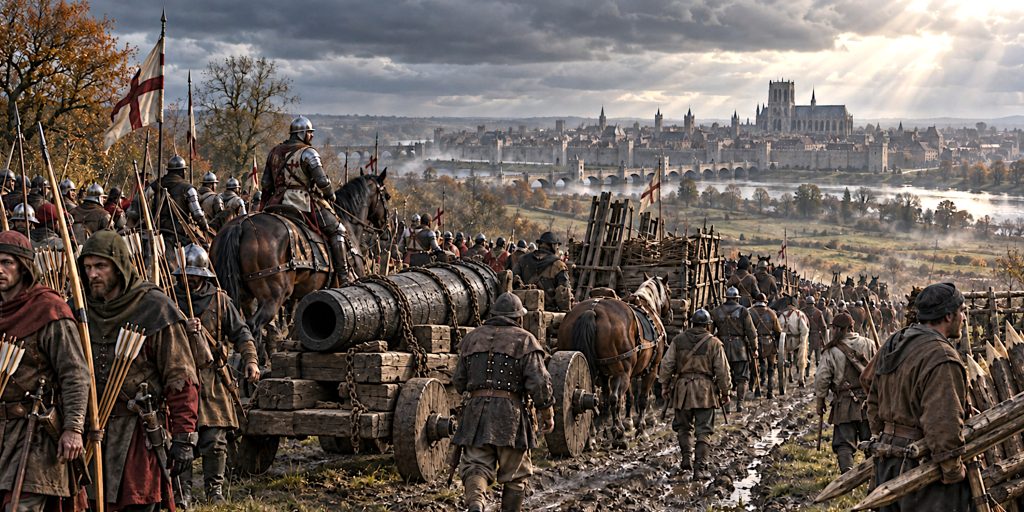
The English army arrived under Thomas Montagu, Earl of Salisbury, one of the most experienced commanders in English service. Rather than immediately storming the city’s walls, Salisbury began securing surrounding settlements and positions controlling the roads and river.
The greatest early success came with the capture of the Tourelles, a fortified complex guarding the southern end of the bridge across the Loire. The French abandoned part of the bridge and demolished an arch to prevent the English from crossing directly into the city.
Salisbury’s success was brief. While inspecting Orléans from the captured fortifications, he was struck by debris caused by a French cannon shot. He died several days later.
His death deprived the besiegers of their strongest commander at a critical stage. William de la Pole, Earl of Suffolk, assumed greater responsibility, while Lord Talbot and Lord Scales commanded important sections of the surrounding English positions.
The besiegers built a chain of fortified bastilles around Orléans. These were defended strongpoints rather than one continuous line. The distinction matters because the English army was too small to encircle the city completely. The siege looked formidable on a map, but maps are wonderfully discreet about empty spaces.
Forces at the Siege of Orléans
Medieval army figures should be treated with care. Chroniclers often used numbers to convey grandeur, terror or divine favour rather than to assist future military accountants. Modern estimates therefore vary.
The English may have begun the campaign with approximately 4,000 to 5,000 men, although disease, casualties, desertion and the need to garrison multiple positions reduced the effective besieging force. The French defence combined professional soldiers, urban militia, artillery crews and relief contingents entering the city at different stages.
Principal Leaders
| Side | Leader | Role |
|---|---|---|
| English | Thomas Montagu, Earl of Salisbury | Original commander, mortally wounded in October 1428 |
| English | William de la Pole, Earl of Suffolk | Senior commander after Salisbury’s death |
| English | John Talbot | Aggressive field commander and veteran captain |
| English | Thomas Scales | Commanded troops and fortified positions around Orléans |
| English | William Glasdale | Commander associated with the Tourelles |
| French | Jean de Dunois | Principal commander inside Orléans, known as the Bastard of Orléans |
| French | Raoul de Gaucourt | Captain and senior defender of the city |
| French | Étienne de Vignolles, called La Hire | Experienced French captain |
| French | Jean Poton de Xaintrailles | French commander and companion of La Hire |
| French | Gilles de Rais | Noble commander in the relief army |
| French | Joan of Arc | Inspirational figure and forceful advocate for offensive action |
Jean de Dunois and the Bastard of Orléans were the same man. Older accounts sometimes list them separately, accidentally granting the French an additional commander. La Hire and Étienne de Vignolles are likewise one person.
English Troop Composition
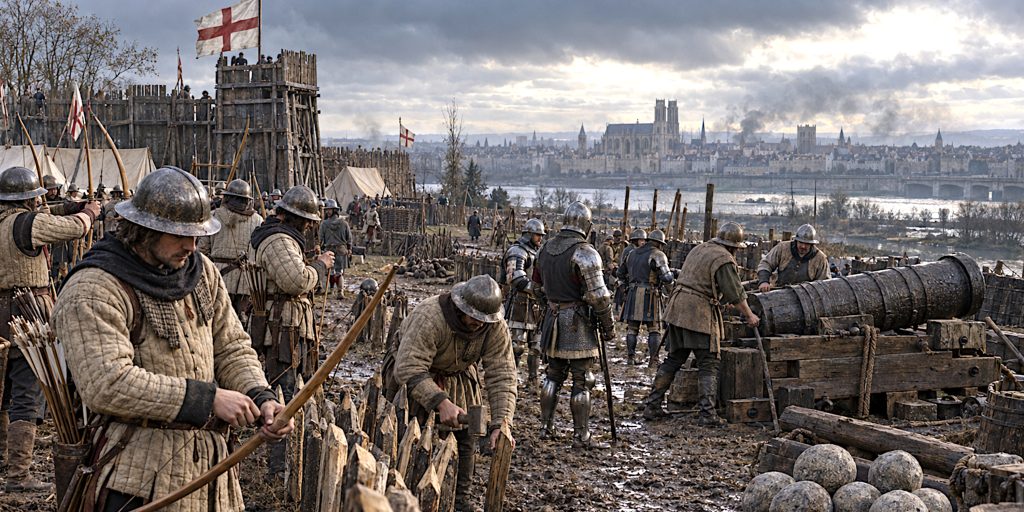
The English force included:
- Men-at-arms fighting on foot or mounted when circumstances allowed
- Longbowmen, who formed a large proportion of the army
- Engineers, carpenters and labourers
- Gunners operating bombards and smaller artillery pieces
- Garrisons distributed among isolated bastilles
- Burgundian and other allied contingents, particularly during the earlier phases
The English position weakened when Burgundian forces departed following a political dispute. An attempt by the citizens to place Orléans under the protection of Philip the Good, Duke of Burgundy, was rejected by the English regent, the Duke of Bedford. Bedford was not prepared to conduct a siege merely to hand the prize to Burgundy. It was a principled position, if one overlooks the strategic damage it caused.
French Troop Composition
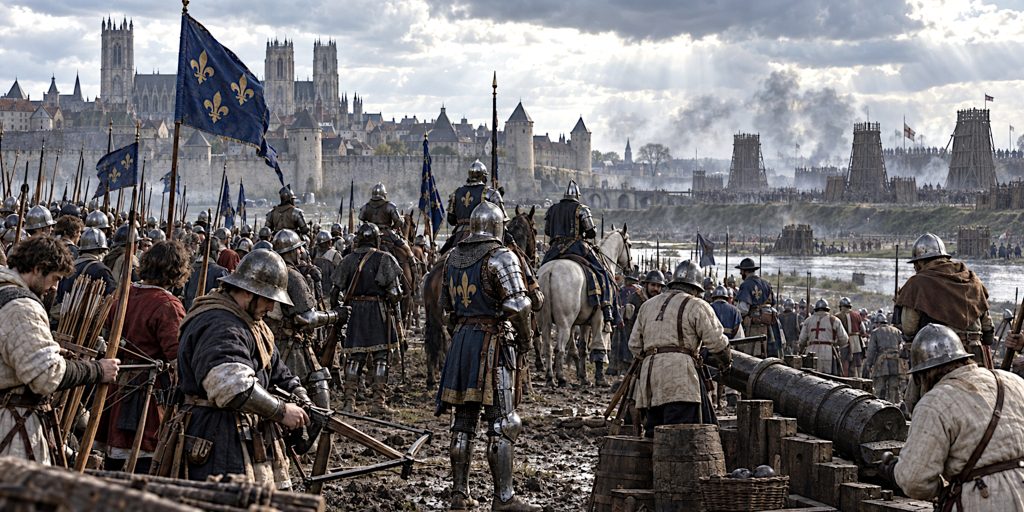
The defenders and relief forces included:
- Professional men-at-arms
- Mounted captains and their retinues
- Crossbowmen
- Archers
- Urban militia
- Artillery crews
- Labourers repairing walls and constructing field defences
- Clergy and civilians supporting supply and morale
- Reinforcements accompanying Joan from Blois
Claims that thousands of regular troops remained inside Orléans throughout the siege are probably too generous. The strength of the defence fluctuated as detachments entered and left through the incomplete English blockade.
The Battle of the Herrings
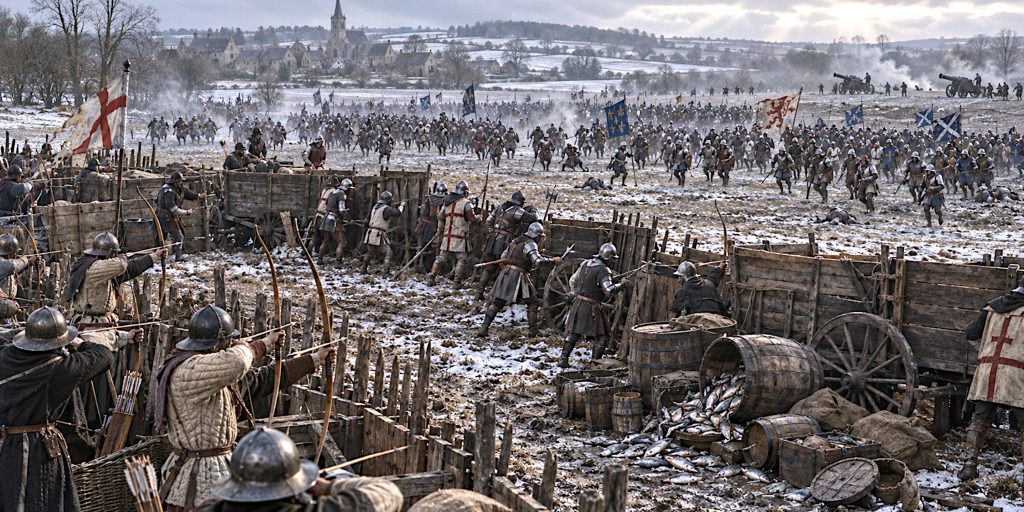
On 12 February 1429, a French and Scottish force attempted to intercept an English supply convoy near Rouvray. The wagons carried food, military supplies and barrels of herring intended for English troops observing Lent.
The convoy commander, Sir John Fastolf, formed the wagons into a defensive enclosure. Stakes and archers strengthened the position. French commanders disagreed over whether to wait for artillery or launch an immediate assault. The attack went ahead without proper coordination and was defeated.
The Battle of the Herrings damaged French morale and seemed to confirm the English reputation for defensive discipline. It also demonstrated a recurring French weakness: brave men enthusiastically doing different things at the same time.
Orléans remained supplied through gaps in the English positions, but confidence in the wider Valois war effort was fading.
Joan of Arc Arrives
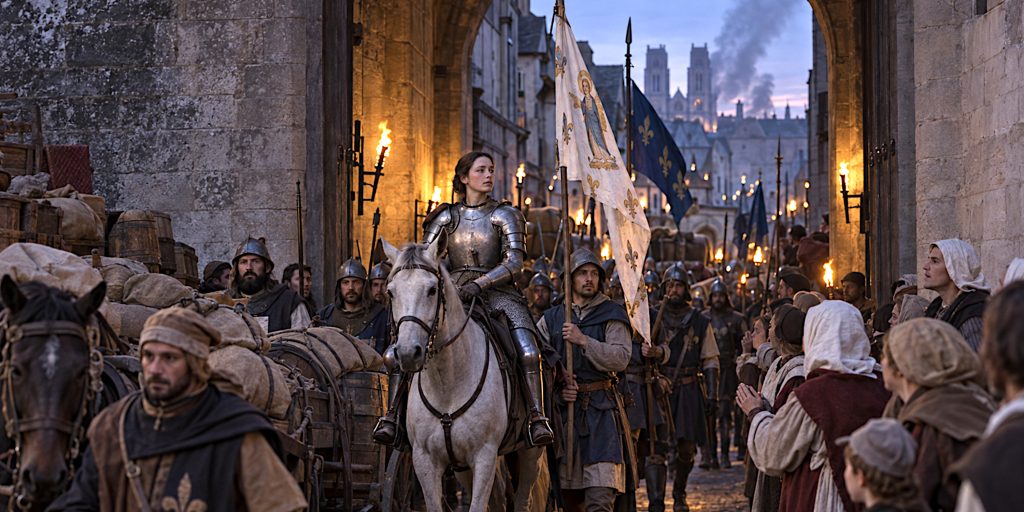
Joan entered Orléans on 29 April 1429 with supplies and a military escort. She was about seventeen years old and claimed that divine voices had instructed her to drive the English from France and bring Charles VII to Reims for his coronation.
Her precise military authority remains debated. Joan was not the sole commander of the French army, and experienced captains such as Dunois, La Hire and Gaucourt retained operational responsibilities. She nevertheless exerted considerable influence. Her presence encouraged soldiers and civilians who had spent months watching the English tighten their hold around the city.
Joan promoted an immediate offensive. She also sent messages demanding that the English withdraw. They answered with insults and threats, apparently believing that mockery was an adequate response to a deteriorating strategic position.
Her importance rested partly in morale, but describing her as merely a mascot goes too far. She joined attacks, pressed commanders to continue operations, carried her standard close to the fighting and returned after being wounded. Symbolism is powerful, especially when the symbol refuses to remain safely behind the army.
The French Counter-Offensive
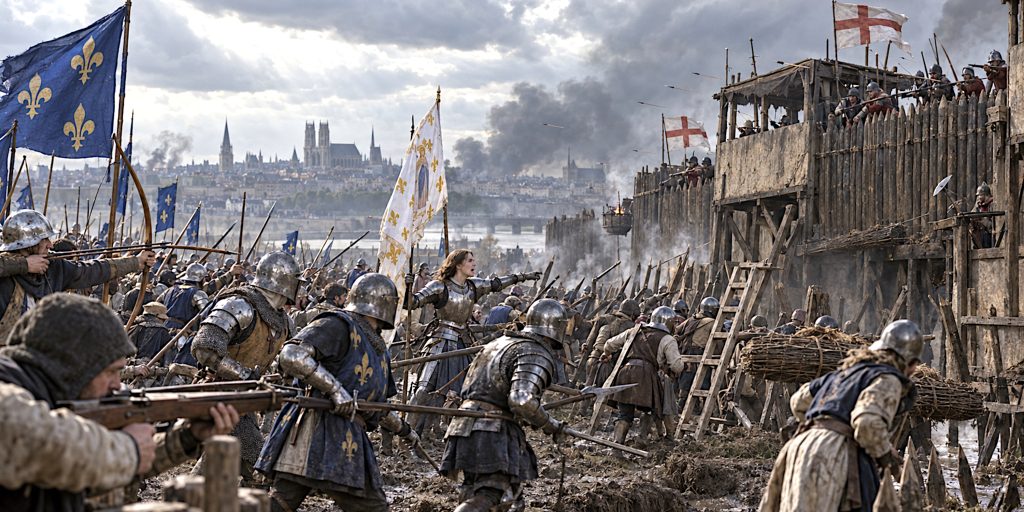
On 4 May, French troops attacked the English bastille of Saint-Loup east of Orléans. Joan reportedly learned of the fighting after it had begun and hurried to join the assault. The position was captured after fierce resistance.
The victory encouraged the defenders. On 6 May, French forces crossed to the southern bank of the Loire and attacked English positions around Saint-Jean-le-Blanc and the Augustins. The English abandoned one position and concentrated their defence around the Tourelles.
That left the bridgehead as the central obstacle. If the French captured it, the English hold over the southern approaches to Orléans would be broken.
The Assault on the Tourelles
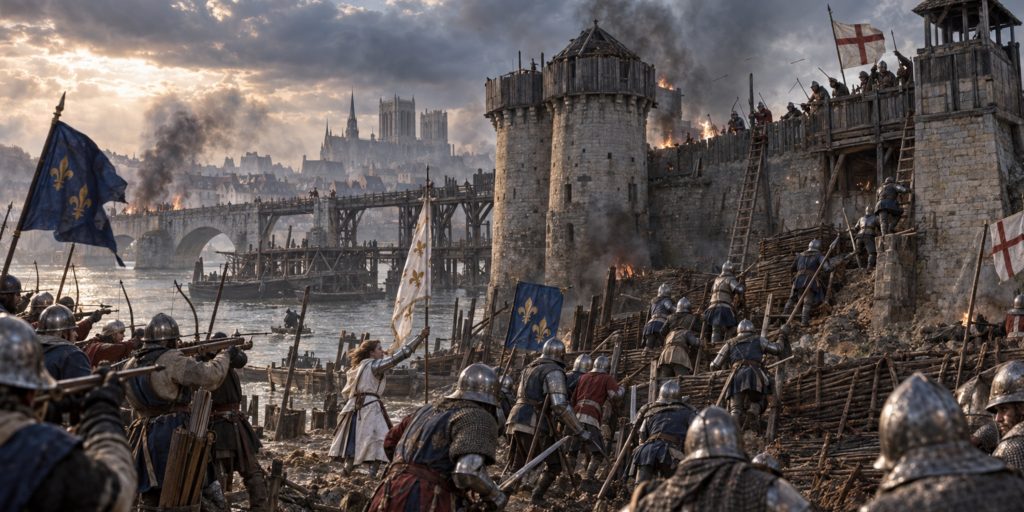
The French attacked the Tourelles complex on 7 May. The position was protected by fortifications, ditches and English archers. Fighting continued for much of the day.
Joan was wounded by an arrow, probably in the shoulder or upper chest. She withdrew briefly but returned to the action. According to testimony given during her rehabilitation proceedings, her reappearance helped renew the assault.
The French eventually breached the position. William Glasdale and other defenders attempted to retreat across a temporary bridge, which collapsed or was destroyed during the fighting. Glasdale drowned in the Loire.
The capture of the Tourelles made the English position around Orléans extremely difficult to sustain. Their southern strongholds had been lost, casualties had mounted and French morale was plainly no longer the scarce commodity it had been a fortnight earlier.
On 8 May, the remaining English forces drew up outside the city. French troops also deployed, but no general battle followed. The English abandoned their bastilles and withdrew.
The siege was over.
Arms and Armour
The fighting around Orléans combined traditional medieval weapons with increasingly important gunpowder artillery. Swords remained valuable personal weapons, but archery, polearms, fortifications and cannon shaped much of the campaign.
Swords Used at Orléans
| Weapon | Likely Users | Characteristics and Use |
|---|---|---|
| Arming sword | Knights, men-at-arms and officers | Single-handed, double-edged sword used with a shield, buckler or as a secondary weapon |
| Longsword | Wealthier men-at-arms | Longer grip permitted one-handed or two-handed use, with effective cutting and thrusting capability |
| Estoc | Some armoured combatants | Stiff, pointed weapon designed primarily for thrusting into gaps in armour |
| Falchion | Infantry and men-at-arms | Single-edged cutting sword, although surviving forms varied considerably |
| Messer or large knife | Soldiers and civilians | Practical single-edged sidearm more common in parts of continental Europe |
| Baselard | Soldiers of differing ranks | Long dagger or short sword used as a secondary weapon |
| Rondel dagger | Men-at-arms | Strong thrusting dagger suited to close fighting against armoured opponents |
It is difficult to assign particular sword types exclusively to the English or French. Late medieval weapon culture crossed political borders, and soldiers selected equipment according to wealth, status and availability.
English Weapons
English longbowmen carried powerful yew bows capable of maintaining rapid shooting. At close range they could use swords, daggers, mallets and polearms.
Men-at-arms employed:
- Arming swords and longswords
- Lances
- Pollaxes
- Spears
- Maces and war hammers
- Rondel daggers
- Polearms used while fighting on foot
French Weapons
French forces relied upon a mixed arsenal:
- Crossbows and bows
- Arming swords and longswords
- Lances used by mounted troops
- Pollaxes and other staff weapons
- Early handguns
- Bombards and smaller cannon
- Daggers for close combat
Armour
A well-equipped man-at-arms could wear a developed plate harness over an arming doublet, with mail protecting vulnerable gaps. Bascinets remained in use, while sallets were becoming more common during the fifteenth century.
Less wealthy troops wore combinations of:
- Brigandines
- Mail shirts or collars
- Padded jacks
- Kettle hats
- Open-faced helmets
- Gauntlets and individual plate elements
Full plate armour offered excellent protection, but it did not make its wearer invulnerable. Arrows, bolts, polearms, falls, crushing blows and daggers aimed at joints remained serious threats.
Artillery and Siege Warfare
Both sides used gunpowder artillery. The French maintained cannon within Orléans, while the English employed artillery against its walls and defensive positions.
One French shot caused the wound that killed Salisbury, giving artillery an influence well beyond the physical damage inflicted. The death of a senior commander could alter an entire campaign more effectively than knocking a modest hole in masonry.
Artillery at Orléans included large bombards and smaller guns firing stone or iron projectiles. Cannon could:
- Damage walls, gates and towers
- Fire upon troops occupying exposed positions
- Disrupt construction work
- Harass supply movements
- Provide covering fire during assaults
- Undermine morale
Yet the siege also showed the limitations of early artillery. Guns were cumbersome, ammunition was expensive and sustained bombardment required reliable supply. Cannon had become important, but they had not yet turned fortified cities into decorative inconveniences.
Battle Timeline
| Date | Event |
|---|---|
| 12 October 1428 | Salisbury’s English army begins operations against Orléans |
| 23 October 1428 | English forces capture the Tourelles at the southern end of the Loire bridge |
| Late October 1428 | Salisbury is mortally wounded while observing the city from the captured position |
| 3 November 1428 | Salisbury dies and English command passes to other senior captains |
| Winter 1428 to 1429 | English troops construct fortified bastilles around Orléans, but fail to seal the city completely |
| 12 February 1429 | English convoy defeats a French and Scottish force at the Battle of the Herrings |
| February 1429 | Burgundian troops withdraw amid disagreement over the proposed Burgundian protection of Orléans |
| 29 April 1429 | Joan of Arc enters Orléans with supplies and reinforcements |
| 4 May 1429 | French forces capture the bastille of Saint-Loup |
| 6 May 1429 | French troops attack positions south of the Loire and capture the Augustins |
| 7 May 1429 | The French storm the Tourelles; Joan is wounded and returns to the fighting |
| 8 May 1429 | The English abandon the siege and withdraw |
| 18 June 1429 | The French defeat the English at Patay during the subsequent Loire campaign |
| 17 July 1429 | Charles VII is crowned at Reims |
Contemporary Voices
Contemporary and near-contemporary accounts of Joan require careful handling. Her letters were dictated, chronicles carried political loyalties, and much of the testimony about Orléans was recorded years later during the proceedings that overturned her conviction.
In a letter addressed to the English in March 1429, Joan demanded that they surrender the towns they held:
“Render account to the King of Heaven; give up to the Maid the keys of all the good towns.”
The wording survives through manuscript transmission and translation, so minor variations appear in modern editions. The voice, however, is unmistakably direct.
During Joan’s rehabilitation trial, Jean de Dunois recalled her confidence when military leaders disagreed with her over the movement of supplies. Joan insisted:
“In God’s name, the counsel of Our Lord is wiser and safer than yours.”
Dunois also testified that the wind changed when boats carrying provisions needed to move towards Orléans. Whether one reads this as providence, fortunate weather or retrospective memory depends largely upon what one brought to the question beforehand.
Jean d’Aulon, Joan’s squire, described her conduct after she was wounded at the Tourelles. His testimony presents her returning to the assault and encouraging the troops rather than abandoning the field.
These accounts were favourable to Joan and recorded long after the siege. They remain valuable, but admiration is not the same thing as neutral observation.
Archaeology and the Battlefield Today
The archaeology of Orléans is complicated by centuries of rebuilding. The medieval city continued to develop, while the Loire bridge and the southern bridgehead were altered, demolished and replaced. Much of the physical setting of the siege now lies beneath later streets, embankments and construction.
Urban archaeology has helped researchers reconstruct:
- The changing line of the medieval walls
- Defensive ditches and gates
- The position and development of the Loire crossings
- Medieval occupation near the river
- The broader topography within which the siege took place
The location of the Tourelles is understood through a combination of archaeology, early maps, written records and architectural study. Visitors should not expect an untouched battlefield. Orléans was a living city before 1428 and remained one afterwards, which is usually inconsiderate from an archaeological point of view.
Stone and iron projectiles, weapon fragments and evidence of medieval defences can illuminate warfare in the city. Individual finds must nevertheless be dated and interpreted cautiously. A projectile discovered in Orléans is not automatically connected to Joan’s campaign simply because that makes a better museum label.
The French National Institute for Preventive Archaeological Research provides an archaeological overview of the city and its changing fortifications, including the medieval landscape associated with the siege.
Why Did the English Lose?
Joan’s arrival transformed the final phase of the siege, but the English defeat had several causes.
- The English army was too small to maintain a complete blockade.
- Its soldiers were dispersed among separate bastilles.
- Salisbury’s death weakened overall command.
- Supplies and French reinforcements continued to reach Orléans.
- Burgundian withdrawal reduced English strength.
- The French increasingly concentrated their attacks against isolated positions.
- Joan restored confidence and pressed for sustained offensive action.
- The loss of the Tourelles made the remaining English deployment untenable.
The victory was therefore neither a solitary miracle nor an ordinary military event with Joan conveniently edited out. The more convincing interpretation lies between those extremes. Existing English weaknesses created an opportunity, experienced French captains supplied military capability, and Joan helped turn that capability into decisive action.
Casualties
Reliable casualty figures do not survive. Losses were probably heaviest during the assaults on Saint-Loup, the Augustins and the Tourelles.
English prisoners may have been killed during or after the storming of certain positions, while others were captured for ransom. Medieval chroniclers provide conflicting totals, and later writers often repeated precise figures without a secure evidential basis.
It is safer to conclude that English losses during the May assaults were serious enough to weaken an already overstretched army. French casualties were also substantial, particularly during the prolonged attack on the Tourelles.
The Aftermath of Orléans
The French quickly exploited the victory. During the Loire campaign, they captured Jargeau, Meung-sur-Loire and Beaugency. On 18 June 1429, French forces defeated an English army at Patay.
Patay was especially damaging because French cavalry caught sections of the English army before the longbowmen had established a secure defensive position. The victory shattered the aura created by earlier English successes.
Joan then accompanied the campaign towards Reims, where Charles VII was crowned on 17 July. The coronation strengthened his legitimacy and fulfilled one of Joan’s stated objectives.
The English remained a formidable military power in France for years afterwards. Orléans did not end the Hundred Years’ War, which continued until 1453. It did, however, alter its political and psychological direction.
The Legacy of the Siege
The Siege of Orléans became inseparable from the legend of Joan of Arc. Her later capture, trial and execution gave the victory a tragic retrospective power, while her rehabilitation and eventual canonisation reshaped her into religious, national and political symbols.
For military historians, the siege is equally valuable because it reveals a transitional form of warfare. Traditional fortifications, armoured men-at-arms, longbows and close-quarter assaults operated alongside increasingly effective gunpowder weapons.
The campaign also demonstrates that morale should not be treated as a vague addition to strategy. The French possessed troops, commanders and artillery before Joan arrived, yet they had struggled to use them decisively. Her presence changed what those soldiers believed possible.
Orléans was saved by logistics, leadership, artillery, vulnerable English positions and determined assaults. It was also saved by a young woman whose certainty proved more infectious than the caution of nearly everyone around her. Historians may argue over the proportions, but removing either half leaves a poorer explanation.
Frequently Asked Questions
How long did the Siege of Orléans last?
The siege lasted from 12 October 1428 until 8 May 1429, a little under seven months.
Did Joan of Arc command the French army?
Joan was not the sole commander. Jean de Dunois, Raoul de Gaucourt, La Hire and other experienced captains directed troops and planned operations. Joan influenced decisions, encouraged offensive action and participated directly in the fighting.
Was Orléans completely surrounded?
No. The English occupied a series of fortified bastilles, but lacked enough troops to create an unbroken blockade. Supplies and reinforcements could still enter the city.
Where was Joan of Arc wounded?
Joan was struck by an arrow during the assault on the Tourelles on 7 May 1429. Accounts differ over the exact position and severity of the wound, but she returned to the fighting.
Did the Siege of Orléans end the Hundred Years’ War?
No. The war continued until 1453. The victory revived the Valois cause and began a broader French recovery, but English power in France did not collapse immediately.
Sources and Further Reading
- Internet Medieval Sourcebook: Joan of Arc trial records
- University of California, Santa Barbara: The Trial of Joan of Arc
- INRAP: Archaeology of the City of Orléans