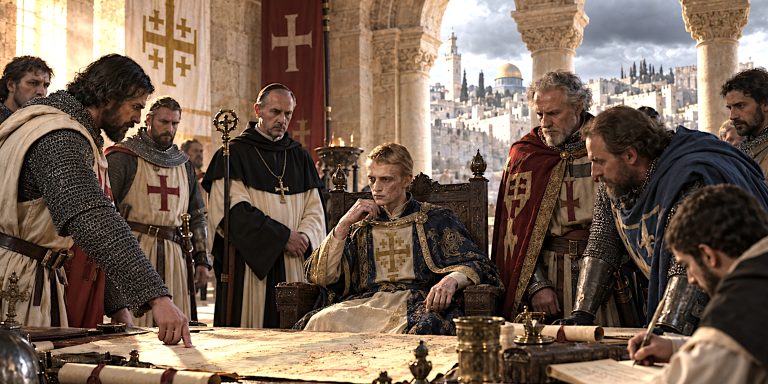
Few rivalries of the Crusading period feel as sharply drawn as that between Baldwin IV of Jerusalem and Saladin. One was a teenage king slowly being undone by illness, ruling a fragile Latin state with limited manpower. The other was a patient, disciplined war leader building a regional power from Egypt and Syria. Their conflict was not a neat duel. It was a prolonged test of nerve, timing, and political judgement, played out across deserts, castles, and uneasy truces.
This article looks at how Baldwin held the line far longer than he should have, why Saladin respected him even as he planned Jerusalem’s fall, and how their encounters reshaped the eastern Mediterranean.
Saladin. The Patient Architect of Victory
Saladin, ruler of the Ayyubid Sultanate, was in many ways Baldwin’s opposite. Where Baldwin ruled a small, divided kingdom, Saladin spent years consolidating Egypt, Syria, and Mesopotamia before striking decisively.
He was not in a rush.
Saladin’s early campaigns against Jerusalem were probing rather than catastrophic. He tested fortresses, watched Frankish responses, and learned who could be bribed, divided, or intimidated. He also recognised that Baldwin IV was not a weak opponent, despite appearances.
Contemporary Muslim chroniclers portray Saladin as respectful, even cautious, in dealing with Baldwin. He understood that reckless aggression could unite the Crusader states and provoke European intervention.
Baldwin’s Military Acumen

From the outset of his reign in 1174, Baldwin understood that Jerusalem’s survival depended on a strong military response to Saladin’s growing power. He did not shy away from leading armies in person, even as his illness worsened. His most notable victory came at the Battle of Montgisard in 1177, where he led a much smaller Crusader force to a stunning victory over Saladin’s army. The young king, reportedly carried on a litter, rallied the knights and personally took part in the fighting, inspiring his men and humiliating Saladin.
Although outnumbered, Baldwin made clever use of the terrain and timing. He struck when Saladin’s forces were spread out and vulnerable after crossing into the Latin Kingdom. The result was a sharp blow to Saladin’s reputation and a crucial morale boost for the Franks.
Defensive Strategy and Castle Building

Baldwin knew that Jerusalem could not rely solely on field victories. He reinforced the kingdom’s frontier by expanding and fortifying castles across key points. Strongholds like Karak, Montreal, and Beaufort played a vital role in containing Saladin’s raids and delaying his advances. These castles acted as forward outposts, disrupting enemy supply lines and providing safe bases for counter-attacks.
He also encouraged the military orders, especially the Knights Templar and Knights Hospitaller, to take a more active role in border defence. Their resources and manpower were indispensable, and Baldwin maintained good relations with their leaders to ensure their continued support.
Political Balancing Act
Internally, Baldwin faced factionalism among the barons of Jerusalem. Powerful lords such as Raynald of Châtillon and Guy of Lusignan often pursued their own interests, creating instability. Baldwin countered this by carefully managing appointments and arranging marriages to bind the nobility closer to the crown. When Guy proved unreliable as a regent, Baldwin replaced him with Raymond III of Tripoli, a move that risked further division but helped maintain strategic coherence.
He also made a key decision in crowning his nephew, Baldwin V, during his own lifetime to ensure a clear line of succession. This was an attempt to prevent a succession crisis upon his death, though it ultimately failed to prevent turmoil after his passing.
Managing Relations with Saladin

Though often at war, Baldwin understood when diplomacy was necessary. He negotiated several truces with Saladin to buy time and regroup. In these negotiations, Baldwin displayed a sharp understanding of regional politics. He used diplomacy to play rival Muslim factions against each other early in his reign and kept pressure off Jerusalem at critical moments.
Saladin himself held a measure of respect for Baldwin. Both leaders were devout and principled, and their conflict was often marked by pragmatism rather than hatred. This may have contributed to the survival of the Latin Kingdom during Baldwin’s reign, even when Saladin held the upper hand militarily.
A War of Raids, Truces, and Nerves

The 1180s were not dominated by constant open warfare. Instead, Baldwin and Saladin engaged in a tense rhythm of raids, counter raids, diplomacy, and uneasy truces.
Baldwin’s strategy was defensive realism. He knew Jerusalem could not defeat Saladin outright. His aim was delay. Every year Jerusalem survived intact was a political victory.
Saladin’s aim was containment. He wanted Jerusalem isolated, its alliances weakened, its leadership divided.
This period saw Baldwin relying increasingly on trusted nobles and military orders while managing internal rivalries, particularly over succession. His illness forced him to think constantly about what would happen after his death, a question Saladin watched with interest.
Legacy and Collapse After Death
Baldwin IV died in 1185 at just 24 years old. His leprosy had progressed to the point where he could no longer walk or feed himself, yet his grip on power remained steady until the end. After his death, the leadership of Jerusalem quickly deteriorated. His nephew Baldwin V died soon after, and Guy of Lusignan, whom Baldwin had tried to sideline, seized the throne.
The fragile balance Baldwin had maintained collapsed. In 1187, Saladin crushed the Crusader army at the Battle of Hattin, capturing most of the nobility and opening the path to Jerusalem. The city fell later that year, a moment that might have come much earlier were it not for Baldwin’s determined leadership.
Timeline. Baldwin IV and Saladin
1161
Birth of Baldwin IV in Jerusalem.
1174
Baldwin IV becomes king of Jerusalem. Saladin consolidates power in Egypt.
1177
Battle of Montgisard. Baldwin defeats Saladin in a surprise victory.
1179 to 1183
Ongoing raids, skirmishes, and negotiated truces between Jerusalem and Ayyubid forces.
1183
Baldwin’s health collapses. Effective command increasingly passes to regents.
1185
Death of Baldwin IV.
1187
Saladin defeats the Crusader army at Hattin and captures Jerusalem.
Frequently Asked Questions
Was Baldwin IV actually a capable ruler, or just symbolic?
He was very capable. Contemporary sources describe him as politically astute and cautious. His decisions consistently prioritised survival over glory.
Did Saladin respect Baldwin IV?
Yes. Muslim chroniclers suggest Saladin saw Baldwin as a serious opponent and adjusted his strategy accordingly.
Why did Jerusalem fall so quickly after Baldwin’s death?
Baldwin held together a fragile coalition through experience and restraint. His successors lacked both, and Saladin exploited that weakness.
Did Baldwin ever fight Saladin directly in battle?
Yes, most notably at Montgisard. Later in life, his illness prevented direct command, but his strategic influence remained.
Was the conflict purely religious?
Religion mattered, but politics mattered more. Both men made pragmatic decisions that often overrode ideological concerns.
The Seven Swords Takeaway
King Baldwin IV’s reign was brief, but his impact was profound. He managed to hold Jerusalem not through numbers or wealth, but through strategic insight, sheer willpower, and a remarkable ability to lead in the face of physical decline. His actions delayed Saladin’s conquest for years and allowed the Crusader states to survive long enough to witness the launch of the Third Crusade. In the end, Baldwin proved that courage and competence could still shape history, even from a body racked by disease.