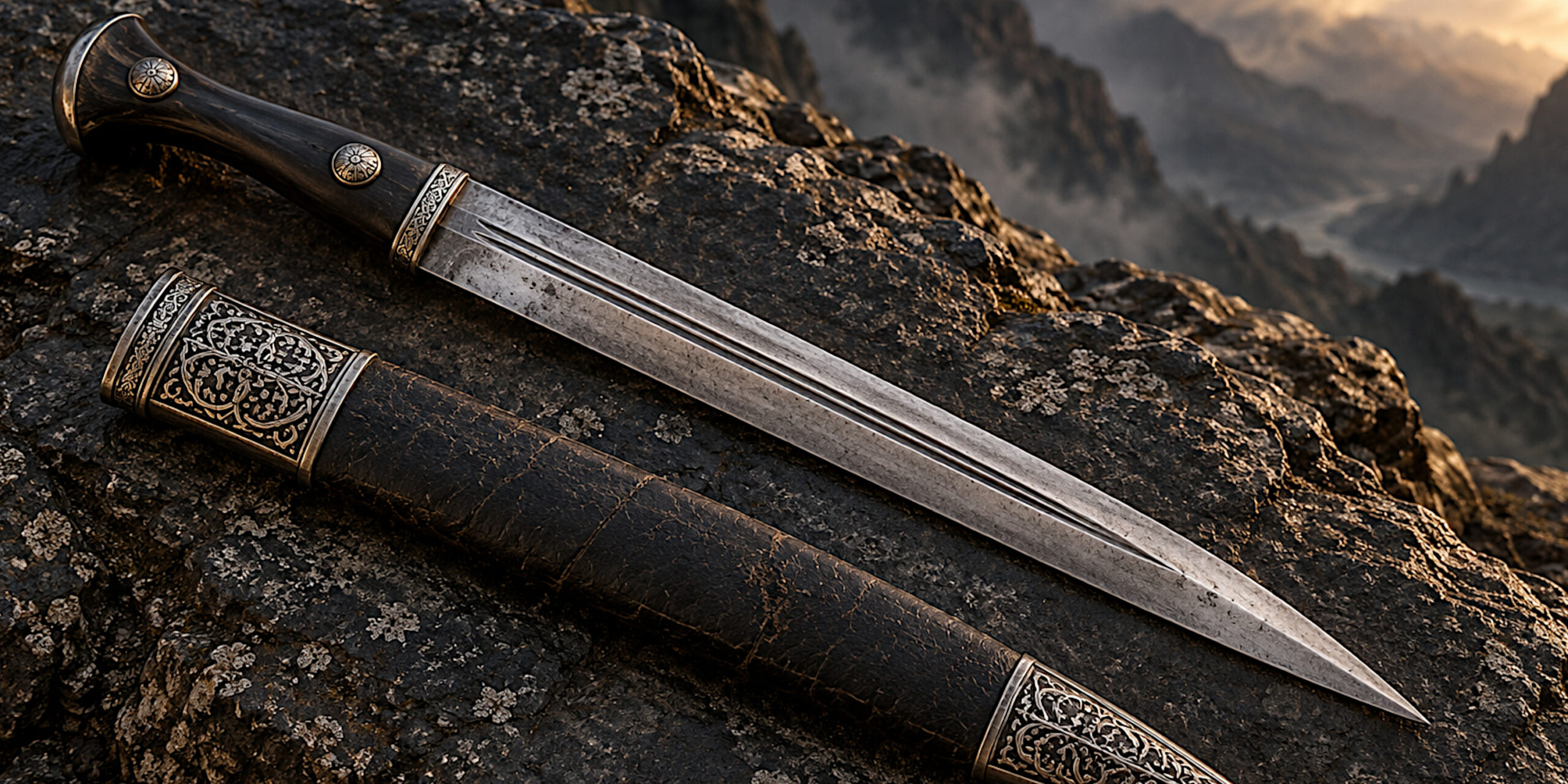
The qama is a straight, double-edged dagger associated with the Caucasus. Larger examples approach short-sword proportions, but museum catalogues generally classify them as daggers. Its most recognisable features are a tapering blade, a guardless grip and a scabbard that often carries as much decorative work as the weapon itself.
The names qama, kama, kindjal and khanjali overlap in historical writing and modern catalogues. They should not be treated as a neat sequence of separate weapon types. The Asia and Pacific Museum in Warsaw, for example, identifies the same tradition as “Qama / Kindjal”, noting its association with Caucasian peoples and its adoption by Cossacks.
Some surviving examples are restrained weapons with horn grips and leather-covered scabbards. Others have elaborate silver mounts, black niello decoration and precious-metal inlay. Both deserve attention: decoration can reveal the patron’s wealth and the workshop’s skill, while simpler pieces often make the underlying construction easier to study.
Qama Specifications and Construction

There was no single specification for every qama. Size, blade geometry, fittings and weight varied between workshops, periods and intended owners.
| Feature | Description |
|---|---|
| Weapon category | Dagger, with larger examples approaching short-sword size |
| Blade | Usually straight and double-edged, tapering towards a point |
| Blade surface | Plain, fullered or decorated; fuller arrangements vary |
| Hilt | Normally guardless, with a narrowed grip and expanded ends |
| Grip materials | Horn, wood and, on some luxury examples, ivory |
| Decorative materials | Silver, niello, gold inlay and gilding |
| Scabbard | Commonly a wooden core with leather covering and metal fittings; some extensively silver-mounted |
| Suspension | Belt-mounted, often angled across the front of the body |
| Principal roles | Personal sidearm, dress accessory and presentation object |
Surviving objects demonstrate why a fixed weight or length range can mislead.
| Documented example | Overall length, excluding scabbard | Blade length | Dagger weight |
|---|---|---|---|
| Dagestani kindjal dated 1856–57, Metropolitan Museum of Art, 91.1.890a–c | 48.4 cm | 37.5 cm | 362.9 g |
| Caucasian qama, nineteenth century, Metropolitan Museum of Art, 91.1.889 | 67 cm | 51.8 cm | 751.3 g |
These are individual measurements, not minimum and maximum dimensions for the type. Scabbard weight must also be distinguished from weapon weight.
Niello is the dark material used to fill engraved decoration, producing a strong contrast against silver. It is particularly prominent on surviving Caucasian hilts and scabbards.
History and Evolution
Origins and early development
Straight, double-edged daggers existed in the ancient Near East, but resemblance alone does not establish an unbroken line of descent. Claims that the qama developed directly from a particular Greek, Scythian or Persian sword need more evidence than a similar outline.
The Metropolitan Museum dates the earliest examples of the recognisable kindjal type to the eighteenth century and suggests that it may have originated in Georgia. This is a more defensible starting point than assigning it a precise ancient ancestor.
Nineteenth-century development
By the nineteenth century, the weapon was established across the Caucasus. A silver-and-niello example attributed tentatively to Kubachi in Dagestan bears a date corresponding to 1818–19. It demonstrates that richly decorated versions were already being produced early in the century.
Its spread also connected different craft centres. Blades, mounts and finished weapons could travel, making a confident regional attribution more complicated than matching a decorative motif to a modern national border.
| Development | Historical significance |
|---|---|
| Regional workshop production | Created differences in blade shape, proportions and decoration |
| Trade between centres | Allowed components and decorative influences to cross regional boundaries |
| Adoption by Cossacks | Extended the weapon’s use beyond its original Caucasian communities |
| Elaborate dress and presentation pieces | Made the dagger an expression of status as well as a practical possession |
| Russian production in Caucasian style | Shows how the design was adopted and reinterpreted outside local workshops |
Museum records include Russian-made examples in Caucasian style from the late nineteenth century. These should be distinguished from weapons made in the Caucasus and subsequently carried by Russian or Cossack owners. The Metropolitan Museum of Art
Advantages and Disadvantages
The following assessment concerns the design’s practical characteristics. It does not assume that every surviving qama had the same balance, heat treatment or handling qualities.
Advantages
- Compact proportions: Easier to carry continuously than a full-length sword.
- Cut-and-thrust capability: A straight point supports thrusting, while sharpened edges allow cuts.
- Unobtrusive hilt: The absence of a projecting crossguard reduces bulk when worn against clothing.
- Useful range of sizes: Smaller daggers favour portability; larger examples offer greater reach.
- Adaptable construction: A serviceable weapon could use modest fittings without requiring expensive decoration.
Disadvantages
- Limited reach: Even a large qama gives away distance against most swords, spears and other long weapons.
- Little hand protection: A guardless hilt provides minimal protection against an opposing blade.
- Variable grip security: Grip shape, surface finish and condition matter, particularly without a substantial guard.
- Limited protection against armour: A pointed blade is not automatically an effective armour-piercing weapon.
- Compromises at larger sizes: A long, heavy example sacrifices some of the convenience that makes a dagger attractive.
The qama’s design makes sense as a personal sidearm. Its usefulness does not require claims that it could routinely overcome longer weapons or defeat substantial armour.
Comparison with Similar Weapons
| Weapon | Shared characteristics | Main distinction |
|---|---|---|
| Kindjal or khanjali | Straight, double-edged Caucasian dagger tradition | Usually an overlapping name, rather than a consistently separate weapon |
| Jambiya | Double-edged dagger with strong dress and cultural associations | Typically has a curved blade, unlike the usually straight qama |
| Shashka | Closely associated with Caucasian and Cossack arms; many have guardless hilts | A full-length, curved sword with substantially greater reach |
| Roman gladius | Straight, double-edged blade capable of cutting and thrusting | A military sword from a different period and tactical setting |
Museum descriptions identify the jambiya’s curved blade and the shashka’s curved, guardless sword form. These are more useful distinctions than attempting to rank the weapons as universally better or worse. National Army Museum, London
The gladius comparison is morphological. It does not establish ancestry or equivalent battlefield use.
Legacy and Cultural Significance
The qama’s importance extended beyond fighting. Nineteenth-century photographs show Caucasian men wearing daggers as part of their clothing, commonly suspended diagonally from the belt. Museum interpretation also records their use as dance accessories and everyday implements.
Several aspects of that legacy remain important:
- Regional identity: Different communities shared the broad weapon form while developing their own preferences and decorative traditions.
- Metalworking: Silver engraving, niello and precious-metal decoration make exceptional examples significant works of craftsmanship.
- Dress and ceremony: A decorated dagger could communicate social position and personal identity.
- Collecting history: Museum acquisitions preserve these weapons, although older catalogue attributions sometimes require revision.
Reducing every example to a “Cossack dagger” obscures the Caucasian traditions from which the weapon developed. Equally, assigning every piece to a specific community without supporting evidence can be misleading.
Where to See Original Qamas
Search museum catalogues under qama, kama, kindjal and khanjali. Institutions do not use the names consistently.
| Collection | Relevant example | Viewing information |
|---|---|---|
| Metropolitan Museum of Art, New York | Kindjal dated 1818–19, possibly Kubachi, Dagestan, accession 26.35.8a, b | Listed on display in Gallery 379 when checked |
| Metropolitan Museum of Art, New York | Kindjal and sheath, approximately 1840–50, possibly northern Dagestan, accession 81.1.599a, b | Listed on display in Gallery 379 when checked |
| Metropolitan Museum of Art, New York | Large nineteenth-century qama, accession 91.1.889 | Online record; listed as not on view |
| Asia and Pacific Museum, Warsaw | Nineteenth-century qama/kindjal, inventory MAP 6499 | Illustrated online; confirm physical display before visiting |
The Met’s two displayed examples provide a useful comparison of proportions and silver-and-niello decoration. Gallery arrangements can change, so check the individual object records before travelling.
Collectors’ Guide: Identification, Condition and Authenticity
A sound purchase begins with the whole object. An impressive blade inscription or elaborate scabbard cannot compensate automatically for uncertain dating, extensive restoration or mismatched components.
| Area to examine | What to look for | Reasons for caution |
|---|---|---|
| Blade | Preserved profile, clear fullers and consistent surface condition | Heavy grinding, reshaped points or decoration cutting through older corrosion |
| Hilt | Secure assembly, appropriate materials and coherent wear | Loose scales, conspicuous adhesive or unexplained replacement rivets |
| Scabbard | Correct fit and fittings compatible with the dagger | Poor fit, mixed decorative styles or recently assembled components |
| Decoration | Crisp engraving and convincing workmanship | Crude imitation marks or decoration represented as proof of age |
| Inscriptions | Independent reading and comparison with documented examples | Unsupported claims of famous ownership or military service |
| Provenance | Old invoices, collection records and identifiable catalogue appearances | A detailed ownership story without documentary support |
Points worth remembering
- A date is not necessarily the date of the entire weapon. Blades, inscriptions and mounts may belong to different phases.
- “Damascus” is an imprecise sales term. Ask whether the seller means crucible steel, pattern-welded steel or surface decoration.
- Silver marks need interpretation. A number or stamp should be assessed in context.
- A replacement scabbard affects value. It may still be old and interesting, but should be described accurately.
- Condition reports matter. Request photographs of both blade faces, the point, hilt junction and scabbard fittings.
For conservation, avoid abrasive polishing, sharpening or attempts to improve inscriptions. Preserve existing surfaces and seek specialist advice before treating fragile organic materials or decorated metalwork.
Qama and Kindjal Auction Prices
Auction searches should include both names. The following are documented published results, rather than estimates or dealer asking prices.
| Auction house | Sale date and lot | Catalogue description | Published result |
|---|---|---|---|
| Antony Cribb | 26 March 2024, lot 267 | Nineteenth-century Caucasian kindjal | £460 |
| Antony Cribb | 26 March 2024, lot 266 | Nineteenth-century Caucasian kindjal | £520 |
| Olympia Auctions archive | 9 December 2009, lot 69 | Silver-mounted Caucasian kindjal dated 1903, with niello decoration | £1,200 |
| Olympia Auctions archive | 10 December 2008, lot 18 | Late nineteenth- or early twentieth-century kindjal with gold koftgari and horn grip scales | £1,300 |
The figures reproduce the auction houses’ displayed results. The retrieved records do not consistently establish whether buyer’s premium is included, so they should not be treated as comparable all-in purchase costs.
These results demonstrate that some antique examples sell for hundreds of pounds, while more elaborate pieces can reach four figures. They do not establish a current market average: the older results are historical comparisons, and condition, originality and provenance vary considerably.
Before bidding:
- Compare completed sales of closely related examples.
- Add the applicable premium, taxes, delivery and any other charges.
- Establish whether the scabbard and fittings belong together.
- Obtain a condition report and material identification where necessary.
- Pay for documented quality and provenance, rather than an attractive attribution alone.