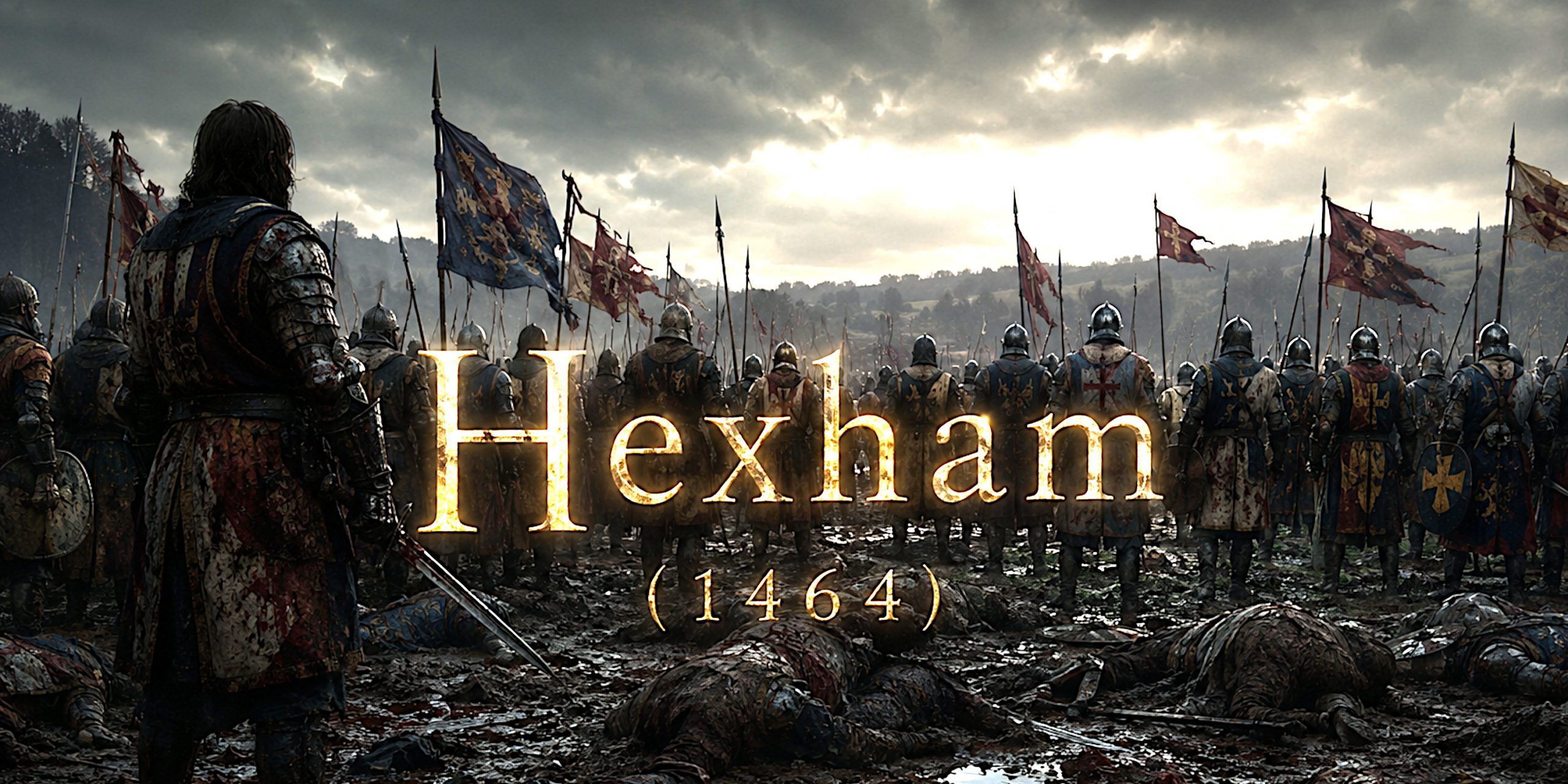
The Battle of Hexham, fought on 15 May 1464, rarely receives the same attention as Towton or Bosworth. That is a shame because its consequences were immense. If Towton shattered Lancastrian military power, Hexham quietly finished the job. It destroyed the last organised Lancastrian army in northern England, sent its commanders to the executioner’s block, and secured Edward IV’s throne for nearly a decade.
It was not a vast clash involving tens of thousands of men. Instead, it demonstrated how preparation, surprise and discipline could overcome numerical uncertainty. The battle was short, brutal and decisive. Many Lancastrian soldiers barely had time to form ranks before the Yorkist assault overwhelmed them.
For historians, Hexham offers a fascinating contrast with the larger engagements of the Wars of the Roses. It reminds us that kingdoms are not always won in spectacular confrontations. Sometimes they are secured in damp Northumbrian fields before breakfast.
Battle at a Glance
| Detail | Information |
|---|---|
| Date | 15 May 1464 |
| Location | Near Hexham, Northumberland |
| Conflict | Wars of the Roses |
| Yorkist Commander | John Neville, Lord Montagu |
| Lancastrian Commander | Henry Beaufort, Duke of Somerset |
| Result | Decisive Yorkist victory |
| Estimated Strength | Around 3,000 to 5,000 men combined |
| Significance | Ended organised Lancastrian resistance in northern England |
Background
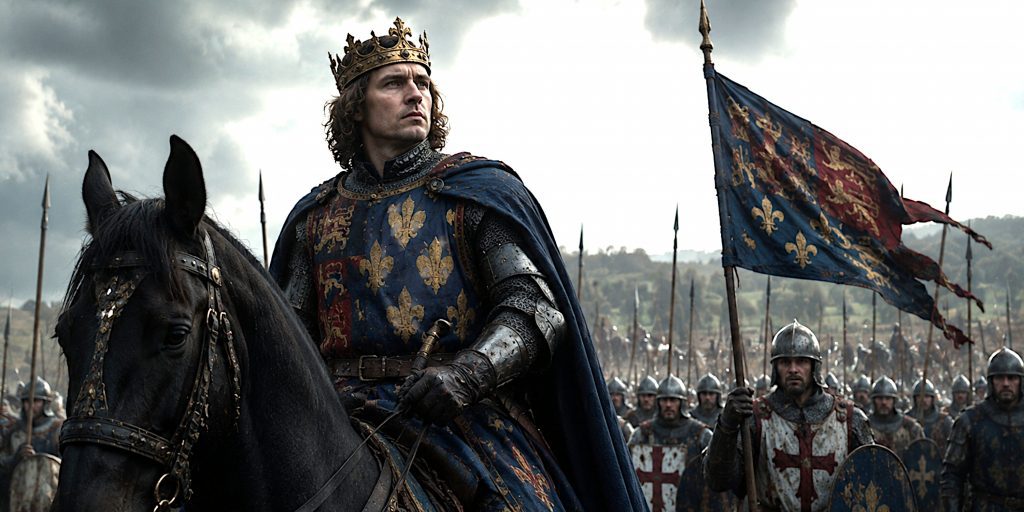
By 1464, Edward IV had already won the crown, but England remained unstable. Queen Margaret of Anjou refused to surrender the Lancastrian claim and continued gathering support from Scotland and loyal northern nobles.
The north of England had become the heartland of Lancastrian resistance. Powerful families remained loyal to Henry VI, while Scottish support allowed fresh armies to cross the border whenever opportunities emerged.
Earlier in 1464, Yorkist victories at Hedgeley Moor weakened Lancastrian confidence but did not eliminate the threat. Henry Beaufort, Duke of Somerset, assembled another army near Hexham, hoping to revive the Lancastrian campaign before Edward IV could fully consolidate his rule.
John Neville, Lord Montagu, moved rapidly to intercept him.
Why Was Hexham Important?
Hexham effectively ended the military phase of the Lancastrian recovery.
Its consequences included:
- Destruction of the last significant Lancastrian field army
- Capture and execution of leading Lancastrian nobles
- Collapse of organised resistance in northern England
- Greater stability for Edward IV’s government
- Forced Henry VI and Margaret of Anjou into continued exile and hiding
The victory allowed Edward to govern with far greater confidence, although fresh political turmoil would emerge several years later through the ambitions of Richard Neville, Earl of Warwick.
Forces
Yorkist Army
| Commander | Estimated Numbers | Composition |
|---|---|---|
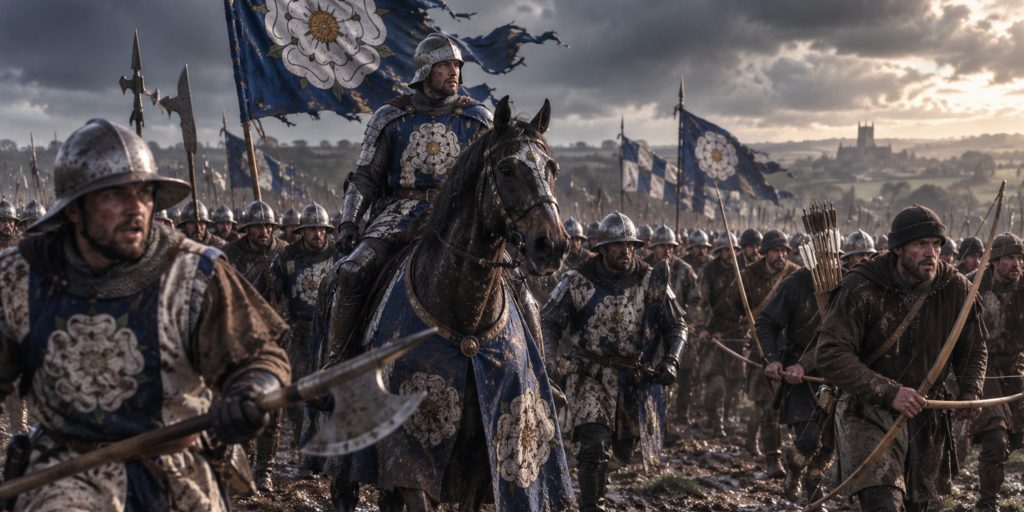
| John Neville, Lord Montagu | 2,500 to 3,500 | Men-at-arms, billmen, longbowmen, mounted retainers |
Strengths
- Experienced northern soldiers
- High morale following recent victories
- Strong leadership
- Rapid mobility
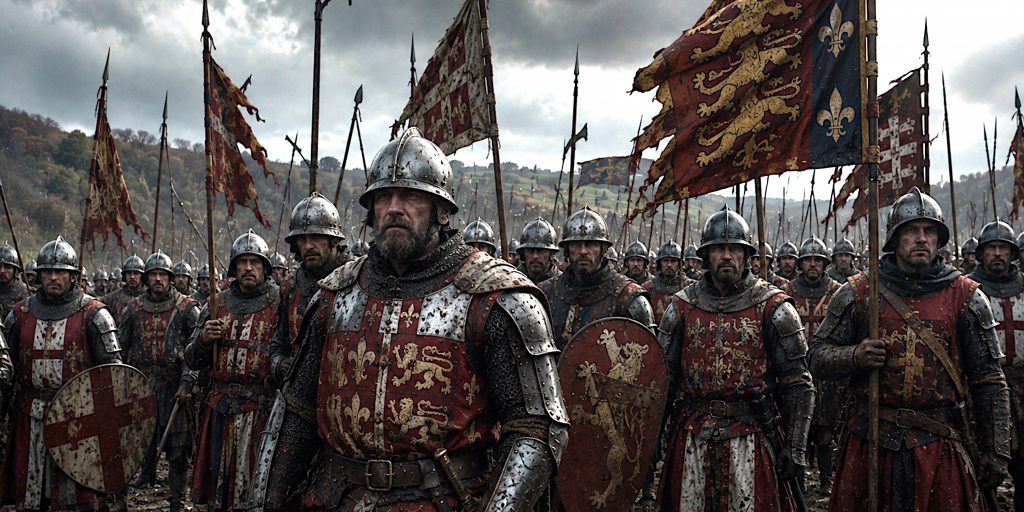
Lancastrian Army
| Commander | Estimated Numbers | Composition |
|---|---|---|
| Henry Beaufort, Duke of Somerset | 1,500 to 2,500 | Men-at-arms, billmen, archers, northern levies |
Weaknesses
- Poor defensive preparations
- Surprise attack
- Inferior organisation
- Limited escape routes
While exact numbers remain uncertain, contemporary chroniclers consistently describe the Yorkists as attacking a force caught before it had fully prepared for battle.
The Battlefield
Hexham lies beside the River Tyne in Northumberland. Somerset chose ground near Linnels Meadow, bordered by marshy streams including the Devil’s Water and Cockshaw Burn.
The landscape proved disastrous for the Lancastrians.
Instead of protecting their flanks, the wet ground restricted movement and made retreat increasingly difficult. Once Yorkist troops attacked, many Lancastrian soldiers became trapped against the streams.
The terrain became as dangerous as the enemy.
Battle Timeline
| Time | Event |
|---|---|
| Early morning | Yorkist army approaches Lancastrian camp |
| Shortly afterwards | Surprise attack begins before Lancastrian deployment is complete |
| Initial fighting | Yorkist billmen and men-at-arms break through defensive positions |
| Mid battle | Lancastrian formations collapse rapidly |
| Retreat | Many soldiers flee towards marshy ground and streams |
| Aftermath | Somerset captured and later executed alongside senior commanders |
The fighting probably lasted less than an hour.
For a medieval battle, that was remarkably swift.
How the Battle Unfolded
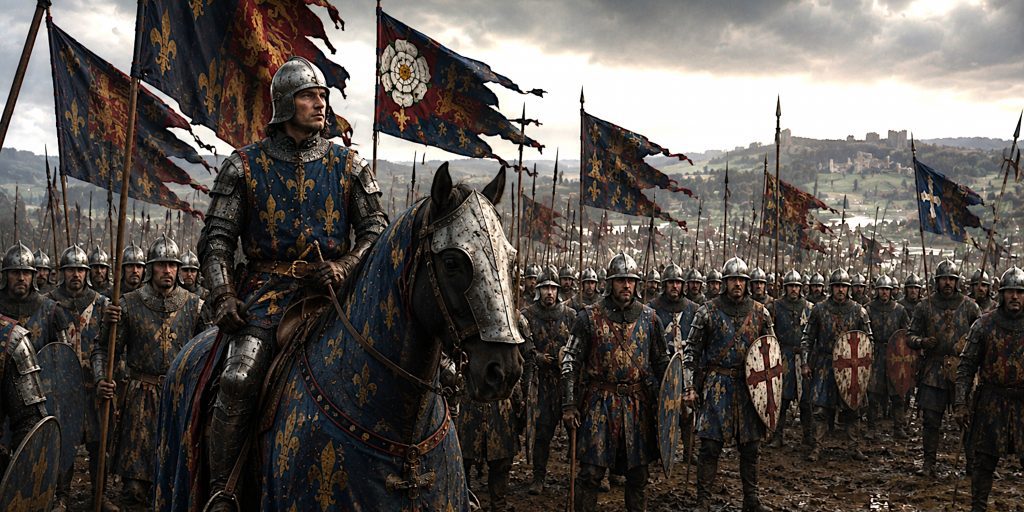
Montagu understood the value of speed.
Rather than allowing Somerset time to organise his troops, he launched an immediate assault. Many Lancastrian soldiers were still arranging their positions when Yorkist forces struck.
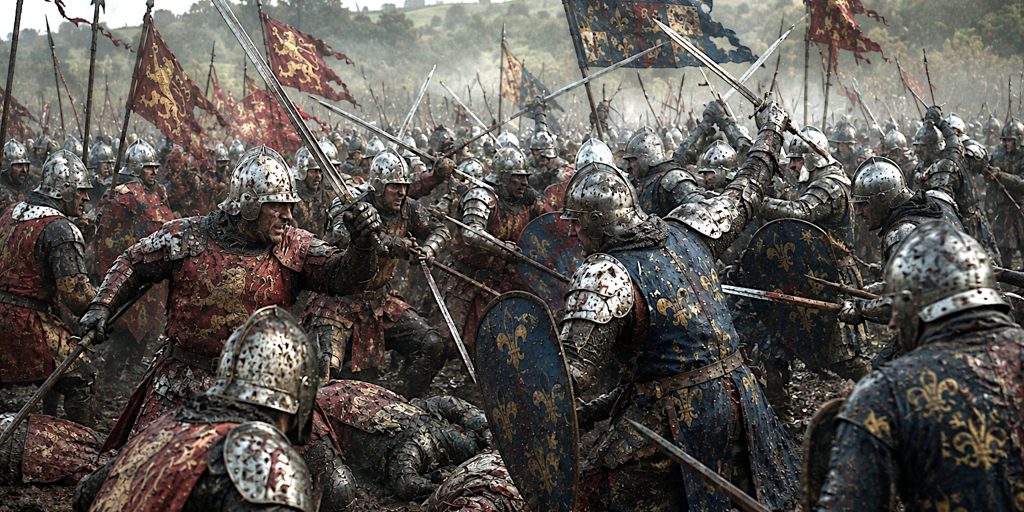
Yorkist archers disrupted attempts to establish defensive lines before disciplined billmen and men-at-arms advanced. Once the Lancastrian centre began to give way, resistance quickly unravelled.
Unlike Towton, where prolonged combat exhausted both armies, Hexham became a pursuit almost from the outset. Small groups attempted to escape, but the surrounding streams and rough ground offered little protection.
By the end of the morning, the Lancastrian army had ceased to exist as an organised force.
Leaders and Commanders
| Commander | Side | Role |
|---|---|---|
| John Neville, Lord Montagu | Yorkist | Commander of the Yorkist army |
| Henry Beaufort, Duke of Somerset | Lancastrian | Commander of Lancastrian forces |
| Edward IV | Yorkist | King of England, not present at the battle |
| Henry VI | Lancastrian | Lancastrian king, in hiding following defeat |
Montagu’s leadership earned widespread praise. His combination of speed, discipline and aggression made him one of Edward IV’s most capable military commanders.
Somerset, by contrast, chose an exposed position and failed to anticipate the speed of the Yorkist advance. History can be rather unforgiving to commanders who expect a leisurely morning.
Arms and Armour
The armies at Hexham were equipped in the style typical of the mid fifteenth century.
Swords
Common sword types included:
- Arming Sword: The standard one handed knightly weapon, carried alongside a shield or polearm.
- Hand-and-a-Half Sword (Longsword): Increasingly popular among men-at-arms. Its longer grip allowed both one and two handed use during close combat.
- Falchion: A broad bladed cutting weapon occasionally carried by infantry and retainers.
Polearms
- Bill
- Poleaxe
- Spear
- Halberd in limited numbers
Missile Weapons
- English longbow
- Crossbows in small numbers
Armour
Elite soldiers wore:
- Milanese or English plate armour
- Sallets
- Bevors
- Brigandines
- Mail protecting vulnerable joints
Less wealthy infantry often fought wearing padded jacks with helmets and partial armour.
Casualties
Exact figures remain uncertain.
Estimated losses include:
| Side | Estimated Casualties |
|---|---|
| Yorkists | Light |
| Lancastrians | Several hundred killed or captured |
More significant than battlefield deaths were the executions that followed.
Somerset, Lord Hungerford, Sir Thomas Roos and several other Lancastrian leaders were executed shortly after the battle. Their deaths removed much of the experienced leadership still supporting Henry VI.
Contemporary Accounts
The chroniclers viewed Hexham as a decisive act of divine judgement.
The Arrivall of Edward IV describes the collapse of the Lancastrian force and emphasises the effectiveness of Montagu’s surprise attack.
The Croyland Chronicle portrays the victory as the final destruction of organised resistance in northern England.
One chronicler remarked that the Lancastrians were “discomfited and taken.”
It is a concise description, but medieval writers often preferred understatement where modern historians might reach for several pages.
Archaeology
Unlike Towton, Hexham has produced relatively little battlefield archaeology.
Finds associated with the battle include:
- Medieval arrowheads
- Horse equipment
- Buckles and harness fittings
- Iron weapon fragments
Much of the battlefield remains under agricultural land, making systematic investigation difficult. Metal detecting and archaeological surveys continue to improve understanding of troop movements, although no large scale excavation comparable to Towton has yet taken place.
Landscape analysis has confirmed the importance of streams and marshy ground in shaping the battle.
Why the Yorkists Won
Several factors combined to produce victory:
- Surprise attack before Lancastrian deployment
- Superior command under Lord Montagu
- Better discipline
- Effective use of terrain
- Strong morale following recent victories
- Collapse of Lancastrian command structure
The battle demonstrated that preparation and leadership often mattered more than simple numbers.
Legacy
Hexham transformed the political landscape.
For nearly six years, Edward IV ruled England without facing another major Lancastrian army. Henry VI became a fugitive before eventually being captured in 1465.
Although Warwick’s rebellion later revived the conflict, Hexham marked the end of the original Lancastrian military campaign.
Modern historians increasingly recognise the battle as one of the most strategically significant engagements of the Wars of the Roses. It lacked Towton’s scale and Bosworth’s famous ending, but its political consequences were every bit as important.
Visiting the Battlefield
Today, visitors can explore much of the surrounding landscape near Hexham.
Highlights include:
- Linnels Meadow
- The Devil’s Water
- Cockshaw Burn
- Hexham town
- Hexham Abbey
- Interpretive information provided by local heritage organisations
Although the battlefield has changed over five centuries, the surrounding terrain still conveys why Somerset found himself trapped between advancing Yorkists and difficult ground.
Battle Summary
| Category | Outcome |
|---|---|
| Victor | Yorkists |
| Losing Commander | Henry Beaufort, Duke of Somerset |
| Strategic Result | Yorkist control of northern England |
| Political Impact | Lancastrian resistance largely destroyed |
| Historical Importance | Secured Edward IV’s reign until Warwick’s rebellion |
Frequently Asked Questions
When was the Battle of Hexham?
The Battle of Hexham was fought on 15 May 1464 during the Wars of the Roses.
Who won the Battle of Hexham?
The Yorkists, commanded by John Neville, Lord Montagu, won a decisive victory over the Lancastrians.
Why was the Battle of Hexham important?
It destroyed the last major Lancastrian army in northern England and firmly established Edward IV’s control of the kingdom.
Where was the Battle of Hexham fought?
The battle took place near Hexham in Northumberland, close to Linnels Meadow and the River Tyne.
What weapons were used?
Combatants fought with longswords, arming swords, bills, poleaxes, spears, English longbows and wore late medieval plate armour and brigandines.
Further Reading
Primary sources include the Arrivall of Edward IV, the Croyland Chronicle and the Paston Letters. Modern works by A.J. Pollard, Charles Ross, Michael Hicks and David Grummitt provide detailed analysis of the campaign and the political significance of Hexham within the wider Wars of the Roses.