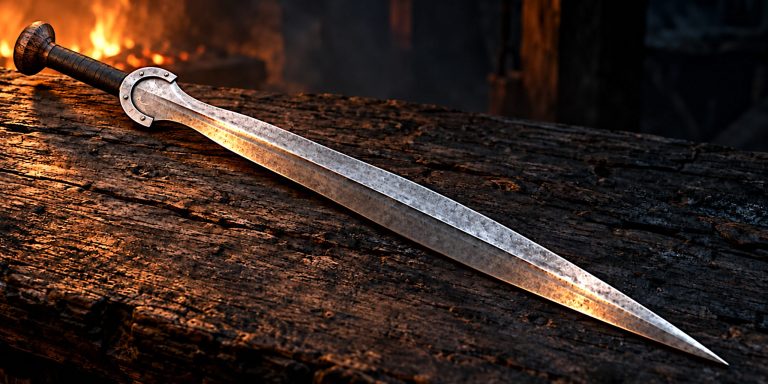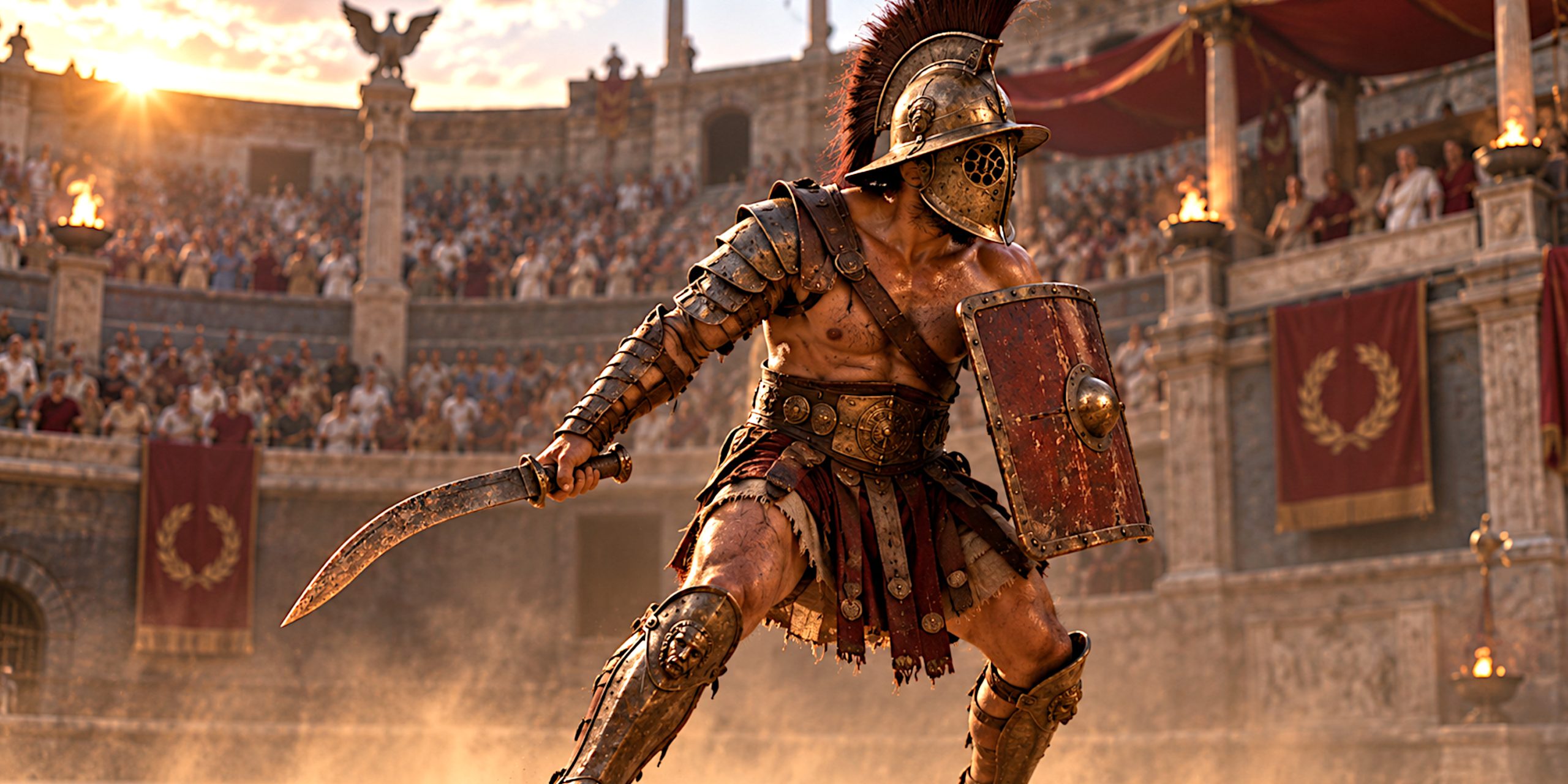
The sica was a short, single-edged weapon with a curve that turns towards the blade’s cutting edge. Used in the northern Balkans, it is associated especially with Thracian and Dacian warriors. In Roman popular culture, it became the signature weapon of the Thraex, the gladiator whose name means “Thracian”.
Calling it simply a “gladiator sword” misses much of its story. Archaeological evidence places the developed sica in the Balkans centuries before its arena association. It was a close-combat weapon, but its place in a warrior’s equipment may also have carried social and ritual meaning. Even its familiar image needs care: the curved swords shown on Roman monuments are not always the same weapon as the shorter sica dagger.
Sica specifications
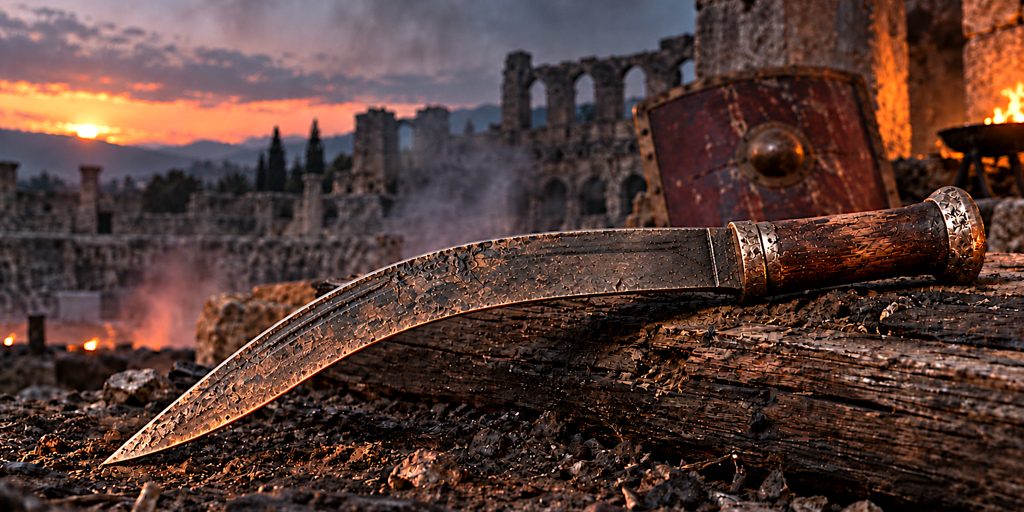
There was no single standard pattern. Excavated examples differ in their blade curve, thickness, hilt and decoration. One archaeological study gives an average length of roughly 25 to 35 cm, while noting that some examples fall outside that range. These figures describe the daggers studied, not every weapon later called a sica.
| Feature | Description |
|---|---|
| Type | Short, single-edged curved dagger or short sword |
| Main region | Northern Balkans, including areas associated with Thracian and Dacian communities |
| Typical length | About 25 to 35 cm in one archaeological study; examples varied |
| Blade | Curved, with the cutting edge on the inner side |
| Hilt | Forms vary; surviving examples and images suggest different haft shapes |
| Materials | Iron blade; organic hilt materials may not survive |
| Use | Close combat; a later Roman gladiatorial form is associated with the Thraex |
The surviving iron blades are often corroded, and a hilt or scabbard may be missing. That makes neat modern specifications attractive, but rarely dependable unless they refer to a named artefact.
History and evolution
A Balkan weapon takes shape
Curved weapons existed in the Thracian world before the recognisable sica form emerged. Archaeologist Aurel Rustoiu places the developed curved dagger in the northern Balkans, among communities linked to the Padea–Panagjurski Kolonii cultural group, towards the end of the third century BCE and into the second century BCE. The weapon spread north of the Danube and was later used in Dacian territory.
This was not a uniform ethnic issue weapon. Finds across the region show variations, and the communities who used them had wider contacts and mixed cultural influences. “Thracian sica” is a useful label, but it should not imply that every example came from one people or one workshop.
The Dacian context
Sicae appear in Dacian archaeological contexts and in Roman depictions of the Dacian wars. Some blades were decorated, and Rustoiu argues that they may have held symbolic or ritual significance alongside their practical role. That interpretation is plausible, though the surviving evidence cannot tell us what every bearer believed about the weapon.
The sica should also be separated from the larger Dacian falx. The two are often blurred together in modern accounts, but the shorter curved dagger and the longer curved sword were distinct forms. Roman monuments sometimes compress that distinction into a recognisable sign of “Dacian” identity.
The Roman arena
In the Roman arena, the sica became associated with the Thraex. Gladiators of this type were presented as fighting in a “Thracian” manner, with a small shield and protective greaves. The University of Michigan’s Kelsey Museum describes the curve as suited to reaching around an opponent’s shield, and displays a modern reproduction to explain the weapon.
The arena version belongs to a theatrical fighting class with its own equipment and rules. It should not automatically be treated as an unchanged copy of a battlefield weapon. The Roman audience recognised a Thracian identity; the weapon was part of that visual language.
Advantages and disadvantages
The sica’s curve shaped what it could do, but no blade profile made it universally superior. Its advantages are best understood in close combat and in the specific context of the small shield and fighting style associated with the Thraex.
Advantages
- Useful at close range: Its compact size suited fighting at arm’s length.
- A distinctive cutting line: The inward curve could bring the edge into contact from angles less natural to a straight blade.
- Potential to work around a shield: This is the role associated with the arena sica, especially against a shield-bearing opponent.
- Portable: Shorter than a full-length sword and easier to carry as a secondary weapon.
Disadvantages
- Limited reach: A short blade puts its user at a disadvantage against a longer sword or spear.
- Technique-dependent: The curve changes the angle of attack and may require practice to use well.
- Poor evidence for battlefield performance: The archaeological record confirms the weapon’s presence, but does not establish a single fighting method or make it possible to rank it against other blades in all conditions.
- Less suited to formation fighting than a standard infantry sword: A short curved dagger would not replace the reach and versatility of a sword such as the Roman gladius.
Sica compared with similar weapons
| Weapon | Main distinction | How it compares with the sica |
|---|---|---|
| Dacian falx | Longer curved sword, sometimes used with two hands | Greater reach and a different battlefield role. It should not be treated as a large sica. |
| Rhomphaia | Long Thracian pole-like blade, often described as two-handed | Longer and built for broader cuts. The name and archaeological identification can be difficult to pin down. |
| Roman gladius | Straight, short sword used by Roman soldiers and some gladiators | More familiar for thrusting and controlled cuts; its straight blade differs from the sica’s curved edge. |
| Greek kopis | Forward-curving blade with a heavier chopping profile | Shares a curved outline, but its shape and cutting mechanics differ from the inward-curving sica. |
| Roman pugio | Straight double-edged dagger | Compact like the sica, but with a different blade profile and edge arrangement. |
These are comparisons of form, not claims that each weapon competed directly with the sica in the same place or period.
Legacy
The sica’s legacy has two strands. Archaeologically, it belongs to the varied weapon traditions of the northern Balkans and appears in both Thracian and Dacian contexts. In Roman imagery, it became a shorthand for the “Thracian” gladiator and, later, a symbol of Dacian resistance.
The name also became associated with sicarii, a Latin term used for people who carried concealed daggers. That political association has often encouraged dramatic claims about the weapon’s reputation. The evidence is more measured: the sica was a real weapon with a long regional history, later adapted into the Roman arena and Roman storytelling.
Where to see the sica
- National Museum of History of Moldova, Chișinău: The museum’s research journal documents a single-edged sica found at the Trebujeni–Potârca hillfort and received by the museum in 2014. The paper notes that the circumstances of discovery limit certainty about its archaeological context. Check with the museum before visiting to confirm whether it is currently on display.
- Kelsey Museum of Archaeology, University of Michigan: The museum’s online gladiator display includes a modern sica reproduction and explains its association with the Thraex. It is a useful way to understand the arena interpretation, not an ancient original.
- British Museum, London: The collection includes objects depicting gladiators and their equipment, including a bronze figure identified as a Thracian gladiator. These are visual evidence for how Roman audiences represented the type, rather than proof that the museum holds an original sica blade.
Museum displays change, so check current collection information before making a special visit.
Collector’s guide and auction prices
Authentic ancient sicae are rare on the open market. A convincing shape is not proof of age, and an auction catalogue’s description is not a substitute for provenance or independent examination. Reproductions are far more common than excavated blades.
A documented 2025 Artmark sale provides a useful reference point:
| Auction record | Price |
|---|---|
| Artmark, 24 June 2025: Dacian sica with a scabbard fragment, dated by the catalogue to the 1st century BCE–1st century CE | €700 starting price |
| Reported hammer price for the same lot | €3,000 |
| Artmark, March 2025: another listed Dacian sica | Withdrawn, no sale price |
The €3,000 result is a single sale, not a reliable general valuation for sicae. The lot’s catalogue described a scabbard fragment and noted that supporting acquisition documents were available to the buyer. A separate sica lot withdrawn from an earlier Artmark auction should not be counted as a sale or price comparison. artmark.ro
What to check before buying
- Provenance: Ask for a clear ownership history and original export or import documents.
- Authentication: Seek an independent specialist opinion. Corrosion, patina and an aged-looking hilt can be imitated.
- Condition report: Check whether the blade has been stabilised, repaired or heavily restored.
- Legal status: Confirm the rules governing cultural property and export in the country where the object is held.
- Price evidence: Compare completed sales of documented archaeological examples, not asking prices or estimates.
- Reproductions: Make sure a modern replica is described and sold as one.
For an ancient object, the paperwork is part of the object’s history. If it is missing, the bargain may turn out to be mostly a lesson.
Sources
- Aurel Rustoiu, “Thracian Sica and Dacian Falx”
- University of Michigan Kelsey Museum, Gladiatorial reproductions
- National Museum of History of Moldova, Late La Tène sica dagger from Trebujeni–Potârca
- Artmark, 2025 Dacian sica auction result