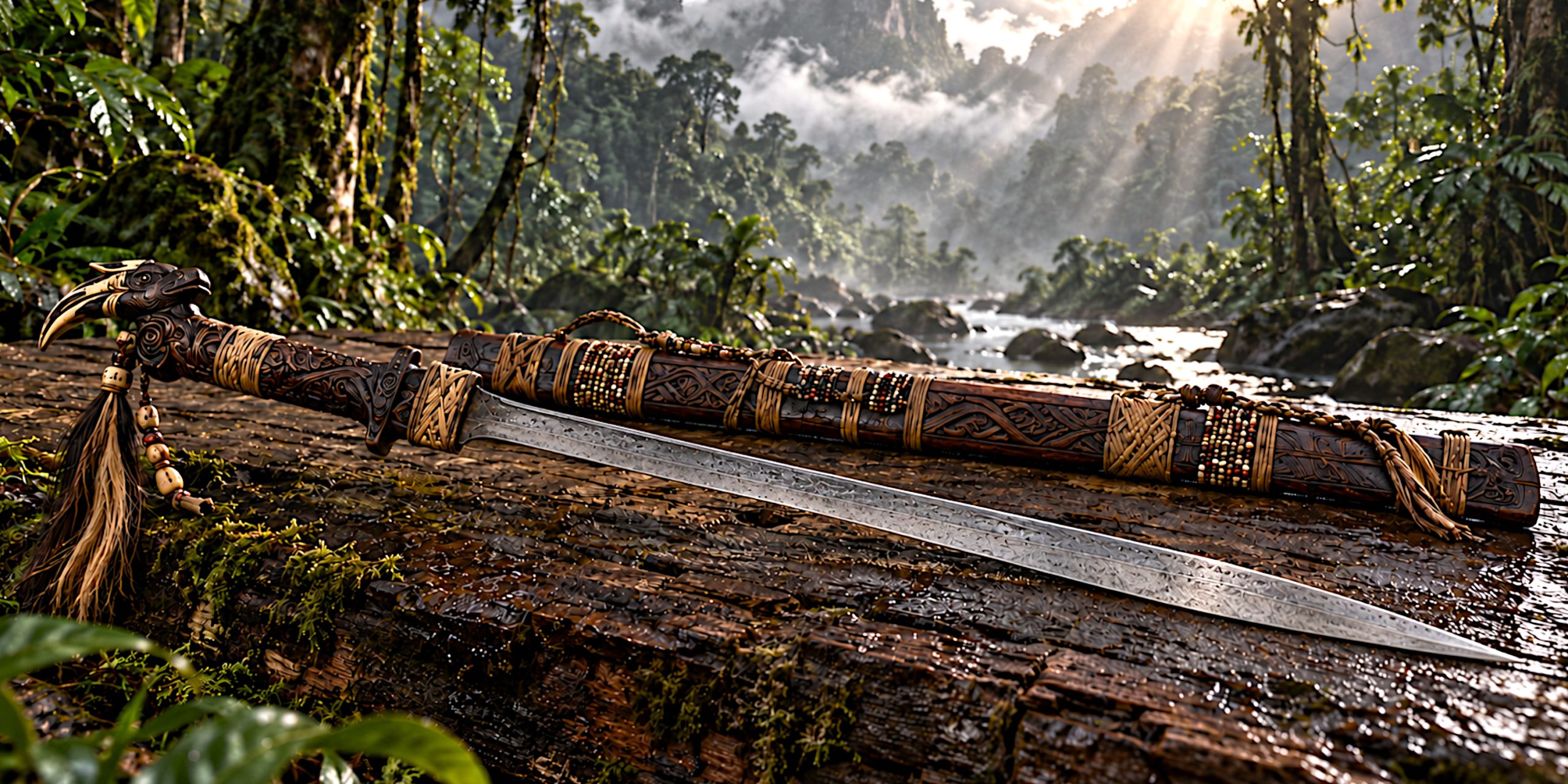
The mandau is a sword associated with Indigenous communities across Borneo, including groups often described collectively as Dayak. That label covers many distinct peoples, and the names, forms and uses of their weapons vary by region. “Mandau” itself is not a universal local name: the Pitt Rivers Museum records it as a Kayan term for the parang ilang, while other communities use different names. A single standard pattern, then, is more museum shorthand than a complete account of Bornean blades.
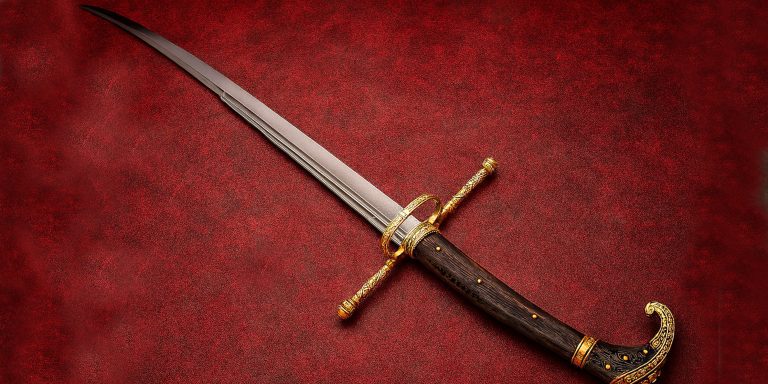
A mandau is recognisable by its single-edged blade, carved hilt and often carefully decorated scabbard. Some are accompanied by a smaller knife fixed to the sheath. These parts make the weapon both practical equipment and a display of skilled craft. Its history is also frequently reduced to headhunting. That association matters, but it should not be allowed to flatten the varied histories and identities of the communities who made and used these swords.
Specifications
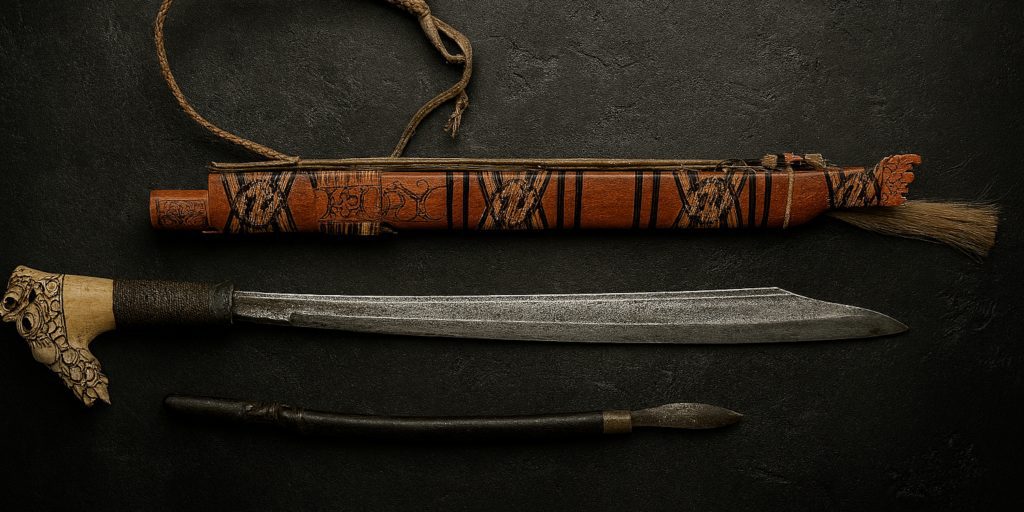
Mandau dimensions and construction differ between examples. The table below uses a dated museum object as a reference point, not as a universal template. The Metropolitan Museum of Art records one 18th–19th-century mandau at 76.2 cm overall, with a 55.9 cm blade and a weight of about 746 g.
| Feature | Typical description | Important qualification |
|---|---|---|
| Overall form | Single-edged sword, usually carried in a fitted scabbard | Blade shape and proportions vary |
| Blade | Forged iron or steel, with a cutting edge and a distinctive back profile | Do not assume every blade has the same curve or edge geometry |
| Hilt | Often carved from wood, horn or antler | Materials and carving styles vary by region |
| Guard | Usually little or no substantial hand guard | Some individual forms differ |
| Scabbard | Commonly wood, with bindings, carving or other decoration | Materials and fittings are not uniform |
| Companion knife | Some scabbards carry a smaller utility blade | The name for this knife also varies |
| Example dimensions | 76.2 cm overall; 55.9 cm blade; 746 g | Measurements from one Met object |
The mandau’s blade profile is often described as having a convex edge and a concave back, but surviving pieces should be assessed individually. A sword’s silhouette can be affected by regional form, later sharpening, damage or restoration.
History and evolution
A family of regional forms
The mandau belongs to a wider world of Bornean swords and edged tools. Museum records and scholarship show why careful naming matters: a blade identified broadly as a mandau may be catalogued under a regional name, or grouped with related forms such as the parang ilang. The Sarawak Museum Journal’s study of Bornean swords discusses the role of museum collections in establishing classifications, while also showing the complexity behind those labels.
Rather than imagining a single design that developed in a straight line, it is more accurate to think of related traditions shaped by local materials, craft practices and use. The hilt and scabbard can be as informative as the blade: their carving, bindings and ornament may reflect a particular community or maker, although attribution is not always possible from appearance alone.
A weapon with more than one role
Mandau and related swords served as weapons, but an object’s meaning could extend beyond fighting. The balance between practical equipment, social status, ceremony and personal inheritance depended on its owner and context. Some examples were made for daily use; others were more elaborate or ceremonial. Museums also hold pieces collected during periods of colonial expansion, when local weapons were documented and removed from their original communities.
The term “headhunting sword” is common in older collecting literature. It reflects a real and important part of some Bornean histories, but it is an incomplete description of the mandau and the people associated with it. The label can turn a complicated subject into a lurid sales pitch. Collectors and writers should distinguish documented history from generalisation, and avoid treating all Dayak communities as culturally interchangeable.
Later and contemporary significance
Mandau-making and its symbolism did not end with the decline of older forms of warfare. Swords may remain important as heirlooms, ceremonial objects or expressions of cultural identity. Their significance is best understood through specific community histories and reliable provenance, rather than assumed from a generic description.
Advantages and disadvantages
These points describe the design’s likely practical qualities. They should not be mistaken for a complete account of how any particular mandau was used.
| Advantages | Limitations |
|---|---|
| A compact sword is easier to carry through confined terrain than a long-bladed weapon | Its reach is limited compared with longer swords, spears or polearms |
| A substantial single edge suits powerful cutting actions | A blade optimised for cutting is less versatile for thrusting than a purpose-designed thrusting sword |
| A scabbard can carry the sword and, on some examples, a smaller utility knife | A minimal guard offers limited protection to the hand |
| The hilt and scabbard can be made functional while displaying considerable craft | Organic fittings and iron or steel need careful care, especially in damp conditions |
It is tempting to call a mandau “lightweight” or “fast” as though that were true of every example. The Met’s recorded example weighs about 746 g, but surviving swords vary. Without handling a specific weapon, balance and speed are difficult to establish from photographs alone.
Comparison with similar weapons
| Weapon | Region | How it compares |
|---|---|---|
| Parang ilang | Borneo | Closely related terminology; in some museum records, mandau is given as the Kayan name for this form |
| Golok | Maritime Southeast Asia | A broad family of working blades, often more plainly utilitarian in appearance |
| Klewang | Indonesian archipelago | A distinct regional sword tradition; examples vary in blade shape and military association |
| Kris | Maritime Southeast Asia | Usually identified by its distinctive wavy blade and different handling and symbolic traditions |
These are broad comparisons, not fixed categories. Regional names can overlap, and catalogues do not always use terminology consistently. The mandau’s carved fittings and associated scabbard are particularly useful clues, but they do not by themselves prove a sword’s exact community, date or history.
Legacy
The mandau is both a weapon and a crafted object whose meaning depends on context. Its silhouette is striking, but the carved hilt, sheath, bindings and companion knife can tell an equally rich story about materials and workmanship.
For modern readers, the main challenge is resisting the shorthand. The mandau should not be presented only through violence or as a timeless emblem shared identically by every Bornean community. Specific provenance, local terminology and the history of collecting all matter. The sword’s legacy is better served by that care than by another dramatic label.
Where to see a mandau
Museum displays and online catalogues offer a way to compare real examples, though not every object is currently on view.
- Pitt Rivers Museum, Oxford: Its online record describes a mandau from Sarawak and explains the related term parang ilang.
- The Metropolitan Museum of Art, New York: The collection includes several mandau; one 18th–19th-century example is currently listed as not on view.
- Musée des Confluences, Lyon: Its catalogue records an 18th–19th-century mandau and companion knife associated with Dayak-Iban culture in Sarawak.
Check each museum’s current display information before visiting. An online collection record is not a promise that the object is in a gallery.
Collector’s guide
What to examine
- Provenance: Ask where and when the sword was acquired, and whether the seller can document its ownership history.
- Blade: Look for clear photographs of both sides, the edge, spine and tang area. Corrosion, sharpening and repairs can change the blade’s original form.
- Hilt and scabbard: Check for cracks, replaced sections, loose fittings and later repairs. Carving alone does not establish age or origin.
- Materials: Ask whether beads, bindings, hair, horn or other fittings are original, restored or modern additions.
- Attribution: Treat confident claims about a named community, maker or ritual use cautiously unless supported by documentation.
- Legal and ethical questions: Check the rules that apply to buying, importing and owning edged weapons in your location. Consider the collecting history and cultural sensitivity of the object, particularly where provenance is unclear.
Recent auction examples
Published results show how much condition, completeness, attribution and venue can affect prices. These are individual sales, not a dependable valuation guide.
| Sale | Published result | What the listing records |
|---|---|---|
| Zemanek-Münster, 24 September 2025 | €550 | A mandau sold above its €250 asking price |
| Zemanek-Münster, 3 March 2012 | €350 | A mandau sold at the house’s 68th tribal art auction |
| Cordys, 29 April 2025 | NZ$280 plus buyer’s premium | A described 19th-century example with a carved scabbard and bone hilt; the scabbard was split |
The results come from different dates, currencies and auction markets, so they should not be compared as if they formed a clean price index. The 2025 sale at Cordys was reported at NZ$280 plus premium, while Zemanek-Münster reported €550 for its September 2025 example.
Before bidding, compare the lot with documented museum objects and ask the auctioneer for a condition report. A carved hilt may attract attention, but sound condition and credible provenance are usually more useful than an extravagant story.