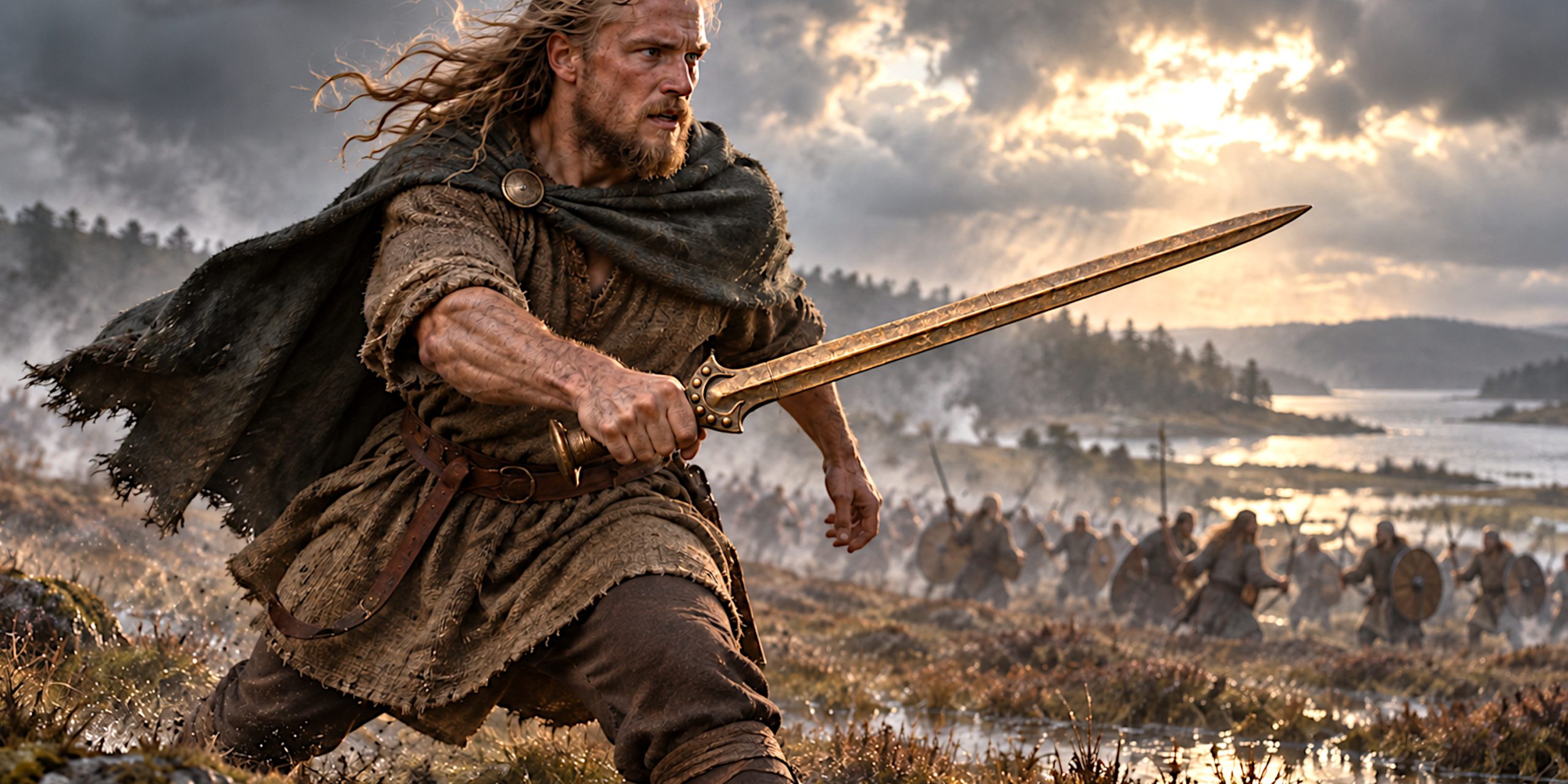
The Valsømagle sword belongs to the moment when the sword became a recognisable part of Scandinavian warfare, ceremony and elite identity. Dating to roughly 1600 to 1500 BCE, it emerged during Nordic Bronze Age Period IB, when metalworkers in southern Scandinavia were adapting ideas from Central Europe and the Carpathian Basin into distinctly local forms.
The name can cause some confusion. It refers both to a particular bronze sword found at Valsømagle on Zealand, Denmark, and to a broader archaeological type represented by swords and daggers elsewhere in Denmark and southern Scandinavia. The type is defined principally by its full metal hilt, blade form and decorative treatment. It is not simply any Bronze Age sword discovered near Valsømagle.
The original Valsømagle find, catalogued as B7522, is held by the National Museum of Denmark. Metallurgical analysis has made it especially important. The weapon was Scandinavian in style, yet the metal and technical knowledge behind it belonged to exchange networks stretching far beyond the Baltic. That is what makes it compelling. It is both local and international, which is a familiar human combination despite archaeologists giving it rather longer names.
Valsømagle Sword Specifications
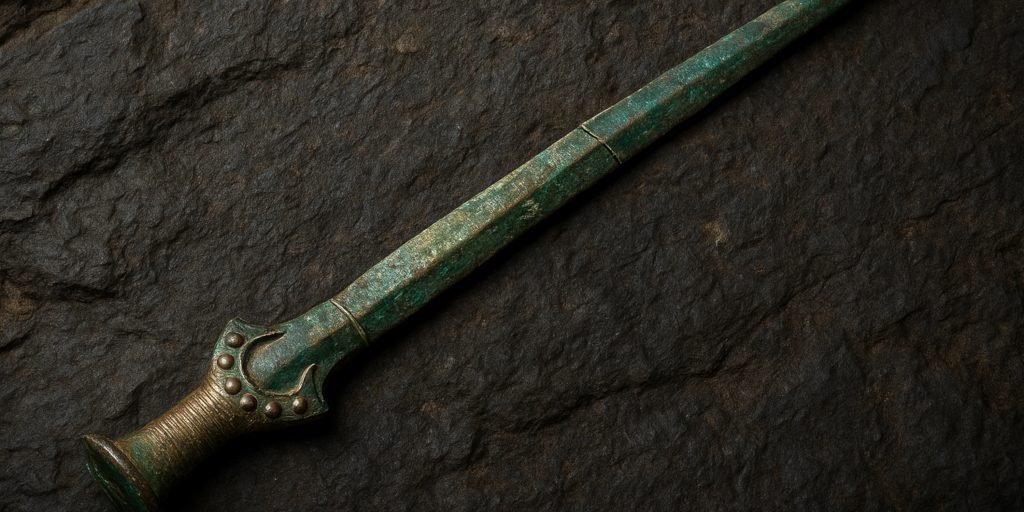
Exact measurements differ across the wider type, and swords overlap with long daggers at the shorter end of the range. The figures below describe the class rather than pretending that every surviving example left the mould to an agreed specification.
| Feature | Typical description |
|---|---|
| Date | Roughly 1600 to 1500 BCE |
| Cultural period | Nordic Bronze Age Period IB |
| Core region | Denmark, especially Zealand, Funen and northern Jutland, with related finds in southern Scandinavia and northern Germany |
| Material | Cast bronze, normally a copper alloy containing tin and minor trace elements |
| Overall form | Straight, double-edged sword or long dagger |
| Blade | Slender bronze blade, usually with a central thickening or midrib and tapered point |
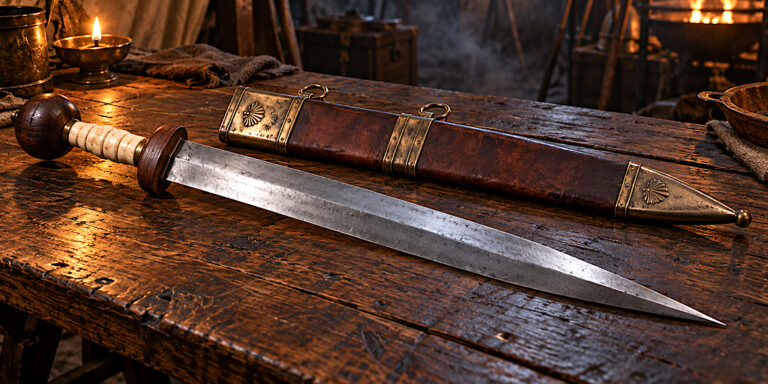
| Hilt | Full metal hilt, made as a separate hollow-cast component and joined to the blade |
| Pommel | Distinctive metal terminal, often with a long lenticular crest |
| Decoration | Grooves, concentric or spiral-derived patterns and other geometric ornament on selected examples |
| Likely handling | One-handed cutting and thrusting weapon |
| Archaeological contexts | Mostly burials, with single wetland deposits and one well-known hoard at Valsømagle |
The term “full-hilted” needs a little care. It does not necessarily mean that blade, grip and pommel formed one solid casting. Research into early Nordic manufacture shows that metal hilts could be hollow-cast separately and mechanically connected to the blade. The Valsømagle object has been sampled at both hilt and rivet, confirming that it is a composite piece rather than an uncomplicated one-piece casting.
History and Evolution
The arrival of the sword in Scandinavia
Before about 1600 BCE, daggers, axes and spears dominated the metal weapon repertoire of southern Scandinavia. The appearance of true swords was therefore more than an increase in blade length. A sword consumed considerable metal, required specialist casting and finishing, and had little purpose outside combat, display or ritual. An axe could clear timber and a spear could hunt. A sword was rather less coy about its intended message.
Early Scandinavian swords were connected to weapon traditions in the Carpathian Basin and Central Europe, particularly the Hajdúsámson-Apa family of full-hilted swords. The relationship was not simple copying. Local smiths selected foreign forms and techniques, then produced regional styles suited to Nordic tastes and social practices.
The Valsømagle style
During Period IB, several regional metalworking traditions developed in southern Scandinavia. The Valsømagle style was concentrated in northern Jutland, Funen, Zealand and Scania. Its swords and daggers appeared alongside characteristic spearheads, axes and prestige objects.
Key features of this development included:
- the adoption of full metal hilts derived from continental casting traditions
- local manufacture rather than wholesale importation of finished weapons
- decorative ideas with links to Central Europe and the Carpathian Basin
- the inclusion of swords and daggers in richly furnished warrior burials
- increased use of imported copper moving through long-distance exchange networks
Recent chemical and isotope research complicates the old picture of neat regional industries. The Valsømagle sword’s metal has been compared with copper sources as far away as Great Orme in Wales, although ore provenance remains an interpretation based on isotopic compatibility rather than a maker’s delivery note. Other Scandinavian weapons used copper associated with Alpine sources. Bronze Age metal travelled, was recycled and could be mixed, so absolute certainty is rarely available.
Burial, hoard and wetland deposition
Approximately 69 per cent of known Valsømagle swords and daggers with recorded contexts come from burials. Around 23 per cent are single finds, none from securely recorded dry contexts. The exceptional Valsømagle II hoard was deposited in a wet place with a shaft-hole axe, a palstave and two spearheads.
This pattern suggests that the weapons carried social meaning beyond immediate utility. In graves they helped present the deceased as a warrior or person of rank. In wetlands, surrendering an expensive weapon may have formed part of a ritual offering. These interpretations can coexist with practical use, but there is a sensible limit to confidence. No systematic use-wear programme has yet been completed for Valsømagle swords and daggers as a group.
What followed
The Valsømagle tradition belonged to a formative phase rather than the mature peak of Nordic sword production. By Period II, roughly 1500 to 1300 BCE, Scandinavian smiths were producing more standardised Nordic full-hilted swords. Flange-hilted and hilt-plated forms also became prominent. The early experiments had become an established craft.
Advantages and Disadvantages
Assessing a prehistoric sword requires restraint. There is no surviving fencing manual from Bronze Age Zealand, which is inconsiderate but not surprising. The following points are based on construction, form and comparisons with better-studied Bronze Age weapons.
Advantages
- Effective reach: A sword offered more reach than a dagger while remaining quicker to redirect than many axes.
- Two usable edges: The double-edged blade allowed cuts from either side without turning the weapon in the hand.
- Cutting and thrusting potential: The tapered point and reinforced blade section supported both actions, although individual examples vary.
- Secure metal hilt: A properly assembled full metal hilt could create a firm connection between hand and blade.
- Repairable edge: Bronze can be work-hardened and resharpened after minor damage.
- Visible status: The quantity of metal, technical skill and distinctive decoration made the sword an unusually clear sign of rank.
Disadvantages
- High material cost: Copper and tin had to enter Scandinavia through long-distance exchange. A sword represented a serious investment.
- Susceptibility to deformation: Bronze blades can bend or notch under heavy impact, particularly if poorly cast or incorrectly worked.
- Limited hand protection: There was no developed crossguard comparable with later iron and steel swords.
- Shorter reach than later swords: Early examples often sit close to the boundary between long dagger and sword.
- Complex construction: Casting a thin blade and producing a sound hollow metal hilt demanded considerable skill.
- Uneven evidence for combat: Some weapons may have fought, while others may have served mainly as prestige or ritual objects. Treating the whole class as either purely ceremonial or purely practical is too tidy.
Comparison With Similar Bronze Age Weapons
| Weapon type | Approximate date | Main region | Hilt construction | Broad distinction |
|---|---|---|---|---|
| Valsømagle sword | 1600 to 1500 BCE | Denmark and southern Scandinavia | Full metal hilt attached to bronze blade | Early Nordic regional form associated strongly with elite burials |
| Hajdúsámson-Apa sword | Early second millennium BCE | Carpathian Basin and connected regions | Elaborate full metal hilt | Major continental influence on the earliest Scandinavian full-hilted swords |
| Sögel-Wohlde sword | Around 1600 to 1500 BCE | Northern Germany, southern Jutland and the Netherlands | Organic grip fitted to a metal blade | Contemporary regional tradition, generally less dependent on a complete metal grip |
| Tréboul-Saint-Brandan sword | Early to Middle Bronze Age | Atlantic western Europe | Riveted organic hilt | Western European tradition with limited distribution in northern Germany and the Netherlands |
| Nordic full-hilted sword of Period II | 1500 to 1300 BCE | Southern Scandinavia | More standardised cast metal hilt | Later and more mature expression of Nordic sword production |
| Spear of the Valsømagle tradition | Around 1600 to 1500 BCE | Denmark, particularly the eastern zone | Socketed bronze head on wooden shaft | Cheaper reach weapon with stronger direct evidence for practical combat use |
The closest comparison is not a Mycenaean Type B sword, as sometimes claimed, but the Central European and Carpathian full-hilted traditions that fed directly into Nordic weapon design. Wider Aegean connections formed part of the exchange network, yet jumping straight from Valsømagle to Mycenae removes several important stages from the story.
The Legacy of the Valsømagle Sword
The Valsømagle sword matters because it belongs near the beginning of a long Scandinavian sword tradition. Its importance lies less in being the single “first Nordic sword” and more in what the type reveals about a rapid social and technological change around 1600 BCE.
Its legacy can be seen in several areas:
- Specialist craftsmanship: Nordic smiths mastered complex full-hilt construction and developed it further in later periods.
- A warrior identity: Swords became part of the equipment through which high-status people were represented in graves and public life.
- Regional style: Foreign ideas were translated into forms recognisably rooted in different parts of Scandinavia.
- Long-distance exchange: The weapon preserves evidence of trade routes carrying copper, tin, techniques and imagery across Europe.
- Ritual practice: Burial and wetland deposition show that swords could move between fighting equipment, heirloom, status object and offering.
The Valsømagle sword therefore sits at a useful historical junction. It belongs to the birth of the Nordic Bronze Age as a connected cultural world, yet it also shows that this world was never isolated.
Where to See a Valsømagle Sword
The named Valsømagle sword is in the collection of the National Museum of Denmark in Copenhagen, under object number B7522. The museum’s online record includes a high-resolution photograph and identifies it as an Early Bronze Age bronze sword from Valsømagle in Haraldsted parish, Zealand.
Display arrangements change, so contact the museum before travelling specifically to see the object. Archaeological collections rotate material for conservation, loans and exhibition changes.
Related early Nordic weapons may also appear in:
- Danish regional museums with Bronze Age collections
- the National Museum of Denmark’s prehistoric galleries
- museums in southern Sweden and northern Germany
- temporary exhibitions concerned with European Bronze Age warfare and metalworking
For deeper context, Helle Vandkilde’s study of the breakthrough of the Nordic Bronze Age explains the wider warrior culture and continental connections behind the weapon.
Collector’s Guide
Can You Buy an Original Valsømagle Sword?
An authenticated sword of the named Valsømagle type is extraordinarily unlikely to appear legally on the ordinary market. The known Danish material is archaeologically important, much of it is held by museums, and freshly discovered objects of special cultural-historical value may qualify as danefæ, meaning that they must be surrendered to the Danish state. The National Museum of Denmark explains the treasure-trove process.
A seller’s use of “Valsømagle type” should therefore be treated as a claim requiring specialist proof, not as reassuring decoration in a catalogue description.
Recorded Auction Prices for Comparable Bronze Age Swords
There is no dependable price guide specifically for Valsømagle swords. The most responsible comparison is with legally traded European Bronze Age swords of other types. Prices vary sharply with provenance, completeness, rarity, condition, publication history and decorative quality.
| Comparable sale | Sale date | Recorded price | What it tells a buyer |
|---|---|---|---|
| European Late Bronze Age sword, Bonhams | 24 October 2012 | £7,500 including premium | A complete but less exceptional sword can sell in the high four figures |
| Central European bronze sword, Bonhams | 5 December 2024 | £46,080 including premium | Strong provenance and quality can push a sword well into five figures |
| Ceremonial bronze sword bought by a Dutch museum at Christie’s | 2017 | £400,000 | An exceptional object with rarity and institutional competition can sit far outside the normal market |
These are historical comparables, not valuations. The £400,000 result is an outlier and should not be used to price an ordinary fragment or undocumented blade. Auction estimates also exclude some combination of buyer’s premium, tax, import costs and conservation work unless the catalogue states otherwise.
What to Check Before Buying
- Provenance before appearance: Demand a documented ownership history and legal export trail. “From an old European collection” is not a provenance by itself.
- Publication and collection records: Match old inventory numbers, photographs and catalogue entries against the object.
- Export documentation: Danish cultural objects dating from before 1660 require permission for export. The official Danish export guidance specifically includes ancient metal weapons.
- Condition report: Ask for details of repairs, joins, modern fills, wax, lacquer, chloride corrosion and areas of recent cleaning.
- Scientific testing: X-radiography can reveal casting structure and repairs. Alloy analysis can help, but it cannot by itself authenticate an object or identify an exact archaeological type.
- Independent expertise: Use a specialist who does not receive a commission from the seller.
- Return terms: Ensure that authenticity, legal title and export history are covered in writing.
Common Warning Signs
- a rare type offered without an excavated or documented collection history
- vague claims of a find from Denmark with no danefæ record
- artificial green patina sitting uniformly across breaks and raised surfaces
- casting seams, bubbles or tool marks inconsistent with ancient finishing
- a perfectly preserved blade paired with a conveniently imprecise history
- typological claims based only on a superficial resemblance to an online photograph
Replicas
A replica is the practical route for most collectors. Look for a maker who clearly labels the piece as modern, explains the casting method and gives the weight, balance and alloy. A good replica should reproduce the separate blade and hilt construction where evidence supports it rather than turning the object into a generic fantasy leaf-bladed sword.
Modern reproductions commonly fall into these broad categories:
| Replica type | Typical price band | Suitable for |
|---|---|---|
| Decorative cast reproduction | £100 to £250 | Static display |
| Research-led handmade replica | £300 to £800 | Education, museum handling and serious display |
| Bespoke archaeological reconstruction | £800 to £2,000 or more | Experimental archaeology and commissioned museum work |
Never strike with a decorative bronze replica unless its maker has explicitly designed and tested it for that purpose. Bronze is forgiving in some ways, but your display cabinet is unlikely to appreciate the experiment.
Frequently Asked Questions
How old is the Valsømagle sword?
The type belongs mainly to Nordic Bronze Age Period IB, roughly 1600 to 1500 BCE.
Where was the original sword found?
It was found at Valsømagle in Haraldsted parish on Zealand, Denmark. The National Museum of Denmark records it as object B7522.
Was it cast in one piece?
No. The surviving Valsømagle sword is a full-hilted weapon, but the metal hilt and blade were separate components joined during manufacture. “Full metal hilt” should not be confused with “one-piece sword”.
Was it a ceremonial weapon?
Possibly in some contexts, but that label should not be applied automatically. The swords carried strong status and ritual associations, yet their form is functional. Because systematic use-wear analysis of the group has not been completed, claims that every example either fought or never fought go beyond the evidence.
How much is an original worth?
There is no reliable market value for an authenticated Valsømagle sword because the recognised Danish examples are exceptionally rare and largely museum-held. Comparable European Bronze Age swords have produced results from £7,500 to £46,080, while one exceptional ceremonial sword sold for £400,000. Provenance and legal title matter as much as the object itself.