There is something quietly extraordinary about Baldwin IV of Jerusalem.
History often reserves its loudest applause for conquerors who expanded empires or generals who marched home beneath triumphal arches. Baldwin achieved neither. He inherited one of the most precarious kingdoms in medieval Europe, watched his own body gradually fail through leprosy, and still managed to preserve the Kingdom of Jerusalem during one of the most dangerous periods in its history.
His reign lasted only eleven years. His life lasted barely twenty-four. Yet his influence stretched far beyond either.
Known to history as the Leper King, Baldwin IV ruled from 1174 until his death in 1185. During that short period he faced ambitious nobles, bitter succession disputes, financial strain, repeated invasions and, above all, the remarkable military talent of Saladin. Against overwhelming odds, he kept the Crusader kingdom alive. When Jerusalem finally fell in 1187, it happened only after Baldwin was gone.
That timing matters.
Modern popular culture often remembers Baldwin as a doomed young king hidden behind a silver mask. It is an unforgettable image, helped enormously by Kingdom of Heaven. Yet the real Baldwin deserves attention for reasons that have little to do with cinematic symbolism. He was politically astute, militarily capable and surprisingly pragmatic. He understood that heroics alone would not save Jerusalem. Survival depended on careful alliances, measured diplomacy and knowing precisely when to fight.
As a historian, I find Baldwin endlessly fascinating because his achievements were never inevitable. Every year of his reign became harder than the last. Every military campaign required increasing assistance. Every political decision carried the knowledge that he might not live long enough to see its consequences.
Few rulers governed under such relentless pressure.
It would be easy to present Baldwin as a saintly figure suffering nobly through illness. Medieval writers occasionally drifted in that direction. Equally, it would be tempting to exaggerate his military successes into legend. The reality is considerably more interesting. Baldwin was neither an untouchable hero nor a tragic victim. He was an intelligent king attempting to hold together a fragile frontier state while the strongest Muslim ruler of the age patiently assembled the forces that would eventually overwhelm it.
Perhaps the greatest compliment we can pay him is this. Saladin did not truly become master of the Holy Land until Baldwin was no longer there to oppose him.
Contents
- Who was Baldwin IV?
- The Crusader Kingdom before Baldwin
- Birth and family
- Childhood in Jerusalem
- William of Tyre and the discovery of leprosy
- Education of a future king
- Becoming King of Jerusalem
- Government and politics
- Baldwin IV and Saladin
- The Battle of Montgisard
- Military campaigns
- Arms and armour
- Castles and fortifications
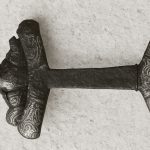
- Archaeology
- Contemporary accounts
- Death and succession
- Legacy
- Timeline
- Frequently asked questions
Who Was Baldwin IV?
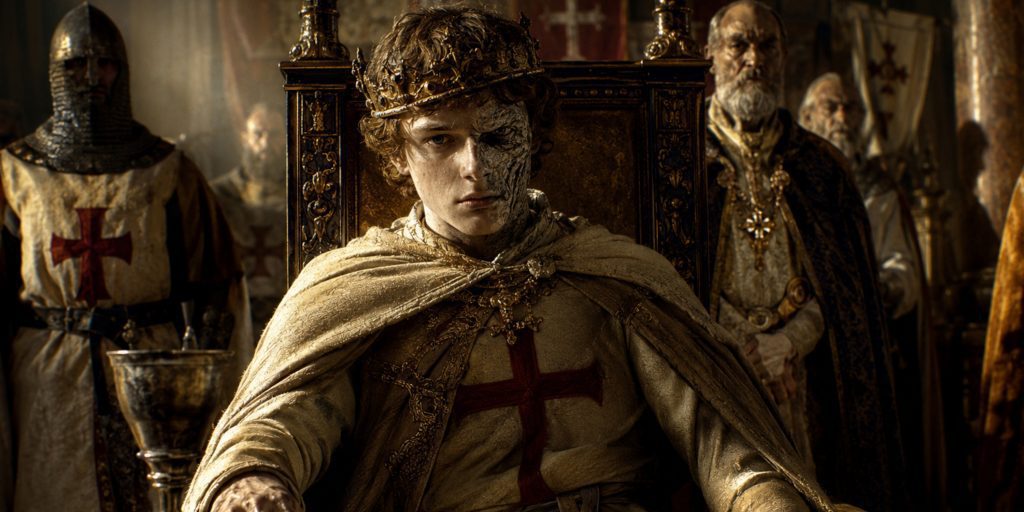
Baldwin IV was King of Jerusalem from 1174 until 1185 and one of the most remarkable rulers produced by the Crusader states.
He inherited the throne at just thirteen years of age after the death of his father, King Amalric I. By then, physicians already knew that Baldwin suffered from leprosy, a disease that would progressively rob him of sensation, movement and eventually his sight. Even so, there was little question that he would succeed his father. Jerusalem required stability, and Baldwin remained the legitimate heir.
His reign coincided with one of the defining moments of Crusader history.
During Baldwin’s lifetime, the Muslim world was becoming increasingly unified under Saladin. Previous generations of Crusader kings had benefited from divisions among rival Muslim rulers. Baldwin would enjoy no such luxury. Instead, he faced an opponent capable of combining Egypt, Syria and much of Mesopotamia into a single political and military force.
It was a contest that appeared hopeless on paper.
Yet Baldwin repeatedly frustrated Saladin’s ambitions through a combination of determined military leadership and careful diplomacy. Most famously, he inflicted a crushing defeat upon Saladin at the Battle of Montgisard in 1177, one of the greatest victories ever achieved by the Kingdom of Jerusalem.
His illness has understandably become the defining feature of his reputation, but it should not overshadow his political ability.

Bernard Hamilton, whose biography The Leper King and His Heirs remains the standard modern study, argues that Baldwin possessed a sharp understanding of government despite his youth. He recognised dangerous personalities at court, balanced competing noble factions and made difficult succession decisions while fully aware that he would never produce an heir of his own.
That awareness shaped almost every decision he made.
Unlike many medieval monarchs, Baldwin governed without the expectation of building a lasting dynasty. Instead, his priority became preserving the kingdom long enough for someone else to inherit it intact.
It was an unenviable task.
The Kingdom of Jerusalem Before Baldwin
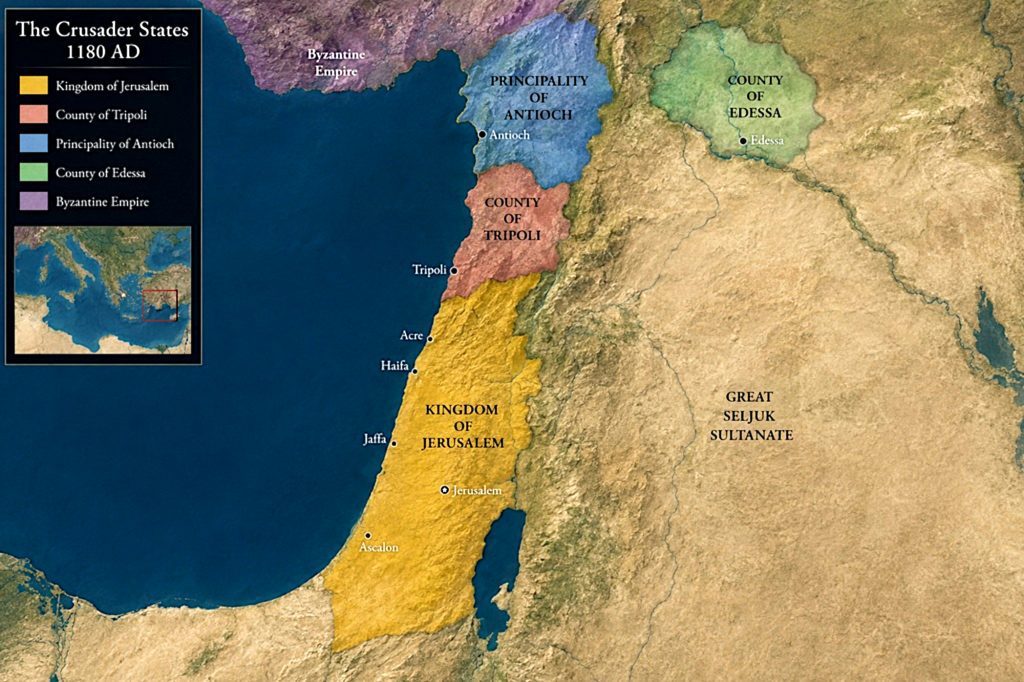
To understand Baldwin, we first need to understand the kingdom he inherited.
The Kingdom of Jerusalem had existed for seventy-five years before Baldwin became king. It was established in 1099 after the First Crusade captured Jerusalem from the Fatimid Caliphate, an event that shocked both the Islamic world and Christian Europe.
Unlike kingdoms in France or England, however, Jerusalem remained permanently vulnerable.
Its population was comparatively small. Most Frankish settlers clustered around fortified towns and castles while the surrounding countryside contained a mixture of Christians, Muslims, Jews and eastern Christian communities. The kingdom relied heavily upon trade, pilgrimage and continued support from western Europe.
Its greatest strength lay in geography.
Stretching along the eastern Mediterranean coast, Jerusalem controlled vital ports including Acre, Jaffa and Tyre. These connected the kingdom directly to Italy, where Genoese, Venetian and Pisan merchants maintained thriving commercial networks.
Its greatest weakness was manpower.
The kingdom simply could not replace heavy battlefield losses.
Every knight represented years of training and considerable expense. Every noble family lost in battle weakened the political fabric of the realm. Victories therefore mattered enormously, but defeats could prove catastrophic.
This scarcity explains much of Crusader strategy.
Rather than seeking conquest for its own sake, Jerusalem depended upon castles, diplomacy and calculated military action. Fortifications such as Kerak, Montreal and Belvoir acted as shields across vulnerable frontiers. Military orders including the Knights Templar and Knights Hospitaller supplemented the kingdom’s limited manpower with disciplined professional soldiers.

The result was a state that resembled less a unified nation and more an armed network of fortified communities.
It survived because its rulers understood that caution often achieved more than spectacular victories.
A Kingdom Surrounded
By the middle of the twelfth century, the political landscape of the Near East was changing rapidly.
When the First Crusaders established Jerusalem, their Muslim neighbours were deeply divided. Rival dynasties frequently fought each other, allowing the Crusader states to survive despite their numerical disadvantage.
That situation gradually disappeared.
The Zengid dynasty under Imad ad-Din Zengi and later Nur ad-Din began unifying Syria. Meanwhile, Egypt remained under the weakening Fatimid Caliphate. Whoever controlled both Syria and Egypt would surround Jerusalem from north and south.
It was precisely this danger that haunted Baldwin’s father, Amalric I.
Throughout the 1160s Amalric launched repeated expeditions into Egypt, hoping to secure it before Nur ad-Din could intervene. Although these campaigns ultimately failed, they demonstrated remarkable strategic foresight. Amalric understood that the future of Jerusalem depended upon preventing Muslim unity.
Unfortunately for Baldwin, events unfolded in exactly the opposite direction.
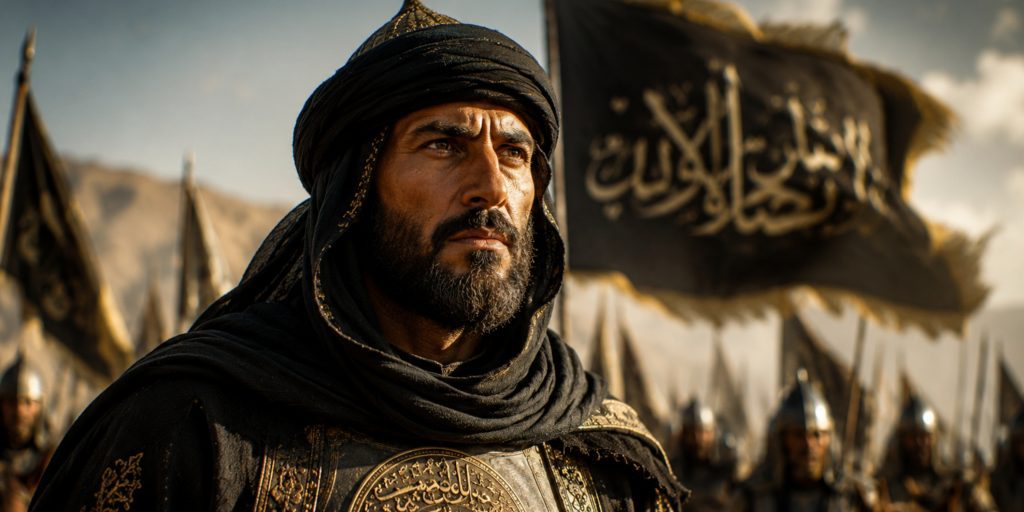
One of Nur ad-Din’s rising commanders, a Kurdish officer named Salah ad-Din Yusuf ibn Ayyub, would soon transform the balance of power forever.
History remembers him simply as Saladin.
Birth and Family
Baldwin was born in Jerusalem during the summer of 1161.
He entered a royal family whose history reflected both ambition and instability.
His father, Amalric I, had become King of Jerusalem in 1163 following the death of his elder brother Baldwin III. Amalric proved energetic, intelligent and deeply interested in expanding the kingdom’s influence. Contemporary chroniclers admired his administrative ability, though they also described him as occasionally impulsive.
William of Tyre painted an affectionate portrait of the king, noting his intelligence and appetite for learning alongside a fondness for hunting and physical activity.
Baldwin’s mother, Agnes of Courtenay, came from one of the leading Frankish noble families of the kingdom. Her marriage to Amalric proved politically controversial because of questions surrounding consanguinity. Shortly after Amalric became king, church authorities annulled the marriage.
The annulment, however, carried an important qualification.
Baldwin and his elder sister Sibylla remained legitimate heirs to the throne.

This distinction would later become enormously important.
Despite no longer serving as queen, Agnes continued to wield considerable influence within Jerusalem’s aristocracy. Medieval chroniclers often criticised her, though many modern historians believe these accounts reflected political bias as much as objective observation.
Like many powerful medieval women, Agnes attracted criticism simply because she exercised influence in public affairs.
Baldwin also grew up surrounded by an unusually cosmopolitan court.
French remained the language of government, yet Greek, Arabic, Armenian, Syriac and Latin could all be heard within Jerusalem itself. Pilgrims arrived from every corner of Europe. Merchants from Italy mingled with eastern Christians, Muslim traders and Jewish scholars.
Few medieval capitals possessed such cultural diversity.
For a young prince, it created an education unlike that available anywhere else in Europe.
Childhood in the Holy City

Modern visitors often imagine medieval Jerusalem as an isolated fortress perched upon a hill.
The reality was considerably richer.
Although conflict remained a constant possibility, Jerusalem functioned as a bustling religious and commercial centre. Pilgrims flooded into the city throughout the year, filling its streets with languages, clothing and customs drawn from across Christendom.
For Baldwin, this environment became normal.
He grew up surrounded by churches, monasteries, military headquarters and royal palaces. Ceremonies marking the Christian calendar unfolded against a backdrop of immense religious significance. Every ruler of Jerusalem understood that they governed not merely another kingdom, but the city regarded by medieval Christians as the spiritual centre of the world.
That symbolism carried enormous expectations.
The king of Jerusalem was expected to protect the Holy Sepulchre, defend Christian pilgrims and preserve the fragile Crusader states established after the First Crusade.
These responsibilities rested upon Baldwin from childhood.
No one yet knew quite how difficult they would become.
William of Tyre and the Discovery of Leprosy
Few medieval kings were fortunate enough to have an educator who also happened to be one of the finest historians of the age.
Baldwin’s tutor was William of Tyre, scholar, diplomat, churchman and eventually Archbishop of Tyre. Educated in Paris, Bologna and perhaps Orléans, William returned to the Kingdom of Jerusalem with an unusually broad intellectual background. He was fluent in Latin, familiar with theology, Roman law and classical literature, and possessed the careful eye of someone who observed events before judging them.
That makes his account of Baldwin’s childhood especially valuable.
Unlike many medieval chroniclers who relied on rumour or second-hand reports, William knew Baldwin personally. He watched him grow from a lively boy into a young king, making his observations among the most reliable evidence we possess.
The discovery of Baldwin’s illness did not come through a dramatic collapse or battlefield injury. Instead, it emerged during an ordinary afternoon of children’s games.
William later described how Baldwin and other noble boys amused themselves by pinching and scratching each other’s arms to test who could endure pain the longest. The future king laughed along with everyone else.
One difference soon became impossible to ignore.
Baldwin showed no reaction at all when his right arm was pinched.
William recalled:
“He felt no pain whatsoever in his right arm, although the boys pinched him repeatedly.”
To a modern reader this might seem a curious detail. To medieval physicians, loss of sensation was one of the classic early signs of leprosy.
Physicians were summoned.
Their conclusions were cautious at first. Baldwin remained healthy in appearance, energetic and physically active. Yet over time the numbness spread, confirming what many had begun to suspect.
The heir to the Kingdom of Jerusalem had Hansen’s disease.
Today we know that leprosy attacks peripheral nerves before causing many of its visible symptoms. Damage to those nerves prevents sufferers from feeling pain, making ordinary injuries surprisingly dangerous. Cuts, burns and infections often become serious because they go unnoticed.
William could not explain the biology, but his observations were remarkably accurate.
His account remains one of the earliest detailed descriptions of neurological symptoms associated with the disease.
Understanding Leprosy in the Twelfth Century
To appreciate Baldwin’s achievement, it helps to understand what leprosy meant to medieval society.
The disease carried a reputation far worse than its medical reality.
Throughout Christian Europe, leprosy was associated with ritual impurity, divine punishment and social isolation. Biblical references encouraged many people to see the disease as evidence of God’s judgement, even though church teaching itself was often more compassionate than popular belief.
Hospitals dedicated to lepers appeared throughout Europe.
Some provided genuine care.
Others effectively removed sufferers from wider society.
In many regions, people diagnosed with advanced leprosy participated in symbolic funeral ceremonies that marked their separation from ordinary life. Although not universal, these rituals demonstrate the stigma surrounding the disease.
Jerusalem presented a slightly different picture.
The Crusader Kingdom had extensive experience caring for lepers, partly because pilgrims arrived from across Europe bringing a wide range of illnesses. One of the best known institutions was the Order of Saint Lazarus, whose members cared specifically for those suffering from leprosy.
Ironically, Baldwin would later become closely associated with this order.
Modern medicine paints a far less frightening picture.
Leprosy spreads only through prolonged close contact and is among the least contagious infectious diseases. Most people possess a natural immunity. Untreated, however, it gradually damages nerves, muscles and eyesight over many years.
For Baldwin, the progression proved relentless.
As a child, only his right arm showed symptoms.
As a teenager, weakness spread to other limbs.
By adulthood, he struggled to ride without assistance.
Eventually he became almost completely blind.
None of this happened overnight.
That gradual decline makes his reign all the more remarkable. Baldwin spent more than a decade adapting constantly to new physical limitations while continuing to govern one of the most dangerous kingdoms in Christendom.
Preparing a Prince for Kingship
Despite his diagnosis, Baldwin’s education continued much as it would have for any future monarch.
There was never serious discussion of removing him from the succession.
In part, this reflected necessity.
His sister Sibylla remained the only realistic alternative, and medieval kingdoms generally preferred male succession wherever possible. More importantly, Baldwin himself demonstrated no signs of intellectual decline. His illness affected his body, not his judgement.
William of Tyre oversaw an education designed to produce a capable ruler rather than merely a ceremonial monarch.
Like other noble boys of the twelfth century, Baldwin studied:
- Latin language and grammar
- Christian theology
- Biblical history
- Classical literature
- Diplomacy and administration
- Law and governance
- Military history
- Royal ceremony
He also received practical instruction expected of every medieval prince.
Horsemanship formed a central part of noble education. Young aristocrats learned to ride confidently from an early age before progressing to hunting, falconry and mock combat. These pursuits were more than entertainment. Hunting taught coordination, leadership and decision making under pressure.
Baldwin embraced them enthusiastically.
William repeatedly comments upon his determination to master activities that growing physical weakness should have made increasingly difficult.
That stubbornness became one of Baldwin’s defining characteristics.
There is something quietly admirable about a teenager who understood his condition better than anyone around him yet continued behaving as though nothing had changed. Whether this reflected optimism, denial or simple courage is impossible to know.
Perhaps it was a little of all three.
The Death of Amalric I
Everything changed in 1174.
King Amalric I fell seriously ill while preparing another campaign linked to Egypt. The exact nature of his illness remains uncertain. Dysentery, typhoid and other infectious diseases have all been suggested by historians.
Whatever the cause, the decline was rapid.
On 11 July 1174, Amalric died in Jerusalem.
He was only thirty-eight years old.
His death created immediate uncertainty.
The new king was thirteen.
He had already been diagnosed with a progressive illness.
The political future of the kingdom suddenly depended upon a boy who could not yet govern independently.
Fortunately, Jerusalem possessed experienced nobles capable of providing stability during the transition.
Unfortunately, they rarely agreed with one another.
A Boy King Takes the Throne
Baldwin was crowned King of Jerusalem on 15 July 1174 in the Church of the Holy Sepulchre.
Few coronation venues in medieval Europe could rival its symbolic power.
The church stood upon what Christians believed to be the sites of Christ’s crucifixion and resurrection. Every coronation there reinforced the idea that the kings of Jerusalem ruled under unique divine responsibility.
The ceremony itself followed traditions established by Baldwin’s predecessors.
The young king received the crown before clergy, nobles and representatives of the military orders. Oaths were sworn. Homage was paid. Outwardly everything appeared orderly.
Privately, many must have wondered how long this arrangement could last.
Baldwin looked healthy enough.
His illness had not yet produced the severe physical changes associated with advanced leprosy. To observers unfamiliar with his diagnosis, he probably appeared little different from any other adolescent prince.
Those closest to him knew otherwise.
Every year would make governing more difficult.
Every year increased the importance of resolving the succession before Baldwin’s condition became terminal.
Those concerns never entirely disappeared throughout his reign.
Raymond III and the Regency
Because Baldwin remained underage, practical authority initially rested with Raymond III, Count of Tripoli.
Raymond was one of the most experienced Crusader nobles alive.
Born into one of the leading aristocratic families of the Latin East, he had fought Muslims, negotiated with Byzantium and even spent years imprisoned by Nur ad-Din after the disastrous Battle of Harim in 1164.
Captivity had not broken him.
If anything, it made him more cautious than many of his contemporaries.
As regent, Raymond inherited an unenviable situation.
Externally, Nur ad-Din remained the dominant Muslim ruler in Syria. Internally, competing noble families watched each other with deep suspicion.
Raymond’s priorities were straightforward.
- Preserve stability.
- Avoid unnecessary wars.
- Prepare Baldwin for independent rule.
- Keep ambitious nobles from tearing the kingdom apart.
His policies reflected experience rather than glory seeking.
Modern historians generally judge Raymond favourably, although medieval chroniclers writing for rival factions often portrayed him as overly cautious.
Personally, I suspect history has been kinder to him than many of his contemporaries were. There is a recurring tendency in medieval politics to mistake patience for weakness. Raymond understood something that hot-headed nobles often forgot.
Jerusalem could not afford reckless victories.
It certainly could not survive reckless defeats.
His regency provided Baldwin with something every young monarch desperately needs.
Time.
Time to mature.
Time to learn.
Time to prepare for responsibilities unlike those faced by almost any other ruler in Europe.
Neither man could know that events unfolding hundreds of miles away would soon transform the political landscape forever.
A Kurdish commander serving in Egypt was steadily accumulating power.
His name was Saladin.
The Rise of Saladin
While Baldwin was learning the responsibilities of kingship, events beyond the borders of Jerusalem were reshaping the political landscape of the Near East.
No ruler represented that transformation more completely than Salah ad-Din Yusuf ibn Ayyub, remembered in Europe simply as Saladin.
Modern culture often presents Baldwin and Saladin as lifelong rivals locked in an inevitable contest. The truth is more subtle.
When Baldwin became king in 1174, Saladin was still consolidating his position. He had not yet become the undisputed master of the Muslim world. That would take years of careful diplomacy, military success and political patience.
Like Baldwin, Saladin inherited problems rather than certainty.
Born around 1137 in Tikrit, in present-day Iraq, Saladin came from a Kurdish military family that served the powerful Zengid ruler Nur ad-Din. His uncle, Shirkuh, proved instrumental in campaigns into Egypt during the 1160s. When Shirkuh died unexpectedly in 1169, Saladin became Vizier of Egypt.
Few expected him to remain there for long.
He was young, relatively inexperienced and surrounded by rivals.
Instead, he quietly dismantled opposition while strengthening his own authority. In 1171 he abolished the Fatimid Caliphate, restoring Sunni rule to Egypt and formally recognising the Abbasid Caliph in Baghdad.
It was one of the most significant political developments of the century.
For the first time in generations, Egypt and Syria appeared capable of falling under a single ruler.
Amalric I had feared exactly this outcome.
Baldwin now had to live with it.
When Nur ad-Din died in 1174, Saladin moved rapidly. Rather than allowing Syria to fracture into competing states, he expanded northward, capturing Damascus before gradually extending his influence across much of the region.
His ambition was clear.
Before confronting the Crusader states directly, he intended to unite the Muslim Near East.
Unlike many rulers, Saladin understood that internal unity could be more valuable than immediate conquest.
It was a lesson Baldwin also appreciated.
The difference was that Saladin possessed vastly greater resources.
Two Young Rulers
One of the striking aspects of this period is the age of its principal figures.
Baldwin was only thirteen when he became king.
Saladin was in his late thirties but had only recently begun establishing his wider empire.
Neither inherited stable circumstances.
Both spent much of the 1170s dealing with internal political challenges rather than launching grand campaigns against one another.
This reality is sometimes overlooked.
The Kingdom of Jerusalem and Saladin’s domains did not exist as two unified powers preparing for a single climactic war. Instead, both rulers spent years trying to keep their own supporters aligned.
Baldwin faced quarrelling barons.
Saladin faced rival Muslim princes who questioned his authority.
Only after consolidating these internal struggles could either devote sustained attention to the wider conflict.
That makes Baldwin’s achievements more impressive.
Jerusalem possessed perhaps twenty thousand fighting men across the entire kingdom under ideal circumstances. Saladin could eventually draw upon manpower from Egypt, Syria, northern Mesopotamia and beyond.
It was never an equal contest.
The remarkable aspect is how long Baldwin prevented that imbalance from becoming decisive.
Baldwin Assumes Personal Rule
By 1176 Baldwin had reached the age at which he could begin exercising authority in his own right.
Although Raymond III remained an influential adviser, the young king increasingly made his own decisions.
This transition revealed much about his character.
Despite his youth, Baldwin demonstrated an independent streak that occasionally surprised older nobles. He listened carefully to advice but did not simply follow the wishes of whichever lord happened to speak most loudly.
William of Tyre admired this quality.
He described Baldwin as possessing intelligence beyond his years, coupled with an impressive memory and an eagerness to learn from experienced counsellors.
The young king also recognised a difficult truth.
His illness meant time was precious.
Many monarchs could postpone difficult political decisions for years. Baldwin understood that every year of delay increased the likelihood that he would leave behind an unresolved succession crisis.
Consequently, he involved himself directly in matters of government earlier than many rulers of similar age.
He attended councils.
He heard petitions.
He confirmed grants.
He intervened in disputes between nobles.
He worked.
That may sound unremarkable, but medieval government depended heavily upon the physical presence of the monarch. Kings travelled, presided over courts, inspected castles and personally rewarded loyalty.
For Baldwin, every journey demanded increasing effort.
Yet he continued.
A Kingdom Divided by Ambition
If Saladin represented the greatest external threat to Jerusalem, the kingdom’s internal politics often proved almost as dangerous.
The nobility of the Crusader states consisted of powerful families whose interests did not always align with those of the Crown.
Some possessed extensive lands.
Others controlled strategically important castles.
Several maintained close relationships with the military orders or influential church leaders.
Each expected to shape royal policy.
Baldwin therefore spent much of his reign balancing competing personalities.
Among the most significant were:
Raymond III of Tripoli
Experienced, cautious and politically astute, Raymond generally favoured diplomacy where possible. He understood the kingdom’s military limitations and preferred avoiding unnecessary confrontation.
Bohemond III of Antioch
Prince of Antioch and one of the senior rulers of the Crusader states. Although frequently an ally, his own priorities naturally centred upon defending Antioch rather than Jerusalem.
The Knights Templar
The Templars answered directly to the Pope rather than the king. They provided elite military forces but sometimes pursued policies independent of royal wishes.
The Knights Hospitaller
Originally founded to care for pilgrims, the Hospitallers had evolved into another formidable military order. Their castles and professional soldiers became indispensable to the defence of the kingdom.
Managing these relationships required diplomacy as much as authority.
Unlike England or France, the King of Jerusalem could not simply command obedience through overwhelming resources.
Consensus mattered.
Compromise mattered.
Personal reputation mattered perhaps most of all.
Reynald of Châtillon: Ally or Liability?
Few figures from the Crusader period inspire stronger opinions than Reynald of Châtillon.
Even medieval chroniclers struggled to decide whether he was courageous, reckless or simply incapable of recognising sensible limits.
Perhaps he was all three.
Reynald had enjoyed an adventurous and often turbulent career before entering Baldwin’s circle. After becoming Prince of Antioch through marriage, he spent sixteen years imprisoned by the Muslims before eventually returning to public life.
Most people might have emerged from such captivity somewhat chastened.
Reynald did not.
Granted control of the great fortress of Kerak in Transjordan, he became responsible for one of the kingdom’s most strategically important frontiers. From there he monitored caravan routes linking Egypt with Syria.
It was an enormously influential position.
Reynald possessed genuine military ability and fierce determination. Baldwin valued both qualities.
Unfortunately, Reynald also possessed a remarkable talent for provoking unnecessary crises.
He launched raids into Muslim territory even during periods of truce.
He attacked caravans protected by diplomatic agreements.
Most astonishingly, he organised an expedition into the Red Sea that threatened the holy cities of Mecca and Medina.
The plan failed.
Its consequences, however, echoed throughout the Islamic world.
Saladin now viewed Reynald not merely as a troublesome frontier lord but as a dangerous enemy whose actions demanded punishment.
Modern historians continue debating Baldwin’s relationship with Reynald.
Did the king genuinely approve these aggressive policies?
Or was he unable to restrain one of his most powerful barons?
The evidence suggests something between the two.
Baldwin appreciated Reynald’s military value but increasingly recognised the political costs of his unpredictability.
It was another reminder that ruling Jerusalem required managing personalities almost as much as confronting foreign armies.
Baldwin’s First Campaigns
Although still young, Baldwin refused to remain a passive observer while experienced commanders fought on his behalf.
He accompanied military expeditions whenever his health permitted and quickly earned respect among the kingdom’s knights.
Contemporary accounts repeatedly emphasise his willingness to share hardships with his soldiers.
This mattered.
Medieval armies expected kings to lead from the front. Royal authority depended heavily upon visibility.
Baldwin understood this instinctively.
Even as sensation gradually disappeared from parts of his body, he continued riding with the army across the harsh landscapes of Palestine and the Jordan Valley.
The climate alone posed formidable challenges.
Summer heat could be exhausting even for healthy men. Water remained scarce. Supply lines required constant protection. Campaigns often revolved around securing wells and controlling routes rather than seeking dramatic battles.
These realities shaped Baldwin’s military thinking.
He recognised that preserving the army often mattered more than risking everything in pursuit of decisive victory.
That careful judgement would soon face its greatest test.
In 1177, Saladin invaded the Kingdom of Jerusalem with one of the largest armies yet assembled against the Crusader states.
Many believed the kingdom stood on the brink of destruction.
Instead, Baldwin prepared one of the most astonishing victories of the Crusading era.
The Battle of Montgisard would transform both his reputation and the wider conflict between Jerusalem and Saladin.
The Road to Montgisard
By the autumn of 1177, the balance of power in the Levant appeared to be shifting decisively in Saladin’s favour.
He had strengthened his authority in Egypt, expanded into Syria and demonstrated that he possessed both political skill and military ambition. Although the Muslim world was not yet completely united under his leadership, he had become the dominant figure in the region.
For Baldwin, the outlook was deeply concerning.
The Kingdom of Jerusalem had survived for decades by exploiting divisions among its enemies. Those divisions were steadily disappearing.
Saladin recognised an opportunity.
In late 1177 he assembled a substantial army in Egypt and marched north into the Kingdom of Jerusalem. Contemporary chroniclers disagree on the exact size of his force, with estimates ranging from around 20,000 men to well over 30,000. Medieval numbers are notoriously unreliable, but there is little doubt that Saladin enjoyed a significant numerical advantage.
More importantly, many of Jerusalem’s strongest forces were unavailable.
Philip of Flanders had recently arrived on pilgrimage, yet disagreements over strategy meant no major joint expedition had materialised. Raymond III of Tripoli was absent in the north. Several garrisons remained tied to defending frontier castles.
The kingdom appeared dangerously exposed.
Saladin crossed into the Latin Kingdom expecting a relatively straightforward campaign.
Initially, events supported that expectation.
His army advanced rapidly across southern Palestine, plundering settlements almost without resistance. Villages burned. Crops were destroyed. Livestock disappeared before the advancing columns.
The route towards Jerusalem seemed increasingly open.
Baldwin’s Difficult Decision
Inside Jerusalem, Baldwin faced perhaps the greatest test of his reign.
He possessed only a fraction of Saladin’s strength.
His own illness had advanced significantly since becoming king. Although still capable of riding, he increasingly relied upon assistance and endured growing physical discomfort. The loss of sensation in his limbs made prolonged campaigning exhausting and dangerous.
Many rulers would have remained behind city walls.
The defensive position was obvious.
Jerusalem’s fortifications were formidable, and Saladin lacked the siege equipment necessary for an immediate assault.
Baldwin chose differently.
Rather than waiting passively, he resolved to gather every available soldier and strike at the invading army before it could consolidate its position.
It was a remarkable decision.
The king’s field army probably numbered no more than four to five hundred knights supported by several thousand infantry, crossbowmen and Turcopoles. Alongside them rode approximately eighty Knights Templar under their Grand Master, Odo of St Amand.
Even allowing for uncertainties in the sources, Baldwin was heavily outnumbered.
His advisers cannot have been entirely comfortable with the plan.
Yet the alternative was equally bleak.
Allow Saladin to roam freely through the kingdom and Jerusalem’s economic heartland would be devastated. Crops could be replanted, but confidence among the kingdom’s nobles and allies would suffer lasting damage.
Sometimes caution carries its own risks.
Baldwin understood this.
Saladin Grows Overconfident
Military success has a habit of encouraging optimism.
Occasionally, it encourages complacency.
Saladin’s campaign had progressed so smoothly that discipline within his army began to loosen. Units spread across the countryside gathering supplies and plunder. The columns became more dispersed as confidence increased that no serious Crusader force remained capable of challenging them.
It was a dangerous assumption.
William of Tyre suggests that Saladin believed Baldwin remained trapped inside Ascalon and posed little immediate threat. Whether this reflected accurate intelligence or simple wishful thinking remains uncertain.
Either way, Saladin relaxed his operational security.
His army no longer marched in the tightly organised formation expected when facing a determined opponent.
For Baldwin, this presented an opportunity.
He moved rapidly along the coast before turning inland, carefully concealing the speed of his advance.
The two armies approached one another near Montgisard, close to modern Ramla.
The encounter surprised both sides.
One army expected an easy conclusion to its campaign.
The other had come specifically to force battle.
Before the Battle
The moments before Montgisard have become some of the most discussed in Crusader history.
Several medieval chroniclers describe Baldwin praying before a relic believed to contain a fragment of the True Cross.
The relic accompanied Crusader armies during major campaigns and carried immense spiritual significance. To the soldiers assembled around Baldwin, it represented far more than a religious symbol.
It reminded them why they believed they were fighting.
William of Tyre records that the king dismounted to pray before battle.
Other sources describe clergy encouraging the army while carrying the relic at its head.
Whether every detail unfolded exactly as later chroniclers described is impossible to verify.
The broader picture, however, is convincing.
Baldwin understood morale.
His army was smaller.
Many soldiers knew they faced overwhelming odds.
Faith helped transform fear into determination.
As a historian, I sometimes smile at attempts to strip medieval warfare of its religious dimension. It is rather like trying to explain modern Formula One without mentioning engines. Faith was not an optional extra for twelfth century armies. It shaped their motivations, expectations and understanding of victory itself.
For Baldwin’s men, defending Jerusalem carried both political and spiritual importance.
Those ideas could not be separated.
The Battle of Montgisard

On 25 November 1177, Baldwin launched one of the most audacious attacks in Crusader history.
Rather than waiting for Saladin to organise his forces, the Crusader army attacked immediately.
Speed became its greatest weapon.
The Frankish knights formed for a classic heavy cavalry charge, supported by infantry advancing behind them. The Templars rode among the leading ranks, adding experienced shock troops to the assault.
Mounted knights lowered their lances.
Horses accelerated.
Then they struck.
The impact was devastating.
European heavy cavalry represented one of the most formidable military systems of the medieval world when employed under favourable conditions. A disciplined charge by armoured knights could shatter infantry formations and disrupt cavalry before it fully organised itself.
At Montgisard, Saladin’s dispersed army struggled to respond.
Units that had been scattered while foraging suddenly found themselves attacked before they could regroup. Confusion spread rapidly through the Muslim ranks.
The Crusaders pressed their advantage.
Wave after wave of mounted attacks drove deeper into Saladin’s formation while infantry secured ground already captured.
William of Tyre describes the assault with clear admiration, portraying Baldwin personally directing operations despite his illness.
Although medieval chroniclers naturally favoured dramatic storytelling, there is broad agreement that the Crusader attack achieved complete tactical surprise.
That surprise proved decisive.

Baldwin at the Centre of the Fighting
One question has fascinated historians for centuries.
How active was Baldwin during the battle itself?
Later artistic depictions often show him charging heroically at the head of the army, sword raised high. They certainly capture the spirit of the event, but probably not its precise reality.
By 1177 Baldwin remained capable of riding, though his illness had already weakened parts of his body.
He almost certainly commanded while mounted.
Whether he physically led every charge is less certain.
Military leadership in the twelfth century involved far more than personal combat. Kings directed reserves, identified opportunities and maintained cohesion across the battlefield.
Evidence suggests Baldwin fulfilled exactly this role.
His presence alone carried enormous significance.
Soldiers could see their king sharing the same risks despite his worsening condition.
That visibility inspired confidence.
It is difficult not to admire the example he set.
Leadership often begins with being present when everyone else wishes you were somewhere safer.
Saladin Escapes
The battle ended in complete victory for Jerusalem.
Saladin’s army collapsed.
Large numbers of soldiers were killed during the fighting or while attempting to flee. Equipment, animals and supplies fell into Crusader hands.
Saladin himself narrowly escaped capture.
According to several accounts, he fled the battlefield with only a handful of companions, eventually reaching Egypt after an arduous journey across the Sinai Peninsula. Much of his baggage train, including personal possessions, was abandoned during the retreat.
For a commander who rarely suffered outright defeat, the experience must have been deeply sobering.
Montgisard did not destroy Saladin’s power.
It did something perhaps more valuable for Baldwin.
It demonstrated that Saladin was not invincible.
Across the Latin Kingdom, news of the victory spread rapidly.
A campaign expected to end in disaster had become one of the greatest triumphs in Crusader history.
Why Montgisard Mattered
It is tempting to exaggerate Montgisard into the decisive battle of the Crusades.
It was not.
Saladin recovered remarkably quickly. Within a few years he had rebuilt his armies and resumed offensive operations. Ultimately, he would capture Jerusalem itself in 1187.
Yet dismissing Montgisard as merely temporary would be equally misleading.
The victory carried profound consequences.
First, it preserved the Kingdom of Jerusalem during a moment of genuine vulnerability.
Had Saladin destroyed Baldwin’s field army in 1177, the road to Jerusalem might have lain open years before Hattin.
Second, it established Baldwin’s reputation.
He was no longer simply the unfortunate young king suffering from leprosy.
He became the monarch who had defeated Saladin against overwhelming odds.
Finally, the battle bought time.
Time for castles to be strengthened.
Time for diplomacy.
Time for the kingdom to prepare for future campaigns.
In retrospect, that additional decade proved one of Baldwin’s greatest achievements.
The Kingdom of Jerusalem did not collapse while he lived.
That was no coincidence.
After the Victory
Celebration across the kingdom was understandably enthusiastic.
Churches gave thanks.
Chroniclers praised divine favour.
Nobles celebrated an achievement few had believed possible only weeks earlier.
Baldwin himself, however, had little opportunity to enjoy lasting peace.
His illness continued its slow progression.
Meanwhile, Saladin immediately began rebuilding both his army and his political position.
The struggle between the two rulers was far from over.
The years following Montgisard would test Baldwin even more severely than the battle itself.
His greatest enemies would increasingly become time, illness and the growing divisions within his own court.
Holding the Kingdom Together
Victory at Montgisard transformed Baldwin IV’s reputation, but it did not transform the strategic reality of the Kingdom of Jerusalem.
One great victory could not erase geography.
Jerusalem remained a relatively small Christian kingdom surrounded by Muslim territories that possessed greater manpower, deeper financial resources and, increasingly, stronger political unity. Baldwin understood this better than anyone. If Montgisard encouraged some of his nobles to believe that God would simply continue delivering miraculous victories, the king himself appears to have drawn a more practical lesson.
He had won because circumstances favoured him.
He could not expect fortune to repeat itself indefinitely.
The years immediately after Montgisard therefore became less about dramatic battles and more about preserving the kingdom through careful government.
Modern readers often focus on medieval warfare because it is exciting. Medieval administration rarely receives the same attention, largely because nobody has yet made tax records look particularly glamorous. Yet administration was precisely where kingdoms survived or failed.
Baldwin spent much of the late 1170s travelling throughout his realm.
Royal charters issued during these years show him visiting Jerusalem, Acre, Nablus, Tyre and numerous castles across the kingdom. These journeys were politically important. Medieval kings ruled through personal presence. Justice had to be seen. Disputes required judgement. Nobles expected access to their sovereign.
For Baldwin, every journey became progressively harder.
By now, weakness had begun affecting more than his right arm.
The disease slowly spread into his hands and feet. Riding became increasingly difficult. Numbness meant injuries often went unnoticed until they became serious. Even mounting a horse demanded assistance from attendants.
Nevertheless, he continued.
William of Tyre repeatedly emphasises that Baldwin refused to withdraw from public life simply because governing had become physically demanding.
That determination earned enormous respect.
Baldwin’s Government
One of the persistent myths surrounding medieval kings is that they governed entirely through instinct and battlefield courage.
In reality, successful rulers relied upon councils, administrators, lawyers and churchmen.
Baldwin was no exception.
The royal court included experienced advisers drawn from the kingdom’s leading families and senior clergy. Important decisions concerning diplomacy, taxation, military campaigns and succession were debated before the king reached a final judgement.
William of Tyre remained one of Baldwin’s most trusted intellectual advisers.
The Archbishop was not simply recording events for future generations. He actively participated in government, negotiated diplomatic missions and advised the Crown on matters of policy.
Alongside him stood men such as Raymond III of Tripoli and members of the High Court of Jerusalem.
The High Court, or Haute Cour, deserves particular attention.
Unlike many western European kingdoms where royal authority steadily expanded during the twelfth century, Jerusalem operated through a delicate partnership between the Crown and its leading nobles.
Major decisions often required consultation.
Land grants.
Military obligations.
Questions of inheritance.
Royal marriages.
All passed through this network of aristocratic consensus.
That system provided stability when cooperation existed.
It became deeply problematic when powerful nobles disagreed.
Unfortunately for Baldwin, disagreement became increasingly common.
Baldwin and Raymond III
Among Baldwin’s most important relationships was his long association with Raymond III, Count of Tripoli.
Modern historians generally regard Raymond as one of the ablest statesmen produced by the Crusader states.
Contemporary opinion proved rather more divided.
Supporters praised his patience and experience.
Critics accused him of excessive caution or political ambition.
As so often happens in medieval history, the truth lies somewhere between the extremes.
Raymond possessed decades of military experience. He understood Muslim politics, appreciated the kingdom’s military limitations and recognised that Jerusalem could not afford reckless adventures.
His strategic outlook often aligned closely with Baldwin’s own.
Both men preferred preserving the kingdom over seeking dramatic but dangerous victories.
This occasionally brought them into conflict with more aggressive nobles who demanded offensive campaigns regardless of the risks involved.
William of Tyre consistently portrays Raymond as loyal to Baldwin.
Later chroniclers writing after the disastrous defeat at Hattin often treated him less kindly, perhaps because they searched for individuals to blame for the kingdom’s eventual collapse.
Modern scholarship has largely restored Raymond’s reputation.
Bernard Hamilton argues that Baldwin and Raymond formed an effective partnership during much of the king’s reign, providing the kingdom with experienced leadership at a time when consistency mattered enormously.
The Military Orders
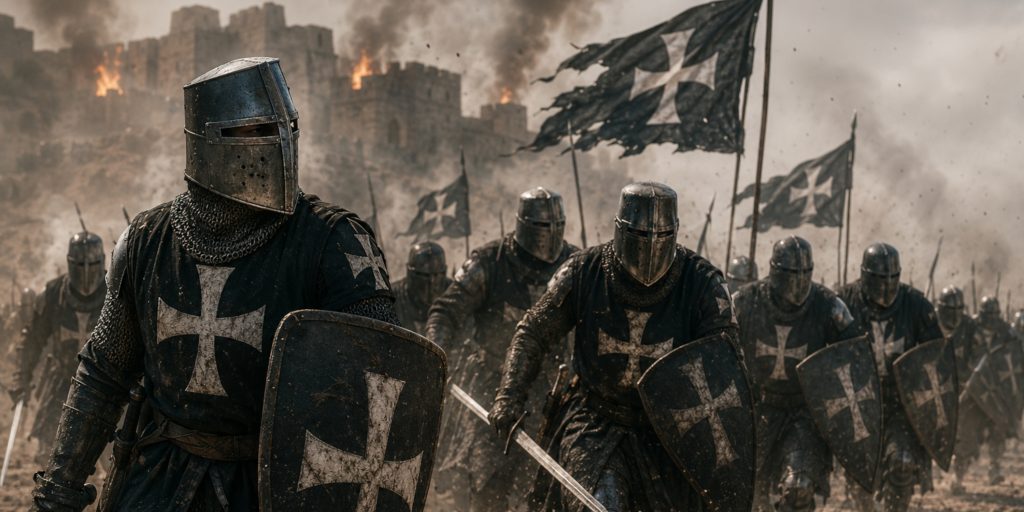
No discussion of Baldwin’s reign would be complete without examining the military orders.
Few institutions better illustrate the unique nature of the Crusader states.
The Knights Templar and Knights Hospitaller were neither ordinary monks nor conventional soldiers.
They were both.
Members took religious vows while serving as professional warriors dedicated to defending the Holy Land.
The Templars had originally emerged to protect pilgrims travelling to Jerusalem.
By Baldwin’s reign they had evolved into one of the most disciplined military organisations in Christendom. Their heavily armoured knights formed an elite striking force capable of delivering devastating cavalry charges.
Their white mantles bearing the red cross became recognised throughout Europe.
The Hospitallers followed a slightly different path.
Founded as a charitable order caring for sick pilgrims, they gradually developed a formidable military arm while continuing many of their medical responsibilities.
Their castles became some of the strongest fortifications in the Levant.
Both organisations answered directly to the Pope.
That independence created advantages and difficulties.
On the one hand, the orders brought experienced soldiers, financial resources and reinforcements from Europe.
On the other, they could not always be compelled to follow royal policy if they believed another course of action better served Christendom.
Baldwin generally maintained productive relationships with both orders.
He recognised their immense military value while occasionally finding himself frustrated by their independence.
It was another reminder that even kings possessed limits to their authority.
The Castle Network
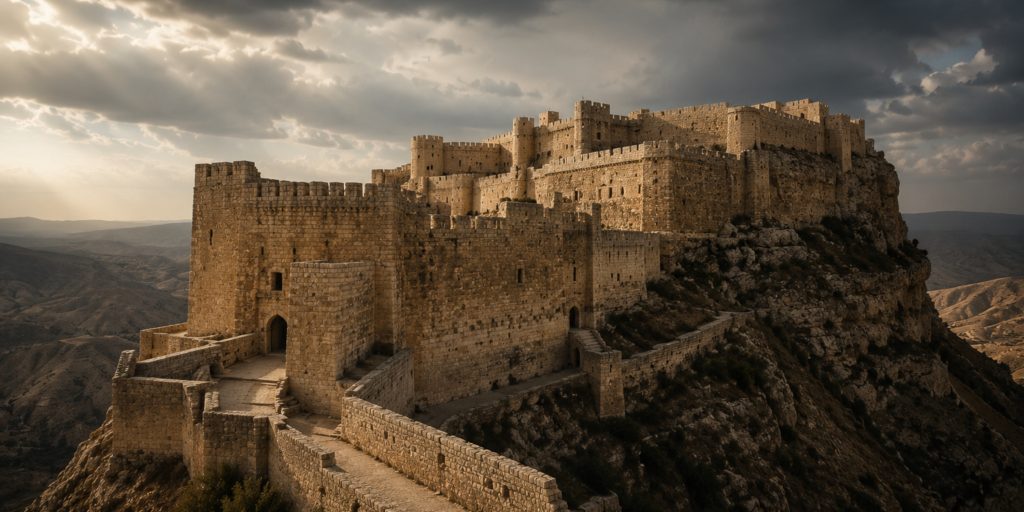
Visitors exploring the Crusader castles of the Middle East today often leave with the impression that the Crusader states resembled an enormous chain of fortresses.
They are not entirely wrong.
Castles formed the backbone of Jerusalem’s defensive strategy.
Rather than attempting to defend every mile of frontier, the kingdom relied upon strategically positioned strongholds controlling roads, mountain passes and water supplies.
Among the most important during Baldwin’s reign were:
Kerak
Perched dramatically above the Dead Sea, Kerak dominated routes linking Syria with Egypt.
Its massive walls and commanding position made it one of the strongest fortresses in the Latin East. Whoever controlled Kerak possessed considerable influence over regional trade and military movement.
It was entrusted to Reynald of Châtillon.
Whether that was an inspired appointment or a spectacular gamble remains open to debate.
Montreal
Built earlier by Baldwin I, Montreal protected southern approaches into Transjordan.
Together with Kerak it formed a defensive pair overlooking vital caravan routes.
Belvoir Castle
Standing high above the Jordan Valley, Belvoir represented one of the finest examples of Crusader military architecture.
Constructed by the Hospitallers, its concentric design anticipated later developments in castle engineering.
Even today its surviving walls provide a striking reminder of Crusader military sophistication.
Chastellet at Jacob’s Ford
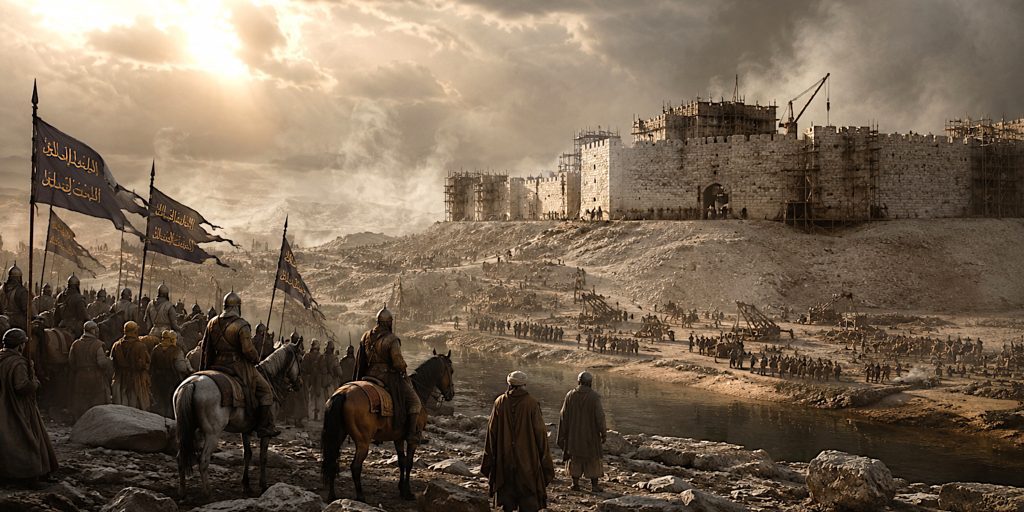
Perhaps the most controversial construction project of Baldwin’s reign.
Located near a crossing of the River Jordan, Chastellet threatened Saladin’s communications between Damascus and the south.
Saladin recognised the danger immediately.
The castle would soon become the focus of one of the most dramatic sieges of the age.
Baldwin’s Health Continues to Decline
While political life remained busy, Baldwin’s physical condition steadily worsened.
Leprosy does not progress in neat stages.
Symptoms vary between individuals, but surviving descriptions suggest Baldwin experienced increasing paralysis, loss of sensation and visual impairment throughout the late 1170s.
William of Tyre observed the changes with evident sadness.
The energetic prince he had taught was gradually disappearing beneath an illness no physician could halt.
Yet Baldwin adapted remarkably well.
When one hand weakened, attendants helped him hold the reins.
When walking became difficult, he relied more frequently upon horses or litters.
When eyesight deteriorated, trusted advisers described documents and battlefield situations in greater detail.
He adjusted rather than surrendered.
As a historian, I think this practical adaptability reveals more about Baldwin than any romantic image of suffering nobility. He rarely appears interested in inspiring sympathy. His surviving actions suggest someone asking a far simpler question.
“What still needs doing?”
It is an attitude that quietly commands respect across eight centuries.
Trouble on the Northern Frontier
Despite the victory at Montgisard, Saladin had not abandoned his ambitions.
Far from it.
Throughout the late 1170s he rebuilt his armies, strengthened alliances and continued consolidating Muslim territories under his leadership.
Unlike many defeated commanders, Saladin learned from failure.
He became increasingly cautious about allowing his forces to become dispersed.
He paid greater attention to intelligence gathering.
Most importantly, he recognised that Baldwin remained the single greatest obstacle preventing complete domination of the Crusader states.
The confrontation between the two rulers was therefore inevitable.
It arrived in 1179.
This time the battlefield would not favour Jerusalem.
Instead, attention shifted to a newly built fortress at Jacob’s Ford, where Baldwin and Saladin would contest one of the most strategically important positions in the Holy Land.
The outcome would reshape the balance of power once again.
The Siege of Jacob’s Ford
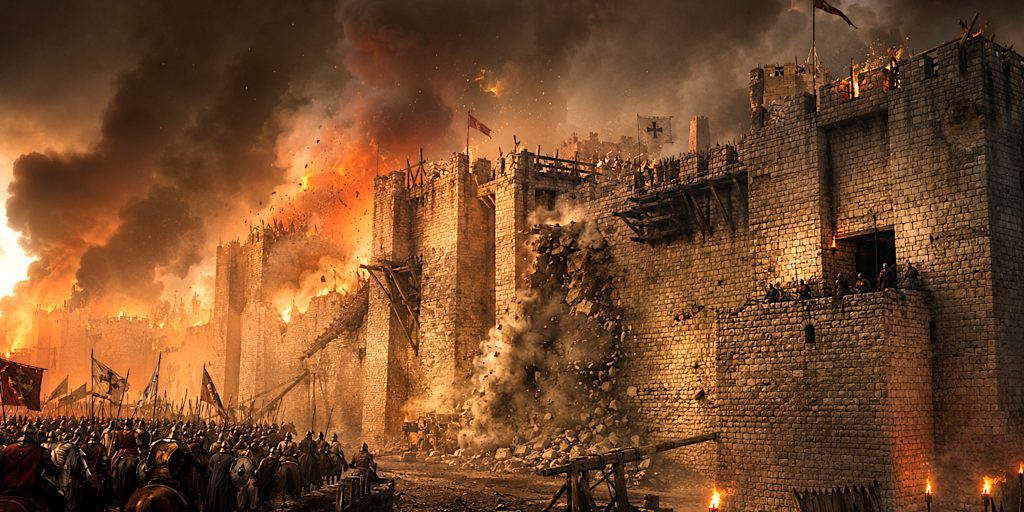
If Montgisard represented Baldwin IV at his boldest, the struggle for Jacob’s Ford revealed him at his most determined.
The fortress itself no longer dominates popular histories in the way that Krak des Chevaliers or Kerak does, yet in the late twelfth century it was arguably one of the most important military projects in the Kingdom of Jerusalem.
Its location made all the difference.
Jacob’s Ford, known in Latin as Chastellet, stood on one of the principal crossings of the River Jordan, roughly forty kilometres north of the Sea of Galilee. Armies moving between Damascus and the Kingdom of Jerusalem frequently passed through the area. Whoever controlled the crossing could monitor troop movements, collect tolls and threaten communications between Syria and Palestine.
Baldwin immediately recognised its strategic value.
So did Saladin.
The king authorised the construction of a substantial new castle on the site in 1178. Work progressed rapidly under the supervision of the Knights Templar, supported by royal funding and labour drawn from across the kingdom.
It was an expensive undertaking.
The investment reflected Baldwin’s long-term thinking.
Unlike some of his contemporaries, he understood that castles could be force multipliers. A strong fortress allowed a relatively small garrison to dominate a much larger area. In a kingdom where manpower remained scarce, that was invaluable.
Saladin regarded the project as intolerable.
Allow the castle to stand, and the Crusaders would possess a permanent base from which to threaten Damascus itself.
It had to be destroyed.
An Offer Baldwin Could Not Accept
Before resorting to force, Saladin attempted diplomacy.
According to several contemporary sources, he offered Baldwin a substantial payment if construction at Jacob’s Ford ceased.
The amount varies between chroniclers.
Some speak of 60,000 gold dinars.
Others suggest even larger sums.
Whatever the precise figure, it represented an enormous fortune.
Baldwin refused.
From a purely financial perspective, accepting the payment might have appeared tempting. The Kingdom of Jerusalem was rarely wealthy enough to ignore such offers.
Strategically, however, abandoning the project would have surrendered one of the kingdom’s strongest advantages.
The refusal also demonstrated something about Baldwin’s character.
He was willing to negotiate.
He was not willing to abandon positions that genuinely strengthened the kingdom.
Modern historians generally agree he made the correct decision.
The castle’s existence posed a genuine threat to Saladin’s plans.
The Sultan’s determination to eliminate it confirms exactly how dangerous he believed it to be.
Saladin Strikes
In August 1179, Saladin assembled a powerful army and marched against Jacob’s Ford.
This time there would be no opportunity for another Montgisard.
The fortress remained unfinished.
Although substantial walls had already been erected, many defensive features were incomplete. Construction materials still lay scattered around the site. Parts of the garrison consisted of labourers rather than experienced soldiers.
The defenders nevertheless prepared to resist.
Inside the walls were approximately:
- Knights Templar
- Royal troops
- Engineers
- Labourers
- Civilian workers
Their total numbers probably reached little more than fifteen hundred.
Outside stood Saladin’s vastly larger army.
The odds were daunting.
Baldwin’s Response
News of the siege reached Baldwin quickly.
Despite worsening health, he immediately attempted to organise a relief force.
Once again, his instinct was to move towards danger rather than away from it.
Unfortunately, circumstances differed dramatically from those at Montgisard.
The kingdom required time to gather troops from scattered garrisons.
Communication across medieval Palestine remained slow.
Saladin understood this perfectly.
Rather than settling into a lengthy siege, he sought to overwhelm the castle before Baldwin could intervene.
Speed became his greatest ally.
For Baldwin, every hour lost reduced the chances of saving the fortress.
The Assault
The siege itself proved remarkably short.
Muslim engineers concentrated their efforts on one vulnerable section of the walls.
Mining operations began almost immediately.
Rather than attempting endless frontal assaults, Saladin’s engineers tunnelled beneath the fortifications, supporting the excavated passages with timber.
When enough material had been removed, the wooden supports were set alight.
As they burned, the tunnel collapsed.
So did part of the castle wall.
The breach allowed Saladin’s troops to storm the fortress.
Fighting inside became brutal.
Contemporary chroniclers describe fierce resistance from the defenders, particularly the Knights Templar, who continued fighting despite overwhelming odds.
Eventually the position became untenable.
The castle fell.
Many defenders were killed during the assault.
Others were taken prisoner.
Several medieval accounts claim the bodies of the dead remained unburied long enough for disease to spread through the victorious army, although the extent of this outbreak remains uncertain.
The newly built fortress that Baldwin had hoped would secure the northern frontier survived for little more than a year.
Archaeology at Jacob’s Ford
Few Crusader battlefields have benefited from archaeological investigation as thoroughly as Jacob’s Ford.
Excavations led by Professor Ronnie Ellenblum during the late twentieth century transformed scholarly understanding of the siege.
The discoveries were remarkable.
Archaeologists uncovered:
- Sections of the unfinished curtain wall.
- The remains of Saladin’s mining tunnel.
- Burnt timber supports used during the assault.
- Arrowheads from both armies.
- Crossbow bolts.
- Fragments of weapons and armour.
- Human remains associated with the fighting.
These finds allowed researchers to reconstruct the siege with unusual precision.
One of the most striking discoveries involved the collapsed section of wall.
Evidence strongly supported the medieval accounts describing mining operations beneath the foundations. Burnt wooden beams and collapsed masonry matched the written descriptions with impressive accuracy.
As historians, we rarely receive such satisfying confirmation.
Usually archaeology complicates written sources rather than reinforcing them.
At Jacob’s Ford, the two complement one another beautifully.
It reminds us that chronicles, despite their biases, often preserve remarkably accurate descriptions when read carefully.
The Battle of Marj Ayyun
Jacob’s Ford was not Baldwin’s only setback in 1179.
Earlier that year he had already experienced defeat at the Battle of Marj Ayyun, fought near the Litani River in southern Lebanon.
Initially, the campaign appeared promising.
Crusader forces intercepted Muslim troops operating near Sidon.
Early success encouraged aggressive pursuit.
Unfortunately, Saladin arrived with substantial reinforcements.
The situation changed rapidly.
The Crusader army found itself heavily outnumbered and gradually forced into retreat.
Several important nobles were captured.
The Grand Master of the Knights Templar, Odo of St Amand, fell into Muslim hands and later died in captivity after refusing conversion.
Baldwin himself narrowly escaped.
The defeat demonstrated something important.
Montgisard had not fundamentally altered the military balance.
When Saladin possessed time to prepare and concentrate his forces, he remained an exceptionally dangerous opponent.
Learning from Defeat
One of Baldwin’s most admirable qualities was his refusal to allow setbacks to define his reign.
Many rulers respond to defeat by becoming reckless.
Others lose confidence entirely.
Baldwin did neither.
Instead, he adapted.
The loss of Jacob’s Ford convinced him that Jerusalem could no longer rely solely upon isolated fortifications to contain Saladin.
The Sultan’s growing resources allowed him to reduce even impressive castles if sufficient determination and manpower were applied.
This did not make castles obsolete.
Far from it.
Rather, Baldwin increasingly recognised that fortifications, diplomacy and field armies had to operate together.
No single element could preserve the kingdom on its own.
It was an increasingly sophisticated understanding of warfare.
Unfortunately, time was working against him.
Every year Saladin grew stronger.
Every year Baldwin became weaker.
The King’s Illness Advances
By the beginning of the 1180s, Baldwin’s leprosy had reached an advanced stage.
Contemporary accounts suggest he had begun losing the effective use of both hands.
His eyesight also deteriorated significantly.
Some sources indicate that he experienced periods of near blindness long before the end of his reign.
Simple tasks became major challenges.
Holding a sword.
Writing documents.
Mounting a horse.
Recognising faces across a crowded hall.
All required assistance.
Yet Baldwin refused to disappear from public life.
Visitors to court continued meeting the king.
Royal charters continued to bear his authority.
Military councils continued to seek his judgement.
Increasingly, however, trusted advisers carried out practical duties on his behalf.
The distinction mattered.
Baldwin remained king.
Others merely enabled him to continue acting as one.
His determination impressed even those who disagreed with his policies.
William of Tyre wrote with obvious admiration about the patience and dignity with which Baldwin endured his illness.
Modern medicine can explain the disease.
It cannot fully explain the resilience.
A New Problem Emerges
As Baldwin’s physical condition deteriorated, one question began dominating political discussion within Jerusalem.
Who would succeed him?
The king had no prospect of marriage or children.
Every noble understood that the succession would shape the future of the kingdom.
Unfortunately, agreement proved elusive.
The debate centred upon Baldwin’s elder sister, Sibylla.
Whoever married her would almost certainly become the next King of Jerusalem.
It was a decision with enormous consequences.
Among the candidates stood a Poitevin nobleman whose rise would divide the kingdom more than any foreign invasion.
His name was Guy of Lusignan.
His arrival at court would trigger one of the most bitter political struggles of Baldwin’s reign.
The Succession Crisis Begins
By the early 1180s, Baldwin IV faced a problem that no military victory could solve.
He was dying.
Leprosy had progressed beyond the point where recovery could even be imagined. The disease continued its slow assault on his nervous system, reducing his mobility and leaving him increasingly dependent upon attendants. Although his mind remained sharp, there could be little doubt that his reign would end sooner rather than later.
That reality transformed succession from an abstract political discussion into the defining issue of government.
Unlike many medieval kings, Baldwin could not simply produce an heir.
The future of the Kingdom of Jerusalem rested almost entirely upon his sister, Sibylla.
Whoever married her would almost certainly become the kingdom’s next ruler.
The stakes could hardly have been higher.
If the wrong man gained the throne, years of Baldwin’s careful diplomacy and military leadership might unravel in a matter of months.
As it turned out, that was precisely what worried the king.
Sibylla of Jerusalem

Sibylla was several years older than Baldwin and, after her brother, possessed the strongest hereditary claim to the throne.
She has often been portrayed rather unfairly by both medieval chroniclers and modern popular culture.
Some writers reduced her to little more than a romantic figure whose personal choices doomed the kingdom. Others dismissed her as politically naïve.
Neither description does her justice.
Like many royal women of the Middle Ages, Sibylla operated within severe constraints.
Marriage was rarely a personal matter.
It was diplomacy.
Every prospective husband brought allies, enemies and political consequences.
Her first marriage had been to William of Montferrat, an experienced nobleman from northern Italy whose family enjoyed considerable prestige across Europe.
The marriage appeared promising.
Unfortunately, William died only months later, probably from illness.
His death left Sibylla widowed while pregnant.
Her son, Baldwin V, would later become central to the succession crisis.
For the moment, however, Jerusalem once again searched for a suitable husband for its future queen.
Finding one proved unexpectedly difficult.
The Arrival of Guy of Lusignan
Into this uncertain political landscape stepped Guy of Lusignan.
Guy belonged to the Lusignan family of Poitou in western France. Although respectable nobles, the Lusignans were hardly among Europe’s greatest dynasties. Guy himself possessed little independent wealth or political influence when he arrived in the Holy Land.
His fortunes changed rapidly.
Supported by influential relatives and welcomed by members of Baldwin’s court, Guy soon attracted attention as a possible husband for Sibylla.
The marriage took place in 1180.
Almost immediately, Guy became one of the most powerful men in the Kingdom of Jerusalem.
Not everyone celebrated.
Raymond III of Tripoli viewed the match with suspicion.
So did William of Tyre.
Several leading nobles questioned whether Guy possessed either the experience or judgement required to govern such a fragile kingdom.
Their concerns were not rooted in personal dislike alone.
Guy had little experience of the Levant.
He barely understood the kingdom’s unique political landscape.
More importantly, he had not yet demonstrated the qualities expected of a Crusader king.
Baldwin initially appeared willing to give his new brother-in-law an opportunity.
That confidence would not last.
Baldwin’s Changing View of Guy
Historians continue debating precisely when Baldwin lost faith in Guy of Lusignan.
What is clear is that the king’s opinion changed dramatically over time.
At first, Baldwin treated Guy as his likely successor.
He granted him important responsibilities and gradually introduced him into the highest levels of government.
This made perfect sense.
If Guy were eventually to inherit the throne, experience would only strengthen his position.
Then came the test.
In 1182, Saladin launched another major campaign against the Kingdom of Jerusalem.
Baldwin’s illness had advanced to the point where he could no longer personally lead every military expedition.
Responsibility increasingly fell upon Guy.
The results disappointed the king.
Several opportunities to confront Saladin passed without decisive action. Guy appeared hesitant, unwilling either to commit fully to battle or to pursue more aggressive strategies.
Caution itself was not necessarily a weakness.
Raymond III frequently advocated caution.
The difference lay in judgement.
Raymond’s restraint usually reflected careful calculation.
Guy’s behaviour struck many contemporaries as uncertainty.
Baldwin watched closely.
The more he observed, the less convinced he became that Guy possessed the leadership qualities needed to preserve Jerusalem after his death.
The Campaign of 1182
Saladin’s offensive during 1182 demonstrated how dramatically the strategic balance had shifted since Montgisard.
The Sultan now commanded armies drawn from an increasingly unified realm.
His logistics had improved.
His intelligence network had expanded.
His commanders operated with greater coordination.
Jerusalem remained capable of resisting, but the margin for error grew smaller every year.
Guy assembled the kingdom’s army to oppose the invasion.
Both sides manoeuvred carefully.
Neither commander wished to risk unnecessary losses.
Eventually the campaign concluded without a decisive engagement.
From a purely military perspective, Guy had avoided disaster.
Politically, however, his performance left Baldwin dissatisfied.
The king expected stronger leadership.
He wanted someone capable of making difficult decisions under pressure.
Instead, Guy appeared indecisive.
For Baldwin, whose own life had become a constant lesson in difficult choices, hesitation may have been the greatest weakness of all.
Baldwin Removes Guy from Power
The turning point came in 1183.
By now Baldwin’s condition had deteriorated significantly.
He could no longer ride independently and often had to be carried in a litter during military campaigns.
Despite these limitations, he retained full authority as king.
One of his boldest political decisions followed.
Rather than allowing Guy’s influence to continue growing unchecked, Baldwin effectively stripped him of authority.
It was an extraordinary move.
Few medieval monarchs publicly distanced themselves from their designated successors so dramatically.
Yet Baldwin believed the kingdom’s survival depended upon it.
William of Tyre strongly supports this interpretation.
He portrays Baldwin as increasingly frustrated by Guy’s inability to inspire confidence among the nobility or respond decisively to military threats.
Modern historians generally agree.
Bernard Hamilton argues that Baldwin recognised Guy’s limitations well before most of his contemporaries.
Jonathan Phillips similarly suggests that the king displayed considerable political courage by attempting to prevent an unsuitable successor from inheriting effective power.
It was not an easy decision.
Guy remained married to Sibylla.
Removing him risked dividing the kingdom into competing factions.
Allowing him to continue unchecked, however, appeared even more dangerous.
Baldwin chose the lesser of two risks.
The Siege of Kerak
While Jerusalem wrestled with political uncertainty, Saladin continued applying military pressure.
One of the most dramatic episodes occurred at Kerak in late 1183.
The great castle stood upon a rocky plateau overlooking the routes connecting Egypt and Syria.
Its commander remained the unpredictable Reynald of Châtillon.
During the siege, an extraordinary coincidence unfolded.
Inside the castle, celebrations were taking place for the wedding of Humphrey of Toron and Isabella of Jerusalem, Baldwin’s younger half-sister.
Outside, Saladin’s army prepared its assault.
According to later tradition, Saladin instructed his engineers not to bombard the specific tower where the wedding celebrations were taking place after being informed of the ceremony by Humphrey’s mother, whom he had once known.
Whether every detail of this story is accurate remains uncertain.
It has nevertheless endured because it reflects the complex relationship between warfare and chivalry during the period.
Meanwhile, Baldwin refused to abandon Kerak.
Despite advanced illness, he organised a relief expedition.
Unable to fight as he once had, the king travelled with the army while commanders directed tactical operations under his authority.
The mere approach of the royal host forced Saladin to lift the siege.
Kerak survived.
Once again, Baldwin had preserved one of the kingdom’s most important fortresses.
A King Who Refused to Retreat
By now Baldwin could scarcely perform many of the physical tasks expected of a medieval ruler.
He struggled to walk.
His eyesight continued failing.
He relied heavily upon attendants.
Yet he still insisted upon accompanying armies into the field.
It is difficult to overstate how unusual this was.
Many rulers in excellent health delegated military command.
Baldwin, despite profound disability, refused to disappear behind palace walls.
His presence carried symbolic weight.
Knights seeing their king endure immense physical hardship found it difficult to complain about their own discomfort.
There is a tendency in modern discussions to focus exclusively upon Baldwin’s illness.
His contemporaries noticed something else.
His persistence.
Again and again, William of Tyre returns to the same theme.
The disease weakened Baldwin’s body.
It never conquered his determination.
Looking Beyond Himself
As 1183 drew to a close, Baldwin understood that time was running out.
His own reign could not last much longer.
The question therefore became urgent.
If Guy of Lusignan could not safely inherit the kingdom, who could?
The answer Baldwin eventually reached was remarkably imaginative.
Rather than choosing between rival adult claimants, he turned to a child.
His young nephew, Baldwin V, would soon become king while experienced nobles governed in his name.
It was not a perfect solution.
Indeed, it carried enormous risks.
But for a dying monarch trying desperately to preserve the Kingdom of Jerusalem, it may have been the only realistic option still available.
Baldwin V and the Search for Stability
By 1184, Baldwin IV had accepted what those closest to him had known for some time.
He would not live long enough to secure the kingdom through his own rule.
His attention therefore shifted almost entirely towards ensuring that Jerusalem survived after his death.
This required setting aside personal pride.
Many monarchs throughout history have clung desperately to power, refusing to acknowledge failing health until events overtook them. Baldwin chose a different path.
He planned for a future he knew he would never see.
The centrepiece of that plan was his nephew, Baldwin V.
The young prince was the son of Sibylla and her first husband, William of Montferrat. Although only a child, he possessed an unquestionable hereditary claim to the throne through both his mother and the royal bloodline of Jerusalem.
Crucially, he also offered Baldwin a way of preventing Guy of Lusignan from immediately becoming king.
If Baldwin V inherited first, the kingdom could be governed by experienced regents until the boy reached adulthood.
It was not an ideal solution.
It was, however, the least dangerous one available.
Crowning a Child King
In one of the most remarkable constitutional decisions of the Crusader Kingdom, Baldwin IV arranged for Baldwin V to be crowned during his own lifetime.
The ceremony took place in 1183.
Co-coronations were not unprecedented in medieval Europe. Kings in France and elsewhere occasionally crowned their heirs while still alive in order to secure an uncontested succession.
Baldwin adapted the idea to Jerusalem’s unique circumstances.
The symbolism was unmistakable.
The kingdom now possessed a recognised successor.
Equally important was the message sent to Guy of Lusignan.
The crown would not automatically pass to him simply because he had married Sibylla.
Instead, authority rested with the young Baldwin V.
Guy’s political future suddenly appeared much less certain.
It was a bold move.
Modern historians generally regard the co-coronation as one of Baldwin IV’s most intelligent political decisions. Bernard Hamilton argues that it represented a determined effort to preserve stability by removing uncertainty over the succession.
Whether it could succeed in practice remained another question.
Children made vulnerable monarchs.
Power inevitably flowed towards those acting in their name.
Baldwin understood this perfectly.
That was why choosing trustworthy regents mattered just as much as selecting the king himself.
The High Court and the Future of Jerusalem
The succession arrangements did not rely upon Baldwin IV’s wishes alone.
The Haute Cour, or High Court of Jerusalem, played an essential role.
Unlike many western monarchies, where succession increasingly followed strict hereditary principles, the Kingdom of Jerusalem retained important elements of aristocratic consent.
The leading nobles expected to participate in decisions affecting the crown.
That system could be frustrating.
It could also provide flexibility during crises.
Baldwin worked carefully with the High Court to create a succession that balanced hereditary legitimacy with political practicality.
Should Baldwin V die before reaching adulthood, the ultimate decision regarding the crown would not rest with any single noble family.
Instead, respected rulers from outside the kingdom, including the Pope, the Holy Roman Emperor and the Kings of England and France, were expected to help resolve competing claims.
The proposal was extraordinary.
Rather than allowing Jerusalem to descend immediately into civil war, Baldwin attempted to place the final decision in the hands of Europe’s most powerful Christian rulers.
Whether they would ever have agreed in practice is another matter entirely.
Still, the proposal demonstrates the king’s willingness to think beyond traditional solutions.
He recognised that preserving peace mattered more than defending personal ambition.
Baldwin’s Court
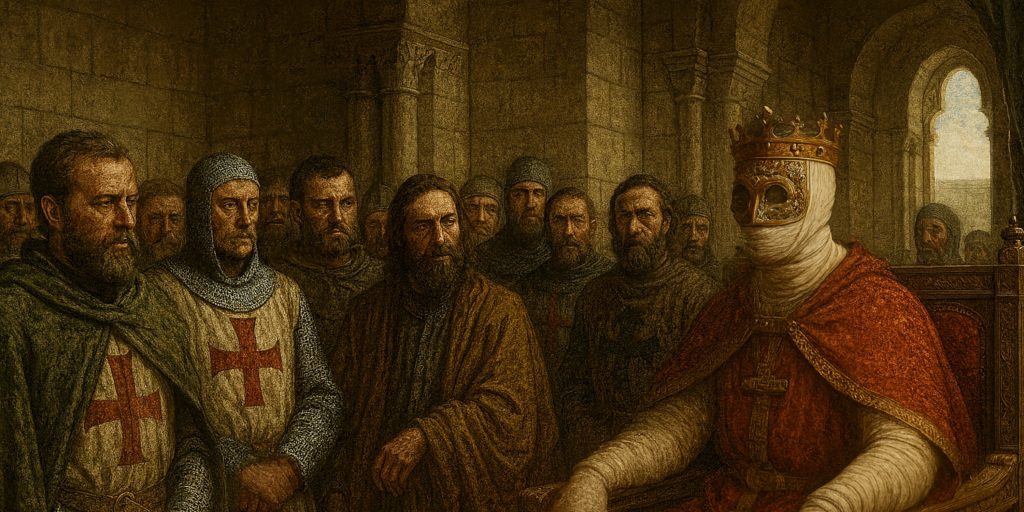
Although his health deteriorated steadily, Baldwin continued holding court whenever possible.
Visitors described a ruler whose physical decline contrasted sharply with the sharpness of his mind.
By this stage, leprosy had profoundly altered his appearance.
Contemporary descriptions suggest that blindness had advanced considerably.
His hands had become severely weakened.
Walking required assistance.
At times he had to be carried.
Yet foreign ambassadors still sought audiences with him.
Legal disputes still came before him.
Royal charters continued to be issued in his name.
The image is surprisingly moving.
One can picture experienced barons entering the royal chamber expecting to see only illness, only to encounter a king whose judgement remained entirely intact.
William of Tyre repeatedly stresses that Baldwin’s intellect never diminished.
If anything, the hardships he endured appear to have strengthened his resolve.
There is a tendency to imagine medieval rulers as distant figures issuing commands from magnificent thrones.
Baldwin’s reality was rather different.
Every day required determination before government could even begin.
Saladin’s Empire Grows Stronger
While Baldwin focused upon internal stability, Saladin continued building one of the most formidable Muslim states of the medieval world.
By the mid-1180s, he controlled:
- Egypt
- Damascus
- Aleppo
- Mosul through varying degrees of influence
- Much of Syria
- Large parts of northern Mesopotamia
The political fragmentation that had protected the Crusader states during previous generations was disappearing.
Saladin now possessed something no earlier Muslim ruler had enjoyed.
Strategic depth.
If one army suffered defeat, another could be raised.
If one city lost supplies, resources could arrive from elsewhere within the empire.
Jerusalem enjoyed no comparable advantage.
The kingdom’s manpower remained limited.
Every experienced knight lost in battle represented an irreplaceable asset.
This imbalance explains why Baldwin often appeared cautious.
Some later historians criticised him for failing to launch more ambitious offensives.
Such criticism overlooks the reality of his position.
A reckless victory might still leave Jerusalem too weakened to survive the following campaign.
Caution was not cowardice.
It was mathematics.
Diplomacy Before War
One aspect of Baldwin’s reign often overlooked by popular histories is his reliance upon diplomacy.
Contrary to modern stereotypes, Crusader kings did not spend every year fighting.
Periods of truce were common.
Negotiations occurred regularly.
Prisoners were exchanged.
Trade frequently continued despite ongoing political hostility.
Baldwin appreciated the value of these arrangements.
Temporary peace allowed crops to be harvested.
Merchants travelled more safely.
Castles could be repaired.
Treasuries recovered.
Even Saladin recognised the practical advantages of occasional truces.
Neither ruler could maintain constant campaigning indefinitely.
This pragmatic approach sometimes frustrated more militant nobles, particularly Reynald of Châtillon.
Reynald viewed truces as temporary inconveniences.
Baldwin saw them as valuable breathing space.
The difference reflected their respective responsibilities.
Reynald defended one frontier.
Baldwin carried the burden of preserving an entire kingdom.
The Problem of Reynald
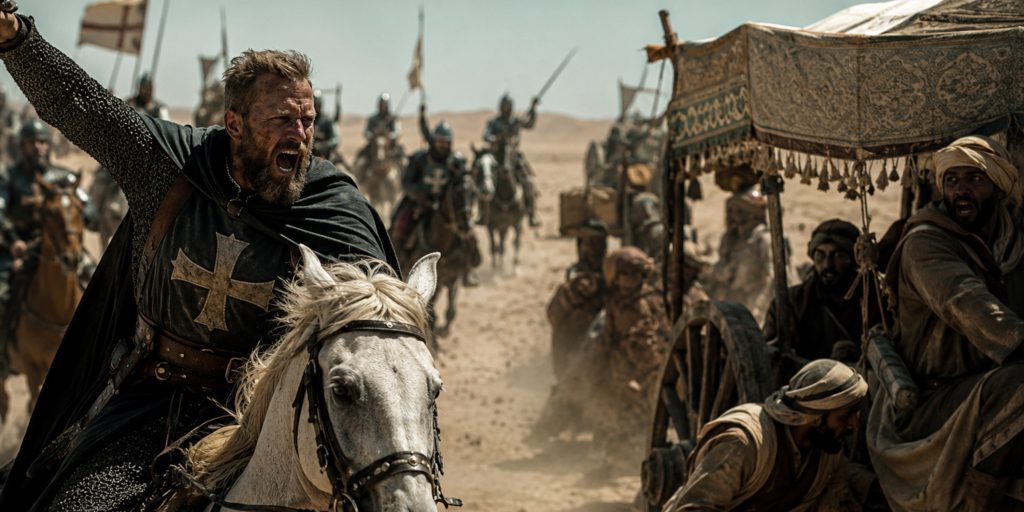
No matter how carefully Baldwin pursued diplomacy, Reynald of Châtillon possessed an extraordinary ability to complicate matters.
From his fortress at Kerak, Reynald repeatedly attacked Muslim caravans travelling between Egypt and Syria.
Some of these raids violated existing truces.
Others targeted merchants who believed they enjoyed safe passage.
Perhaps most provocative of all, Reynald continued threatening routes associated with the annual pilgrimage to Mecca.
Saladin regarded these actions as intolerable.
He demanded compensation.
He demanded punishment.
Neither arrived.
Historians remain divided over Baldwin’s ability to restrain Reynald.
Some argue the king simply lacked sufficient political authority.
Others believe Baldwin privately approved of at least some of the raids while publicly maintaining plausible deniability.
The surviving evidence refuses to provide a simple answer.
Personally, I suspect Baldwin recognised Reynald as both an asset and a liability.
His courage was unquestionable.
His judgement was considerably less dependable.
Unfortunately, frontier kingdoms rarely enjoy the luxury of choosing only convenient allies.
Baldwin’s Final Public Appearances
By 1185, Baldwin’s condition had become critical.
Contemporary accounts describe a king who was almost completely blind.
Movement required extensive assistance.
The disease had ravaged his limbs.
Military command in the traditional sense had become impossible.
Even so, Baldwin refused to disappear entirely.
He continued participating in government whenever circumstances allowed.
The symbolism remained important.
The kingdom still had a king.
His authority still mattered.
His decisions still carried legal force.
William of Tyre’s admiration becomes particularly evident when describing these final months.
There is little sentimentality in his writing.
Instead, he records the quiet endurance of a man determined to fulfil his responsibilities until he physically could not continue.
It is difficult not to find that admirable.
Not because Baldwin suffered.
Many people throughout history have suffered.
Rather because he continued governing despite suffering.
That distinction feels important.
The Final Months
As spring approached in 1185, those closest to Baldwin knew the end was near.
Attention increasingly shifted towards implementing the carefully prepared succession arrangements.
Young Baldwin V stood ready to inherit.
The kingdom hoped that experienced regents could preserve stability until the boy reached adulthood.
It was a fragile plan.
Its success depended upon cooperation among ambitious nobles whose patience had never been unlimited.
Baldwin had spent more than a decade holding those competing interests together through force of personality and political judgement.
Soon that stabilising influence would disappear.
Within weeks, the Kingdom of Jerusalem would lose one of its most capable rulers.
The consequences would echo across the medieval world.
The Death of Baldwin IV
Baldwin IV died in Jerusalem during the spring of 1185, probably on 16 March, although medieval sources differ slightly regarding the exact date.
He was approximately twenty-four years old.
For a modern reader, that is an age at which many people are only beginning adult life. Baldwin had already spent more than a decade governing one of the most contested kingdoms in the medieval world, fighting repeated campaigns, navigating bitter political rivalries and enduring an illness that would have forced many others into complete isolation.
His death was not unexpected.
Those closest to him had watched his health decline for years. Blindness, paralysis and severe weakness had gradually confined him, yet his authority had endured almost until the end.
The chroniclers who recorded his passing wrote with genuine sadness.
William of Tyre, whose history unfortunately breaks off before Baldwin’s death, had already made clear the affection and admiration he held for his former pupil. Later writers, including Ernoul and the anonymous author of the Chronicle of Ernoul, portray a kingdom mourning not only its king but also the loss of its greatest source of stability.
Baldwin was buried in Jerusalem, almost certainly within the Church of the Holy Sepulchre alongside other kings of the Latin Kingdom.
Sadly, no identifiable tomb survives today.
The upheavals of subsequent centuries, repeated rebuilding and changing control of Jerusalem mean that the exact location of his remains has been lost.
There is something strangely fitting about that.
One of the kingdom’s greatest rulers survives not through monuments but through the record of what he achieved.
Baldwin V and the Collapse of the Succession Plan
Following Baldwin IV’s death, his carefully constructed succession came into effect.
His nephew, Baldwin V, became king under the regency of Raymond III of Tripoli.
The arrangement immediately encountered difficulties.
The new king was only around eight years old.
Every powerful noble understood that whoever controlled the child effectively controlled the kingdom.
Initially, the transition remained peaceful.
Raymond governed cautiously and attempted to preserve the political balance Baldwin IV had spent years maintaining.
Unfortunately, fate intervened once again.
In the summer of 1186, Baldwin V died at Acre.
His exact cause of death remains unknown.
Some medieval writers hinted at poisoning, though there is no convincing evidence to support such claims. Most historians believe illness is the far more likely explanation.
His death destroyed Baldwin IV’s succession strategy.
The kingdom once again faced the question the Leper King had worked so hard to postpone.
Who should rule Jerusalem?
Guy of Lusignan Becomes King
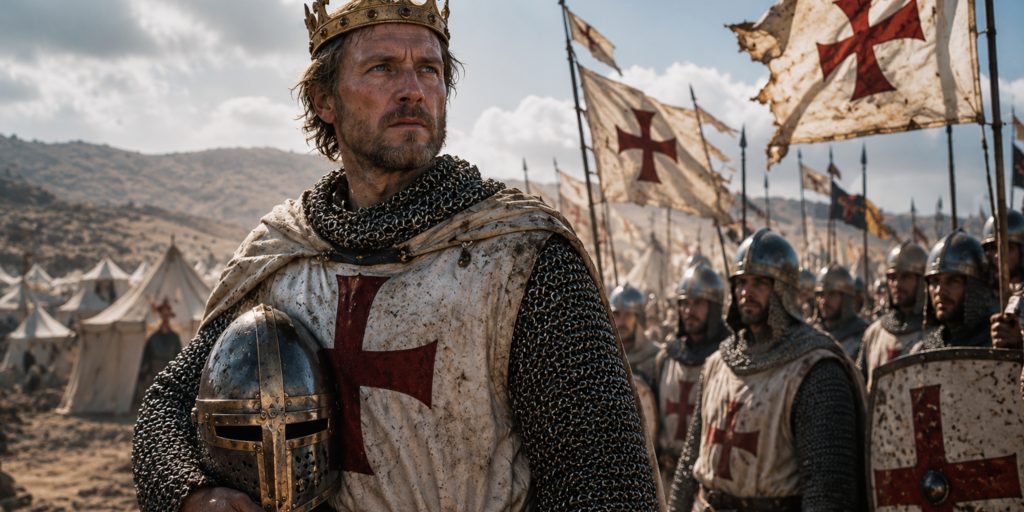
Events moved quickly.
Sibylla travelled to Jerusalem, where supporters secured control of the city before rival factions could react.
In a carefully choreographed ceremony, Sibylla was crowned queen.
She then surprised many observers.
After publicly agreeing that she would choose a new husband if crowned, she instead placed the crown upon the head of Guy of Lusignan.
Guy was now King of Jerusalem.
Raymond III and several leading nobles refused to recognise him immediately.
The political divisions Baldwin IV had spent years containing now burst into the open.
Historians continue debating whether Guy deserves the harsh reputation he acquired after the fall of Jerusalem.
He was certainly placed in an extraordinarily difficult position.
He inherited a kingdom facing the strongest Muslim ruler of the age, divided aristocrats and growing financial pressure.
Even so, comparisons with Baldwin IV are unavoidable.
Where Baldwin had united competing factions through personal authority, Guy struggled to command universal confidence.
Where Baldwin generally balanced caution with calculated aggression, Guy increasingly found himself reacting to events rather than shaping them.
The difference would become painfully clear in 1187.
Hattin and the Loss of Jerusalem
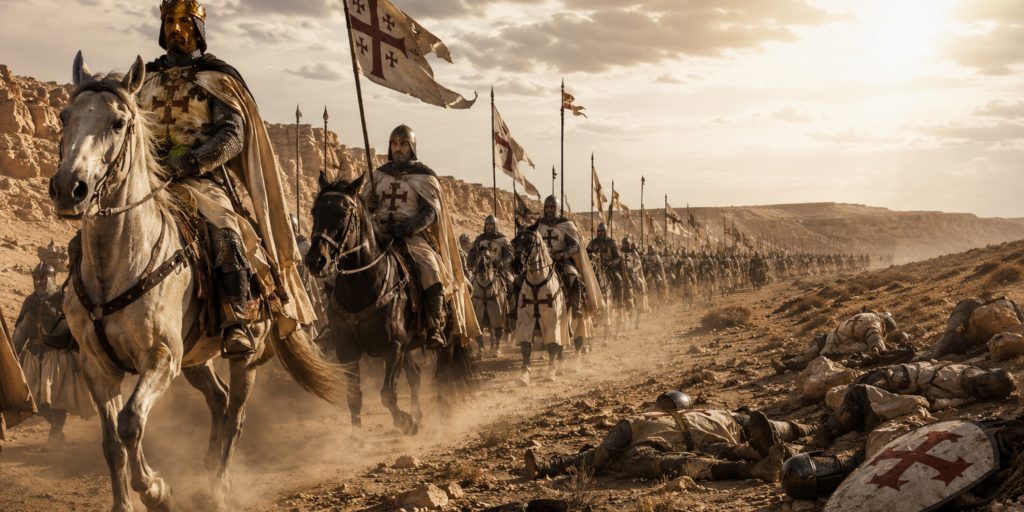
The final act of Baldwin IV’s story unfolded after his death.
In 1187, Reynald of Châtillon once again attacked Muslim caravans despite existing truces.
For Saladin, patience had finally run out.
He assembled perhaps the largest army yet seen in the region and invaded the Kingdom of Jerusalem.
Guy of Lusignan gathered the full strength of the kingdom.
The resulting campaign culminated at the Battle of Hattin on 4 July 1187.
Unlike Montgisard, almost everything favoured Saladin.
The Crusader army marched across dry ground under intense summer heat.
Water became desperately scarce.
Saladin’s cavalry continually harassed the exhausted Christian forces.
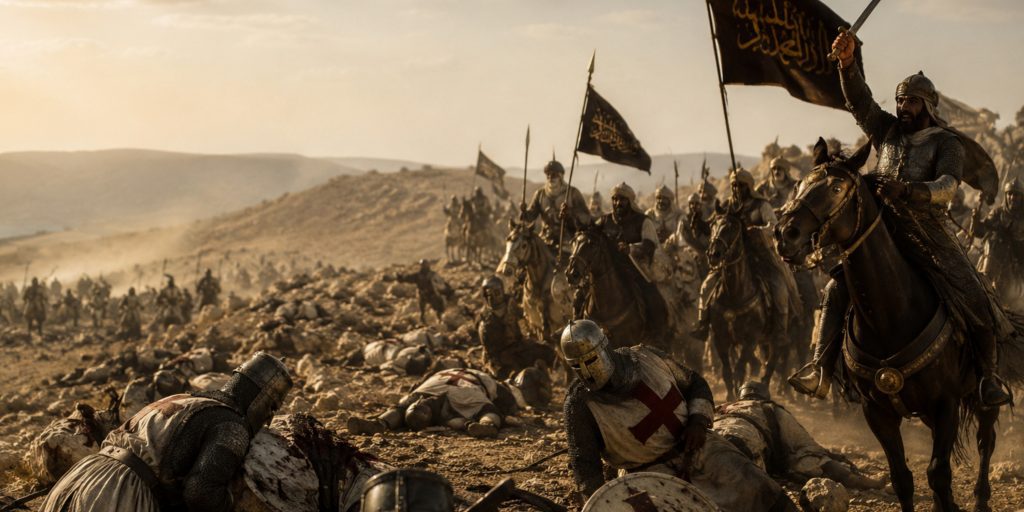
When battle finally began, the Crusader army was already near collapse.
The defeat proved catastrophic.
The True Cross was captured.
Most of the kingdom’s leading nobles became prisoners.
Reynald of Châtillon was executed personally by Saladin.
Guy of Lusignan entered captivity.
Within months, Jerusalem itself surrendered.
The city Baldwin IV had defended throughout his reign fell on 2 October 1187.
It is impossible not to wonder whether events might have unfolded differently had Baldwin lived another decade.
Historians must be careful with such speculation.
We cannot know.
What we can observe is that the kingdom survived throughout Baldwin’s reign despite enormous pressure.
It collapsed only two years after his death.
That timing speaks volumes.
Baldwin IV as a Military Commander
Modern scholarship has become increasingly appreciative of Baldwin’s military ability.
Earlier historians often viewed him primarily through the lens of his illness.
Recent work places greater emphasis upon his strategic judgement.
His strengths included:
- Excellent understanding of the kingdom’s military limitations.
- Effective use of heavy cavalry at decisive moments.
- Strong appreciation of castles as strategic assets.
- Careful coordination with the military orders.
- Willingness to delegate when circumstances required.
He also displayed political realism.
Unlike some Crusader leaders who pursued dramatic offensives deep into enemy territory, Baldwin generally sought to preserve the kingdom rather than expand it.
That distinction mattered.
He recognised that Jerusalem lacked the manpower for prolonged campaigns of conquest.
Survival represented success.
Not every king possesses the discipline to accept such limits.
Arms and Armour
Like every Frankish monarch of the twelfth century, Baldwin would have worn equipment reflecting the latest developments in western European warfare, adapted to the conditions of the Levant.
Personal Arms
Although no surviving weapon can be confidently attributed to Baldwin himself, contemporary evidence allows a good reconstruction of the equipment he almost certainly used during the earlier years of his reign.
His primary weapon would have been a straight, double-edged knightly sword.
Examples from the period correspond closely with Oakeshott Types X, XI and the emerging Type XII.
These swords measured roughly 90 to 100 centimetres in blade length and balanced effective cutting with increasingly capable thrusting performance.
Mounted combat remained their principal role.
The lance remained the decisive battlefield weapon.
A disciplined charge by heavily armoured knights could shatter infantry formations and disrupt opposing cavalry before prolonged sword fighting even began.
As Baldwin’s illness progressed, handling both lance and sword would have become increasingly difficult.
Loss of sensation in the hands reduced grip strength and made precise control harder to maintain.
By the final years of his reign, he almost certainly relied more upon trusted commanders than personal combat.
Armour
Typical royal equipment included:
- Riveted mail hauberk reaching to the knees.
- Long mail chausses protecting the legs.
- Mail coif covering head and neck.
- Padded gambeson beneath the armour.
- Nasal helmet, with early enclosed great helms beginning to appear.
- Large kite shield bearing the Cross of Jerusalem.
- Leather sword belt and scabbard.
- Spurs signifying knightly rank.
Contrary to popular films, plate armour did not yet exist in the form familiar from the fourteenth and fifteenth centuries.
Mail remained the dominant protection.
Despite its considerable weight, a well-fitted mail hauberk distributed that weight surprisingly effectively.
Archaeology and Material Evidence
Unlike many medieval rulers, Baldwin left behind very few objects directly associated with his life.
This is hardly unusual.
Most surviving archaeological evidence relates instead to the wider world in which he lived.
Important sites include:
Jacob’s Ford
Excavations directed by Ronnie Ellenblum uncovered collapsed walls, mining tunnels, arrowheads, crossbow bolts and human remains matching the siege described in contemporary chronicles.
Belvoir Castle
The remarkably well-preserved Hospitaller fortress provides one of the clearest surviving examples of Crusader military architecture from Baldwin’s reign.
Kerak Castle
Modern archaeological work continues revealing details of one of the kingdom’s greatest frontier fortresses, including defensive improvements associated with the later twelfth century.
Jerusalem
Excavations around the Tower of David, the Church of the Holy Sepulchre and the Muristan district continue expanding our understanding of daily life within Baldwin’s capital.
Archaeology rarely uncovers famous individuals directly.
Instead, it reveals the society they governed.
In Baldwin’s case, that society appears increasingly sophisticated, commercially active and remarkably multicultural.
Contemporary Sources
Our understanding of Baldwin IV rests upon several outstanding medieval writers.
William of Tyre
The most important source.
Tutor to Baldwin, Archbishop of Tyre and one of the finest historians of the twelfth century.
Although naturally sympathetic towards his former pupil, William generally demonstrates careful judgement and impressive attention to detail.
Ernoul
A valuable continuation covering the later years of the kingdom.
Although written from a different political perspective, it provides important information unavailable elsewhere.
Ibn al-Athir
Writing from the Muslim world, Ibn al-Athir offers an alternative perspective on Saladin’s campaigns and the Crusader states.
Baha ad-Din ibn Shaddad
Although writing primarily about Saladin, his work illuminates the wider political and military environment surrounding Baldwin’s reign.
Comparing Latin and Muslim sources allows historians to separate probable fact from political bias.
Fortunately, they often agree on the broad outline of events, even while disagreeing about motives and responsibility.
Baldwin IV in Modern Scholarship
Historians have reassessed Baldwin considerably during the past century.
Steven Runciman admired his courage but sometimes portrayed him as a tragic figure overwhelmed by circumstances.
Bernard Hamilton’s The Leper King and His Heirs fundamentally reshaped modern understanding by emphasising Baldwin’s political intelligence and administrative competence.
Thomas Asbridge and Jonathan Phillips likewise argue that Baldwin deserves recognition as one of the most capable rulers produced by the Crusader Kingdom.
This reassessment feels entirely justified.
His achievements become more impressive the more closely one studies the evidence.
Timeline
| Year | Event |
|---|---|
| 1161 | Baldwin IV is born in Jerusalem. |
| 1174 | Death of Amalric I. Baldwin becomes King of Jerusalem. |
| 1174 | Raymond III serves as regent. |
| 1177 | Baldwin defeats Saladin at the Battle of Montgisard. |
| 1179 | Defeat at Marj Ayyun and loss of Jacob’s Ford. |
| 1180 | Sibylla marries Guy of Lusignan. |
| 1183 | Baldwin V crowned as co-king. Siege of Kerak relieved. |
| 1185 | Baldwin IV dies aged about twenty-four. Baldwin V succeeds him. |
| 1186 | Baldwin V dies. Guy of Lusignan becomes king. |
| 1187 | Battle of Hattin and fall of Jerusalem to Saladin. |
Frequently Asked Questions
Who was Baldwin IV?
Baldwin IV was King of Jerusalem from 1174 to 1185. He is remembered as the Leper King because he ruled while suffering from Hansen’s disease.
How did Baldwin IV get leprosy?
The exact source is unknown. Hansen’s disease spreads through prolonged close contact, and there is no evidence regarding when or where Baldwin contracted it.
Did Baldwin IV really fight Saladin?
Yes. He directed several campaigns against Saladin and achieved his greatest victory at the Battle of Montgisard in 1177.
Did Baldwin IV wear a silver mask?
No contemporary source mentions a silver mask. The idea comes largely from modern fictional portrayals, particularly Kingdom of Heaven.
Why was Montgisard important?
It delayed Saladin’s expansion, preserved the Kingdom of Jerusalem and established Baldwin’s reputation as a capable military leader.
Was Baldwin IV a good king?
Most modern historians believe he was one of the Kingdom of Jerusalem’s most effective rulers. His political judgement and military leadership helped preserve the kingdom for over a decade despite overwhelming challenges.
Recommended Reading
Primary Sources
- William of Tyre, A History of Deeds Done Beyond the Sea
- The Chronicle of Ernoul
- Ibn al-Athir, The Complete History
- Baha ad-Din ibn Shaddad, The Rare and Excellent History of Saladin
Modern Scholarship
- Bernard Hamilton, The Leper King and His Heirs
- Thomas Asbridge, The Crusades
- Jonathan Phillips, The Crusades 1095-1204
- Malcolm Barber, The Crusader States
- Christopher Tyerman, God’s War
Legacy
More than eight centuries after his death, Baldwin IV remains one of the most compelling figures of the Crusades.
Not because he suffered.
History contains countless stories of suffering.
Not because he defeated Saladin once at Montgisard, remarkable though that victory was.
He endures because he accomplished something far more difficult.
He governed well while living with a progressively disabling illness that would eventually take almost everything except his judgement.
He preserved a kingdom that many expected to fall.
He recognised dangerous political realities long before others accepted them.
He planned for a future he knew he would never witness.
There is a quiet dignity to Baldwin’s life that resists romantic exaggeration. The medieval world often celebrated warriors for moments of spectacular courage. Baldwin demonstrated a different kind of courage entirely. The determination to wake each day, confront worsening illness, listen to quarrelling nobles, prepare armies, negotiate alliances and continue carrying responsibilities that would have overwhelmed many healthy rulers.
History rarely grants us perfect kings.
It occasionally gives us remarkable ones.
Baldwin IV of Jerusalem was undoubtedly among them.
Watch the documentary: