Matilda of Tuscany, better known in Italy as Matilda of Canossa, was one of the most powerful political figures of the European Middle Ages. Born around 1046 and dead by 1115, she controlled an extraordinary collection of estates, castles and political rights across northern and central Italy. More importantly, she knew how to use them.
Her lifetime coincided with the Investiture Controversy, the bitter struggle over whether popes or secular rulers held ultimate authority over appointments to the Church. Matilda committed herself to the papal cause, particularly that of Pope Gregory VII, placing her in prolonged opposition to the German king and later Holy Roman Emperor Henry IV.
That decision turned her lands into one of the principal theatres of an international political conflict.
Calling Matilda a “warrior countess” is tempting, although it can also simplify her story. She was a military leader, but her real strength came from combining fortifications, wealth, diplomacy, dynastic connections, religious patronage and control of strategically important territory.
I find her more interesting for that reason. Medieval history has plenty of people who could swing a sword. Matilda understood power.
Matilda of Tuscany at a Glance
| Detail | Information |
|---|---|
| Full name | Matilda of Tuscany, also Matilda of Canossa |
| Italian name | Matilde di Canossa |
| Born | c. 1046 |
| Died | 24 July 1115 |
| Dynasty | House of Canossa |
| Father | Boniface III, Margrave of Tuscany |
| Mother | Beatrice of Lorraine |
| Principal titles | Margravine of Tuscany, Countess of Canossa |
| Religion | Latin Christianity |
| Principal ally | Papacy, particularly Pope Gregory VII |
| Principal opponent | Henry IV |
| Famous residence | Canossa |
| First husband | Godfrey the Hunchback |
| Second husband | Welf V |
| Children | No surviving children |
| Burial | Originally San Benedetto in Polirone, later St Peter’s Basilica |
The House of Canossa
Matilda was born into one of the most formidable aristocratic families in Italy.
The Canossa dynasty had built its position through a combination of imperial service, land acquisition and the construction of strategically placed castles. Its territories were not a tidy state with modern borders. Medieval lordship rarely had the courtesy to organise itself so neatly.
Instead, Matilda inherited a network of estates, fortresses, rights and jurisdictions extending through areas of Lombardy, Emilia, Tuscany and neighbouring regions.
Her father, Boniface III of Tuscany, was one of the wealthiest and most powerful magnates in Italy. His position made the Canossa family useful to the German emperors, but also sufficiently powerful to become dangerous.
Boniface was assassinated in 1052.
Matilda’s brother Frederick died only a few years later, leaving Matilda as the surviving heir to the family’s enormous inheritance.
Her mother, Beatrice of Lorraine, consequently became crucial in protecting both the family possessions and her daughter’s position.
Childhood in a Very Dangerous Family
The usual image of an aristocratic medieval childhood involving embroidery, prayers and vaguely educational walks around a castle does not quite fit Matilda’s circumstances.
Her father’s murder immediately made succession a serious political issue.
Beatrice subsequently married Godfrey the Bearded, Duke of Lower Lorraine, without obtaining the approval of Emperor Henry III. The emperor reacted by taking Beatrice and Matilda into custody in 1055.
The episode tells us something important about Matilda’s world. Her inheritance was already geopolitically significant while she was still a child.
Following Henry III’s death in 1056, Beatrice and Matilda were able to return to Italy.
Matilda therefore grew up surrounded by negotiations over land, loyalty, dynastic marriage and imperial authority. Her later political sophistication did not appear from nowhere.
What Was Matilda’s Territory?
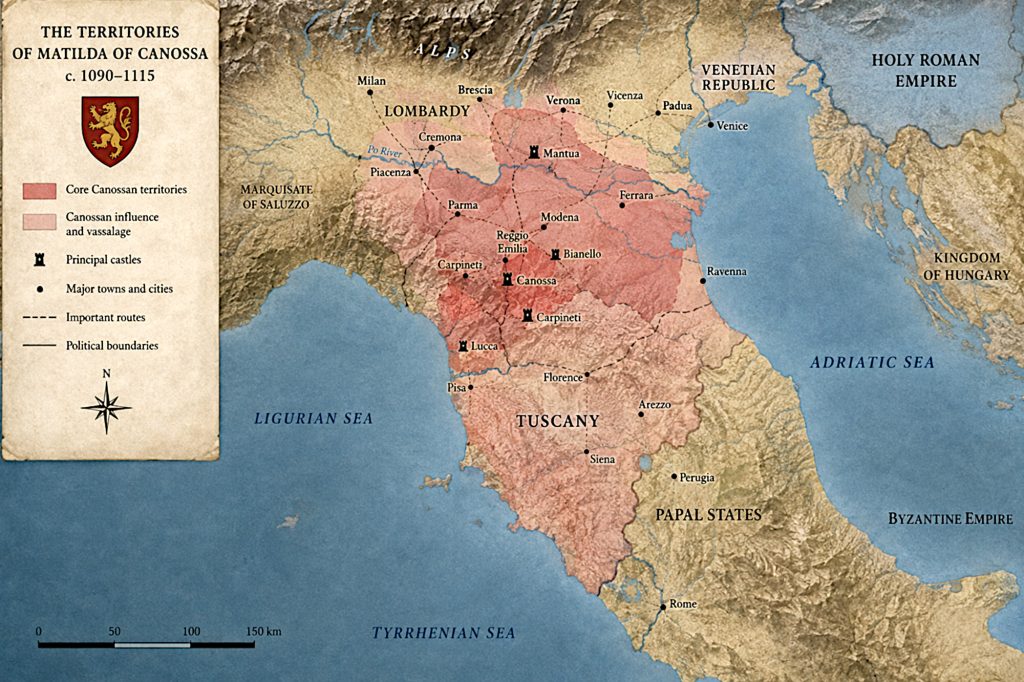
The expression “Matilda of Tuscany” can give the impression that she simply ruled Tuscany.
Her political geography was considerably more complicated.
Canossan power included estates and rights around:
- Mantua
- Reggio Emilia
- Modena
- Parma
- Ferrara
- Lucca
- Tuscany
- The northern Apennines
- Important routes between northern Italy and Rome
The Apennine castles were particularly important.
An invading army could occupy towns and devastate estates, but controlling a network of fortified positions in difficult terrain was another matter entirely. Matilda repeatedly exploited this geographical advantage during her wars with Henry IV.
Her castles were not picturesque backdrops. They were instruments of government and war.
Matilda and Pope Gregory VII
The defining political relationship of Matilda’s career was her alliance with Pope Gregory VII.
Gregory became pope in 1073 and pursued an ambitious programme of Church reform. Among the most contentious issues was the practice of secular rulers investing bishops with the symbols of their religious office.
Behind the theological arguments sat a rather obvious political question:
Who actually controlled the Church?
Gregory believed ecclesiastical authority ultimately belonged to the Church and papacy. Henry IV regarded control over bishops as fundamental to royal government.
Matilda strongly supported Gregory.
Her loyalty was spiritual, political and personal. She provided the reform papacy with money, protection, military support and access to her network of fortresses.
It made her one of the most important secular supporters of the Gregorian reform movement.
It also made Henry IV her enemy.
The Investiture Controversy
The conflict between Gregory VII and Henry IV escalated dramatically during the 1070s.
Henry challenged Gregory’s authority. Gregory excommunicated Henry in 1076 and released his subjects from their obligations of loyalty.
For a medieval king, excommunication could be politically catastrophic. German princes already hostile to Henry suddenly possessed a religious justification for rebellion.
Henry needed the excommunication lifted.
The solution brought him to Matilda’s front door.
Quite literally.
The Walk to Canossa
In January 1077, Henry IV crossed the Alps and travelled to Canossa, where Gregory VII had taken refuge under Matilda’s protection.
The encounter became one of the most famous episodes of the Middle Ages.
Henry performed penance outside the castle before eventually being admitted and receiving absolution from Gregory.
Later accounts turned the scene into an almost theatrical humiliation, complete with Henry standing barefoot in the snow. Some details have probably been embellished through centuries of retelling, but the political significance is beyond doubt.
Matilda was central to the negotiations.
She was related to Henry and allied to Gregory, making her a valuable intermediary between two men who had managed to turn an argument about bishops into a European political crisis.
The reconciliation did not last.
Within a few years, pope and king were enemies again.
Was Matilda Really a Warrior?
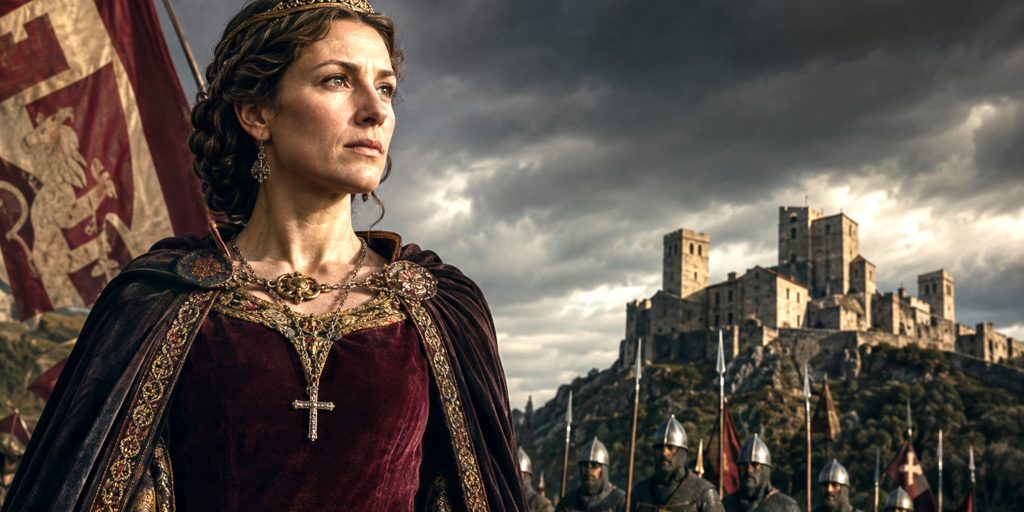
This is where modern accounts can become a little enthusiastic.
Matilda unquestionably exercised military command. Contemporary evidence associates her with armies, campaigns, fortifications and military decision-making. She personally travelled through contested territory and remained closely involved with the conduct of war.
That does not necessarily mean she routinely charged into combat with sword in hand.
There is an important difference between being a medieval commander and personally fighting in the front rank.
Later artistic traditions often emphasised Matilda’s martial qualities, but historians should be cautious about turning those images into literal eyewitness evidence.
What we can say confidently is more impressive anyway.
Matilda:
- Raised and maintained armed forces
- Directed military campaigns
- Controlled castles and fortified routes
- Coordinated the defence of her territories
- Supported papal military operations
- Used terrain to frustrate imperial armies
- Recovered territory after serious defeats
- Continued resisting Henry IV when many of her supporters defected
She did not need to become a fictional shield-maiden to qualify as a formidable military leader.
What Weapons and Armour Would Matilda Have Known?
No securely identified personal sword or suit of armour belonging to Matilda survives.
Claims about her personal equipment should therefore be treated cautiously.
The elite warriors serving her during the late 11th century would typically have used equipment such as:
| Equipment | Typical form |
| Sword | Straight, double-edged knightly sword |
| Spear | Principal mounted and infantry weapon |
| Long mail hauberk protecting torso and limbs | |
| Helmet | Conical helmet, frequently with nasal protection |
| Shield | Large kite-shaped shield |
| Horse | Essential for aristocratic mobility and mounted warfare |
| Bow/crossbow | Missile weapons increasingly important in Italian warfare |
If Matilda wore armour while accompanying military forces, mail and a conical helmet would fit the period. But there is a difference between historically plausible reconstruction and documented personal equipment.
It is worth keeping that line intact.
War Against Henry IV
The renewed struggle between Henry and Gregory placed Matilda under immense pressure.
Henry entered Italy and targeted territories supporting the papacy. Matilda’s lands were repeatedly attacked, while several of her vassals and cities shifted allegiance.
The war was not a steady sequence of heroic victories.
Matilda suffered serious reverses.
This is actually one of the strongest reasons to take her military reputation seriously. She survived them.
The Battle of Volta Mantovana
Matilda’s forces suffered a defeat at Volta in 1080, after which her political position deteriorated considerably.
Supporters defected and Henry’s pressure increased.
This was precisely the sort of crisis that could destroy medieval aristocratic power. Loyalty depended heavily upon the expectation that a lord could continue protecting followers and rewarding service.
Matilda nevertheless recovered.
Victory at Sorbara

On 2 July 1084, Matilda’s forces defeated pro-imperial troops at Sorbara, near Modena.
The victory helped reverse her deteriorating military position.
Among those captured was Bernardo, Bishop of Parma, an imperial supporter.
Sorbara demonstrated one of Matilda’s greatest qualities as a political commander: persistence.
Her career contains defeats, lost cities, wavering vassals and periods when Henry appeared close to breaking her power. Yet she repeatedly rebuilt her position.
That is rather more convincing than a spotless military record, which is usually a sign that somebody’s medieval biographer has been getting carried away.
Gregory VII Dies
Gregory VII died in exile at Salerno in 1085.
His death did not end Matilda’s support for the reform papacy.
She subsequently backed Victor III and Urban II, continuing to provide military and political assistance to the papal party.
In 1087 she participated in efforts to restore Victor III to Rome, although imperial resistance made the situation difficult.
Matilda’s commitment was therefore not merely loyalty to Gregory as an individual. She remained attached to the wider political and religious programme he represented.
Matilda’s First Marriage
Matilda’s personal life was thoroughly entangled with European politics.
Her first husband was Godfrey the Hunchback, Duke of Lower Lorraine, whom she married around 1069.
The marriage appears to have been unhappy.
A daughter was born but died in infancy. Matilda eventually returned to Italy while Godfrey remained in Lorraine.
Godfrey was murdered in 1076.
There is no reliable evidence that Matilda was involved in his death, although political murder and unhappy aristocratic marriages naturally make excellent compost for later rumours.
The marriage left Matilda without a surviving heir.
That would become enormously important.
The Remarkable Marriage to Welf V
In 1089 Matilda married Welf V, heir to the powerful Welf dynasty.
She was around forty-three.
He was probably somewhere around seventeen.
Even by the standards of dynastic medieval marriages, it is a pairing that makes you stop reading for a moment.
The marriage was politically useful. An alliance between Matilda and the Welfs created a potentially powerful anti-imperial bloc stretching across the Alps.
It was not a lasting personal success.
By 1095 the couple had separated in practice, although their marriage was apparently never formally dissolved.
Later writers supplied colourful and frequently improbable stories about their marital relationship. They are entertaining sources for medieval attitudes towards Matilda, but rather less useful as evidence for what actually happened in the bedroom.
Henry IV Invades Again
Henry IV returned to Italy in 1090 and launched another major offensive against Matilda.
This time the danger was severe.
Mantua fell in 1091 after a long siege. Imperial forces captured further strongholds, and many of Matilda’s supporters made peace with Henry.
By 1092 her position appeared desperate.
She withdrew towards the Apennine fortresses that formed the defensive heart of her territory.
At Carpineti, Matilda reportedly consulted her remaining supporters. Many favoured peace.
She chose to continue fighting.
Canossa and the Turning Point of 1092
Henry moved against Canossa in 1092.
The imperial campaign subsequently faltered in the difficult terrain around Matilda’s mountain strongholds. Henry failed to destroy her resistance and eventually withdrew.
The psychological consequences were considerable.
A ruler who had appeared close to eliminating Matilda instead found himself trapped in an increasingly hostile political environment.
Rebellions and defections weakened Henry’s position in northern Italy.
Matilda survived again.
Henry eventually returned north of the Alps in 1097 and never again personally invaded Italy.
How Matilda Fought Her Wars
Matilda’s military success depended less upon spectacular battlefield tactics than upon strategic endurance.
Her principal advantages included:
- Fortified geography: Apennine castles made complete conquest difficult.
- Control of routes: Her territories sat across important connections between northern Italy, Tuscany and Rome.
- Religious alliances: Papal support gave her political legitimacy and access to a broader network of allies.
- Financial resources: The Canossan estates could sustain prolonged resistance.
- Mobility: Matilda moved frequently between castles, monasteries and political centres.
- Political resilience: She repeatedly persuaded followers to continue resisting after setbacks.
This is medieval warfare viewed from the commander’s table rather than through the eye slit of a helmet.
Frankly, that is where most wars were actually won.
Government and Administration
Focusing exclusively on Matilda’s wars risks overlooking the activity that occupied much of her career.
She governed.
Hundreds of documents associated with Matilda survive, providing evidence of land grants, legal decisions, religious patronage and relationships with aristocrats, monasteries and communities.
She held courts and exercised judicial authority.
She negotiated with bishops, abbots, nobles and rulers.
She managed a geographically fragmented collection of territories over several decades.
This administrative record matters because female political power in medieval Europe was often vulnerable to being characterised as temporary or dependent upon husbands and sons.
Matilda’s authority endured.
She was not simply holding somebody else’s seat warm.
Matilda and the Revival of Roman Law
Matilda’s lifetime coincided with an important revival in the study of Roman law in northern Italy, particularly around Bologna.
Her court had connections with legal scholars and ecclesiastical reformers, and later traditions associated her with the development of legal learning.
Some older accounts go too far by presenting Matilda almost as the founder of the University of Bologna or personally responsible for the rediscovery of Justinian’s legal texts.
The evidence does not justify claims that neat.
What can be said is that her political world formed part of the environment in which Roman legal scholarship began to flourish again.
That development would have enormous consequences for medieval European government.
Religion and Patronage
Matilda was intensely religious.
She supported monasteries, churches and reforming clergy and maintained close relationships with leading ecclesiastical figures.
Her religious convictions cannot easily be separated from her politics.
Modern readers sometimes treat medieval expressions of faith as a decorative layer hiding “real” political motives. That can badly distort the period.
Matilda probably believed deeply in the religious principles she defended.
She was also perfectly capable of understanding their political implications.
Medieval rulers were allowed to possess more than one thought at a time.
The Matildine Donation
Perhaps the most complicated issue surrounding Matilda’s legacy concerns what became known as the Matildine Donation.
Matilda declared that her possessions should pass to the Roman Church. A surviving document records a renewed donation in 1102, apparently confirming an earlier grant.
The legal situation was extremely complicated because her holdings included different categories of property and rights. Some were hereditary possessions while others were held within the imperial feudal structure.
Modern scholars have also debated the authenticity, dating and exact legal significance of the donation documents.
What is certain is that Matilda’s inheritance became the subject of a prolonged dispute between popes and emperors after her death.
Land has a remarkable ability to make theological disagreements even less friendly.
Reconciliation with Henry V
The final years of Matilda’s life brought a significant change.
Henry IV’s son, Henry V, entered Italy.
Rather than simply continuing his father’s war against Matilda, Henry reached an accommodation with her.
In 1111 they met and Matilda received imperial recognition of her political status. Sources and later interpretations differ over the exact terminology and meaning of the honours she received, so descriptions such as “Vice-Queen of Italy” should be used carefully.
The meeting nevertheless represented a remarkable conclusion to her political career.
A woman who had spent decades resisting Henry IV had become sufficiently indispensable that his successor preferred reconciliation.
Matilda’s Appearance
We do not possess a reliable portrait that allows us to know exactly what Matilda looked like.
The most important near-contemporary visual source is associated with Donizone of Canossa, the monk who composed the Vita Mathildis in the early 12th century.
Its manuscript illustrations depict Matilda enthroned and exercising authority.
These images should not be treated as realistic portraits. Medieval manuscript art communicated rank and political relationships more readily than cheekbones.
What they do reveal is how Matilda wished to be remembered: legitimate, authoritative, devout and firmly embedded within the political order.
The Vita Mathildis
Our understanding of Matilda owes a great deal to the Vita Mathildis, written by Donizone of Canossa.
The work is invaluable.
It is also partisan.
Donizone admired Matilda and the House of Canossa, and his account presents their history through a favourable political and religious lens.
That does not make it useless. Almost every major medieval narrative source has an agenda of some sort. The historian’s job would be suspiciously easy otherwise.
The Vita provides information about Matilda’s family, political relationships, castles and conflicts that would otherwise be lost.
It must simply be compared with charters, letters and other contemporary evidence.
Did Matilda Personally Fight in Battle?
There is no compelling evidence that Matilda regularly engaged enemies in hand-to-hand combat.
She certainly commanded armies and participated directly in military campaigns.
That distinction is worth maintaining.
A medieval commander did not need to personally kill opponents to exercise military leadership. Kings and nobles could direct troops, coordinate fortifications, organise supplies and determine strategy without behaving like characters in an action film.
Matilda’s documented military authority is impressive enough without inventing sword fights for her.
Archaeology and the Landscape of Matilda
Physical evidence for Matilda’s world survives across northern Italy, although linking individual weapons or everyday objects directly to her is difficult.
Archaeological and architectural investigation is particularly valuable for understanding the fortified landscape upon which Canossan power depended.
Important sites include:
Canossa
The ruins of Canossa Castle remain the location most closely associated with Matilda.
Later destruction and rebuilding mean visitors are not looking at an untouched 11th-century fortress, but the position of the site makes its strategic value immediately understandable.
Bianello
Bianello Castle, one of a group of Canossan fortifications, retains strong associations with Matilda and the territorial network controlled by her dynasty.
Carpineti
The castle at Carpineti was another important Apennine stronghold and became particularly significant during the crisis of 1092.
San Benedetto in Polirone
The monastery at San Benedetto Po enjoyed Matilda’s patronage and became her original burial place.
These landscapes are arguably more informative than an isolated sword in a museum case. They reveal how her power actually functioned.
Where Is Matilda Buried?
Matilda died on 24 July 1115, probably at Bondeno di Roncore.
She was initially buried at the monastery of San Benedetto in Polirone.
Centuries later, Pope Urban VIII ordered her remains transferred to Rome.
Her monumental tomb now stands in St Peter’s Basilica.
The monument was designed under Gian Lorenzo Bernini and commemorates Matilda as one of the great historical defenders of the papacy.
The Baroque memorial tells us as much about how 17th-century Rome wanted to remember her as it does about the woman herself.
That, in itself, is historically fascinating.
Where to Follow Matilda’s Story Today
| Location | Why it matters |
| Canossa Castle, Emilia-Romagna | Setting of the famous meeting between Gregory VII and Henry IV |
| Museo Nazionale di Canossa | Material and interpretation relating to Canossa and Matilda |
| Bianello Castle | Important stronghold associated with Matilda |
| Carpineti Castle | Connected with her resistance during Henry IV’s invasion |
| San Benedetto in Polirone | Matilda’s original burial place and an important beneficiary of her patronage |
| St Peter’s Basilica, Rome | Location of her later tomb and memorial |
| Vatican Library | Preserves the celebrated manuscript tradition of the Vita Mathildis |
Myths and Misconceptions
Matilda was a sword-wielding warrior queen
Possibly armed on campaign, certainly a military commander, but direct evidence for regular personal combat is lacking.
She defeated Henry IV in every campaign
No. Matilda suffered substantial defeats and lost important territories. Her achievement was surviving and recovering from them.
Canossa permanently defeated Henry IV
No. Henry received absolution and rebuilt his political position. His conflict with Gregory VII continued.
She ruled a unified Kingdom of Tuscany
No. Her authority rested upon a complex network of titles, estates, feudal rights and castles scattered across different regions.
She simply gave all her land to the pope
The Matildine inheritance was legally much more complicated and became the subject of prolonged disputes after her death.
Matilda of Tuscany’s Legacy
Matilda has accumulated several identities over the centuries.
She has been remembered as the Gran Contessa, the Great Countess. Papal histories celebrated her as a loyal defender of the Church. Italian traditions transformed her into a regional heroine. Modern popular history has increasingly presented her as a medieval female warrior.
Each version contains part of the truth.
None quite captures the whole woman.
The Matilda I find most convincing is neither saintly champion nor sword-swinging heroine. She was a hard, resilient and exceptionally capable medieval ruler who inherited enormous advantages but also faced circumstances that could easily have destroyed them.
She survived assassination within her family, political detention, two unsuccessful marriages, rebellion among her followers, papal-imperial warfare and repeated invasions of her territory.
When Henry IV appeared to have beaten her, she continued fighting.
When allies abandoned her, she retreated into the Apennines and rebuilt.
When Henry’s son eventually came south, he negotiated with her rather than attempting to erase her.
For a woman governing in the intensely masculine political culture of the 11th century, simply holding power for decades would have been noteworthy. Matilda did considerably more.
She became one of the people around whom the politics of medieval Europe revolved.
And, rather satisfyingly, the emperor who once tried to destroy her is now inseparable from the name of her castle.