Emma of Normandy married two kings who had fought for the same throne. Her sons by each marriage later ruled England. That is a remarkable family history, even by the standards of the eleventh century, when royal succession could resemble a particularly dangerous argument over dinner.
Born into Normandy’s ruling family, Emma became the wife of Æthelred II in 1002 and of his Danish conqueror Cnut in 1017. She lived through invasions, exile and competing claims to the crown, then helped shape the written account of those events. Her career offers something more interesting than a simple tale of survival: a view of how a queen could exercise influence through marriage, property, patronage, family alliances and control of a political story.
| At a glance | Detail |
|---|---|
| Born | Probably in the 980s, in Normandy |
| Parents | Richard I of Normandy and Gunnor |
| Husbands | Æthelred II, king of the English; Cnut, king of England and Denmark |
| Children | Edward, Alfred and Godgifu by Æthelred; Harthacnut and Gunnhild by Cnut |
| Died | 6 March 1052 |
| Associated places | Normandy, Winchester, Flanders |
Why did Emma come to England?
Emma was the daughter of Richard I, ruler of Normandy, and Gunnor. In 1002 she married Æthelred II, strengthening relations between two courts whose interests overlapped across the Channel. England faced repeated Scandinavian attacks, while Normandy’s ports and rulers mattered to the movement of ships and exiles. A royal marriage offered a diplomatic connection, though it could hardly guarantee lasting cooperation.
In English records Emma was also known as Ælfgifu. That name fitted the court she had joined; it should not be mistaken for proof that her Norman identity disappeared. Her position depended on connections on both sides of the Channel, and those connections would matter greatly when her children later sought refuge in Normandy.
Queen to Æthelred: marriage during an invasion crisis
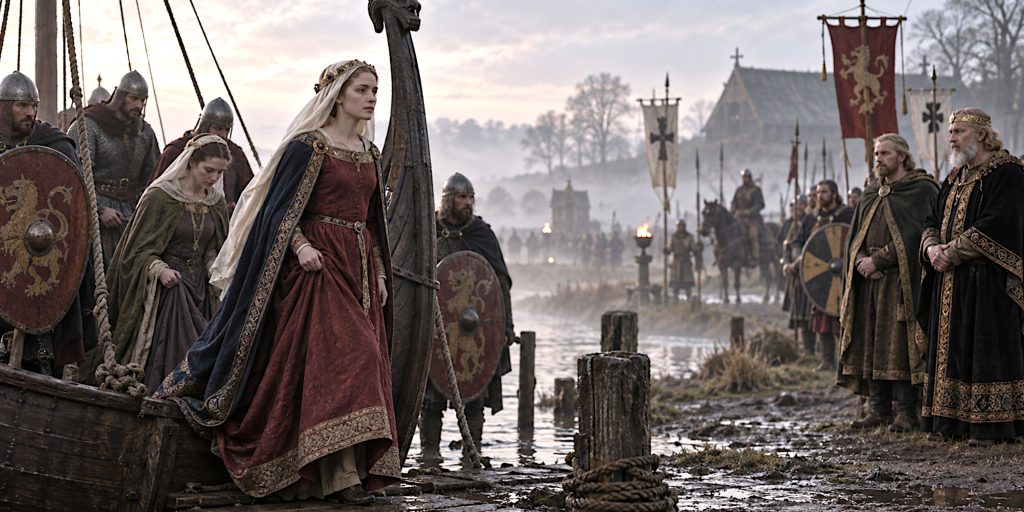
Emma entered a kingdom under growing pressure from Scandinavian armies. The notorious killings of Danes ordered on St Brice’s Day in 1002 belong to the wider story of Æthelred’s reign, but the evidence does not make Emma their architect. It is tempting to make every queen a secret strategist. Sometimes the sources simply do not let us.
She and Æthelred had three known children: Edward, the future Edward the Confessor; Alfred; and Godgifu. They were not Æthelred’s only children. His older sons from an earlier marriage also had claims and political followings, a detail that helps explain why Emma’s position as a mother was never as straightforward as the tidy family trees suggest.
In 1013 Sweyn Forkbeard conquered England, and Emma fled with her children to Normandy. Æthelred joined them before returning after Sweyn’s death in 1014. The reprieve was brief. Æthelred died in April 1016, while his son Edmund Ironside was still resisting Sweyn’s son Cnut. Cnut defeated Edmund at Assandun later that year; Edmund died in November, leaving Cnut in control of the kingdom. Emma’s future had to be negotiated in the aftermath of a conquest, not in a peaceful change of reign.
Why did Emma marry Cnut?
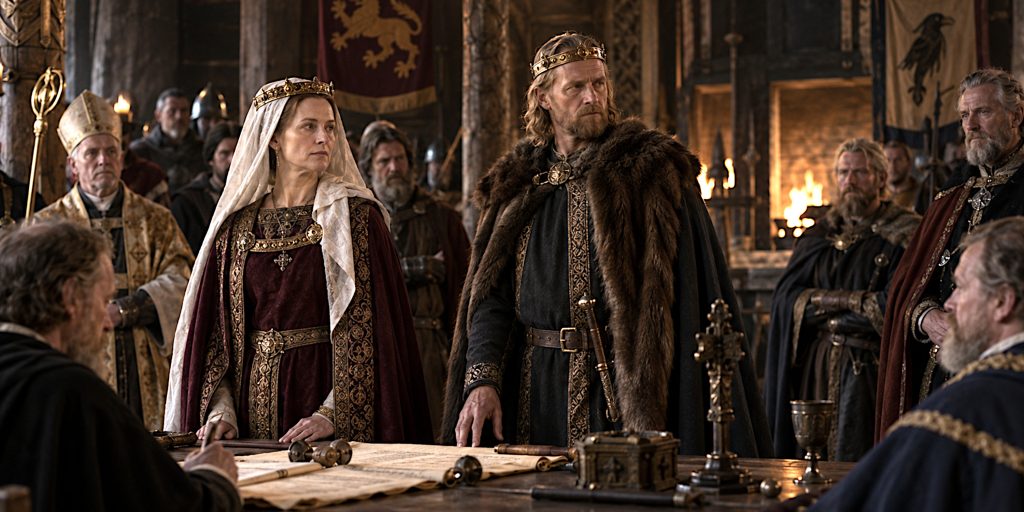
Emma married Cnut in 1017. For him, the marriage linked the new Danish regime to the previous royal household and to Normandy. For Emma, it restored her place at the centre of English politics and gave any children of the marriage a powerful claim. We cannot know how she privately felt about the arrangement. Its political value to both parties is much easier to see.
Cnut already had sons, including Harold, by Ælfgifu of Northampton. Emma’s marriage did not erase those rival claims. She and Cnut had a son, Harthacnut, and a daughter, Gunnhild. Their household sat within a North Sea realm whose politics reached beyond England into Denmark and Norway, although calling Emma ruler of all those territories in her own right would overstate the evidence.
As queen, Emma appears in the political and religious life of the reign. Her status was expressed through royal documents, landed wealth and gifts to churches. A queen did not need to command an army to matter to the distribution of influence. In this period, access to the king, control of resources and the standing of her children were consequential forms of power.
Cnut’s death and the fight for the crown
When Cnut died in 1035, Harthacnut was in Denmark and could not immediately secure England. Harold Harefoot, Cnut’s son by Ælfgifu of Northampton, gained support at home. Emma held a position at Winchester on Harthacnut’s behalf, but Harold’s power grew. By 1037 he was recognised as king, and Emma left for Flanders.
The struggle also drew in Emma’s sons by Æthelred. Alfred returned to England in 1036, was seized and blinded, and died soon afterwards. The surviving accounts differ over responsibility and the circumstances of his journey. The event was a personal catastrophe as well as a brutal demonstration of what a disputed succession could cost.
Harold died in 1040, allowing Harthacnut to become king of England. Emma returned. Harthacnut later brought his half-brother Edward back from Normandy, and Edward succeeded him in 1042. Emma had seen a son from each of her marriages take the English throne. Few mothers could claim that distinction; fewer would have wished for the route by which it happened.
The Encomium: Emma’s version of events
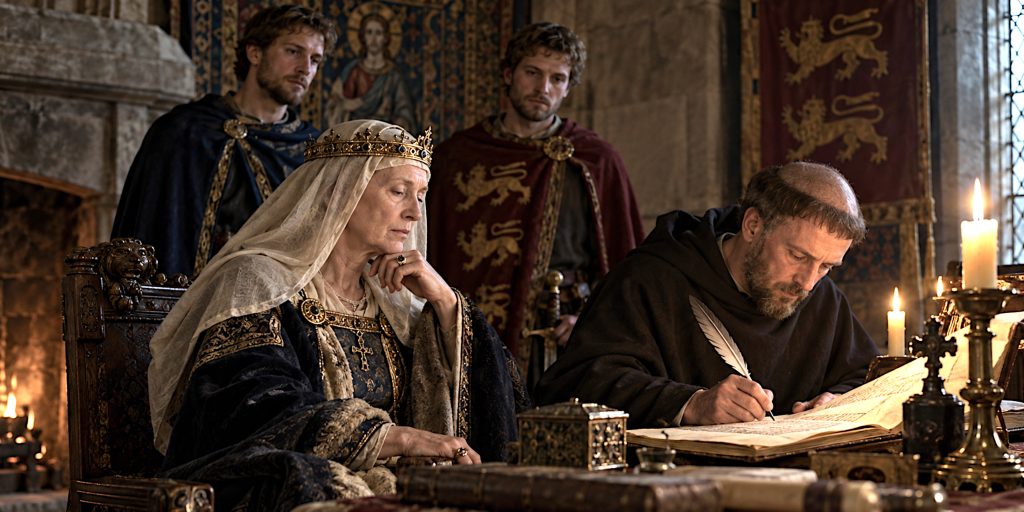
Around 1041 to 1042, a writer working for Emma composed the Latin Encomium Emmae Reginae, or Praise of Queen Emma. It recounts the rise of Cnut and the disputes that followed his death, presenting Emma and her sons Harthacnut and Edward in a favourable light. A celebrated manuscript image places Emma at the centre as she receives the work, with the two sons behind her.
The Encomium is invaluable, but its purpose matters. It is an argument for Emma’s family and political standing, not a neutral court transcript. It gives remarkably little space to Æthelred, the father of Edward and Alfred. That omission tells us how carefully a useful past could be assembled. A historian should read the book for what it says, and also for whom it leaves outside the frame.
What can we say with confidence? Emma commissioned a work that defended a particular account of succession. What remains uncertain? How much of its phrasing she directed, and how far its presentation reflected her private views. Patronage gave her a voice in the historical record, but it does not let us listen in on her thoughts.
Emma and Edward the Confessor
Emma’s influence did not carry over smoothly into Edward’s reign. In 1043 Edward went to Winchester and took possession of her wealth. Later accounts attach accusations to the episode, but their details require caution. The secure point is that Emma’s control of resources and her place in royal politics were sharply reduced.
She remained a prominent figure and died in 1052. She was buried at Winchester, the city so closely associated with the English royal household. Edward ruled until 1066, when his death without a direct heir reopened the succession question and helped set the stage for the Norman Conquest.
Emma did not plan the events of 1066. Her Norman connections and Edward’s years of exile across the Channel form part of its longer background, but treating her as the hidden author of William’s invasion would give a medieval queen an implausibly long and reliable political timetable.
What survives of Emma’s world?
- The Encomium Emmae Reginae: The British Library holds the famous eleventh-century manuscript, Additional MS 33241, including the image of Emma receiving the work. Consult the Library’s catalogue or digital collections for access and current display information.
- Winchester Cathedral: Emma’s burial was associated with Winchester’s Old Minster. Her remains were later moved; the cathedral’s mortuary chests and their contents have a complicated history, so an individual set of bones should not casually be labelled as hers.
- Royal documents and church records: These help establish Emma’s public standing, gifts and connections. They reveal more about her political position than about her personality.
There is no known sword or battlefield artefact that can be securely attributed to Emma. The material story here is one of manuscripts, religious patronage and burial, which is rather less theatrical than a sword in a glass case but considerably more useful to a historian.
Emma of Normandy’s legacy
Emma’s achievement was neither absolute control nor effortless endurance. She lost ground, suffered exile and saw one son murdered before two others became kings. Within those limits she remained a consequential participant in English politics for roughly half a century.
What stays with me is her attention to the record. The Encomium lets us see a queen involved in deciding how the upheavals of her lifetime would be explained to others. It also warns us to ask whose account we are reading. Emma’s life survives in part because she understood that political power could outlast a reign on the page.
Selected sources and further reading
- British Library, Additional MS 33241, Encomium Emmae Reginae.
- Oxford Dictionary of National Biography, “Emma [Ælfgifu]”
- Pauline Stafford, Queen Emma and Queen Edith: Queenship and Women’s Power in Eleventh-Century England.
- The Anglo-Saxon Chronicle, particularly its accounts of the succession crises of 1016 and 1035 to 1043.