Few rulers from early medieval Britain have undergone such a remarkable transformation in reputation as Aethelflaed (Old English: Æthelflæd). Once remembered primarily as Alfred the Great’s daughter, she is now recognised as one of the most capable political and military leaders of the Anglo-Saxon age. It is a reassessment that feels long overdue.
At a time when Viking armies dominated much of England, Aethelflaed did far more than preserve her inheritance. She expanded it. She commanded armies, strengthened frontier defences, founded fortified towns, negotiated with rival kingdoms and governed Mercia with an authority that won the respect of nobles, soldiers and, perhaps most tellingly, her enemies.
Unlike many famous medieval figures, Aethelflaed has never acquired a thick layer of romantic legend. There are no miraculous swords pulled from stones, no dragons to dispatch and no conveniently embroidered speeches before battle. Medieval chroniclers recorded her achievements with a matter-of-fact confidence that almost understates them. Reading the surviving sources, one occasionally wishes they had been just a little more enthusiastic. If a king had accomplished the same list of victories, some monks might well have declared the heavens themselves applauded.
Modern archaeology and renewed interest in Anglo-Saxon England have steadily filled in the picture. Excavations at towns she fortified, reassessments of contemporary chronicles and fresh scholarship all point towards the same conclusion. Aethelflaed was not an exceptional woman because she happened to inherit power. She was exceptional because she exercised it with remarkable intelligence.
Her greatest achievement was helping to create the conditions in which England could eventually emerge as a unified kingdom. Without the work undertaken by Aethelflaed and her brother Edward the Elder, their nephew King Athelstan would have inherited a very different political landscape.
That alone secures her place among the most important rulers in British history.
Who Was Aethelflaed?
| Fact | Details |
|---|---|
| Full name | Aethelflaed (Old English: Æthelflæd) |
| Title | Lady of the Mercians |
| Born | Around AD 870 |
| Died | 12 June 918 |
| Father | Alfred the Great |
| Mother | Ealhswith |
| Husband | Æthelred, Lord of the Mercians |
| Daughter | Ælfwynn |
| Principal residence | Tamworth |
| Burial | St Oswald’s Priory, Gloucester |
| Known for | Military leadership, fortified burhs, resistance to Viking expansion, ruler of Mercia |
Early Life
Aethelflaed was born around AD 870, probably in Wessex, into one of the most remarkable royal households in Europe. Her father, Alfred the Great, had not yet earned the title by which history remembers him. In fact, when she was born, his kingdom faced the very real possibility of destruction.
The Great Heathen Army had swept across England during the previous decade, conquering Northumbria, East Anglia and much of Mercia. Viking warlords appeared unstoppable. Several Anglo-Saxon kingdoms had disappeared altogether.
Growing up amid this uncertainty must have shaped Aethelflaed’s outlook. She belonged to a generation that understood peace as something that had to be actively defended rather than simply enjoyed.
Unlike many medieval princesses, she was raised within Alfred’s ambitious programme of educational reform. Alfred believed that learning strengthened kingdoms just as surely as armies did. He promoted literacy among both clergy and nobles, commissioned translations of important Latin works into Old English and sought to restore scholarship after decades of disruption caused by war.
Although few records describe Aethelflaed’s education directly, it would be surprising if Alfred excluded his eldest daughter from these reforms. She almost certainly learned to read Old English and was probably familiar with Latin religious texts. More importantly, she grew up at the centre of a court where politics, diplomacy and military planning formed part of daily life.
Children of medieval rulers were expected to observe rather than participate. Even so, observation can be an excellent teacher.
The World She Inherited
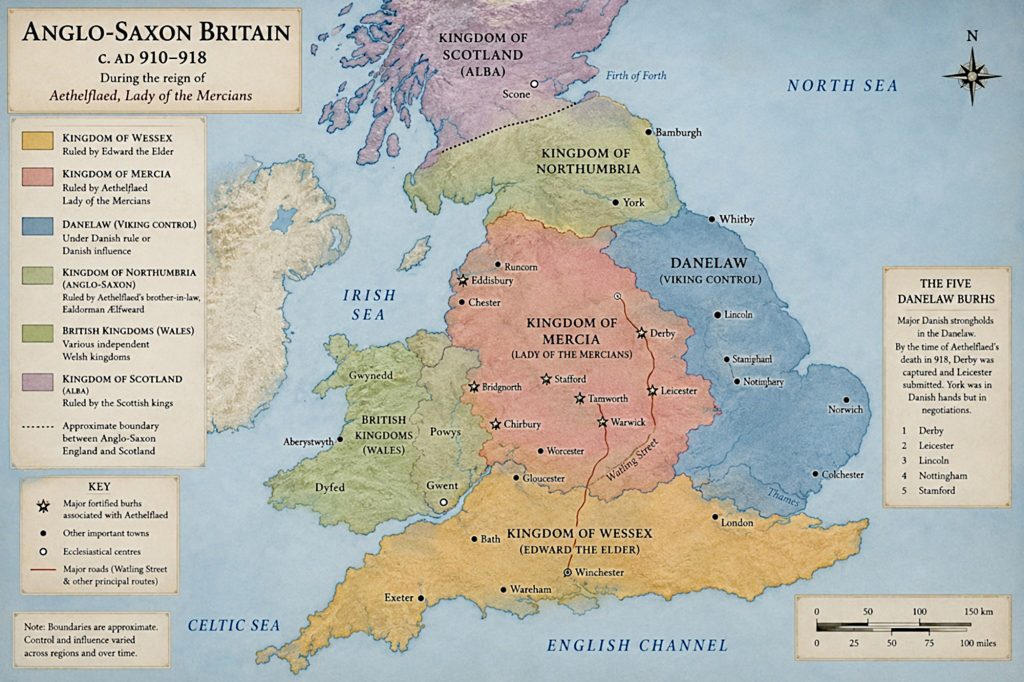
To understand Aethelflaed, it helps to understand the England into which she was born.
There was no Kingdom of England.
Instead, Britain consisted of several competing Anglo-Saxon kingdoms alongside powerful Welsh rulers, Scandinavian settlers and independent British communities.
Mercia had once dominated southern England under rulers such as Offa, whose great earthwork still stretches across the Welsh border. By Aethelflaed’s childhood, however, Mercian fortunes had declined dramatically. Viking invasions had shattered its political power and left large areas under Danish control.
Meanwhile, Alfred fought to preserve Wessex.
His victory over Guthrum at the Battle of Edington in 878 halted the immediate Viking threat, but it solved very little in the long term. The Danelaw remained firmly established across eastern England, creating a permanent frontier between Anglo-Saxon and Scandinavian rule.
For the next forty years, nearly every political decision made by Alfred’s family revolved around recovering these lost territories.
Aethelflaed would eventually become one of the architects of that recovery.
Alfred the Great’s Daughter
Being Alfred’s daughter brought opportunity, but it also brought expectation.
Alfred viewed kingship differently from many earlier Anglo-Saxon rulers. He believed a king should govern through wisdom as well as military strength, combining learning, justice and Christian leadership.
These ideals shaped the royal household.
The future rulers of Wessex received practical experience in administration, while Alfred’s daughters appear to have enjoyed an unusually sophisticated education for the period. Contemporary writers praised the learning of the royal family, suggesting that intellectual ability was considered an important royal virtue.
This environment produced capable administrators rather than ornamental nobles.
It is tempting to imagine Alfred discussing fortifications, military logistics or diplomacy over the evening meal while his children listened nearby. We cannot prove it, of course, but given the crises facing Wessex, conversations were unlikely to revolve around gardening.
Whatever lessons Aethelflaed absorbed during these formative years, they would later become visible throughout her own government.
Marriage to Æthelred

Around AD 886, Alfred arranged Aethelflaed’s marriage to Æthelred, Lord of the Mercians.
Like many royal marriages, the union served political as well as personal purposes.
Mercia occupied a crucial position between Wessex and the Viking-held territories of the Danelaw. A close alliance between Alfred and Æthelred strengthened the Anglo-Saxon position while creating greater stability across southern England.
Although modern historians sometimes debate whether Mercia should be viewed as fully independent at this point, Æthelred retained considerable authority within his own kingdom. His marriage to Alfred’s daughter symbolised cooperation rather than conquest.
Contemporary evidence also suggests this became a genuine political partnership.
Unlike many medieval royal wives who remain almost invisible in the documentary record, Aethelflaed increasingly appears alongside her husband in charters and religious foundations. She witnessed grants, participated in major decisions and gradually emerged as one of the leading figures within Mercian government.
This visibility becomes particularly significant during the closing years of Æthelred’s life.
A Partnership in Government
By the late ninth century, Æthelred’s health appears to have deteriorated.
Exactly what afflicted him remains unknown. Medieval chroniclers, who could happily devote pages to miraculous visions, become oddly vague when discussing medical conditions. Modern historians have suggested possibilities ranging from chronic illness to injuries sustained during earlier campaigns, but no firm conclusion is possible.
What is clear is that Aethelflaed assumed an increasingly prominent role.
She participated in diplomatic initiatives, supported religious institutions and helped oversee the continued development of Mercia’s defensive network.
The rebuilding of Worcester provides an excellent example of this shared leadership. Charters record both Æthelred and Aethelflaed granting privileges to the church while encouraging urban growth and strengthening local administration.
These activities reveal a ruler learning every aspect of government before she formally inherited power.
When the time eventually came to lead Mercia alone, she was already an experienced administrator.
Nothing about her later success suggests someone suddenly promoted beyond their abilities.
Quite the opposite.
Mercia Before Aethelflaed’s Rule
Understanding Mercia’s position in the early tenth century helps explain why Aethelflaed’s later achievements were so remarkable.
The kingdom remained wealthy, strategically important and culturally influential, but decades of warfare had taken their toll.
Large areas east of Watling Street remained under Danish rule.
Trade routes faced repeated disruption.
Communities along the frontier lived with the constant possibility of Viking raids.
Mercian rulers therefore faced several urgent priorities:
- Secure the frontier with the Danelaw.
- Rebuild damaged towns.
- Strengthen communications between settlements.
- Encourage trade and agriculture.
- Maintain close cooperation with Wessex.
- Prevent renewed Scandinavian expansion.
These challenges demanded far more than battlefield courage.
They required organisation, patience and an ability to think years ahead.
Fortunately for Mercia, those qualities would soon define its new ruler.
Lady of the Mercians

Æthelred died in 911, leaving Mercia at a crossroads.
In many medieval kingdoms, the death of a ruler created an opportunity for ambitious neighbours, rival nobles or even family members to seize power. Mercia might easily have been absorbed directly into Wessex under Edward the Elder, Alfred’s son and Aethelflaed’s younger brother.
That did not happen.
Instead, the Mercian nobility accepted Aethelflaed as their ruler, bestowing upon her the title Lady of the Mercians (Myrcna hlæfdige). The choice was remarkable, not because women never exercised authority in Anglo-Saxon England, but because Aethelflaed ruled in her own right rather than acting merely as a regent.
The decision tells us something important about Mercia.
Its leading nobles clearly believed Aethelflaed possessed the experience, judgement and authority necessary to lead a kingdom that remained under constant military threat. Medieval aristocrats could be fiercely practical. They were unlikely to support someone incapable of protecting their lands.
Her accession therefore represented both political continuity and a vote of confidence.
It also reflected the years she had already spent governing alongside Æthelred.
Far from stepping into unfamiliar responsibilities, Aethelflaed inherited an administration she already understood.
A Different Style of Leadership
Unlike Alfred, whose reputation rests partly on famous victories such as the Battle of Edington, or Edward the Elder, who often directed large royal armies, Aethelflaed’s leadership was characterised by careful planning.
She understood that recovering England from Viking rule would not be achieved through one dramatic battle.
Instead, it required a patient campaign built upon secure fortifications, reliable supply lines, economic recovery and carefully coordinated offensives.
This approach reflected the realities of warfare in the early tenth century.
Viking armies excelled at exploiting weak frontiers. A kingdom protected only by field armies could still suffer devastating raids between campaigns.
A network of fortified towns offered something much more valuable.
It denied raiders easy targets.
The Burh Strategy
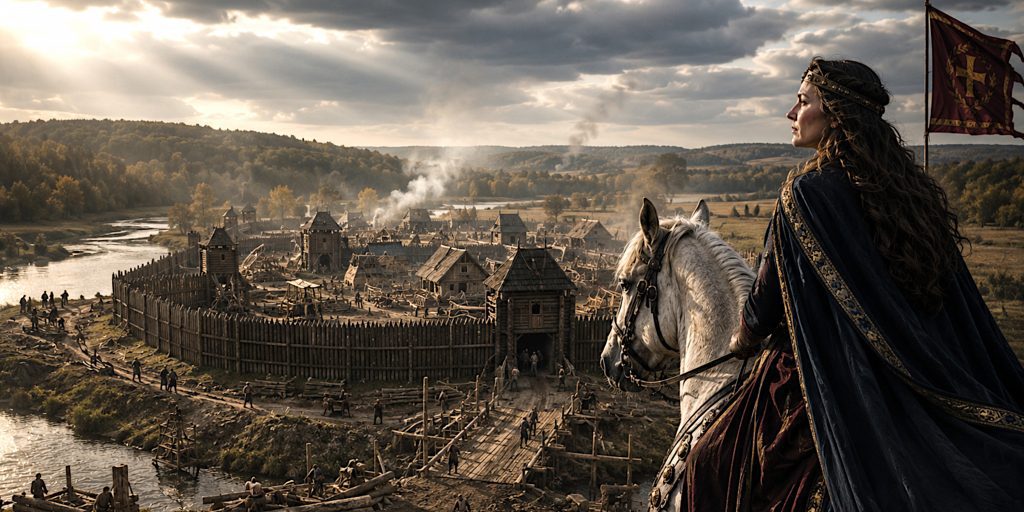
One of the defining features of Aethelflaed’s reign was the expansion of Mercia’s burh system.
Burhs were fortified settlements that combined military, administrative and commercial functions. Some occupied former Roman towns, while others were entirely new foundations.
To modern eyes they might resemble fortified market towns, but they served a far broader purpose.
Each burh acted as:
- A defensive stronghold.
- A refuge for surrounding communities.
- A military base.
- An administrative centre.
- A centre for trade.
- A symbol of royal authority.
Together they transformed the political geography of Mercia.
Rather than defending every village individually, Aethelflaed created a network capable of supporting rapid military responses across the kingdom.
It was infrastructure serving strategy.
Fortified Towns Established by Aethelflaed
Contemporary records and archaeological evidence allow historians to identify many of the burhs associated with her reign.
| Burh | Date | Purpose |
|---|---|---|
| Bridgnorth | 912 | Guarded crossings on the River Severn |
| Stafford | 913 | Protected central Mercia and communications |
| Tamworth | 913 | Royal centre and frontier fortress |
| Warwick | 914 | Defended approaches from Danish territory |
| Eddisbury | 914 | Strengthened north-western frontier |
| Chirbury | 915 | Controlled Welsh border routes |
| Runcorn | 915 | Protected the Mersey estuary |
Each location was chosen with care.
Rivers, Roman roads, hilltops and natural barriers all influenced where new defences were constructed.
The impressive earthworks that survive at several sites remind us just how much labour these projects demanded.
Thousands of workers must have participated.
The logistics alone speak volumes about Aethelflaed’s administrative ability.
Tamworth: Heart of Mercia
Among all her fortified centres, Tamworth occupied a special place.
Long before Aethelflaed’s reign, Tamworth had served as a royal residence of the Mercian kings. Under her leadership it became both political capital and military headquarters.
Its position allowed communication across much of central England while controlling important river crossings and road networks.
Archaeological excavations have uncovered evidence for extensive occupation during the late ninth and early tenth centuries, supporting the historical picture of a thriving administrative centre.
Modern Tamworth still preserves traces of its Anglo-Saxon origins beneath later medieval and Norman development.
Standing there today, it takes only a little imagination to picture messengers arriving with reports from the frontier, merchants entering through the gates and warriors preparing for campaigns into the Danelaw.
Campaigns Against the Vikings
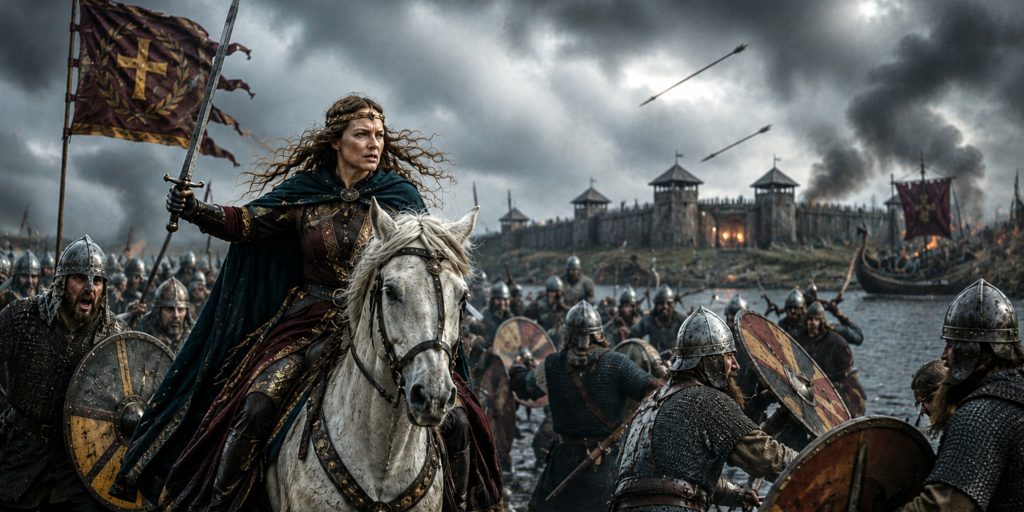
The fortified towns were never intended simply to withstand attack.
They formed launching points for offensive operations.
Between 912 and 918, Aethelflaed steadily expanded Mercian control while coordinating closely with Edward the Elder.
Together they applied relentless pressure on Danish-held territory.
Rather than risking everything in a single confrontation, they captured strategic positions one after another.
It was a methodical campaign that gradually made Viking control increasingly unsustainable.
This strategy demanded patience.
Fortunately, Aethelflaed seems to have possessed plenty of it.
The Welsh Expedition
One of the earliest military actions associated with Aethelflaed occurred in 916.
According to the Anglo-Saxon Chronicle, an abbot and his companions were murdered in Brycheiniog, a Welsh kingdom to the west.
Aethelflaed responded swiftly.
Mercian forces crossed into Wales, captured the royal residence and took the queen along with more than thirty hostages.
The campaign demonstrated several important aspects of her rule.
First, she was willing to act decisively beyond Mercia’s borders when political circumstances demanded it.
Second, she understood that medieval warfare often centred upon negotiation and hostages rather than territorial conquest alone.
The operation restored Mercian authority without triggering a prolonged conflict.
It was a measured display of strength rather than indiscriminate violence.
The Capture of Derby
If one campaign defines Aethelflaed’s military reputation, it is surely the capture of Derby in 917.
Derby formed one of the famous Five Boroughs of the Danelaw, alongside Leicester, Lincoln, Nottingham and Stamford.
These towns represented the backbone of Scandinavian power in eastern Mercia.
Taking one of them was no small achievement.
According to the Mercian Register, Derby fell after determined fighting, although victory came at considerable cost.
Several prominent Mercian thegns lost their lives during the assault.
The chronicler does not linger over the details, but the brief account suggests fierce resistance.
Urban warfare in the early medieval period was brutal.
Attackers faced timber walls, defended gates and narrow streets where defenders enjoyed every advantage.
Success therefore reflected careful planning as much as battlefield courage.
Derby’s capture also carried immense symbolic importance.
For the first time, one of the principal Danish strongholds had fallen permanently into Mercian hands.
The balance of power had begun to shift.
Coordination with Edward the Elder
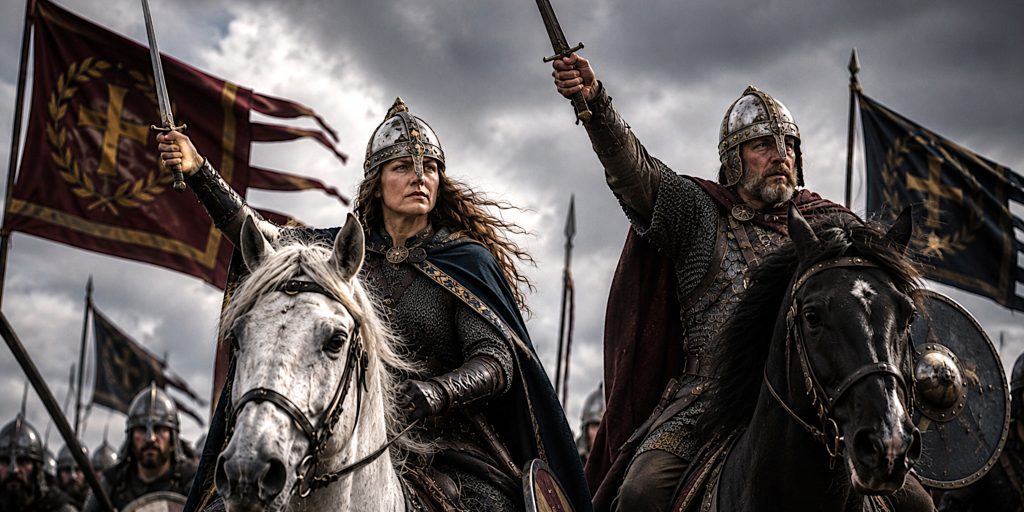
Throughout these campaigns, Aethelflaed maintained a close working relationship with her brother, Edward the Elder.
Modern writers occasionally present their campaigns as separate efforts, but contemporary evidence suggests careful coordination.
While Edward advanced across parts of southern and eastern England, Aethelflaed secured the Midlands.
Together they steadily compressed Danish territory from multiple directions.
It is difficult to imagine such sustained success without considerable communication between the two courts.
There was almost certainly a shared strategic objective.
Recover England one region at a time.
It lacked the dramatic flair of a single decisive battle, but it proved extraordinarily effective.
Leicester Surrenders
In early 918, Aethelflaed achieved another remarkable success.
Leicester, another of the Five Boroughs, submitted without major fighting.
The reasons remain debated.
Perhaps the town recognised that resistance had become futile.
Perhaps negotiations had already taken place behind closed doors.
Perhaps the fall of Derby convinced its leaders that accommodation offered better prospects than destruction.
Whatever the explanation, Leicester’s peaceful submission represented a significant political victory.
Aethelflaed had gained one of the Danelaw’s principal centres without exposing her army to another costly siege.
That kind of outcome rarely happens by accident.
York Looks South
By 918, events had begun to unfold that could have transformed English history.
Following instability among Scandinavian rulers in Northumbria, influential leaders in York reportedly approached Aethelflaed regarding possible submission.
This was extraordinary.
York remained one of the wealthiest and most strategically important cities in Britain.
Its willingness to consider recognising Aethelflaed suggests her reputation extended far beyond Mercia.
Unfortunately, history had other plans.
Before negotiations could develop further, Aethelflaed died.
It remains one of the great unanswered questions of Anglo-Saxon history.
Would York have accepted her authority?
Would England have unified more quickly?
We shall never know.
Historians dislike unanswered questions.
Sadly, history supplies rather more of them than we’d prefer.
Mercia at Its Strongest
By the final months of her life, Aethelflaed had transformed Mercia.
The kingdom possessed:
- A sophisticated network of fortified towns.
- Greater economic security.
- Stronger frontier defences.
- Expanding influence across the Midlands.
- Successful cooperation with Wessex.
- A growing reputation among neighbouring kingdoms.
Few rulers accomplish so much within seven years.
Fewer still manage it while confronting one of the most persistent military threats in European history.
Aethelflaed’s achievements were not simply defensive.
They laid the foundations for the emergence of a single English kingdom.
The victories still to come would owe much to the groundwork she had already completed.
Government and Administration
Aethelflaed is rightly celebrated for her military achievements, but reducing her career to battles alone would miss the larger picture. Victories could secure territory. Governing it successfully required an entirely different set of skills.
Mercia under Aethelflaed remained an organised and prosperous kingdom despite decades of warfare. Roads were maintained, trade continued to grow, religious houses received patronage and new fortified towns became thriving centres of commerce rather than isolated military outposts.
This was no accident.
Like her father Alfred before her, Aethelflaed understood that a kingdom’s strength rested upon more than soldiers. Wealth, law, administration and public confidence mattered just as much as fortified walls.
The survival of charters issued during her reign demonstrates an active royal government. Land grants continued, legal rights were confirmed and churches received protection and privileges. These documents reveal a ruler engaged in the routine business of governing, even while campaigning against Viking armies.
It is often these quieter administrative records that convince historians of a ruler’s competence. Winning battles is memorable. Keeping a kingdom functioning year after year is considerably harder.
Working with Edward the Elder
One of the most important political relationships of Aethelflaed’s life was with her younger brother, Edward the Elder.
Earlier historians occasionally portrayed Edward as the dominant figure, with Aethelflaed acting in support of his wider ambitions. Modern scholarship has become much more cautious about this interpretation.
The evidence suggests something closer to a partnership.
Edward concentrated his campaigns in southern England and East Anglia, while Aethelflaed secured Mercia and advanced into the Midlands. Their operations frequently complemented one another, placing Danish territories under pressure from multiple directions.
Neither ruler appears to have competed openly for authority.
Instead, they shared a common objective.
Recover the territories lost to Scandinavian rule and strengthen Anglo-Saxon England.
Political cooperation also benefited both kingdoms economically. Secure frontiers encouraged trade, while improved communications allowed armies to move rapidly when required.
It was an impressive example of coordinated strategy long before the concept acquired a modern name.
Mercia and Wessex
Although closely allied, Mercia remained distinct from Wessex throughout Aethelflaed’s lifetime.
Mercian identity had deep roots stretching back centuries. Even after Viking invasions weakened the kingdom, its nobles continued to value their traditions and institutions.
Aethelflaed seems to have appreciated this balance.
She maintained close ties with Edward without allowing Mercia simply to disappear into Wessex. Charters continued to reflect Mercian authority, while local elites retained important positions within government.
This careful management probably helped explain why Mercian nobles accepted her rule so readily.
She represented continuity rather than revolution.
Only after her death did Edward move to absorb Mercia directly into his expanding kingdom.
Diplomacy Beyond Mercia
Successful rulers in the early medieval world relied as much upon diplomacy as military strength.
Aethelflaed maintained relationships with neighbouring Welsh kingdoms, church leaders and Scandinavian communities.
The Welsh campaign of 916 demonstrated that she would use force when necessary, but it also highlighted the importance of negotiation.
Hostages, marriages, tribute and political alliances remained standard tools of medieval diplomacy.
Her dealings with Leicester and the reported negotiations with York further illustrate this approach.
Not every town required a siege.
Not every dispute demanded a battle.
Sometimes reputation alone persuaded opponents that cooperation offered the wiser course.
Building such a reputation took years.
Destroying it could take only one defeat.
Aethelflaed managed to avoid the latter.
Religion and Patronage
Religion stood at the heart of Anglo-Saxon kingship.
Royal authority carried a spiritual dimension, and successful rulers were expected to protect churches, support monasteries and demonstrate Christian piety.
Aethelflaed fulfilled these expectations throughout her reign.
Her most important religious foundation was St Oswald’s Priory in Gloucester.
Founded jointly with Æthelred, the priory became one of Mercia’s leading religious institutions. Around 909, the relics of Saint Oswald, the seventh-century King of Northumbria, were translated there from Bardney Abbey in Lincolnshire.
This was much more than an act of devotion.
Possessing the relics of a revered saint enhanced Gloucester’s prestige while strengthening Mercian authority. Medieval rulers understood that religious symbolism could reinforce political legitimacy remarkably effectively.
Aethelflaed was no exception.
Learning and Culture
As Alfred’s daughter, Aethelflaed inherited a tradition of intellectual renewal.
Although little direct evidence survives regarding her own literary patronage, Mercia continued to support religious scholarship during her reign.
Monasteries remained centres of learning, manuscript production and record keeping.
Without their efforts, much of what we know about Aethelflaed would have vanished centuries ago.
This presents one of history’s more pleasant ironies.
Many medieval monks had little interest in creating biographies that would satisfy modern readers. Yet through careful record keeping, they preserved enough evidence for historians to reconstruct the achievements of one of England’s greatest rulers.
Arms and Armour
No contemporary description survives of Aethelflaed wearing armour or fighting personally in battle.
This absence should not be mistaken for evidence that she lacked military authority.
Early medieval rulers frequently directed campaigns through planning, logistics and command rather than individual combat. Whether Aethelflaed ever carried a sword remains unknown.
The armies she commanded, however, are much better understood.
Mercian Warriors
Mercian military forces consisted primarily of the fyrd, a levy drawn from free landholders, supported by professional household troops serving local nobles and the royal court.
Elite warriors formed the backbone of any campaign.
These experienced fighters possessed the finest weapons and armour available in Anglo-Saxon England.
Mail Armour
The most prestigious form of protection remained the byrnie, a mail shirt constructed from thousands of interlocking iron rings.
Producing one required extraordinary craftsmanship.
Consequently, mail armour remained expensive and relatively uncommon.
Only wealthy nobles and their retainers could usually afford such equipment.
Its effectiveness, however, justified the cost.
Mail offered excellent protection against sword cuts while allowing considerable freedom of movement.
Helmets
Anglo-Saxon helmets rarely survive, making every discovery particularly valuable.
The famous Coppergate Helmet, although dating from the eighth century, provides a useful comparison for the sort of equipment elite Mercian warriors may have worn.
Typical features included:
- Iron bowl construction.
- Nasal guard.
- Decorative bronze fittings.
- Mail neck protection on some examples.
Helmets remained symbols of both status and military experience.
Many ordinary members of the fyrd probably fought without them.
Mercian Swords
By Aethelflaed’s lifetime, sword making had reached an impressive level of sophistication.
Elite warriors carried double-edged straight swords measuring approximately 75 to 90 centimetres in blade length.
Common characteristics included:
| Feature | Description |
|---|---|
| Blade | Double edged with broad fuller |
| Length | Approximately 75 to 90 cm |
| Weight | Around 1.1 to 1.4 kg |
| Construction | High quality iron with steel cutting edges |
| Grip | Wood covered with leather |
| Pommel | Brazil nut or trilobate forms becoming increasingly common |
Earlier pattern-welded blades remained in circulation, although advances in steel production increasingly produced blades with hardened cutting edges instead.
To own such a sword represented wealth as much as military capability.
Many were passed from one generation to the next as treasured family possessions.
Spears
Despite the prestige attached to swords, the spear remained the battlefield’s true workhorse.
Nearly every warrior carried one.
Advantages included:
- Long reach.
- Lower production cost.
- Effective in shield wall fighting.
- Useful for both thrusting and throwing.
If medieval chroniclers devoted as much attention to spears as they did to famous swords, museums would probably receive far fewer questions beginning with “Where’s Excalibur?”
The Seax

The seax continued to serve as both weapon and everyday tool.
Although gradually declining in military importance during the tenth century, it remained common throughout Mercia.
Different forms included:
- Narrow seaxes for daily use.
- Broad seaxes suitable for combat.
- Long seaxes approaching the size of short swords.
Its practicality made it indispensable.
Shields
Round wooden shields protected most Anglo-Saxon warriors.
Typically constructed from linden, alder or poplar boards, they measured between 70 and 90 centimetres across.
A central iron boss protected the hand gripping the handle behind the shield.
Leather coverings and painted designs probably varied between regions and warbands, although very few examples survive.
Contemporary Sources
Reconstructing Aethelflaed’s life depends upon a surprisingly small number of written sources.
Fortunately, several are exceptionally valuable.
The Mercian Register
The Mercian Register, preserved within some versions of the Anglo-Saxon Chronicle, provides the fullest contemporary account of her campaigns.
Unlike later chroniclers, its authors wrote relatively close to the events themselves.
Their record gives Aethelflaed unusual prominence, reflecting the respect she commanded within Mercia.
The Anglo-Saxon Chronicle
Compiled over many decades, the Anglo-Saxon Chronicle remains one of the most important sources for Anglo-Saxon England.
Different manuscripts sometimes preserve slightly different versions of events, reminding historians that medieval chronicles were copied, edited and occasionally influenced by local political priorities.
Even so, they consistently portray Aethelflaed as an active ruler rather than a ceremonial figure.
William of Malmesbury
Writing in the twelfth century, William of Malmesbury described Aethelflaed with considerable admiration.
Although writing long after her death, he praised both her wisdom and determination.
He famously remarked that she was:
“…a powerful accession to the party of her brother.”
It is a characteristically understated medieval observation.
Modern historians would probably choose rather stronger language.
Contemporary Reputation
Perhaps the clearest measure of Aethelflaed’s standing comes not from later praise but from the actions of her contemporaries.
Mercian nobles accepted her rule.
Leicester surrendered to her.
York appears to have considered recognising her authority.
Her brother coordinated campaigns alongside her rather than replacing her.
Taken together, these facts reveal something significant.
People who actually lived during Aethelflaed’s lifetime treated her as one of the leading rulers of Britain.
That may ultimately be the strongest evidence of all.
Archaeology and Recent Discoveries
For much of the twentieth century, Aethelflaed’s reputation rested largely upon the written sources. Today, archaeology is steadily strengthening the picture those chronicles describe.
Excavations across Mercia have revealed evidence of urban renewal, large-scale fortification projects and expanding trade networks that fit remarkably well with the recorded events of her reign.
Although no object can be identified with certainty as having belonged to Aethelflaed herself, the physical remains of the kingdom she governed continue to emerge from the ground.
Each excavation adds another piece to the puzzle.
Tamworth
Tamworth was the political heart of Mercia and one of Aethelflaed’s principal residences.
Excavations have uncovered evidence for extensive occupation during the late ninth and early tenth centuries, including defensive earthworks, industrial activity and domestic buildings.
Archaeologists have also identified evidence of metalworking, pottery production and trade, demonstrating that Tamworth functioned as far more than a military headquarters.
It was a thriving royal town.
Although the Norman castle dominates the skyline today, much of the Anglo-Saxon settlement survives beneath the modern streets.
Stafford
The fortified burh at Stafford remains one of the clearest examples of Aethelflaed’s military planning.
Excavation and landscape surveys have identified sections of the original defensive circuit, confirming the impressive scale of the earthworks.
The town rapidly developed into an administrative and commercial centre.
Its location enabled Mercian forces to control movement through the Midlands while protecting important communications between east and west.
Nearby, the discovery of the Staffordshire Hoard in 2009 transformed our understanding of the warrior elite of Mercia.
Although deposited before Aethelflaed’s reign, the hoard contains magnificent sword fittings, helmet fragments, crosses and military equipment that reflect the martial culture she inherited.
It remains the largest collection of Anglo-Saxon gold and silver metalwork ever discovered.
Chester
Chester occupied one of the most strategically important positions in western Britain.
Originally founded as a Roman fortress, it became one of Aethelflaed’s major defensive centres.
Archaeological investigations have identified renewed occupation and construction during the early tenth century, supporting the historical record of significant rebuilding.
Repairs to the Roman walls provided a formidable defensive position while allowing the town to develop as an important trading port.
From Chester, Mercian rulers could monitor both the Welsh frontier and maritime routes across the Irish Sea.
Few locations better illustrate Aethelflaed’s ability to combine military strategy with economic development.
Derby
Modern excavations at Derby have uncovered evidence of both Scandinavian and Anglo-Saxon occupation.
Archaeological layers indicate changes in settlement patterns during the period surrounding Aethelflaed’s capture of the town in 917.
Although archaeology cannot recreate the battle itself, the material evidence confirms Derby’s importance as a major urban centre within the Danelaw.
The recovery of the town represented much more than a symbolic victory.
It secured one of the key administrative centres of eastern Mercia.
Gloucester
Gloucester became one of the most significant religious centres of Aethelflaed’s kingdom.
Excavations around St Oswald’s Priory have revealed evidence of extensive Anglo-Saxon activity, although later construction has inevitably altered much of the original site.
The translation of Saint Oswald’s relics to Gloucester elevated the city’s prestige and reinforced Mercian political authority.
Following her death in 918, Aethelflaed herself was buried there beside her husband.
Although little survives of the original priory above ground, it remains one of the most important locations associated with her life.
Coins, Seals and Everyday Finds
Archaeology does not consist solely of spectacular treasures.
Small finds often tell equally important stories.
Across Mercia, archaeologists have recovered:
- Silver pennies.
- Lead weights.
- Balance scales.
- Iron tools.
- Pottery.
- Dress fittings.
- Horse equipment.
- Agricultural implements.
Together these discoveries reveal a kingdom recovering from decades of conflict.
Trade expanded.
Craft production increased.
Markets flourished inside the security provided by the burhs.
This quieter evidence perhaps tells us more about Aethelflaed’s success than any battlefield ever could.
Where to See Artefacts Today
Several museums and historic sites help bring Aethelflaed’s world to life.
| Site | Highlights |
|---|---|
| Tamworth Castle | Mercian history, archaeological displays and the royal centre of Aethelflaed’s kingdom |
| Birmingham Museum Collection | The Staffordshire Hoard, including sword fittings, military equipment and goldwork |
| Gloucester | Site of St Oswald’s Priory, where Aethelflaed was buried |
| Grosvenor Museum, Chester | Roman and Anglo-Saxon collections connected with the city’s development |
| Leicester Museum & Art Gallery | Finds from the Danelaw and Anglo-Saxon Leicester |
| The British Museum | Anglo-Saxon coins, weapons and everyday objects from the period |
Many of the most significant discoveries continue to travel as part of temporary exhibitions, making it worth checking museum programmes before visiting.
Timeline of Aethelflaed’s Life
| Year | Event |
|---|---|
| c. 870 | Birth of Aethelflaed |
| 878 | Alfred defeats Guthrum at Edington |
| c. 886 | Marries Æthelred, Lord of the Mercians |
| c. 888-890 | Birth of daughter Ælfwynn |
| 909 | Relics of Saint Oswald moved to Gloucester |
| 911 | Death of Æthelred and Aethelflaed becomes Lady of the Mercians |
| 912 | Fortifies Bridgnorth |
| 913 | Fortifies Stafford and Tamworth |
| 914 | Builds defences at Warwick and Eddisbury |
| 915 | Fortifies Chirbury and Runcorn |
| 916 | Campaign into Brycheiniog in Wales |
| 917 | Captures Derby |
| 918 | Leicester submits peacefully |
| June 918 | Dies at Tamworth and is buried at Gloucester |
Death and Succession
Aethelflaed died on 12 June 918, probably at Tamworth.
Her death came at a pivotal moment.
Mercian power stood at its greatest for generations, while Scandinavian control across England continued to weaken.
Her daughter, Ælfwynn, briefly succeeded her as Lady of the Mercians.
The succession lasted only a matter of months.
Edward the Elder moved quickly to assume direct control of Mercia, bringing the kingdom formally under the authority of Wessex.
Some historians have criticised Edward’s actions, arguing that he brought an abrupt end to Mercian independence.
Others point out that political unity strengthened the continuing struggle against the Vikings.
Whatever the interpretation, Aethelflaed’s independent rule came to an end with her death.
Her achievements, however, endured.
Legacy
Few Anglo-Saxon rulers have experienced such a dramatic revival in historical reputation.
Victorian historians often admired Alfred the Great while giving comparatively little attention to his daughter.
Today that imbalance has largely disappeared.
Modern scholarship increasingly recognises Aethelflaed as one of the architects of medieval England.
She demonstrated that effective leadership depended upon intelligence, organisation and political judgement as much as battlefield heroics.
Her fortified towns continued to protect communities long after her death.
Her campaigns weakened Danish power across the Midlands.
Her cooperation with Edward the Elder laid the foundations for the eventual unification of England under Athelstan.
Perhaps most importantly, Aethelflaed reminds us that medieval politics was often more flexible than popular imagination suggests.
While opportunities for women remained limited, exceptional individuals could exercise extraordinary authority.
She earned loyalty through competence.
Her contemporaries accepted her leadership because it worked.
As a historian, I find that particularly refreshing. Medieval history has no shortage of colourful rulers who mistook ambition for ability. Aethelflaed possessed both, which is a considerably rarer combination.
Aethelflaed in Modern Culture
Interest in Aethelflaed has grown enormously during the twenty-first century.
She has become the subject of:
- Academic biographies.
- Historical novels.
- Television dramas.
- Museum exhibitions.
- Public statues.
- Educational projects celebrating Mercian history.
The unveiling of a striking bronze statue in Tamworth in 2018, commemorating the 1,100th anniversary of her death, symbolised this renewed appreciation.
She is no longer viewed simply as Alfred’s daughter.
She is recognised as one of England’s greatest rulers in her own right.
Frequently Asked Questions
Who was Aethelflaed?
Aethelflaed (Old English: Æthelflæd) was the Lady of the Mercians from 911 until 918. She was the daughter of Alfred the Great and played a leading role in resisting Viking expansion and recovering territory from the Danelaw.
Did Aethelflaed fight in battle?
No contemporary source records her personally fighting with weapons. She certainly directed military campaigns and commanded armies, making her one of the most successful military leaders of Anglo-Saxon England.
What was Aethelflaed famous for?
She is best known for:
- Defeating Viking forces.
- Capturing Derby.
- Securing Leicester.
- Building fortified burhs across Mercia.
- Strengthening the alliance with Edward the Elder.
- Helping lay the foundations of a united England.
What was a burh?
A burh was a fortified town combining military, commercial and administrative functions. These settlements protected local populations while serving as bases for offensive campaigns.
Where is Aethelflaed buried?
She was buried at St Oswald’s Priory in Gloucester, alongside her husband Æthelred.
Did Aethelflaed become Queen?
No.
She ruled as Lady of the Mercians, exercising powers similar to those of a monarch while retaining Mercia’s distinctive political traditions.
Was she related to King Athelstan?
Yes.
Aethelflaed was the aunt of King Athelstan, who would later become the first ruler to govern a unified Kingdom of England.