Baldur’s Gate timeline: the short version
The Baldur’s Gate games cover more than a century of Forgotten Realms history. The first game begins during the iron crisis of 1368 DR. Baldur’s Gate II and Throne of Bhaal continue the story of the Bhaalspawn, while Baldur’s Gate 3 moves the action to 1492 DR, after the Spellplague, the Second Sundering and the fall and return of Elturel.
DR means Dalereckoning, the calendar commonly used in Faerûn. The dates below follow the games and their connected D&D material where possible. A few details vary between game journals, novels and later sourcebooks, because apparently even a fantasy calendar can start an argument.
Spoilers: This timeline covers major story events across the games, including the Bhaalspawn saga and Baldur’s Gate 3.
Baldur’s Gate timeline at a glance
| Date | Event | Why it matters |
|---|---|---|
| 1358 DR | Time of Troubles | Bhaal dies, setting the Bhaalspawn story in motion. |
| 1368 DR | Baldur’s Gate | The iron crisis and Sarevok’s plan threaten the Sword Coast. |
| 1368–1369 DR | Siege of Dragonspear | The Bhaalspawn faces Caelar Argent and a crisis involving Avernus. |
| 1369–1370 DR | Baldur’s Gate II and Throne of Bhaal | The struggle over the Bhaalspawn’s soul and Bhaal’s legacy reaches its end. |
| 1385 DR | The Spellplague begins | Mystra’s death reshapes magic and the wider Realms. |
| 1482–1489 DR | The Second Sundering | The gods and the structure of the Realms undergo another major upheaval. |
| 1492 DR | Baldur’s Gate 3 | A mind flayer plot, the Dead Three and the fate of Baldur’s Gate collide. |
Before the games: the Time of Troubles
1358 DR: Bhaal’s death and the Bhaalspawn
During the Time of Troubles, the gods are cast down into the mortal world by Ao, the Overgod. Bhaal, the god of murder, is killed by Cyric. Before his death, Bhaal sets a plan in motion to preserve his power through mortal descendants. These children become known as the Bhaalspawn.
The scheme gives the original games their central conflict. Bhaal’s children are not simply a family tree with unusually poor boundaries. Their existence carries the possibility of renewed divine violence, and several of them pursue power for themselves.
The key point: events in 1358 DR do not form a playable chapter in the main series, but they explain why the later heroes and villains are bound to Bhaal.
1368 DR: Baldur’s Gate and the iron crisis
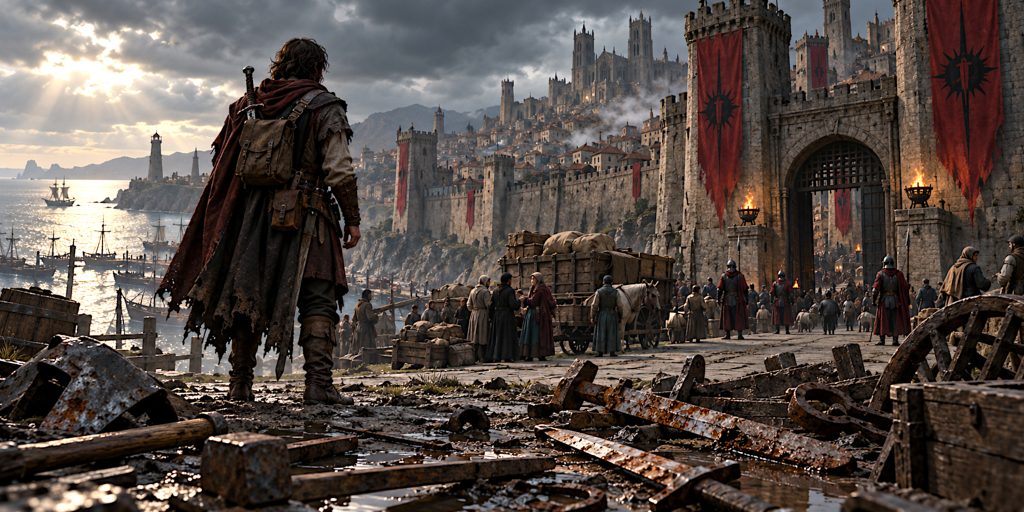
The first Baldur’s Gate begins in the Year of the Banner, 1368 DR. The protagonist leaves Candlekeep with Gorion, their foster father, and is soon drawn into a crisis spreading across the Sword Coast.
Iron weapons and tools are failing. The shortage threatens trade and public order, while the Iron Throne appears to be profiting from the chaos. The investigation gradually reveals a more personal danger: Sarevok, a powerful Bhaalspawn, is using the crisis to push the region towards war and make himself a candidate for divine power.
The protagonist ultimately defeats Sarevok and prevents his scheme from succeeding. The victory ends the immediate crisis, though the Bhaalspawn are still very much part of the world.
| Story element | What happens |
|---|---|
| Opening | Gorion takes the protagonist away from Candlekeep. |
| Regional crisis | A shortage of iron fuels fear, violence and political instability. |
| The conspiracy | The Iron Throne’s activities lead towards Sarevok’s wider plan. |
| The revelation | The protagonist learns of their connection to Bhaal. |
| The climax | Sarevok is defeated before he can claim Bhaal’s power. |
1368–1369 DR: Siege of Dragonspear
Set after the first game, Baldur’s Gate: Siege of Dragonspear follows the protagonist as a celebrated hero whose reputation does not protect them from new trouble. Caelar Argent, known as the Shining Lady, leads a crusade that draws the Sword Coast into a conflict reaching towards Avernus, the first layer of the Nine Hells.
The expansion connects the original games to the later Descent into Avernus material and gives the Bhaalspawn story another chapter before the events in Amn. Its exact chronology is less tidy than the main games’ broad sequence: the story begins in late 1368 DR and continues into 1369 DR.
Why it matters: Dragonspear gives the saga a bridge between Sarevok’s defeat and the next attempt to control the protagonist’s unusual inheritance. It also establishes Avernus as more than a distant name dropped by a devil with excellent marketing.
1369–1370 DR: Baldur’s Gate II and Throne of Bhaal
Shadows of Amn
In Baldur’s Gate II: Shadows of Amn, the protagonist is captured and held by the mage Jon Irenicus. His experiments are designed to exploit the protagonist’s Bhaalspawn heritage and steal their divine soul.
The story moves from Athkatla through Spellhold and the Underdark to Suldanessellar. Irenicus is defeated, and the protagonist regains their soul, but the wider struggle over Bhaal’s legacy continues.
Throne of Bhaal
Throne of Bhaal brings the Bhaalspawn saga to its conclusion. A group known as the Five pursues power through the essence of Bhaal’s children, while the protagonist faces Amelyssan, who seeks to claim Bhaal’s divinity.
At the end, the protagonist must choose whether to ascend to godhood or remain mortal. The choice gives the saga a suitably large ending: after several games of being hunted, manipulated and repeatedly asked to save the world, the protagonist gets one last decision with cosmic consequences.
A note on the dates
The games are generally placed around 1369 DR, with events extending towards 1370 DR. Some novels and reference works give different dates or compress the story into 1368 DR. For a game-focused timeline, it is clearest to treat Shadows of Amn and Throne of Bhaal as the next phase after Dragonspear, while acknowledging that the precise year is disputed.
1385 DR: the Spellplague
The Spellplague begins in 1385 DR after the death of Mystra, goddess of magic. Magic across the Realms becomes dangerously unstable, and the effects reach far beyond the Sword Coast.
This catastrophe takes place after the Bhaalspawn saga and before Baldur’s Gate 3. It helps explain why the world the later game inhabits has a complicated recent history, even when the main plot is focused on tadpoles, mind flayers and the immediate problem of not turning into one.
1482–1489 DR: the Second Sundering
The Second Sundering is another period of upheaval involving the gods and the structure of the world. Its effects help restore parts of the Realms altered during the Spellplague and set the stage for the version of Faerûn familiar in fifth-edition D&D.
This period matters as background to the later game, rather than as a direct chapter in the Baldur’s Gate video-game story. The saga’s central cast has changed, but the setting’s divine politics have never been especially good at staying in the background.
1492 DR: Baldur’s Gate 3
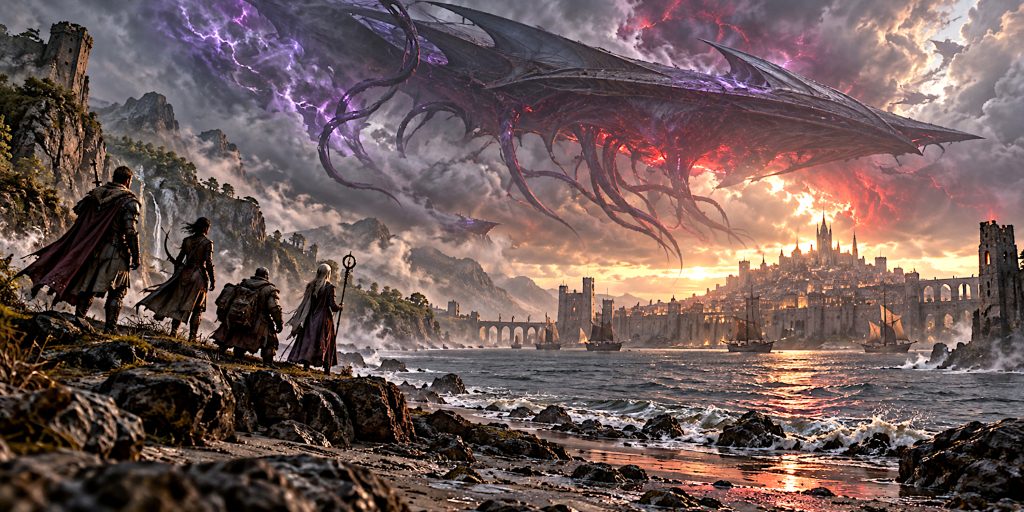
Baldur’s Gate 3 takes place in 1492 DR, more than a century after the Bhaalspawn saga. Larian describes the story as occurring around a hundred years after Baldur’s Gate II and shortly after Descent into Avernus. The game’s opening follows a nautiloid ship abducting people and implanting them with mind flayer tadpoles.
The survivors of the crash search for a way to remove the parasite. Their journey draws them towards Baldur’s Gate, where the threat is linked to the Dead Three: Bhaal, Bane and Myrkul. The city is once again caught between mortal ambition and divine interference. It has had a long time to recover from the last crisis, which in Faerûn seems to mean just long enough for a new one to arrive.
What connects BG3 to the earlier games?
- Bhaal’s legacy: The original trilogy’s central divine inheritance remains relevant.
- Returning characters: Familiar figures connect the new story to the earlier games.
- The city itself: Baldur’s Gate remains a political and commercial centre where personal schemes can become regional disasters.
- The wider Realms: The Spellplague and Second Sundering have changed the world between the sagas.
How the Baldur’s Gate stories fit together
The series is easiest to follow as two connected arcs:
| Arc | Games and events | Central conflict |
|---|---|---|
| The Bhaalspawn saga | Baldur’s Gate, Siege of Dragonspear, Baldur’s Gate II, Throne of Bhaal | The consequences of Bhaal’s death and the struggle over his divine power. |
| The tadpole crisis | Baldur’s Gate 3 | A mind flayer plot entangles the city, the Dead Three and a new group of heroes. |
The stories share a setting and a long shadow of divine politics, but BG3 does not require a complete playthrough of the earlier games. Knowing the Bhaalspawn saga adds context, especially when familiar characters or divine names appear. It is useful background, not mandatory homework.
Frequently asked questions
When does Baldur’s Gate 3 take place?
Baldur’s Gate 3 takes place in 1492 DR, the Year of Three Ships Sailing. It is set more than a century after the Bhaalspawn saga and shortly after the events of Descent into Avernus.
When does the first Baldur’s Gate game take place?
The first game is set in 1368 DR, during the iron crisis and Sarevok’s attempt to seize power.
How much time passes between Baldur’s Gate II and BG3?
A little over a century passes between the events of Baldur’s Gate II and Baldur’s Gate 3. Larian describes BG3 as taking place roughly a hundred years after the second game.
Do I need to play the earlier games before BG3?
No. BG3 tells a new main story with its own party and central threat. The earlier games add history and context, but the game introduces what new players need to understand.
What does DR mean?
DR stands for Dalereckoning, a calendar used to date events in Faerûn.
The Baldur’s Gate timeline in perspective
From Bhaal’s death in 1358 DR to the mind flayer crisis of 1492 DR, the games trace how one divine legacy can keep reshaping ordinary lives. The first saga is about inheritance and the danger of becoming a god. BG3 shifts the focus to identity, control and the question of what a person becomes when someone else has already planted something inside their head.
The dates are not perfectly uniform across every game and tie-in book, but the broad sequence is clear: the Bhaalspawn saga comes first, the Realms endure several world-changing upheavals, and Baldur’s Gate eventually finds itself in trouble again. It would be odd if it didn’t.
Editorial source links for the article: Larian Studios’ story and lore FAQ · BG3 Wiki timeline · Beamdog’s Siege of Dragonspear field report